U.S. gets its first new national park in six years

Arizona’s Chiricahua, previously a monument, is known for its rock spires.

Scenic rocks at Chiricahua in Arizona. (Dukas/Universal Images Group/Getty Images)

In southeastern Arizona, hundreds of rock spires rise out of a landscape where desert, grassland and forest ecosystems meet.

Meet the United States’ newest national park: Chiricahua.

The sacred Apache site, also called the “Wonderland of Rocks,” became the 64th national park late Tuesday when President Trump signed the Chiricahua National Park Act. The law had easily passed in the House by voice vote in March and was agreed by unanimous consent in the Senate last month.

Chiricahua — pronounced “cheery-cow-uh” — is the first national park declared in the U.S. in six years. Before it, the most recently declared national park was New River Gorge National Park and Preserve in West Virginia, signed into law by Trump in 2020.

Read the full story

Daily energy and environment updates. Free 30-day subscription

U.S. gets its first new national park in six years Read More »

Penn State research startup to scale-up domestic critical mineral recovery

Intel-E-Waste will scale-up and commercialize its metal transformation platform, building on foundational Penn State research, with Penn State as its research partner


From Penn State IE&E, Published:

Old electronics and solar panels could become a new, domestic source for critical and strategic materials through Intel-E-Waste, a startup whose technology builds on foundational research from Penn State.

The U.S. National Science Foundation (NSF), through STRIDE Ventures, selected Intel-E-Waste as one of only eight winners of the inaugural Tech Metal Transformation Challenge, a national program designed to strengthen domestic supply chains for critical and strategic metals. Selected from 130 applicants nationwide, the Intel-E-Waste-led team is now in the first 10-month stage of the milestone-driven program, advancing prototype development, technical validation, and pathways to industrial deployment for complex electronic waste streams.

Penn State serves as a key research partner on the project through the work of Mohammad Rezaee, co-founder and chief technology officer of Intel-E-Waste and Centennial Career Development Professor of Mining Engineering at the University.

Intel-E-Waste researchers conduct experiments at their laboratory at Penn State Innovation Park to develop processes for recovering valuable metals from electronic waste and end-of-life solar panels. The work supports Intel-E-Waste’s metal transformation platform, which builds on foundational Penn State research
Intel-E-Waste researchers conduct experiments at their laboratory at Penn State Innovation Park to develop processes for recovering valuable metals from electronic waste and end-of-life solar panels. The work supports Intel-E-Waste’s metal transformation platform, which builds on foundational Penn State research. Credit: Courtesy Mohammad Rezaee / Penn State. Creative Commons 

The Intel-E-Waste team is receiving up to $2 million in federal funding in the first 10-month stage of the project, with Penn State supporting key research activities as a subrecipient of the award. The team will develop and validate a prototype system designed to extract, convert, and return metals from complex domestic waste streams into high-performance materials for advanced manufacturing. The award will support what industry often calls “de-risking,” helping demonstrate that the system can integrate with current recycling facilities and produce materials that meet industry requirements.

“Our goal is to help build an end-to-end domestic pathway for critical materials by converting the tsunami of e-waste and the upcoming wave of end-of-life solar panels into high-value feedstocks for U.S. manufacturing,” Rezaee said. “We are doing this by utilizing the existing recycling and refining infrastructure and adding the missing transformation steps needed to recover and upgrade materials that are currently diluted or lost.”

Read the full post here 

Daily energy and environment updates. Free 30-day subscription

Penn State research startup to scale-up domestic critical mineral recovery Read More »

First utility-scale thermal networks coming to New York

Haverstraw, New York, will get one of the state’s first utility thermal energy networks. (Alexisrael, CC BY-SA 3.0, via Wikimedia Commons) 

By Jeff St. John, Canary Media,

For the past four years, the UpgradeNY coalition of clean energy, environmental, and labor groups has been pushing New York regulators to approve projects that could switch entire neighborhoods from fossil gas to clean electric heating — and to do it without undermining fossil gas utility jobs and investments.

The vision? Replace gas pipelines with networks that tap into latent, otherwise wasted sources of heat, from both underground and industrial or municipal systems, to dramatically improve the efficiency and sustainability of electric heat pumps.

Last week, the coalition won a long-delayed — if partial — victory. The New York Public Service Commission approved two of these utility thermal energy network (UTEN) plans, committing a combined $111.5 million to build what will be the second and third such projects of their kind in the country.

Read the full story 
Daily energy and environment updates. Free 30-day subscription

First utility-scale thermal networks coming to New York Read More »

Is the solution to America’s aluminum crunch hiding in landfills?

Advanced sorting technologies and stronger state recycling policies can help recover more scrap metal to meet U.S. aluminum demand, experts say.

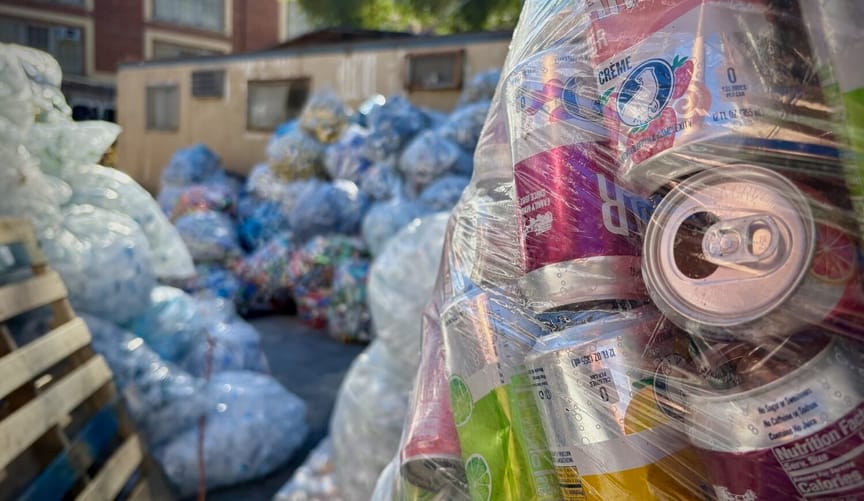
Close up of cans in a clear bag, with lots of other bags stacked in the background
Aluminum cans are bagged for recycling at the Sure We Can redemption center in Brooklyn, New York. (Maria Gallucci/Canary Media)

By Maria Gallucci, Canary Media, 19 October 2026

A global supply shortage and U.S. tariffs have roiled the aluminum market this year, putting greater pressure on the United States to produce more of its own metal. Plans to build or reopen giant smelters are moving forward, but they all hinge on securing huge amounts of cheap power — at a time when data centers are chasing every last electron.

Recycling aluminum, on the other hand, uses only 5% of the energy needed to make virgin metal in smelters, and the U.S. has an abundance of scrap. The problem is that millions of tons of it still wind up in landfills, owing to the country’s spotty recycling policies and the logistical headache of salvaging high-quality aluminum scrap.

As U.S. demand grows for the versatile metal — for soda cans, solar panels, lightweight cars, power cables, and data centers — policy experts are pushing states and the federal government to adopt measures that can boost aluminum recycling rates and reduce the country’s dependence on imported and smelter-made metal.

“It’s a secure supply chain issue,” said Joe Quinn, executive director of the Center for Strategic Industrial Materials at SAFE, a think tank that published a report this month on America’s aluminum deficit.

“There are environmental benefits all day long,” he said of recycling. ​“But I need the metal back in the market.”

A major reason why so much aluminum winds up as waste is that mechanical recycling systems aren’t up to the task.

Click to read the full story

____________________________________________________
Daily energy and environment updates. Free 30-day subscription

Is the solution to America’s aluminum crunch hiding in landfills? Read More »

NJ Shellfish Industry Gets Backing for Aquaculture Law Change

By John Reitmeyer, Budget/Finance Writer, NJ Spotlight, Sept. 28, 2026

Just as farmers use barns to shelter livestock or to store equipment, many of New Jersey’s clam and oyster growers rely on land facilities to support their operations.

These hatcheries, processing areas and other structures, though, are not legally considered to be part of a shellfish grower’s business under what’s known as aquaculture laws.

Industry experts say that holds back investment and generally makes life more difficult for the shellfish farmers operating in a multimillion-dollar sector of the state economy.

“It is really important to the industry,” said Scot Mackey, executive director of the Garden State Seafood Association.

Many miles from the New Jersey tidal flats and marshes where clam and oyster farmers are growing their products, lawmakers in Trenton are working on a bipartisan basis to provide some relief. Legislation approved by the state Assembly last week would rewrite the state’s definition of aquaculture to ensure it incorporates land facilities.

Bivalve farms

The measure is part of a package of bills drafted by lawmakers in response to concerns raised by New Jersey shellfish growers. More than 60 bivalve farms are located up and down New Jersey’s Atlantic coast and along the Delaware Bay, lawmakers said.

As part of this effort, lawmakers convened at the State House this month to hear directly from industry experts, including those growing Eastern oysters and hard clams in New Jersey. Mackey and others testified during the more than hourlong hearing.

Read the full story here

____________________________________________________
Daily energy and environment updates. Free 30-day subscription

NJ Shellfish Industry Gets Backing for Aquaculture Law Change Read More »

NJIT study finds lesser-known ‘forever chemicals’ in water, drinks

NJIT study finds lesser-known ‘forever chemicals’ in water, drinks Read More »