
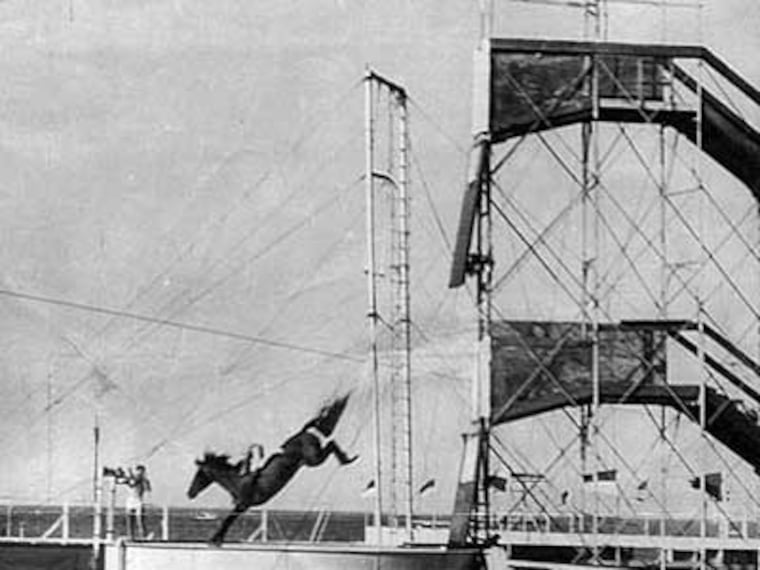
Want to buy a pier? This one’s famous. Horses used to jump off it.

This historic site, once a place of diving horses and beauty pageants and currently a popular amusement pier, could jut another 1800 feet into the ocean. It could be yours for $85M.
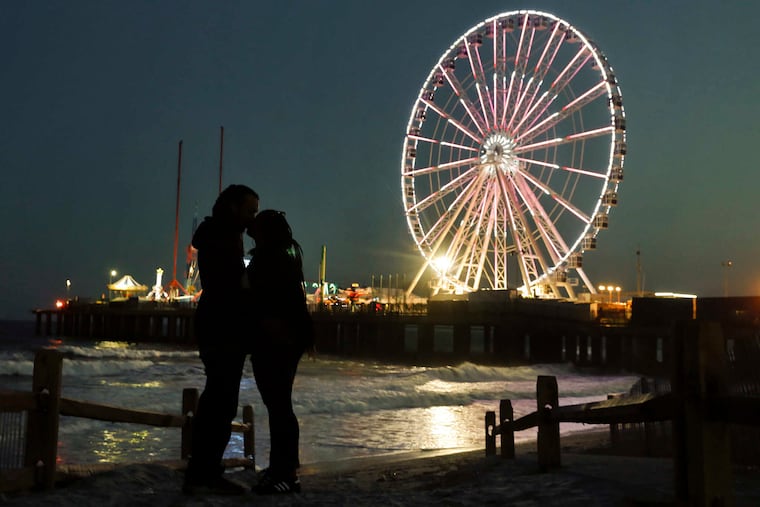
The Observation Wheel at Steel Pier has become a distinctive feature of Atlantic City's casino skyline.
The Observation Wheel at Steel Pier is a distinctive feature of Atlantic City’s casino skyline.

ATLANTIC CITY — The Steel Pier, home to some of Atlantic City’s most iconic spectacles, including diving horses and Miss America pageants, and lately an amusement pier, is up for sale.

Priced at $85 million, the pier, which was built in 1897, has been listed by the luxury New York City Serhant agency, whose owner, Ryan Serhant, is the star of Netflix’s Owning Manhattan.
The pier has been owned by the Catanoso brothers since 2011, but the family says the next generation is not interested in taking over. “It’s kind of a succession thing,” Anthony Catanoso said in an interview with The Inquirer.

The agency is targeting a buyer that envisions expanding the pier into a commercial hospitality venue, like a boutique hotel, a wedding venue, or an expanded amusement park, listing agent Michele Zyska said. She said luxury residential properties built over the ocean could also be a draw.

Mayor Marty Small Sr. said the prospect of the pier lacking amusements and entertainment would be “devastation.”

“The Steel Pier has always been the legendary part of the Atlantic City Boardwalk,” he said.

The pier structure measures 150 feet wide and 965 feet long and is anchored 90 feet into bedrock. A perpetual riparian grant permits it to extend up to 2,850 feet into the Atlantic.

“It’s like nothing else in the world,” Zyska said. “I keep saying that. It’s an iconic piece of American history. We’re thinking probably more hospitality, music, and maybe even residential. We do have interest in someone keeping it as an amusement park.”
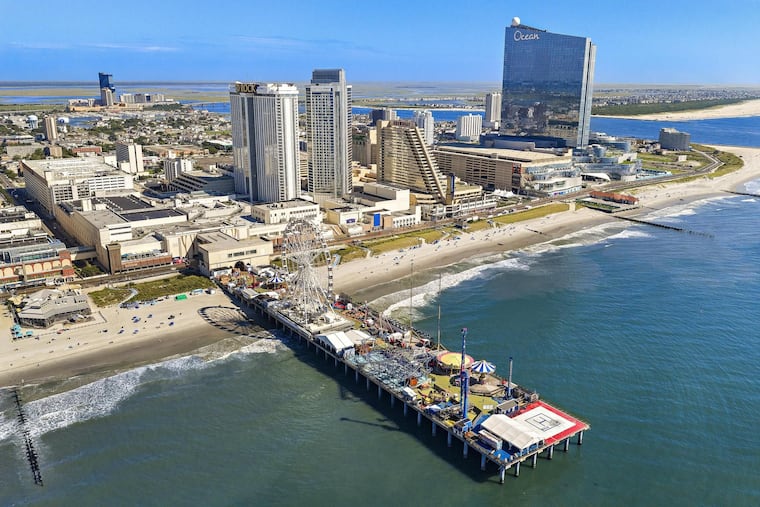
Atlantic City's historic Steel Pier is up for sale for $85 million.

The Catanoso brothers originally leased the pier from Trump Entertainment after winning the lottery in 1993 and bought it for $4.25 million in 2011.

They built its Observation Wheel, now a distinctive feature of the city’s casino skyline, teetered on bankruptcy, and found some stability in recent years running the pier with various amusements, bars, and restaurants.

Catanoso said business has been good, though wage costs have been a challenge.

“We’re getting older, me and my brothers,” Catanoso said. “The kids aren’t taking it over. It’s time for the next chapter. It’s a big development opportunity for somebody.”

Miss Philadelphia Nellie Orr competes in the 1921 Inter-City Beauty Pageant held on Atlantic City's Steel Pier. The Miss America Organization will mark the 100th anniversary, but not in Atlantic City. Orr finished second.
Miss Philadelphia Nellie Orr competes in the 1921 Inter-City Beauty Pageant held on Atlantic City’s Steel Pier. 


Serhant calls the Steel Pier “one of the most recognizable landmarks on the East Coast.” The listing was first reported by the New York Post.

The agency notes the pier’s built-in helipad and previously obtained condo-hotel approvals.

“The Steel Pier is that rarest of offerings: a piece of developable American history extending straight into the Atlantic Ocean,” the company said in a release.

George A. Hamid Jr. built up his family's Steel Pier in Atlantic City by finding hot new acts.
George A. Hamid Jr. built up his family’s Steel Pier in Atlantic City by finding hot new acts.


In addition to the amusement park, the property includes a 40,000-square-foot building with a sky bridge and roof.

“How often does someone get to own a piece of the ocean?” Ryan Serhant said in a statement. “The Steel Pier isn’t just five acres on the most famous boardwalk in the world, it actually offers the chance to own the Atlantic itself and build something unforgettable on top of it.”

The company also noted new residential projects that are in the works in that end of Atlantic City, including Kushner Cos.’ Caspian Point, K. Hovnanian Homes’ South Inlet townhomes, Colosseo Atlantic City’s Chelsea townhomes, and Zoubek Properties’ Residences at the Orange Loop.

Anthony Catanoso, owner of Atlantic City's Steel Pier, takes in the view from the Observation Wheel Tuesday, December 26, 2017.
Anthony Catanoso, owner of Atlantic City’s Steel Pier, takes in the view from the Observation Wheel 
___________________________________________________________
Daily energy and environment updates. Free 30-day subscription

Want to buy a pier? This one’s famous. Horses used to jump off it. Read More »

Trump Moving to Gut a Core Endangered Species Protection

An internal memo reinterprets the law so that only the intentional killing of animals, not collateral harm, is illegal.

A North Atlantic right whale breaking the surface and spouting. The sea is calm and the sky is clear.

A North Atlantic right whale off Cape Cod, Mass., in 2023. Only about 380 remain on the planet. APress photo

Sept. 16, 2026

In what would be a seismic shift, the Trump administration is quietly moving to strip a core protection of the Endangered Species Act, according to an internal memo obtained by The New York Times.

Under a new interpretation of the law’s language outlined in the memo, the accidental killing or injury of an animal would no longer be considered illegal; only actions specifically intending to target an animal would.

The change would be transformative because, in the United States, the killing of endangered animals almost always happens incidentally, in the course of economic activity. Until now, industries and individuals could be held accountable for those foreseeable deaths and, as a result, they have been incentivized to avoid them.

At the center of the change is what it means to “take” an endangered animal, something that has long been prohibited under the act.

“A vessel that inadvertently strikes a whale has not taken it, because the vessel’s course was not set against the whale,” states the memo, which was dated Sept. 14 and was distributed to U.S. Fish and Wildlife Service field offices. “Felling a tree is not a take of the bats roosting in it unless the tree is felled for the purpose of killing or capturing them.”

Currently, enforcement of the Endangered Species Act relies on a permitting system that seeks to balance protecting imperiled animals with allowing business to operate.

For example, if developers wanted to build houses on a tract of land that is home to endangered salamanders, they would have to apply for a permit. In exchange for implementing some measures to protect the salamanders, and perhaps paying for salamander conservation elsewhere, the Fish and Wildlife Service would issue what’s known as an incidental take permit, absolving them of killing a certain number of salamanders.

The memo, signed by Brian Nesvik, director of the Fish and Wildlife Service, appears to upend that entire system.

Read the full story here

___________________________________________________________
Daily energy and environment updatesFree 30-day subscription

Trump Moving to Gut a Core Endangered Species Protection Read More »

Schism among participants at the G20 energy parley in Houston

Schism among participants at the G20 energy parley in Houston Read More »

Trump’s EPA continues its environmental rollbacks

The US Environmental Protection Agency is expected to formally rescind carbon pollution standards for fossil fuel-fired power plants as soon as Monday, according to people familiar with the matter.
Stacks from a coal-fired power station in Kentucky, US. Photographer: Jeff Swensen/Getty Images
By Zahra HirjiAri Natter, and Jennifer A Dlouhy, Bloomberg.com

The Trump administration’s latest major climate rollback is expected to come on the sidelines of a Group of 20 energy ministers’ meeting in Houston, said the people, who asked not to be named because the details aren’t yet public. Earlier this year, the EPA rescinded similar climate standards for vehicles and the 2009 endangerment finding, a landmark ruling which held that greenhouse gases threaten human health.

Under Trump, the EPA first proposed rolling back the power-plant climate rules last summer. This week, the agency is finalizing a piece of the initial proposal — scrapping Biden-era mandates requiring existing and future US fossil fuel-fired power plants to deploy specific emissions-reduction technologies, including carbon capture and storage, to sharply cut their greenhouse gas emissions in the coming decades, according to the people.

Agency officials also plan to propose a separate rule repealing the federal finding that greenhouse gases from power plants specifically pose a threat, effectively a separate endangerment finding for power plants under the Clean Air Act.

Power plants are the US’s largest industrial source of greenhouse gas emissions. If the US power sector were a country by itself, it would rank as the world’s sixth-largest emitter of greenhouse gases, according to a New York University School of Law’s Institute for Policy Integrity analysis of 2022 emissions data.

The EPA didn’t respond to requests for comment outside business hours on Sunday.

Trump’s EPA continues its environmental rollbacks Read More »

Norcross sees his lithium-ion battery bill passing if Democrats take back Congress


Camden residents hold signs reading STOP the BURN and HOLD EMR ACCOUNTABLE

Some Camden residents at the City Council meeting on April 8, 2025

By Sophia Schmidt, WHYY News, September 11, 2026

U.S. Rep. Donald Norcross is pushing a bill he says could help stop the recurring fires at a scrap metal recycling company in Camden.

Norcross, a Democrat who represents the city in Congress, introduced a bill last fall that would incentivize the detection and recycling of highly flammable lithium-ion batteries.

EMR, a multinational scrap metal recycling company with its U.S. headquarters and several industrial sites in Camden, has blamed the batteries as the primary driver of fires at its junkyards.

“It certainly has become something that really doesn’t leave my mind, ever,” EMR USA CEO Joe Balzano said at a press conference promoting Norcross’ bill Thursday at EMR’s metal shredding facility in the Waterfront South neighborhood.

The company’s five facilities in Camden have been the site of 14 major fires since 2020, according to a lawsuit filed by the state against the company earlier this year. Some of these fires have sent dangerous pollution into Waterfront South, where the majority of residents are Black or Hispanic. Residents have evacuated their homes during the fires and been left with lingering psychological distress and concerns about their health.

Lithium-ion batteries are present in consumer products such as smartphones and electric bikes. They are banned at EMR’s junkyards, but the company says they are often delivered anyway and are difficult to detect.

The tax credit would partially reimburse recycling companies for the cost of battery detectors and would tax battery manufacturers. It would also create a lithium battery recycling grant program that would give funds to facilities that collect and recycle the batteries.

Read the full story here

____________________________________________________
Daily energy and environment updates. Free 30-day subscription

Norcross sees his lithium-ion battery bill passing if Democrats take back Congress Read More »

Trump blocks $25 M in funding for national parks

The Interior Department did not approve more than 130 partnership agreements covering activities such as tending to sled dogs and preventing damage to burial mounds.

Joshua Tree National Park in 2019. (Jae C. Hong/AP)


By
The Washington Post,  September 11, 2026

The Trump administration has blocked more than 130 projects in national parks across the country worth at least $25 million, according to internal documents reviewed by The Washington Post — funding that had already been secured for some of the most visited parks for work such as fire preparedness in California, prehistoric mound protection in Iowa and sled dog care in Alaska.

The Interior Department, which oversees the National Park Service, said in a statement it “disapproved” a raft of planned agreements with groups it said work against administration priorities. The agreements were rejected last month and would have allowed the parks, including Yellowstone, Yosemite and Zion, to pay outside partners for various projects in the next fiscal year that begins Oct. 1, the documents show.
Similar to issuing government contracts, the Park Service often partners with outside organizations when specialized expertise or work is needed, allowing it to do work without hiring additional full-time federal employees. The blocked funding instead puts additional pressure on a national park system that has struggled with losing roughly a quarter of its staff since President Donald Trump took office last year and launched efforts to shrink the government.


The changes appear to most affect Joshua Tree National Park, which had at least 10 planned partnership agreements blocked. That park’s partnership agreements would have hired at least 16 people, helped recover areas in the park burned in wildfires, and removed rodents that carry hantavirus from historic buildings, among other activities listed in the documents.

“If this work is not completed, the park will be unable to fight wildfire. Fires will be larger, and fire suppression will be more expensive,” the documents read, describing the impact if a fire preparedness project at Joshua Tree does not gain funding.

Interior spokesperson Aubrie Spady confirmed that the department “disapproved a number of partnership agreements with groups actively working against the best interests of the American people and the priorities of this administration.”

“This decisive action is ensuring that these taxpayer dollars are being used in alignment with the administration’s objectives to make life more affordable for Americans, unleash domestic energy production and expand access to our public lands,” Spady added.

She did not give further details on the agreements or partner organizations affected.

Read the full story here

____________________________________________________
Daily energy and environment updatesFree 30-day subscription

Trump blocks $25 M in funding for national parks Read More »