July 31, 2026 at 9:45 a.m. EDTToday at 9:45 a.m. EDT
13 min

Make us preferred on Google

An overlook above Lake Mead, one of the two biggest reservoirs on the Colorado River, near Boulder City, Nevada. (Caroline Brehman/Reuters)

Arizona, California and Nevada will be required to curb their use of the water from the Colorado River by about 20 percent over the next two years — and could ultimately face even larger cuts, according to three officials familiar with negotiations over a long-awaited federal plan to rescue the depleted waterway.

The plan, part of which the Bureau of Reclamation described in an Environmental Impact Statement early on Friday morning, comes at a time of escalating crisis for the Colorado River, a crucial water source for seven states, 30 Native tribes and a swath of northwestern Mexico. But experts say it will not be sufficient to resolve a political standoff among the river’s many users or prevent the beleaguered waterway from teetering toward collapse.

Friday’s announcement outlines a broad 10-year framework for operating the river’s dams and reservoirs. It calls for more specific operating plans to be developed every two years and offers a wide range of possible measures those plans could include — including reducing the amount of water released to the Lower Basin by as much as 40 percent.

The framework does not consider mandatory cuts to water use from the four states in the upper part of the basin — Colorado, New Mexico, Utah and Wyoming — though it does allow for voluntary reductions. Arizona, California and Nevada make up the Lower Basin.

Read More »

Clean energy advocates see opportunity in state races

Clean energy advocates see opportunity in state races Read More »

Rethinking how wind turbine blades are made

Wind turbines in rural AmericaSNEHIT PHOTO/Shutterstock

By Nate Williams, Slashgear 

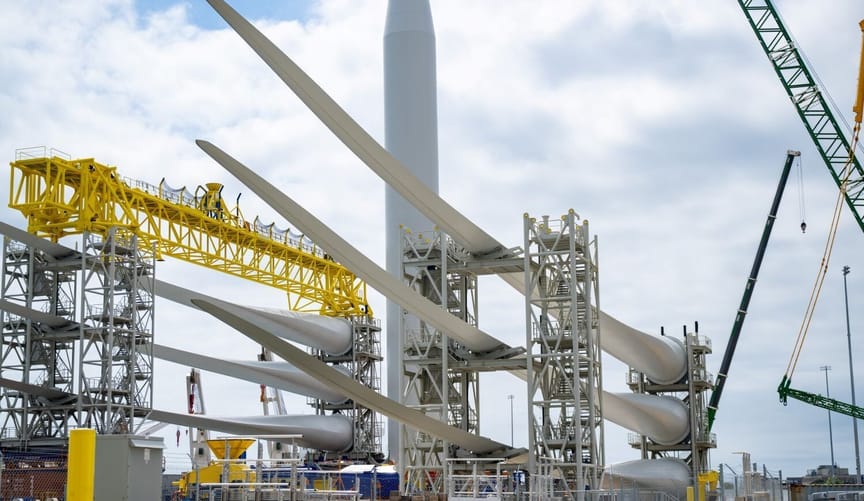
For years now, the U.S. Department of Energy has had one major roadblock to the streamlining of wind turbine installation: the sheer amount of work it takes to manufacture blades. Thanks to 3D printing, the DOE has a new approach that could dramatically change the speed at which these lightweight blades are designed and built.


Rather than relying exclusively on the traditional process of creating a full-scale plug before manufacturing a blade mold, researchers are finding ways to use large 3D-printed molds to make manufacturing faster, more affordable, and even more flexibility in the design of future blades. The best wind turbine blade design is currently the three-bladed horizontal-axis rotor, but that very well could change if experimental blades could be more accessible.


This 3D printing effort is currently moving in various different directions, including the Department of Energy’s Wind Energy Technologies Office and Advanced Manufacturing Office alongside national laboratories and various private-sector partners. Wind energy already supplies more than 10% of U.S. electricity and generating enough power for tens of millions of American homes. With these advances, the DOE could take the nation’s renewable energy infrastructure to entirely new heights, and it’s also worth noting that the U.S. is also home to many large wind turbine manufacturers.


Read More

Rethinking how wind turbine blades are made Read More »

Population shift from farmlands seen as contributor to wildfires in France and Spain

The giant wildfires in France and Spain are the countries’ largest on record, and at roughly 100,000 acres each, the blazes are bigger than all but six of last year’s wildfires in the American West.

Studies have shown that global warming is driving Southern Europe’s recent increase in sprawling, fast-moving fires that create their own weather and can be all but impossible to put out. But experts say there’s another factor behind the continent’s large fires, one rooted in societal changes that could be hard to reverse.

In parts of Europe, a generational shift away from farming has replaced patchworks of pastures and plowed fields with untamed vegetation that burns intensely during hot, dry summers like this one.

“Climate change needs to be taken into account, but also the social changes are very important,” said Emilio Chuvieco, a professor of geography at the University of Alcalá in Spain. “There is no simple solution to big problems.”

Population shift from farmlands seen as contributor to wildfires in France and Spain Read More »

NJ Governor Sherrill signed these bills today

NJ Governor Sherrill signed these bills today Read More »

Today’s Keyport NJ cancer cluster news


By Joanna Gagis, Senior Correspondent, NJ Spotlight News

Sixteen years after Keyport groundwater was found to contain cancer-causing chemicals, the latest samples show the presence of heavy metals plus benzene and vinyl chloride above acceptable levels.

The tests, near the former Aeromarine landfill, were conducted after illnesses in a nearby neighborhood triggered fears of a cancer cluster. More than 400 cases have been reported by residents of Keyport and Union Beach.

Tests 16 years ago found a multitude of cancer-causing contaminants. In June, a company planning to purchase the old landfill, Pacer Partners, contracted with an environmental engineering firm, SESI, to conduct groundwater samples. SESI found benzene and vinyl chloride at higher that acceptable levels for state standards, and heavy metals including lead, cobalt and arsenic.


NJ Advance Media journalist Karin Price Mueller, whose work appears on NJ.com, helped break the story of a potential cancer cluster, reporting about 40 known cases in April. The number since has grown to 415 individuals in Keyport and Union Beach.

View the full interview here

Today’s Keyport NJ cancer cluster news Read More »