Massachusetts sets big battery goals — and the policies to back them up

Energy storage is taking off as the state moves to make development easier and more profitable, but the horizon isn’t all clear for the sector.


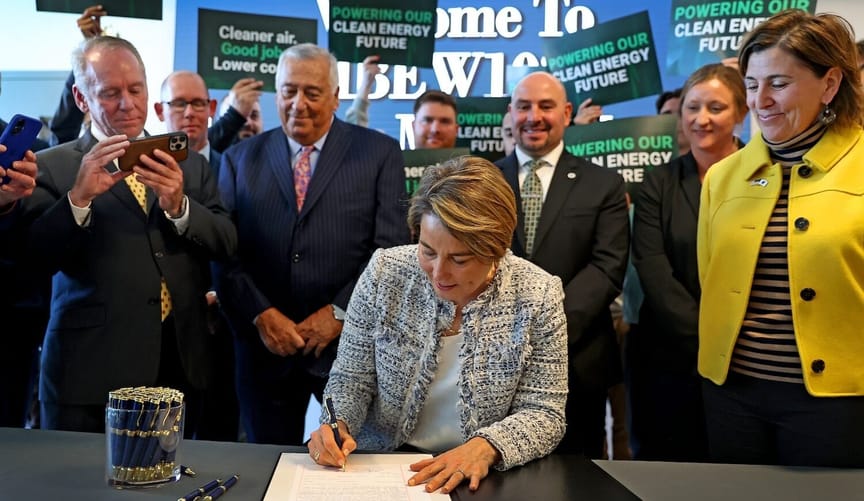
Woman sitting and signing a paper, surrounded by people holding signs reading "Powering our clean energy future"
Massachusetts Gov. Maura Healey holds a ceremonial signing celebration in Boston for climate legislation in late 2024. Expanding energy storage is key to the state’s clean energy strategy. (David L. Ryan/The Boston Globe via Getty Images)

Just outside Boston, a developer is getting set to build a 700-megawatt storage facility that is expected to dwarf every other battery project in New England. One town over, another energy company just closed on $850 million in financing to build a 250-MW battery. Down near the Rhode Island border, ground has been broken on a 200-MW storage facility that is expected to be up and running by the end of the year.

These and roughly a half dozen other projects at various stages are taking advantage of policies Massachusetts has put in place to help reach its goal of getting 5 gigawatts of battery storage capacity online by 2030, with another 5 GW to follow by 2035.

While several larger and generally sunnier states top the list for installed storage capacity — California boasts a whopping 23 GW — Massachusetts’ ambition and policies put it at the forefront of the push to get more batteries on the grid. Thirteen states have set procurement targets for battery storage, but Massachusetts’ total of 10 GW by 2035 is the highest. And its policy landscape is setting the state up for success, observers say.

“Massachusetts is really a leader in this space,” said Erin Smith, energy and grid policy director for the Environmental League of Massachusetts. ​“We’re ahead of the pack as it relates to encouraging battery buildout.”

Read more

Daily energy and environment updates. Free 30-day subscription

Massachusetts sets big battery goals — and the policies to back them up Read More »

A legal defeat for Trump could free $7B in frozen ‘Solar for All’ funds

Nonprofits and companies are ready to relaunch solar projects to help low-income residents — if the Trump administration obeys a court order to give them the money.


By Jeff St. John, Canary Media,


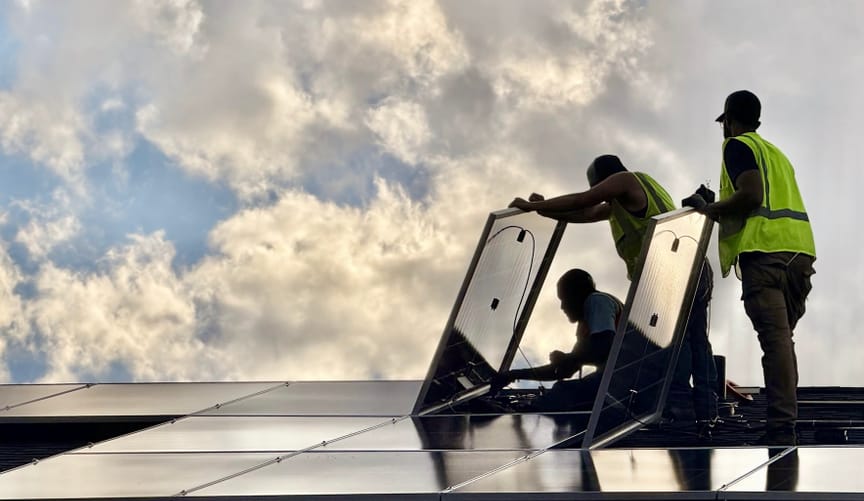
Three people on a roof installing solar panels with dramatic clouds overhead
Sunpath Solar employees install solar panels on the roof of Chamblee First United Methodist Church in Chamblee, Georgia. (Sunpath Solar)


Denise Abdul-Rahman, founder and CEO of nonprofit Black Sun Light Sustainability, can list in detail the harms that the Trump administration’s shutdown of the $7 billion Solar for All program has caused the Indiana communities she serves.

About 1,000 low-income households have been denied access to low-cost solar that would have cut their electric bills by at least 20%, she said. About 200 jobs installing solar and batteries at homes, community centers, and city buildings, representing roughly $9 million a year in wages, haven’t been created. And residents of Gary, Indiana, have been denied solar-and-battery-equipped resiliency centers that could have helped them recover from a nearly two-week-long grid outage in August.

That’s why Abdul-Rahman joined a lawsuit challenging the U.S. Environmental Protection Agency’s decision to kill the program. Last week, a Trump-appointed federal judge with the U.S. District Court for the District of Rhode Island upheld that challenge, ruling that the EPA acted illegally and must let the money flow.

“We just want the Trump Administration to comply with the law,” Abdul-Rahman said. ​“We would like them to resume what has started. We’re committed to this because we truly believe it will save lives and change lives.”

Read more here

Daily energy and environment updates. Free 30-day subscription

A legal defeat for Trump could free $7B in frozen ‘Solar for All’ funds Read More »

Opinion: A closer look at New Jersey’s nuclear task farce


The state is pushing ahead with costly new reactors without adequately examining alternatives, financial risks, or the potential burden on ratepayers.

By Jeff Tittel in The Jersey Vindicator, Oct. 19, 2026

New Jersey’s Nuclear Power Task Force is supposed to help shape the future of our energy system. But this is not an independent investigation into whether new nuclear reactors are safe, affordable, or necessary. It is a government-organized sales team for a nuclear expansion that politicians have already decided to pursue.

Instead of asking whether New Jersey should build new reactors, the task force is figuring out how to get them built, finance them, streamline permitting, and persuade the public to accept them. That’s government by public relations, not public policy.

On April 8, Gov. Mikie Sherrill’s administration moved to lift New Jersey’s roughly 50-year de facto moratorium on new nuclear construction. On July 13, Sherrill signed the Power NJ Act, establishing a procurement process for at least 1,100 megawatts of new nuclear generation. The law directs the Board of Public Utilities (BPU) and the New Jersey Economic Development Authority (NJEDA) to evaluate proposals and negotiate project terms. At its first meeting Oct. 1, the task force established five subcommittees covering permitting, financing, technology and supply chains, workforce development, and public engagement.

New Jersey is preparing to build a new nuclear industry before answering the most basic questions about whether it should. Where is the independent study demonstrating that new reactors are the best way to lower electricity bills? Where is the comprehensive comparison with solar, wind, battery storage, energy efficiency, demand management, and grid modernization? Where is the analysis showing that the benefits outweigh the financial, environmental, waste, and safety risks?

The state has announced its destination before honestly examining the alternatives. It is putting the cart before the reactor, and asking ratepayers to pick up the tab.

Read more here

Daily energy and environment updates. Free 30-day subscription

Opinion: A closer look at New Jersey’s nuclear task farce Read More »

Grid batteries are surging but fire risks are not

Battery fires are like shark attacks: frightening events that loom cinematically large in the American psyche and almost never actually happen.

As batteries have become America’s top choice for new on-demand grid power, community concern about their fire risk has emerged as a limiting factor on the technology’s growth. There’s no disputing that battery fires have happened, and have been nigh impossible to put out by conventional means. But a dataset compiled by the nonprofit Electric Power Research Institute shows that these fires strike in the U.S. even less frequently than sharks.

Read more here

Daily energy and environment updates. Free 30-day subscription

Grid batteries are surging but fire risks are not Read More »

Enviro groups offer government leaders a guide to responsible data center development

Model legislation provides local governments and state officials with a legal framework for responding to data center development while protecting consumers, utility grids, and natural resources


Today, the Model Climate Laws Initiative (MCLI), a joint project of Environmental Advocates NY (EANY) and the Sabin Center for Climate Change Law at Columbia Law School (Sabin Center), in partnership with Climate Mayors and Climate XChange, released a legislative package of two model laws on responsible and sustainable data center development.

The legislative package includes a model state law designed for state governments and authorities, and a model local law tailored to the needs of mayors and city officials.

EANY and the Sabin Center co-launched the MCLI in 2025 to give governments and lawmakers across the country the legal tools they need to adapt public policy quickly amidst evolving climate challenges. Now, as data center development accelerates rapidly across the country, placing unprecedented demands on local electricity systems, water resources, and land usage, these two model laws provide policy leaders with a framework for accommodating the environmental and energy impacts of data centers in a climate-responsible way.

“As data centers sprout up across the country, state and local governments can draw on these model laws to craft strong climate and energy protections,” said Jon Binder, Executive Director of the Model Climate Laws Initiative. “We aim to give lawmakers the tools they need to reap the investment and revenue benefits without straining existing energy grids, depleting natural resources, or pushing costs onto consumers.”

The model local law, A Framework for Responsible Data Center Development, is designed specifically to support city mayors, who are often on the front lines of data center expansion, regardless of how state agencies choose to handle development. It outlines a strategy around planning for and responding to growth that protects their communities through provisions such as zoning regulations, renewable energy requirements, and caps on water use and noise.

The model state law, Creating Low Emissions, Accountability, and New Generation Rules for Infrastructure and Data Center (CLEAN GRID) Act, is designed to help state governments address issues such as ensuring data centers provide new, additional clean energy to satisfy their own energy loads.

Even in states like New York, where Governor Kathy Hochul signed the first statewide moratorium on new large-scale data centers in July, the model law supports agencies in ensuring future projects comply with statewide energy and environmental standards.

Both model laws, written by lawmakers, policy experts, and advocates, offer strategic implementation and regulatory guidance with a focus on five main policy areas:

  • Siting and permitting: Establishes requirements for where data centers can be located and how projects move through state and local approval processes, including public notification, hearings, and assessments of water, energy, noise, and utility capacity.

  • Operational standards: Provides standards for incorporating new renewable energy and storage, potable water use, groundwater, noise, landscaping and setbacks, building design, materials, and backup generators.

  • Transparency: Establishes disclosure and public-access provisions related to water, stormwater, trees, noise, energy use, power purchase agreements, and grid impacts.

  • Planning: Establishes a statewide Planning Commission tasked with assessing industry impacts, while identifying technical opportunities for data centers to support clean energy and efficiency, including by supporting thermal energy networks and virtual power plants.

  • Community benefits: Provides a framework for community benefits agreements addressing measurable local benefits, workforce and community investment, environmental mitigation, decommissioning, and enforcement.

“It’s never been more important for state and local leaders to step up and protect their constituents from Washington’s disastrous climate rollbacks,” said Vanessa Fajans-Turner, Executive Director of Environmental Advocates NY. “The Model Climate Laws Initiative empowers lawmakers, agencies, and policy leaders across the country to meet the urgency of this moment by comparing and evaluating laws and policies that can be used to face a range of climate, environmental, and energy regulatory challenges.”

The new model laws are available on MCLI’s new website, which houses publicly available and ready-to-use climate policy examples from across the country that public agencies and private actors can use as models for their own laws and policies.

The website also offers an interactive search function to help users easily find model laws based on jurisdiction type and/or specific legislation topics, including power sector, cross-sector, transportation, buildings, carbon capture and removal, methane and non-CO2 pollutants, fuels, foundational policies and context, climate justice, and resilience and adaptation.

Enviro groups offer government leaders a guide to responsible data center development Read More »

Introducing Data Center Reporter — Our Newest News Publication

Tracking America’s Data Center Boom

Artificial intelligence is driving an unprecedented expansion of data centers across the United States, raising important questions about electricity demand, water consumption, environmental impacts, and the costs borne by local communities.

To help readers follow these developments, we’re pleased to introduce Data Center Reporter, a new online news publication covering the rapidly expanding data center industry and its implications for communities, businesses, and government.

Our reporting focuses on:

Local opposition to proposed data center projects

State and local legislation and regulation

Electricity and water consumption

Environmental and economic impacts

Major projects, investments, and industry developments

Data Center Reporter will provide frequent news updates and analysis to help readers understand one of the nation’s fastest-growing—and increasingly controversial—industries.

While you’re there, click Get Updates to subscribe to our free email news alerts.

We hope you’ll join us as we follow this important story.

Frank Brill
Editor, EnviroPolitics
Data Center Reporter

Introducing Data Center Reporter — Our Newest News Publication Read More »