Five Morris County NJ Municipalities Awarded $1,500 in Grants

The Morris County Municipal Utilities Authority (MCMUA) has announced its annual mini-grant program aimed at promoting waste reduction and enhancing recycling efforts.

This year, five municipalities were awarded $1,500 grants each to support innovative recycling and waste prevention projects. The competitive grant program provides funding to increase recycling participation, educate residents, reduce waste and promote community sustainability across Morris County.

“Supporting these local projects is a great way to help our municipalities find practical ways to reduce waste and improve recycling,” said Morris County Commissioner Tayfun Selen, liaison to the MCMUA. “We appreciate the work these communities are doing and look forward to seeing the results of their efforts.”

The 2026 Waste Reduction and Recycling Mini Grant recipients are:

  1. Mendham Borough – Residential Food Waste Collection Program
  2. Mendham Township – Plastic Film Recycling Pilot Program & Backyard Composting Training and Starter Kit Program
  3. Morris Township – Residential Food Waste Collection and Drop-off Pilot
  4. Morristown – Residential Food Waste Collection and Drop-off Pilot
  5. Rockaway Township – CCTV Cameras for its Curbside Recycling Trucks to monitor for recycling contamination and provide proper recycling education practices to residents.

About The Morris County Municipal Utilities Authority:

The MCMUA was established by the Morris County Board of Commissioners to provide regional leadership in drinking water, solid waste management and open space preservation. Through its Water Division, the MCMUA supplies wholesale drinking water to local distribution systems. Its Solid Waste Division implements the Morris County Solid Waste Management Plan, overseeing recycling, waste disposal, hazardous and vegetative waste programs, and litter prevention. The MCMUA also promotes open space preservation to protect drinking water resources.

###

Five Morris County NJ Municipalities Awarded $1,500 in Grants Read More »

The huge untapped opportunity offered by end-of-life wind farms

Far from junk, old wind turbines represent an untapped reservoir of rare earths waiting to be exploited, argues Luke Wray, senior vice president at Paladin Envirotech, a technology-lifecycle and critical-materials recovery company


By David M. Zimmer, NorthJersey.com

New Jersey is betting on nuclear power to help meet growing electricity demand. But even if every reactor envisioned under a new state law is built, it would cover only about half of the state’s current power shortfall.

Gov. Mikie Sherrill’s Power NJ Act, signed on July 13, sets a target of at least 1,100 megawatts of new nuclear generation, roughly the output of a large reactor. But even if the full amount is approved and built, it would generate enough electricity to offset only about 52% to 55% of the state’s current power shortfall, based on a NorthJersey.com analysis of state data.

The analysis provides one of the first measures of how far the state’s headline nuclear goal would go toward solving a problem Sherrill has made central to her energy agenda: New Jersey produces far less electricity than it uses. Even under the law’s most optimistic scenario, the state would have to import nearly half of the power needed to close that gap.

The law starts a competitive process for developers but does not guarantee that the full number will be approved or built.

If it were, the new reactors could generate between 8.7 million and 9.2 million megawatt-hours per year at the operating rates cited by the Sherrill administration.

New Jersey’s latest in-state generation gap was nearly twice that size.

Read the rest of the story


The huge untapped opportunity offered by end-of-life wind farms Read More »

Wow! 500th individual humpback whale cruising through New York waters

Whale watchers in New York and New Jersey have documented their 500th individual humpback whale in local waters, a milestone they said highlights the creatures’ growing role in the local ecosystem.

A confluence of factors has made the region more attractive to humpback whales, according to Chris St. Lawrence, a spokesperson for Gotham Whale, a Staten Island-based nonprofit that has spearheaded an effort to catalog humpback whales in the New York City region since 2012.

The waters around New York and New Jersey have gotten cleaner in recent decades, allowing more fish to thrive in the area. That’s big for whales, whose traditional feeding grounds in New England and Canada have been disrupted as climate change warms ocean temperatures and changes the distribution of prey species.

“ These whales are looking for new food sources, and right here in New York, thanks to fishery management, thanks to cleaner water, now we have a new food resource for them to exploit,” St. Lawrence said.

But the whales coming to New York and New Jersey face serious risk of being hit by ships and boats in one of the nation’s busiest waterways. The Port of New York and New Jersey was the second-busiest port for cargo imports in the country in June, according to the Port Authority. Whales spotted in the area are frequently found with wounds or scars from propeller strikes.

Read the full story here.

Wow! 500th individual humpback whale cruising through New York waters Read More »

Dangerous rip currents force NYC to close swimming beaches

By Phil Corso, Gothamist

People sit on a boardwalk bench on July 24, 2026, in Coney Island.

New York City Parks officials said swimming is prohibited at Coney Island and Manhattan Beach in Brooklyn, Rockaway Beach in Queens, and Midland Beach, South Beach, Cedar Grove Beach and Wolfe’s Pond Beach on Staten Island. Orchard Beach in the Bronx remains open for swimming, officials said.

The closures come as the National Weather Service forecasts a high risk of dangerous rip currents and breaking waves of five to seven feet along the region’s Atlantic coastline.

“The safety of New Yorkers is our top priority,” Parks Commissioner Tricia Shimamura said in a statement. “We strongly urge all New Yorkers to heed these warnings and not risk their lives by entering the water.”

Beachgoers can still use the sand, but Parks Enforcement Patrol officers will be stationed at affected beaches to keep swimmers out of the water, city officials said.

Read the full story here

Dangerous rip currents force NYC to close swimming beaches Read More »

New York challenges the myth that solar is swallowing farmland

As the White House and viral influencers push misleading information about solar, New York says the facts show that clean energy and agriculture can thrive together.


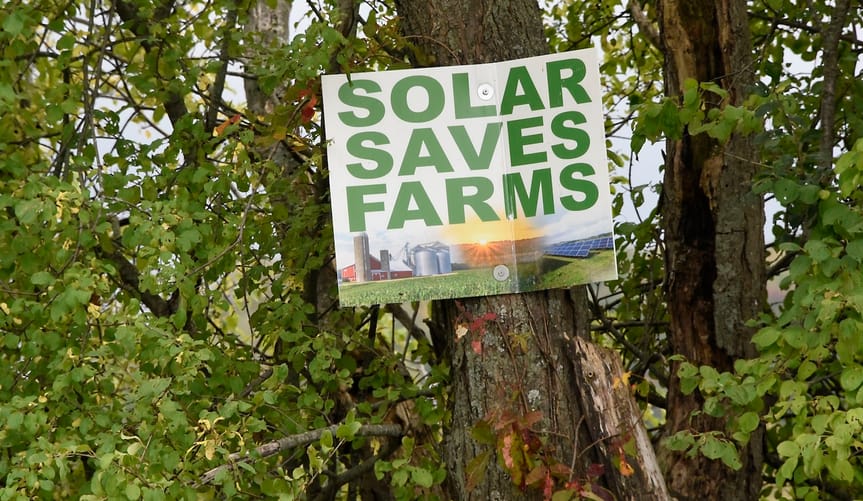
A ”Solar Saves Farms” sign, white with green lettering, on a tree

This “Solar Saves Farms” sign was posted near a plot that was being developed into a large solar farm in Coxsackie, New York. (Lori Van Buren/Albany Times Union via Getty Images)

By Kathryn Krawczyk, Canary Media

In rural areas across the U.S., solar power opponents keep leaning on the argument that utility-scale arrays are gobbling up valuable farmland. But plenty of evidence proves that’s just not true, and now, New York is tackling the misinformation head-on.

After the Trump administration accused the state of fast-tracking solar farms on prime farmland, New York leaders fired back last week, saying that renewables ​empower our farmers to keep their land in use and in their family, while avoiding the threat of permanent conversion or abandonment.” That’s because farmers can lease a plot to solar developers and return it to agricultural use at the end of the array’s life, as the state officials explained in their 11-page letter.

recent study by Cornell found that the overwhelming majority of farmers who received solar lease payments used that income to continue or even expand farming on their land, not to exit farming or scale back operations,” the leaders wrote. ​Discouraging or inhibiting property owners’ ability to independently make choices about what they can and cannot do with their land can cause financial harm and undermine fundamental property rights.”

The New York State Energy Research and Development Authority has more proof that solar and farming can work hand in hand, and outlined all that in a major guidebook it released last year. Sheep and cattle are munching below panels on several New York farms, the guidebook notes, and the state has zoning rules and protections in place to preserve undeveloped land.

Read the full story here.

New York challenges the myth that solar is swallowing farmland Read More »

Virginia is working to combine more solar with farming

A new state law aims to spur agrivoltaics projects where crops or livestock thrive amid solar panels, as AI power demand booms and concerns about farmland loss rise.

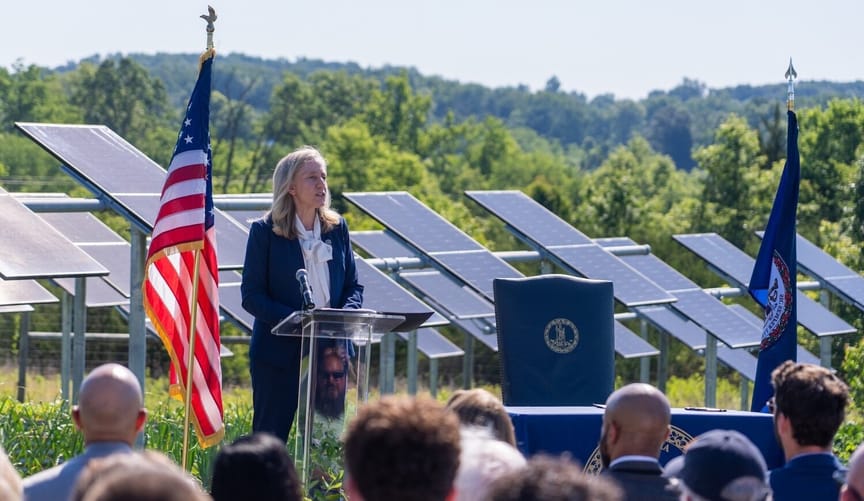
Governor in blue suit with white shirt speaks amid a field with solar panels to a seated crowd. American flag at her left.
Gov. Abigail Spanberger at a signing ceremony for Virginia’s new agrivoltaics law in Loudoun County in June (Hugh Kenny/Piedmont Environmental Council)

By Elizabeth Ouzts, Canary Media

As the world’s data center capital, Virginia faces a surge in energy demand that could spike power costs and lead to more polluting fossil fuel plants. At the same time, the state is seeing its farmland disappear at one of the fastest rates in the United States.

The two problems may seem unrelated, but Old Dominion leaders believe they could be mitigated by a common solution: Use the same plot of land for both farming and solar panels. That’s the idea behind a new state law that officially defines ​agrivoltaics,” the dual use of land for agriculture and solar photovoltaics.

Proponents say the measure will spur more affordable, clean power to meet rising electricity needs while also helping farmers earn a living. Virginia is just the fourth state in the country to pass an agrivoltaics law.

For years, the conventional wisdom has forced us into a zero-sum game, viewing solar panels as a replacement for crops rather than a partner to them,” said Josephus Allmond, the chief energy officer for Gov. Abigail Spanberger, a Democrat, at a June bill-signing event in Loudoun County. ​Today, we are rejecting that false choice. Agrivoltaics moves us from an either-or mindset to a both-and function.”

Bring this abandoned farmland back”

The new law, which passed the Democratic-led General Assembly early this year with bipartisan support, is taking effect as power-hungry data centers and large-scale solar fields have become flashpoints in Virginia and across the country.

Hundreds of data centers have already set up shop in the state, lured in part by generous tax credits. The giant computer warehouses have polluted the air and threatened to overwhelm the grid. Dominion Energy, the state’s largest utility, estimates that the facilities could make up over half its sales by 2035. Legislators this year debated but failed to adopt incentives or mandates for tech companies to build their own clean energy.

Experts say solar is the cheapest, quickest way to meet the colossal needs of large electric customers like data centers. Plus, a 2020 law requires the state’s two largest utilities to build more than 16 gigawatts of land-based renewable energy, mostly solar, on their way to zero-carbon emissions by midcentury.

But early solar developers who failed to control their sediment pollution, combined with rampant disinformation, have helped tarnish the reputation of large projects. Though studies show that housing developments are bigger culprits, solar has emerged as a popular scapegoat for Virginia’s rapid loss of farmland. As of early this year, nearly two-thirds of Virginia counties outlawed or severely restricted large-scale solar.

Virginia is working to combine more solar with farming Read More »