Enviro groups offer government leaders a guide to responsible data center development

Model legislation provides local governments and state officials with a legal framework for responding to data center development while protecting consumers, utility grids, and natural resources


Today, the Model Climate Laws Initiative (MCLI), a joint project of Environmental Advocates NY (EANY) and the Sabin Center for Climate Change Law at Columbia Law School (Sabin Center), in partnership with Climate Mayors and Climate XChange, released a legislative package of two model laws on responsible and sustainable data center development.

The legislative package includes a model state law designed for state governments and authorities, and a model local law tailored to the needs of mayors and city officials.

EANY and the Sabin Center co-launched the MCLI in 2025 to give governments and lawmakers across the country the legal tools they need to adapt public policy quickly amidst evolving climate challenges. Now, as data center development accelerates rapidly across the country, placing unprecedented demands on local electricity systems, water resources, and land usage, these two model laws provide policy leaders with a framework for accommodating the environmental and energy impacts of data centers in a climate-responsible way.

“As data centers sprout up across the country, state and local governments can draw on these model laws to craft strong climate and energy protections,” said Jon Binder, Executive Director of the Model Climate Laws Initiative. “We aim to give lawmakers the tools they need to reap the investment and revenue benefits without straining existing energy grids, depleting natural resources, or pushing costs onto consumers.”

The model local law, A Framework for Responsible Data Center Development, is designed specifically to support city mayors, who are often on the front lines of data center expansion, regardless of how state agencies choose to handle development. It outlines a strategy around planning for and responding to growth that protects their communities through provisions such as zoning regulations, renewable energy requirements, and caps on water use and noise.

The model state law, Creating Low Emissions, Accountability, and New Generation Rules for Infrastructure and Data Center (CLEAN GRID) Act, is designed to help state governments address issues such as ensuring data centers provide new, additional clean energy to satisfy their own energy loads.

Even in states like New York, where Governor Kathy Hochul signed the first statewide moratorium on new large-scale data centers in July, the model law supports agencies in ensuring future projects comply with statewide energy and environmental standards.

Both model laws, written by lawmakers, policy experts, and advocates, offer strategic implementation and regulatory guidance with a focus on five main policy areas:

  • Siting and permitting: Establishes requirements for where data centers can be located and how projects move through state and local approval processes, including public notification, hearings, and assessments of water, energy, noise, and utility capacity.

  • Operational standards: Provides standards for incorporating new renewable energy and storage, potable water use, groundwater, noise, landscaping and setbacks, building design, materials, and backup generators.

  • Transparency: Establishes disclosure and public-access provisions related to water, stormwater, trees, noise, energy use, power purchase agreements, and grid impacts.

  • Planning: Establishes a statewide Planning Commission tasked with assessing industry impacts, while identifying technical opportunities for data centers to support clean energy and efficiency, including by supporting thermal energy networks and virtual power plants.

  • Community benefits: Provides a framework for community benefits agreements addressing measurable local benefits, workforce and community investment, environmental mitigation, decommissioning, and enforcement.

“It’s never been more important for state and local leaders to step up and protect their constituents from Washington’s disastrous climate rollbacks,” said Vanessa Fajans-Turner, Executive Director of Environmental Advocates NY. “The Model Climate Laws Initiative empowers lawmakers, agencies, and policy leaders across the country to meet the urgency of this moment by comparing and evaluating laws and policies that can be used to face a range of climate, environmental, and energy regulatory challenges.”

The new model laws are available on MCLI’s new website, which houses publicly available and ready-to-use climate policy examples from across the country that public agencies and private actors can use as models for their own laws and policies.

The website also offers an interactive search function to help users easily find model laws based on jurisdiction type and/or specific legislation topics, including power sector, cross-sector, transportation, buildings, carbon capture and removal, methane and non-CO2 pollutants, fuels, foundational policies and context, climate justice, and resilience and adaptation.

Enviro groups offer government leaders a guide to responsible data center development Read More »

Introducing Data Center Reporter — Our Newest News Publication

Tracking America’s Data Center Boom

Artificial intelligence is driving an unprecedented expansion of data centers across the United States, raising important questions about electricity demand, water consumption, environmental impacts, and the costs borne by local communities.

To help readers follow these developments, we’re pleased to introduce Data Center Reporter, a new online news publication covering the rapidly expanding data center industry and its implications for communities, businesses, and government.

Our reporting focuses on:

Local opposition to proposed data center projects

State and local legislation and regulation

Electricity and water consumption

Environmental and economic impacts

Major projects, investments, and industry developments

Data Center Reporter will provide frequent news updates and analysis to help readers understand one of the nation’s fastest-growing—and increasingly controversial—industries.

While you’re there, click Get Updates to subscribe to our free email news alerts.

We hope you’ll join us as we follow this important story.

Frank Brill
Editor, EnviroPolitics
Data Center Reporter

Introducing Data Center Reporter — Our Newest News Publication Read More »

U.S. gets its first new national park in six years

Arizona’s Chiricahua, previously a monument, is known for its rock spires.

Scenic rocks at Chiricahua in Arizona. (Dukas/Universal Images Group/Getty Images)

In southeastern Arizona, hundreds of rock spires rise out of a landscape where desert, grassland and forest ecosystems meet.

Meet the United States’ newest national park: Chiricahua.

The sacred Apache site, also called the “Wonderland of Rocks,” became the 64th national park late Tuesday when President Trump signed the Chiricahua National Park Act. The law had easily passed in the House by voice vote in March and was agreed by unanimous consent in the Senate last month.

Chiricahua — pronounced “cheery-cow-uh” — is the first national park declared in the U.S. in six years. Before it, the most recently declared national park was New River Gorge National Park and Preserve in West Virginia, signed into law by Trump in 2020.

Read the full story

Daily energy and environment updates. Free 30-day subscription

U.S. gets its first new national park in six years Read More »

Penn State research startup to scale-up domestic critical mineral recovery

Intel-E-Waste will scale-up and commercialize its metal transformation platform, building on foundational Penn State research, with Penn State as its research partner


From Penn State IE&E, Published:

Old electronics and solar panels could become a new, domestic source for critical and strategic materials through Intel-E-Waste, a startup whose technology builds on foundational research from Penn State.

The U.S. National Science Foundation (NSF), through STRIDE Ventures, selected Intel-E-Waste as one of only eight winners of the inaugural Tech Metal Transformation Challenge, a national program designed to strengthen domestic supply chains for critical and strategic metals. Selected from 130 applicants nationwide, the Intel-E-Waste-led team is now in the first 10-month stage of the milestone-driven program, advancing prototype development, technical validation, and pathways to industrial deployment for complex electronic waste streams.

Penn State serves as a key research partner on the project through the work of Mohammad Rezaee, co-founder and chief technology officer of Intel-E-Waste and Centennial Career Development Professor of Mining Engineering at the University.

Intel-E-Waste researchers conduct experiments at their laboratory at Penn State Innovation Park to develop processes for recovering valuable metals from electronic waste and end-of-life solar panels. The work supports Intel-E-Waste’s metal transformation platform, which builds on foundational Penn State research
Intel-E-Waste researchers conduct experiments at their laboratory at Penn State Innovation Park to develop processes for recovering valuable metals from electronic waste and end-of-life solar panels. The work supports Intel-E-Waste’s metal transformation platform, which builds on foundational Penn State research. Credit: Courtesy Mohammad Rezaee / Penn State. Creative Commons 

The Intel-E-Waste team is receiving up to $2 million in federal funding in the first 10-month stage of the project, with Penn State supporting key research activities as a subrecipient of the award. The team will develop and validate a prototype system designed to extract, convert, and return metals from complex domestic waste streams into high-performance materials for advanced manufacturing. The award will support what industry often calls “de-risking,” helping demonstrate that the system can integrate with current recycling facilities and produce materials that meet industry requirements.

“Our goal is to help build an end-to-end domestic pathway for critical materials by converting the tsunami of e-waste and the upcoming wave of end-of-life solar panels into high-value feedstocks for U.S. manufacturing,” Rezaee said. “We are doing this by utilizing the existing recycling and refining infrastructure and adding the missing transformation steps needed to recover and upgrade materials that are currently diluted or lost.”

Read the full post here 

Daily energy and environment updates. Free 30-day subscription

Penn State research startup to scale-up domestic critical mineral recovery Read More »

First utility-scale thermal networks coming to New York

Haverstraw, New York, will get one of the state’s first utility thermal energy networks. (Alexisrael, CC BY-SA 3.0, via Wikimedia Commons) 

By Jeff St. John, Canary Media,

For the past four years, the UpgradeNY coalition of clean energy, environmental, and labor groups has been pushing New York regulators to approve projects that could switch entire neighborhoods from fossil gas to clean electric heating — and to do it without undermining fossil gas utility jobs and investments.

The vision? Replace gas pipelines with networks that tap into latent, otherwise wasted sources of heat, from both underground and industrial or municipal systems, to dramatically improve the efficiency and sustainability of electric heat pumps.

Last week, the coalition won a long-delayed — if partial — victory. The New York Public Service Commission approved two of these utility thermal energy network (UTEN) plans, committing a combined $111.5 million to build what will be the second and third such projects of their kind in the country.

Read the full story 
Daily energy and environment updates. Free 30-day subscription

First utility-scale thermal networks coming to New York Read More »

Is the solution to America’s aluminum crunch hiding in landfills?

Advanced sorting technologies and stronger state recycling policies can help recover more scrap metal to meet U.S. aluminum demand, experts say.

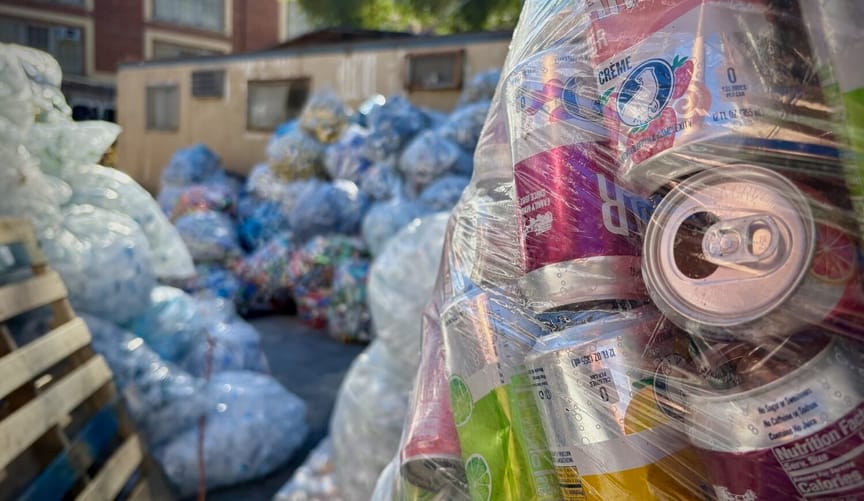
Close up of cans in a clear bag, with lots of other bags stacked in the background
Aluminum cans are bagged for recycling at the Sure We Can redemption center in Brooklyn, New York. (Maria Gallucci/Canary Media)

By Maria Gallucci, Canary Media, 19 October 2026

A global supply shortage and U.S. tariffs have roiled the aluminum market this year, putting greater pressure on the United States to produce more of its own metal. Plans to build or reopen giant smelters are moving forward, but they all hinge on securing huge amounts of cheap power — at a time when data centers are chasing every last electron.

Recycling aluminum, on the other hand, uses only 5% of the energy needed to make virgin metal in smelters, and the U.S. has an abundance of scrap. The problem is that millions of tons of it still wind up in landfills, owing to the country’s spotty recycling policies and the logistical headache of salvaging high-quality aluminum scrap.

As U.S. demand grows for the versatile metal — for soda cans, solar panels, lightweight cars, power cables, and data centers — policy experts are pushing states and the federal government to adopt measures that can boost aluminum recycling rates and reduce the country’s dependence on imported and smelter-made metal.

“It’s a secure supply chain issue,” said Joe Quinn, executive director of the Center for Strategic Industrial Materials at SAFE, a think tank that published a report this month on America’s aluminum deficit.

“There are environmental benefits all day long,” he said of recycling. ​“But I need the metal back in the market.”

A major reason why so much aluminum winds up as waste is that mechanical recycling systems aren’t up to the task.

Click to read the full story

____________________________________________________
Daily energy and environment updates. Free 30-day subscription

Is the solution to America’s aluminum crunch hiding in landfills? Read More »