The fact that some corporate Democrats want to ram this garbage down our throats in a lame duck Congress after a tidal wave election is obscene.
If this doesn’t make your head explode, nothing will.
It is fairly well known – and has gotten considerable media coverage – that Trump Executive Orders and the Justice Department have perverted civil rights laws to claim that they discriminate against white men.
Well, a little known or media covered “disparate impact” provision of Section 1402 of the BAAJA bill does exactly the same thing for fossil energy and polluters.
Just imagine how corrupt and deeply cynical you have to be to use a civil rights and hard fought EJ legal standard to protect polluters.
These are my ideas and research, but let’s let AI explain:
Two Massachusetts projects are the nation’s first to grow cranberries beneath solar panels, in another example of how agriculture and clean energy can coexist.
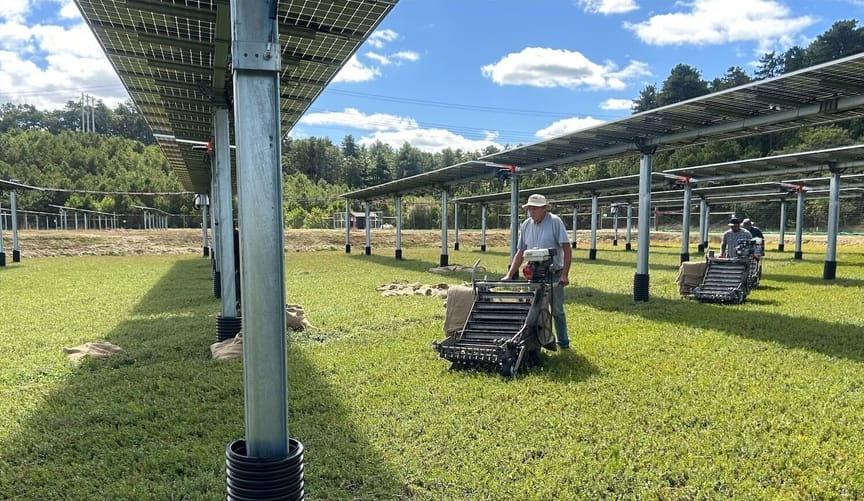
It’s cranberry season in southeastern Massachusetts. At bogs throughout the region, growers are collecting the ruby-red berries destined for holiday cakes, juice bottles, and cans of jellied sauce. At two farms, however, the harvesting process looks a little different: Pickers are navigating equipment around metal poles in the shade of solar panels.
The two bogs are the first in the country — perhaps the world — to grow cranberries beneath an operating solar installation. This fall marks the second season cranberries have been harvested from beneath the panels.
“We are literally proving it can be done,” said Prateek Tare, co-founder and executive vice president of Distributed Energy Infrastructure. His company constructed the two projects — a 4.4-megawatt array paired with a 13.5-megawatt-hour battery in the town of Kingston, and a 1-MW solar array in neighboring Plymouth.
Solar development is a major part of Massachusetts’ plan to reach net-zero carbon emissions by 2050. The state has offered solar incentives since 2001, evolving and expanding them over the decades to drive even more development.
However, the question of where to site solar projects has become a major point of contention in the densely populated and heavily wooded state. Building on rooftops and parking lots in developed areas can increase costs and limit generation capacity. But proposals for arrays on previously undeveloped land often spark protests from locals worried about the character of their community and environmental groups opposed to disrupting ecosystems. Using pre-cleared farmland has potential, but raises concerns about taking agricultural acres out of production. Many of these same dynamics are at play in communities across the U.S.
One of the solutions Massachusetts has been encouraging is agrivoltaics, or dual-use solar, which involves building solar panels above active agricultural operations. This strategy, which is gaining traction nationwide, allows farmland to be used for energy generation even as livestock graze or crops flourish beneath the elevated arrays.
Winds gusting to more than 50 mph and flooding reaching record levels has closed bridges and roads as a severe storm slams New Jersey on Thanksgiving.
More than 53,000 homes and businesses were without power across the state, with Jersey Central Power & Light reporting more than 33,500 customers and Atlantic City Electric reporting more than 17,300 customers affected as of 1 p.m. PSE&G was reporting more than 2,700 outages.
The Commodore Barry Bridge over the Delaware River is closed in both directions after the high winds blew loose part of the set-up for the ongoing bridge painting project, the Delaware River Port Authority said.
“The closure is a precaution to protect motorists while crews make repairs,” the agency said. “Crews are working as quickly and safely as possible. There is no estimated reopening time.”
Cape May County was seeing the brunt of the flooding on Thursday morning, with Ocean City, Stone Harbor, Cape May and the Wildwoods particularly hard hit.
The New Jersey Supreme Court has sided with the fishing, boating, and beach-going public in a test of a 2019 law passed to prevent private property owners from hogging the shoreline and other waterfronts.
The law in question requires property owners who apply for permits to develop tidal lands to provide additional public access if development would change a structure’s existing footprint. Lawmakers meant for the law to clarify and expand the public trust doctrine, a concept rooted in an 1821 lawsuit over access to oyster beds in the Raritan River. The doctrine holds that the sea and its shores are common to mankind, and all people have a right to them.
Sea Point, a homeowners’ association in Point Pleasant Borough, challenged the law in court after it applied in 2020 for a permit to rebuild a deteriorated bulkhead on its property along Beaver Dam Creek, and the Department of Environmental Protection conditioned approval on the submission of a public access plan, according to a state Supreme Court ruling released Tuesday.
The proposed project included extending the bulkhead two feet into the water and rebuilding piers and mooring piles that originally had been built without a permit, the ruling says.
Sea Point objected to the public access requirement, saying sufficient public access already existed elsewhere and offering to pay into a public access improvement project nearby, the decision says. The association characterized the law as unconstitutional, arguing it results in a taking of private property without just compensation.
The association took its fight to the Office of Administrative Law. That court sided with the state, the association appealed, and the appellate court upheld the decision.
Tuesday’s decision affirmed the lower courts’ rulings.
The world’s largest ride-hailing app is seeing record EV growth among U.S. drivers, a bright spot for the country’s floundering electric vehicle market.
An Uber driver navigates the streets in a Tesla. (Lance McMillan/Toronto Star via Getty Images)
U.S. electric vehicle sales fell off a cliff last year after Republicans deleted the federal EV tax credit. But sky-high gasoline prices are causing EV adoption to soar among one of the populations most exposed to fuel costs: Uber drivers.
The ride-hailing company tracks EV adoption on its platform to measure progress toward a corporate goal to reach 100% electric by 2030 in the U.S., Canada, and Europe. Uber is not on track to hit that ambitious timeline, but a striking trend has emerged from the latest data: Uber drivers in the U.S. and Canada made a smaller share of rides in EVs in the last quarter of 2025 and the first quarter of this year. But from April through September, U.S. Uber drivers set consecutive monthly records for miles driven electric, said Santosh Rao, the company’s global head of mobility electrification.
During a three-hour meeting at Cedar Crest College, the DEP fielded questions and listened to testimony from people who live near the proposed $8.9 billion Project Atlas site, or who have children attending the high school.
Representatives from Project Atlas developer CDE Acquisitions LLC- Edged US also answered questions about the project, though few in the audience seemed satisfied with their answers.
She noted that Edged has proposed buying wetlands in another part of the Lehigh River watershed through mitigation credits — something that is allowed under the federal Clean Water Act — to make up for the wetlands they’d destroy in South Whitehall, but said that wasn’t enough.