
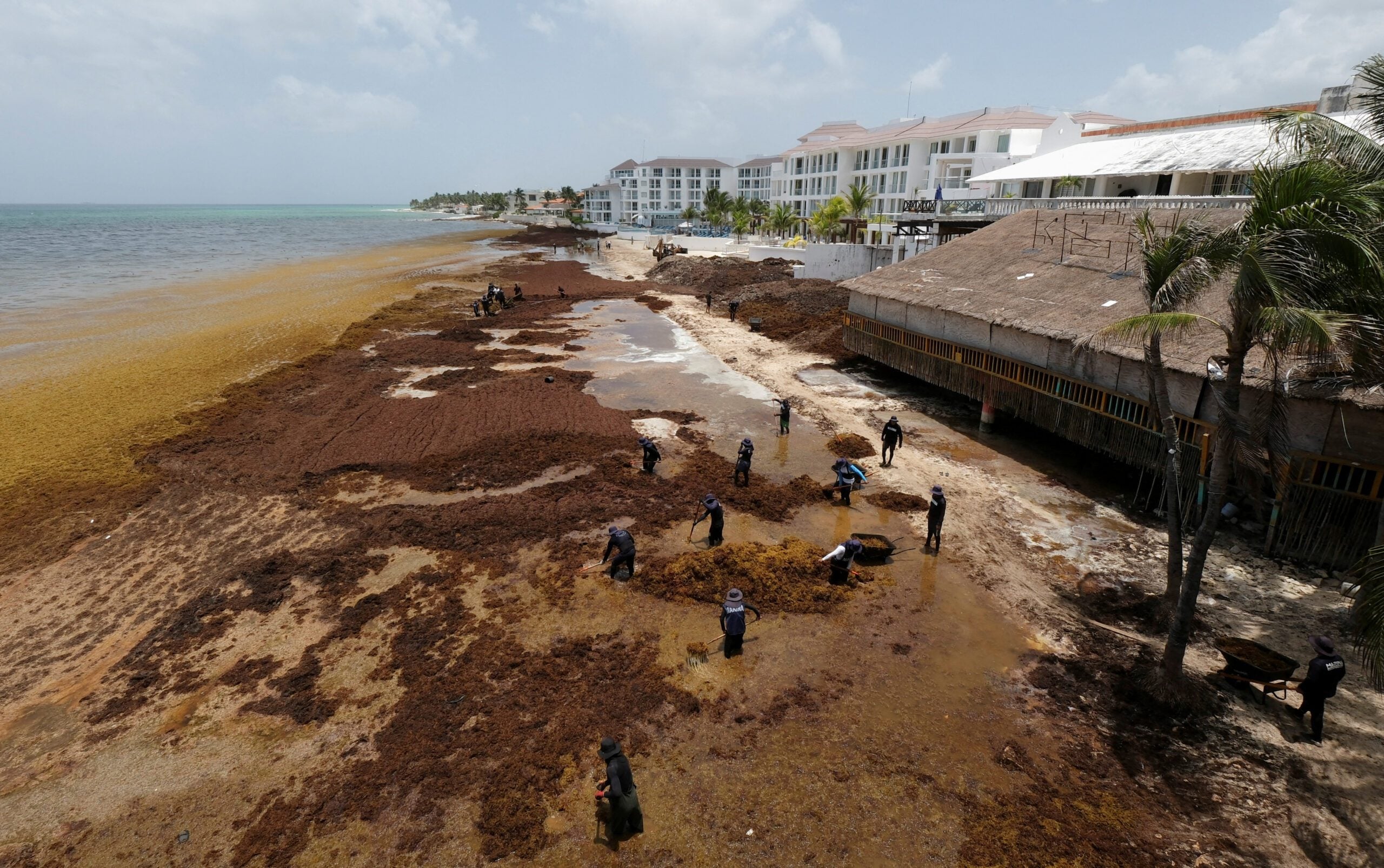
Members of the Mexican Navy remove sargassum seaweed from a beach in Playa del Carmen, Mexico, June 4, 2026. REUTERS/Paola Chiomant
MEXICO CITY, July 31 (Reuters) – Hundreds of Mexican hotel workers, tractor operators and specialized Navy personnel are heading out to the beach each day at dawn to clean record masses of rotting sargassum seaweed off pristine Caribbean coastlines around popular tourist resorts.
The seasonal phenomenon has caused hotels across the Caribbean to cut rates and invest millions of dollars in clearing up piles of the foul-smelling algae from their beaches, while governments and businesses look for solutio
Sargassum – a brown seaweed that forms floating mats on the ocean surface – was historically confined to the so-called Sargasso Sea in the North Atlantic, but unusually strong winds around 2010 blew sargassum into nutrient-rich tropical waters off West Africa, where it found ideal growing conditions.
The displaced seaweed turned into a self-sustaining belt that rides on ocean currents to northern Brazil and through the Caribbean, bringing masses of algae onto Caribbean island nations, the popular Riviera Maya and into the Gulf of Mexico.
In the tropical Atlantic, sargassum feeds on nutrients running in from major rivers such as the Amazon, Orinoco and Congo rivers, as well as upswells from the deep ocean, Saharan dust and warming sea temperatures.
WHERE IT’S GOING
The University of South Florida’s Optical Oceanography Lab expects 2026 to be at least the second-largest year for sargassum abundance, with more seaweed likely to heap up around the Caribbean and southeastern Florida in coming months.
Brian Barnes, research assistant professor at the university’s College of Marine Science, who works in the lab, told Reuters the novelty of the phenomenon and its seasonality makes predicting its future course challenging.
“Before 2010 there’s nothing, and since then we’ve gone to up to 1 million metric tons over the entire area in 2011 to 40 million last year,” he said, suggesting the seaweed could be doubling in mass every five years.