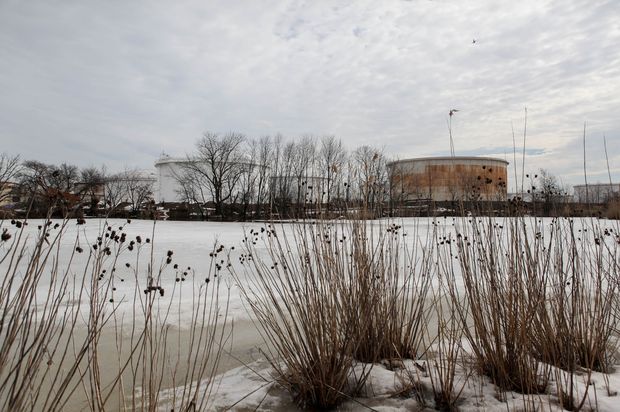
Morses Creek, turned into a lagoon for waste products at Bayway Refinery in Linden, NJ (Stephen Nesssen – WNYC)
“After repeated vetoes by Gov. Chris Christie, the state Senate on Monday passed a constitutional amendment to require that settlement money from polluters be spent almost exclusively on restoring the environment,” Christopher Baxter reports for NJ.com.
The measure (SCR163) would dedicate money received from lawsuits against polluters solely “to repair damage to, restore, or permanently protect the state’s natural resources,” with the exception of up to 5 percent for administrative costs.
Democrats want the change in response to the Christie administration’s proposed $225 million settlement in a long-running case against Exxon, a deal they say sells the state short in a battle that had estimated damages as high as $9 billion.
The measure passed 27-12, which is more than the three-fifths needed to put it on the ballot in November. The Assembly must pass it by the same margin by August to seek voter approval this year. Otherwise, it would probably be next year.
“The Supreme Court on Monday struck down the Obama administration’s plan for controlling emissions of mercury and other toxins from power-company smokestacks, saying the Environmental Protection Agency should have considered the cost of the rules first, “Robert Barnes
The court’s 5-to-4 decision halts further implementation of the Mercury and Air Toxic Standards rule, which required hundreds of coal-burning plants to install equipment to control mercury, a substance linked in multiple studies to respiratory illnesses as well as birth defects and developmental problems in children.
Justice Antonin Scalia wrote for the majority, which included Chief Justice John G. Roberts Jr. and Justices Anthony M. Kennedy, Clarence Thomas and Samuel A. Alito Jr.
Justice Elena Kagan wrote the dissenting opinion for Justices Ruth Bader Ginsburg, Stephen G. Breyer and Sonia Sotomayor.
Now on the desk of New Jersey Governor Chris Christie is A-2579/S-1510, legislation that would enable property owners to obtain 10 to 30-year private financing (through special assessments attached to municipal property taxes) to cover 100 percent of the cost of clean energy and resiliency improvements without any initial investment by the property owner.
Those involved with the national PACE (Property Assessment Clean Energy) program say that it gives property owners the ability to install more extensive systems than they likely could afford under traditional financing programs and that the resulting saving in energy costs often outpaces the financing costs from day one of the project.
The PACE program, which has had significant success in states like California and Connecticut. was hailed by a number of commercial developers, investors, energy construction companies and public officials at a seminar held on June 12 to boost the legislation’s chance of passage.
Panelists at the event, held at Princeton University, included former NJ Governor Jim Florio, NJBPU Commissioner Upendra Chivukula, State Senator Bob Smith, Jersey City Deputy Mayor Marcos Vigil, executives from the Simon Property Group, MSLGroup, NJ Builders Association and others.
At the time of the seminar, PACE executives were concerned that the state legislature might recess for the summer before their bill cleared both houses, but final legislative passage was secured on June 25 in the Senate (36-1) and Assembly (63-9-3).
Now the question is whether Governor Christie will sign it. He pocket vetoed a PACE bill at the end of the previous legislative session but changes were made to the bill this year to address potential concerns.
In the videos above, NJ Builders Association President George Vallone and PACE co-founder Victoria Zelin highlight features of the program.
Jon Hurdle of NJ Spotlight covered the June 12 seminar and filed a detailed story here.
Who is responsible to pay for the damage when overpumping of
groundwater causes surface soils to slump and properties to sink and crack?
A legal suit that resulted from the practice 25 years ago in
San Luis Obispo went all the way to the California Supreme Court. The result
should have been fair warning to other towns.
“The Legislature is poised today to pass legislation aimed at boosting the solar sector in New Jersey, but even its proponents concede it is only a temporary fix.”
NJ Spotlight’s Tom Johnson writes that, if approved and signed into law by Gov. Chris Christie, the measure would encourage increased investment in solar energy systems, particularly for residential and small business projects.
The legislation (A-3838) is important because New Jersey has ambitious targets to increase the use of cleaner ways of producing electricity for utility customers, hoping to have 22.5 percent of its power come from renewable sources of energy by 2020. It is unlikely to meet those goals if solar is not a big component of that mix.
The measure, which is expected to be voted on in both the Assembly and the Senate, would revamp the rules governing when owners of solar systems get paid for the power they produce but do not use. The electricity they do not need goes into the traditional power grid.
The system, known as net metering, is used by 44 states and is credited with helping to promote the rapid growth in solar not only in New Jersey but also in other states. New Jersey has more than 36,000 solar systems installed, making it one of the nation’s leaders in the use of this technology.
New Jersey’s clean energy fund is being tapped once again by legislators — this time to provide $20 million for maintenance and salaries for the state’s park system, NJ Spotlight’s Tom Johnson reports.
The proposed diversion from the often-raided Clean Energy Fund presumably would retain $20 million for a new open-space preservation program instead of being used to finance parks management as the Christie administration proposed in its spending plan for next year.
Gov. Chris Christie’s proposed budget already is counting on using approximately $152 million from the Clean Energy Fund to finance various energy initiatives and to pay utility bills at state facilities, including NJ Transit.
The persistent withdrawal of money from the Clean Energy Fund by lawmakers and the administration is a source of frustration for clean-energy advocates. More than $1 billion in clean-energy funds has been used to help balance budgets in the past several years. The fund is replenished by surcharges on gas and electric bills for residents and businesses.
Was this of value to you? Click here for free updates The social media icons below make it easy to share this.