Pretty and practical, green roofs sprouting all over Philly

Workers are busy installing greenery on the roof of the Philadelphian condo complex
   The city now has 111 green roofs, with 64 on the way. David Swanson/ Photographer
 

On Earth Day, Sandy Bauer reports in the Philadelphia Inquirer:

"Across the city, the tops of buildings and parking lots are sprouting greenery like never before. The number of green roofs in Philadelphia has tripled since 2010, according to the Water Department, which tracks the roofs because they absorb storm-water runoff.

"The city now has 111 green roofs, roughly 25 acres’ worth. An additional 64 roofs are in the queue. The completed ones range from a tiny poof of greenery atop a bus stop shelter – installed at 15th and Market Streets as an attention-getter in 2011 – to one of the latest and biggest, one-acre-plus of greenery at Cira Centre South in University City.

"Roof gardens are atop hospitals, office buildings, the Philadelphia Free Library, schools, and private homes. Since 2009, virtually every new building and major renovation at the University of Pennsylvania has been designed with a green roof – "an integral part of Penn’s sustainability goals," said spokeswoman Heidi Wunder.

Some are even the equivalent of mini parks in the sky. One under construction atop a parking garage near the Cira Centre will be more than an acre, with trees and prime views of the city. The 2.7-acre project nearing completion at the Children’s Hospital of Philadelphia is perhaps even more inviting because it’s so visible – just above street level. But it’s a roof all the same. The rest of the building, a parking lot, is simply underground.

"We’re doing it for all the appropriate technical reasons, but it’s also designed as a park for people to use," said Douglas Carney, vice president of facilities at Children’s Hospital. Thus, the trees, benches, and fountains.
mouse click - left to right
 
     Was this post of value to you?
  
 Click here for free updates
 

NJ Water Supply Plan hearing Wednesday in Trenton 
Top PADEP executive joins PR firm’s energy practice


Pretty and practical, green roofs sprouting all over Philly Read More »

NJ Water Supply Plan hearing Wednesday in Trenton


The New Jersey Senate’s Legislative Oversight Committee will meet at 11 a.m. on Wednesday, April 22, 2015,  in Committee Room 1, 1st Floor, State House Annex,
Trenton, New
Jersey.

The
committee will hear testimony from invited guests on the need for the
Department
of Environmental Protection to update the Statewide Water Supply
Plan.


mouse click - left to right
 
      Was this post of value to you?
    
 Click here for free updates

NJ Water Supply Plan hearing Wednesday in Trenton Read More »

Top PADEP executive joins PR firm's energy practice

Jeff Logan
Advocacy and public relations firm Bravo Group Inc. has lured away a top administrator from the Pennsylvania Department of Environmental Protection to the firm’s energy practice, Sam Kusic reports in Pittsburgh Business Times.
"Jeff Logan, who since 2011 had served as an executive deputy secretary for administration and management at the department, is joining Bravo to head up its environmental and regulatory unit, which is part of the firm’s Pittsburgh-based energy practice. He oversaw the DEP’s business management and finance functions, and worked closely with department’s oil and gas program to set up the current well permit fee structure and operating model.
"Prior to his time at the DEP, Logan was the director of business development and government relations for the wireless business unit of Harris Corp., a communication and IT company."
mouse click - left to right
 

Top PADEP executive joins PR firm's energy practice Read More »

The photos that could bring down a U.S. senator

The photos that could bring down a U.S. senator Read More »

Wyo. coal-bed methane: Boom, bust and hard lessons

Jill Morrison, left, and Kenny Harbaugh observe an ephemeral Powder River
Basin draw in 2006. Usually dry, yet moist enough to provide good grazing,
the draw was flooded with water from coal-bed methane gas wells.
(Photo: Dustin Bleizeffer/WyoFile)
Today Wyoming’s coal-bed methane gas play in the Powder River Basin is a bust. Few of the 24,000 wells drilled during the heyday of the 2000s produce much gas, many sit idle and approximately 3,000 wells are left orphaned—a liability for the state to clean up," reports in the public-interest publication WyoFile.
"But in the early part of this century, the fervor surrounding coal-bed methane gas and its potential was as enormous as Powder River Basin coal itself—a trove of mineral wealth lurking just below the surface in coal formations the size of Lake Erie. Coal-bed methane was a play for both big operators and mom-and-pops. It made new millionaires among companies and landowners—not to mention hundreds of millions of dollars for local and state coffers.
"Coal-bed methane also fueled hot controversies in the realms of landowner rights, environmental stewardship, the value of water and—at every turn—state and local politics.
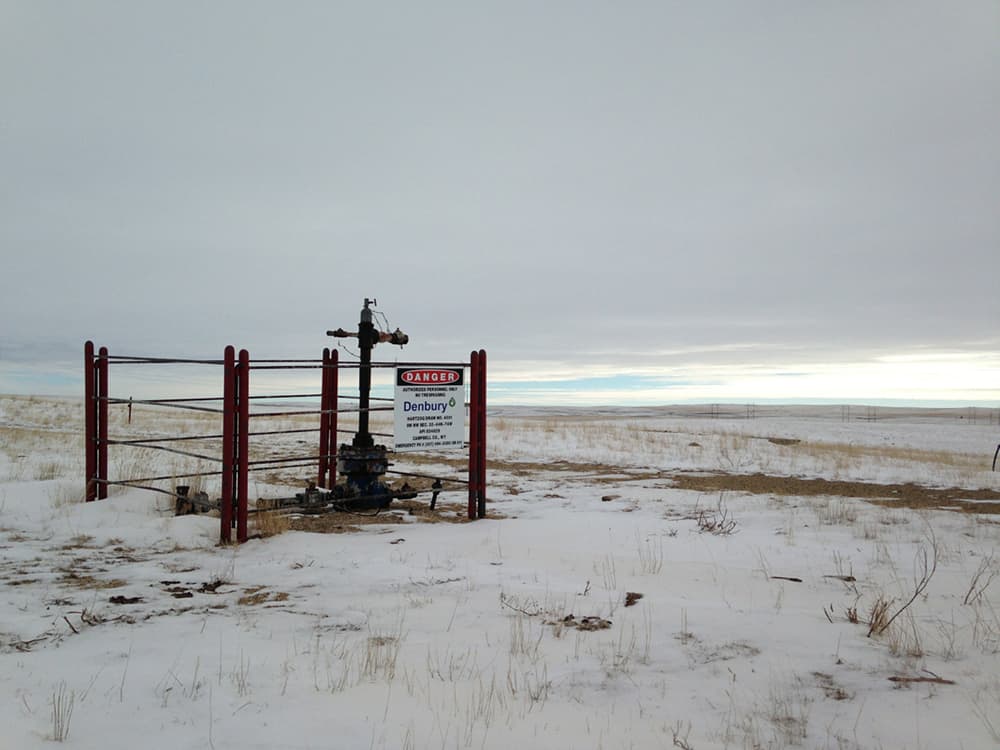
Coal-bed methane gas drilling concentrated mostly in Campbell, Johnson and Sheridan counties. Shown here in winter 2015 is a well just east of the Pumpkin Buttes in southern Campbell County. (Dustin Bleizeffer/WyoFile)

Coal-bed methane gas drilling concentrated mostly in Campbell, Johnson and Sheridan counties. Shown here in winter 2015 is a well just east of the Pumpkin Buttes in southern Campbell County. (Dustin Bleizeffer/WyoFile)

"Some blamed the development for harming domestic water wells. One rural homeowner fired shots at a compressor station in rifle range of his house out of frustration at the constant whirring noise. A fistfight nearly broke out on a tour bus in front of elected officials, including then Montana Gov. Judy Martz, who stepped in to cool tempers. One operator said he feared he would be blackballed by his colleagues for putting in a new water well for an elderly couple on the Powder River to replace one that had supposedly been bled dry.
“If a company or an individual involved in trying to help these people with this [replacement] well were named, there would be those who would perceive them as being guilty of something,” Casper geologist Jimmy Goolsby of Goolsby, Finley & Associates, told the Casper Star-Tribune in December 2003.
"For a time, coal-bed methane was responsible for making the Powder River Basin the largest producing natural gas field in the state, at more than 1 billion cubic feet of gas per day. During the early 2000s, coal-bed methane was the only big gas play in the state—a godsend for a mineral revenue-dependent state that had endured a long dry spell in the 1990s.
"As did so many resource booms before it, Wyoming’s coal-bed methane gas boom burned brightly and then died, leaving a complicated legacy. And, as often is the case, it left lingering hope for a revival, as well as frustrations over lessons that still appear unlearned."
mouse click - left to right

Wyo. coal-bed methane: Boom, bust and hard lessons Read More »

Fracking’s unintended consequence: Oklahoma quakes

In a piece published today in The New Yorker titled Weather Underground: The Arrival of Man-Made Earthquakes, Rivka Galchen writes: 

“Until 2008, Oklahoma experienced an
average of one to two earthquakes of 3.0 magnitude or greater each year.
(Magnitude-3.0 earthquakes tend to be felt, while smaller earthquakes may be
noticed only by scientific equipment or by people close to the epicenter.) In
2009, there were twenty. The next year, there were forty-two. In 2014, there
were five hundred and eighty-five, nearly triple the rate of California.
Including smaller earthquakes in the count, there were more than five thousand.
This year, there has been an average of two earthquakes a day of magnitude 3.0
or greater.
“William Ellsworth, a research geologist at the United States
Geological Survey, told me, “We can say with virtual certainty that the
increased seismicity in Oklahoma has to do with recent changes in the way that
oil and gas are being produced.” Many of the larger earthquakes are caused by
disposal wells, where the billions of barrels of brackish water brought up by
drilling for oil and gas are pumped back into the ground. (Hydraulic fracturing,
or fracking—in which chemically treated water is injected into the earth to
fracture rocks in order to access oil and gas reserves—causes smaller
earthquakes, almost always less than 3.0.) Disposal wells trigger earthquakes
when they are dug too deep, near or into basement rock, or when the wells
impinge on a fault line. Ellsworth said, “Scientifically, it’s really quite
clear.”


Read the full story here

Fracking’s unintended consequence: Oklahoma quakes Read More »