What a difference a dune makes and how to build one

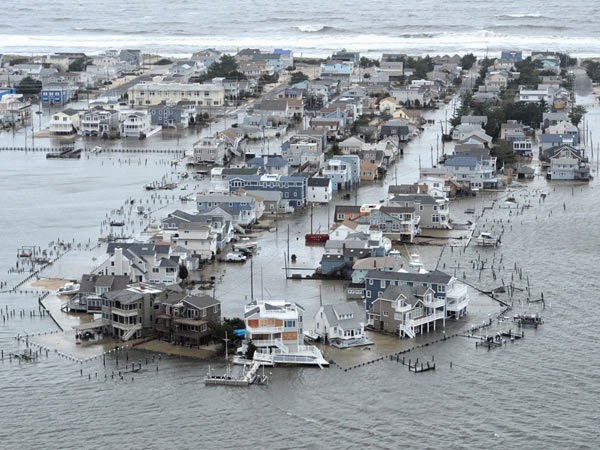
Temporary dune built in Ortley Beach, NJ after Sandy struck – Reuters photo


When Superstorm Sandy ripped into New Jersey at 89 miles-an-hour last October, it knocked a boardwalk roller coaster into the ocean, pushed homes into Barnegat Bay, destroyed others in place and caused millions of dollars worth of damage and untold heartache for homeowners and businesses.


In tiny Midway Beach, however, a quarter-mile-long community within South Seaside
Park, only one house sustained minor water damage.

What spared the community of mostly post-World War II, one-story bungalows?

The answer is Midway’s 25-foot-high (7.6-meter-high) dunes that the community started passively building 30 years ago.

In the interesting article, How (And Why) to Build a Dune, National Geographic explains
that the project started out as a way to prevent an annual annoyance and ended up being
the town’s best defense.

Wooden fencing layered in a saw tooth pattern catches wind-blown sand

In the same post, Dominick Solazzo, a trustee on the Midway Beach Condominium Association‘s board of directors, also offers a three-step tutorial on how his town built
their dune–and how you can, too.


We’d love to hear your thoughts on dunes or other shore-protection measures. Use the comment box below.
__________________________________________________________________________

For more information like this, try a FREE subscription to EnviroPolitics. 
Our daily newsletter also tracks NJ & PA legislation—from introduction to enactment
__________________________________________________________________________


Our most recent posts:  
Work to begin on controversial PA-to-NJ power line 
Court green lights Susquehanna-Roseland power line  
Hurricane season coming but some still block NJ dunes 
New rules governing gas drilling under review in Pa 
Home-elevation expert urges more industry training 

What a difference a dune makes and how to build one Read More »

Work to begin on controversial PA-to-NJ power line


Vegetation clearing and access road construction is set to begin on Tuesday for the Susquehanna-Roseland power project after a federal judge on Friday dismissed objections
from environmentalists who claim that the massive infrastructure upgrade will damage sensitive areas in the Delaware Water Gap.

Other segments of the line already are under construction in both Pennsylvania and New Jersey. When completed, the 500,00-volt transmission line, being built by two utility companies, will run from PPL’s service territory in Berwick, Pa to PSE&G’s substation in Roseland, NJ.

PSE&G says it expects the line to be in service by June, 2015.

__________________________________________________________________________

For more information like this, try a FREE subscription to EnviroPolitics
Our daily newsletter also tracks NJ & PA legislation—from introduction to enactment __________________________________________________________________________
Regional grid operator PJM Interconnection has argued that the project is necessary because the existing power line cannot keep up with projected electricity demands in 
heavily urbanized areas of northern New Jersey and New York.

Environmental groups, like the New Jersey Sierra Club, argue that energy use has not been increasing and that PJM cancelled two similar transmission expansion projects–the Mid Atlantic Power Pathway and the Potomac Appalachian Transmission Highline.

NJ Sierra Club director Jeff Tittel said that his organization will explore possible grounds for an appeal. 

While a handful of local officials in the affected areas objected, there has been no state-level governmental opposition to the upgrade project either in New Jersey or Pennsylvania. And, despite the opposition of environmentalists, the project was fast-tracked in 2010 by the Obama administration.
Related environmental news stories:
Controversial PSE&G upgrade: Work starts in Delaware Water Gap area Tuesday 
Court throws out environmental challenge to PPL power line
Power line project cleared in courts 


Our most recent posts:
 
Court green lights Susquehanna-Roseland power line 
Hurricane season coming but some still block NJ dunes
New rules governing gas drilling under review in Pa
Home-elevation expert urges more industry training
NJDEP cutting red tape for post-Sandy restorations

Work to begin on controversial PA-to-NJ power line Read More »

Court green lights Susquehanna-Roseland power line

High power lines

This news release was distributed this afternoon by PPL.  We’ll add reactions later


Federal judge rules in favor of utility companies and National Park Service

ALLENTOWN, Pa., Aug. 30, 2013 /PRNewswire/ — PPL Electric Utilities called a federal judge’s decision to dismiss a lawsuit challenging federal permits for the Susquehanna-Roseland power line "the right decision for millions of people throughout the mid-Atlantic region who will have more reliable electric service because of this project."

In a ruling Friday (8/30), Judge Richard W. Roberts of the United States District Court for the District of Columbia dismissed the action filed by several environmental groups seeking to block construction of the project through the Delaware Water Gap National Recreation Area.

"This ruling affirms the position of the companies and the National Park Service that these permits were issued properly and after thorough study," said Stephanie Raymond, PPL Electric Utilities vice president of Transmission and Substations. "We will move forward with construction as planned."

The 145-mile Susquehanna-Roseland line is already under construction elsewhere in Pennsylvania and New Jersey. The project is needed to keep the regional electric grid reliable, and to prevent overloads of other existing power lines. The line is expected to be in service by June 2015.


PPL Electric Utilities, a subsidiary of PPL Corporation (NYSE: PPL), provides electric delivery services to about 1.4 million customers in Pennsylvania and has consistently ranked among the best companies for customer service in the United States. More information is available at www.pplelectric.com.

For more information like this, try a FREE subscription to EnviroPolitics  
Our daily newsletter also tracks NJ & PA legislation—from introduction to enactment 


Court green lights Susquehanna-Roseland power line Read More »

New rules governing gas drilling under review in Pa

The rules would ban the permanent storage of fracking fluids in open pits and
would
force drillers to locate and monitor abandoned wells within 1,000 feet 
of a proposed well site.
Environmentalists and drillers are gearing up for a fight over how best to protect rivers and drinking water as the state implements the biggest change to its oil and gas laws in 30 years, the Tribune-Review reports. .

The state Department of Environmental Protection released 74 pages of proposed regulations on Tuesday aimed at shielding the state’s drinking wells and rivers from the Marcellus shale drilling industry.

“The most important provisions are those that are designed to improve the protection of water quality,” said David Hess, DEP secretary under former Gov. Tom Ridge and a Harrisburg lobbyist whose clients include environmental groups.

The regulations would ban permanent storage of hydraulic fracturing fluid in open pits and require drillers to notify state agencies if they plan to drill near a scenic river, among other rules, according to a summary.

The rules are the first to be issued under the 2012 Oil and Gas Act, said DEP spokeswoman Lisa Kasianowitz. They also aim to protect the state’s $1 billion in industries tied to natural resources, the DEP said.

“This puts Pennsylvania pretty far ahead of other states in environmental protection measures,” Hess said.

But not far enough, some say.

Among the concerns raised by environmental groups, a proposed rule against open-air storage pits doesn’t ban them outright and another governing abandoned wells doesn’t go far enough.

Find reporter Mike Wereschagin’s full story here 

Related environmental news stories:
Environmental Quality Board Approves New Draft Regulations For Drilling
Pennsylvania Proposes New Oil and Gas Regulations
Bill seeks to relax environmental regulations
So far, it’s a split decision on fracking, health

For more information like this, try a FREE subscription to EnviroPolitics.  
Our daily newsletter also tracks NJ & PA legislation—from introduction to enactment 

New rules governing gas drilling under review in Pa Read More »

Home-elevation expert urges more industry training

The unfortunate house-raising mishap that resulted in the destruction of two homes in Highlands, NJ [Two NJ houses destroyed as Sandy elevation slips up] reminded us of
the video interview we recently conducted with structure-elevation expert Rod Scott.

Rod, who earned his chops in New Orleans during Hurricane Katrina, has been visiting communities along the New Jersey coast that were devastated by Superstorm Sandy. He estimates that up to 150,000 structures will need to be elevated over the next 20 years and he’s calling for greater training, certification and insurance requirements for companies offering building-elevation services to the public.

You might want to listen to what he has to say in the video below.


For more information like this, try a FREE subscription to EnviroPolitics
Our daily newsletter also tracks NJ & PA legislation—from introduction to enactment

Our most recent posts:
NJDEP cutting red tape for post-Sandy restorations
Will PA Gov. Corbett add climate deniers to key posts?

Advanced Disposal sells off its NY, NJ operations 


Home-elevation expert urges more industry training Read More »

Two NJ houses destroyed as Sandy elevation slips up

                                                                                      Asbury Park Press photo

You might not consider yourself lucky if you house survived Superstorm Sandy only to be crushed  by a neighboring home, but a Highlands, NJ family might because they could have been inside at the time.

News 12 New Jersey reports:

A two-story house in Highlands that was being raised tipped over on Friday, landing on top of the house next door.

No one was injured because the family who lives at the home on Locust Street is on vacation, but officials say both homes needed to be demolished for safety reasons. The home fell off the cribbing that was holding it up shortly before 11 a.m. At 3:30 p.m., crews began tearing it down, with the family’s possessions still inside. 

Asbury Park Press story and video

For more information like this, try a FREE subscription to EnviroPolitics.  
Our daily newsletter also tracks NJ & PA legislation—from introduction to enactment

Our most recent posts: 

Will PA Gov. Corbett add climate deniers to key posts?

Advanced Disposal sells off its NY, NJ operations

Two NJ houses destroyed as Sandy elevation slips up Read More »