 |
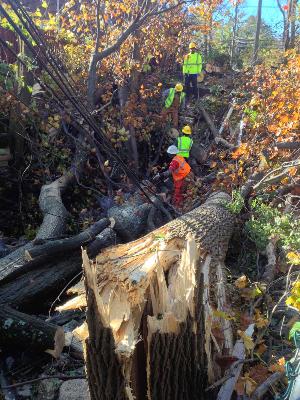
| Post-Sandy tree trimmers – Montclair Times |
Recent news stories examining the environmental damage caused by Hurricane Sandy and the roles that
climate change and development
may have played.
Partially treated sewage flowing into channel in East Rockaway, NY
NBC News 4 reports:
Two weeks after Sandy flooded the Bay Park sewage treatment plant in East Rockaway, sewage that has only been partially treated continues to pump into the Rockaway Channel, according to Nassau County officials.
“The raw sewage that is going into the plant is being treated, it’s being chlorinated,” said Nassau County Ed Mangano. “But the secondary systems are down.”
Before the storm, the plant was pumping water that had been fully treated, said Mangano. But because so many of the plant’s pumps were compromised when nine feet of water gushed on to shore during Sandy, the raw sewage had to be diverted in order to prevent it from going into people’s homes.
On Oct. 31, two days after Sandy hit the area, NBC 4 New York was in the Bay Park section of East Rockaway where the effects of the damaged plant were first seen. Raw sewage gushed up from the streets like fountains and it rose up in residents’ basements.
To prevent a health hazard, Mangano ordered the raw sewage to be diverted into Rockaway Channel.
While the sewage is now partially treated, this could have lasting effects on the environment. The Bay Park plant treats the waste of approximately 550,000 homes in Nassau County. The area is defined east of Queens, south of the Long Island Expressway and ends at the Meadowbrook Parkway.
Storm-damaged New Jersey sewage plant getting emergency assistance
In a press-release reported today in WaterWorld, Texas-based Synagro Technologies, Inc. announced today that “it is has agreed to provide critical support to bring New Jersey’s largest wastewater treatment facility back into operation following damage sustained from Hurricane Sandy.”
The company is providing 10 centrifuges and additional equipment to the Passaic Valley Sewage Commission facility in Newark, whose operations were curtailed after flooding damaged vital equipment. The facility treats biosolids extracted from 330 million gallons of wastewater each day routed from Newark, Essex, Passaic, Union, Hudson and Bergen counties, serving more than 3.5 million New Jersey residents. Approximately 35 Synagro employees will work on the recovery project.
The emergency support will allow the facility to continue treating wastewater while it takes steps to regain full operational capacity. Under the terms of the agreement, Synagro will provide support on an as-needed basis until the facility becomes fully operational.
The company is working alongside the Army Corps of Engineers, the Environmental Protection Agency and state and local officials. As part of this process, the company re-routed equipment and personnel previously committed to non-emergency services across the country and in Canada.
“In an emergency situation, it is imperative these facilities be brought back into operation as quickly and effectively as possible, both for health and safety reasons,” said Eric Zimmer, the company’s president and chief executive officer. “I laud the efforts of our entire team and want to thank all of the federal, state and local authorities who are helping to make our job that much easier.”
***********************************************************************************************************
For thorough coverage of environmental news, issues, legislation and regulation in New Jersey and Pennsylvania, try a FREE subscription to EnviroPolitics, our daily newsletter that also tracks environment/energy bills–from introduction to enactment
***********************************************************************************************************
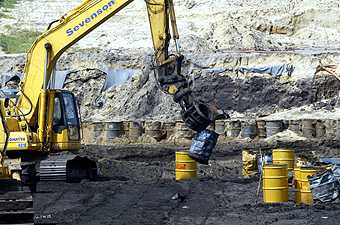
NJDEP says its making major progress in cleaning up Arthur Kill fuel spill
From a news release from NJ Governor Chris Christie:
Department of Environmental Protection Commissioner Bob Martin today praised the well-coordinated response by a dedicated team of public and private groups to a major diesel fuel spill in the Arthur Kill caused by Hurricane Sandy, saying it limited what could have been major environmental damage to the waterway and surrounding areas.
A record tidal surge caused by the storm dislodged and at least one massive bulk fuel tank belonging to the Motiva Oil Tank Facility in the Sewaren section of Woodbridge Township, spilling some 378,000 gallons of low sulfur diesel fuel – including approximately 277,000 gallons that escaped a containment area and entered the Arthur Kill, which is the tidal strait and navigational channel that separates New Jersey and Staten Island.
An intensive cleanup and containment effort was initiated immediately after the storm subsided, coordinated by the U.S. Coast Guard, working closely with Motiva and its contractors, Atlantic Response and Marine Spill Response Corp., as well as the DEP, the National Oceanic and Atmospheric Administration, the city of Woodbridge and Tri-State Bird Rescue to promptly deal with the spill.
As of today, the response group has collected approximately 100,000 gallons of diesel fuel that escaped the containment area, and is continuing fuel recovery and remediation efforts. Also, an unknown percentage of the fuel in the Arthur Kill and Raritan Bay has dissipated.
New Jersey seafood industry returning to normal after Sandy
NewsWorks reports:
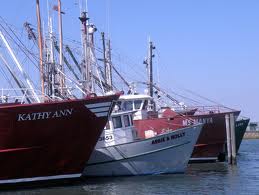
The state opened shellfish beds in the Delaware Bay Monday morning, and fishing operations based in North Jersey have largely resumed production.
Shellfish gathering had been off limits throughout the Garden State because of elevated bacterial and viral levels in coastal waterways. Flooding and broken water-treatment equipment along the coast meant sewage was streaming into many shellfish beds.
Those toxins get concentrated in the flesh of filter feeders including oysters, mussels and clams.
“They filter out bacteria and viruses as well as any nutrients in the water,” said Jill Lipoti, director of water monitoring and standards for the state Department of Environmental Protection.
“To really put this in perspective for the public, we allow people to swim in areas that have up to 200 colony-forming units in the water,” Lipoti said. “But for shellfish (harvesting), the limit is 14.”
After declaring Delaware Bay beds clean, the state is testing shellfish in beds along the shore. Officials hope to reopen many as early as Thursday. The state estimates when all the shellfish beds were shut down, the $876 million industry lost about a million dollars of revenue a day.Meanwhile, Lipoti said water quality in the ocean is just fine. But commercial fishing boats were docked for days if not longer due to Sandy-induced physical damage to cleaning and unloading equipment on shore.
Full picture of Sandy’s environment damage may not unknown for months
The Waterbury (CN) Republican-American reports:
A full picture of how Sandy damaged the environment may not be known for months, but a preliminary profile is being put together by the National Fish and Wildlife Foundation. The Washington, D.C.-based nonprofit wildlife conservation group expects to release a report on damage from Delaware Bay to Long Island Sound by mid-December.
The foundation is working with federal government officials and other nonprofit groups, including the American Littoral Society based in Highlands, N.J. The groups plan to present their findings to Congress, state officials, scientists and the public.
“The idea is to do a very quick assessment to see what the major impacts are and identify the major changes in the habitat areas,” said Tim Dillingham, executive director of the American Littoral Society. “Obviously, the biggest impacts are to the beaches and the barrier island system. There are shorebirds and other animals that depend on those.”
Dillingham expects more comprehensive studies to follow his group’s assessment, as well as lengthy debates on how to rebuild the shorelines.
Many environmentalists are also eagerly awaiting the completion of a U.S. Geological Survey imaging project that’s expected to show exactly how the storm changed the coastline from North Carolina to Massachusetts. The project is using “lidar,” or light detection and ranging, from an aircraft-based system that uses laser pulses to collect highly detailed ground elevation data.
Did climate change make Sandy more ferocious?
The (Newark) Star-Ledger reports:
“Climate change did not cause Sandy to form, but climate change certainly made it worse,” said Micheal Oppenheimer, a professor of geosciences at Princeton and a member of the United Nation’s Intergovernmental Panel on Climate Change. “We know that because the sea level is about a foot higher than it was a century ago. That worsens the storm surge by that much. I’m confident of that.”
Sea level rise, due to the historic melting of the polar ice caps, may be only one of three global-warming nudges that pushed Sandy over the edge. The two others: warmer sea surface temperatures this year, by 3-5 degrees in the Mid-Atlantic, say climate scientists, encouraged Sandy northward even though it was fall. And that stubborn ridge of high pressure, which may have been enhanced by the disappearance of arctic ice, blocked the storm’s escape. That last factor is the focus of much of Francis’s research.
Miles of arctic sea ice have been lost in the past several decades, equivalent to nearly half the acreage of the lower 48 states, according to scientists. That loss, they say, has set in motion a chain of events that likely helped Sandy become the monster storm it was. With less bright, white ice to reflect the sun’s rays back into space, there is more water to absorb that sunlight, raising ocean temperatures and warming the air.
Francis believes there is strong evidence to suggest that a warming atmosphere is slowing the jet stream, causing deeper troughs and higher ridges — also known as Arctic Amplification — as it moves west to east. Bigger swings in the jet stream allow cold arctic air to plunge farther south and warm tropical air push farther north. And because the waves in a jet stream control the formation of storms, the slower the waves, the more extreme the weather and the longer the weather conditions will persist, according to Francis.
***********************************************************************************************************
For thorough coverage of environmental news, issues, legislation and regulation in New Jersey and Pennsylvania, try a FREE subscription to EnviroPolitics, our daily newsletter that also tracks environment/energy bills–from introduction to enactment
***********************************************************************************************************
Hurricane Sandy Damage Amplified By Breakneck Development Of Coast
The
Huffington Post reports:
The surge flattened whole communities on
New Jersey’s barrier islands, causing untold billions in damage, and topped
seawalls in lower Manhattan and throughout the metropolitan area, plunging
millions into darkness. It also claimed lives, especially on Staten Island,
where 21 people drowned during the storm. Given the size and power of the storm, much of the
damage from the surge was inevitable. But perhaps not all. Some of the damage
along low-lying coastal areas was the result of years of poor land-use decisions
and the more immediate neglect of emergency preparations as Sandy gathered
force, according to experts and a review of government data and independent
studies.
Authorities in New York and New Jersey simply allowed
heavy development of at-risk coastal areas to continue largely unabated in
recent decades, even as the potential for a massive storm surge in the region
became increasingly clear. In the end, a pell-mell, decades-long rush to
throw up housing and businesses along fragile and vulnerable coastlines trumped
commonsense concerns about the wisdom of placing hundreds of thousands of
closely huddled people in the path of potential cataclysms.
And you thought your solar panels would keep the lights on
The Asbury Park Press reports:
The thousands of solar-powered New Jersey homeowners have spent the
last week at the mercy of the power grid, just like everyone else.
“I’ve been asked that all week long,” says Jeff Lega, whose home in
Brick is covered in rooftop solar panels. “Why don’t you have power?’
”
Understanding the answer requires an understanding of how residential
solar panels function.On a sunny day, rooftop panels can produce more
electricity than is needed to power a home. But with no way to store it, the
excess juice is sent back to the power grid for consumption elsewhere.
During outages, solar
panels connected to the grid cut off automatically so they can’t send a wave of
electricity through while a utility worker is doing power line repairs. It’s a
necessary safety precaution, but for the last week or so it has left in the dark
people who have a free supply of electricity right over their heads.