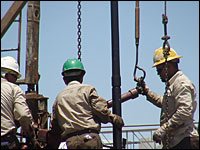
Oil industry: Fracking can’t harm groundwater. Really?

Whenever anyone asks if carcinogenic chemicals used in the gas-drilling process called hydrofracturing–or fracking–pose a risk to groundwater, the oil industry’s answer is always immediate and unequivocal.

No, the industry representative will tell you. There’s never been such as case.

Actually, it turns out there has been a documented case of fracking fluids contaminating a drinking well.

And there may be others hidden from public view by legal settlements.

The New York Times reports today that researchers have been unable to investigate “many suspected cases because their details were sealed from the public when energy companies settled lawsuits with landowners.”

“I still don’t understand why industry should be allowed to hide problems when public safety is at stake,” said Carla Greathouse, the author of the E.P.A. report that documents a case of drinking water contamination from fracking. “If it’s so safe, let the public review all the cases.”


Read the entire story at: One Tainted Water Well, and concern there may be more  


Tell us what you think in the comment box below.  If one isn’t visible, activate it by clicking on the tiny ‘comments’ link, also below
———————————————————————————————————————————-

Our most recent posts:
Wind energy proposal leaves NJ regulators guessing
Up next: Moving PA’s Marcellus Shale gas to market
Crucial tax credit bill introduced for offshore wind
Drink a beer – Save the planet 

Enviros sweating summer hearings on NJ’s Energy Plan 
 

———————————————————————————————————————————-

Like this post? You’ll love our daily newsletter, EnviroPolitics

Try it free for 30 days!  No obligation. Cancel anytime with one click.

Oil industry: Fracking can’t harm groundwater. Really? Read More »

Wind energy proposal leaves NJ regulators guessing


“Offshore wind developers yesterday presented a proposal to set up a mechanism for financing up to 1,100 megawatts of wind farms off the Jersey coast, but the proposal raised more questions than it answered among state regulatory official,”Tom Johnson writes in today’s NJ Spotlight.

“The proposal, a consensus mechanism agreed upon by several offshore wind developers, suggests a framework for how the New Jersey Board of Public Utilities (BPU) could award ratepayer-subsidized credits to the wind farms for the electricity they generate. That would guarantee the projects a steady stream of funding that should convince banks to invest in the clean energy technology.


“What the proposal failed to spell out, however, was any semblance of what these projects — priced at upward of $5 billion by some — would cost ratepayers, who ultimately will foot the bill, under bipartisan legislation signed into law by Gov. Chris Christie.”


Frustrated by Few Details

Johnson reports that the proposal seemed to leave the  BPU and Division of Rate Counsel officials frustrated,  particularly over lack of details of how precisely the developers’ proposal would work.


Click here to read the entire story.

___________________________________________________________________________

Get dozens of environmental, energy and political news stories every day for New Jersey, Pennsylvania, New York, Delaware–and beyond in EnviroPolitics.
Try it free for 30 days!  
___________________________________________________________________________

Our most recent posts: 
Up next: Moving PA’s Marcellus Shale gas to market 

Crucial tax credit bill introduced for offshore wind
Drink a beer – Save the planet  

Enviros sweating summer hearings on NJ’s Energy Plan  

Trying to stop raw sewage flow and it’s 103 degrees!

Wind energy proposal leaves NJ regulators guessing Read More »

Up next: Moving PA’s Marcellus Shale gas to market

Most of the public debate over natural gas extraction in the Marcellus Shale regions of Pennsylvania and New York so far has focused on hydrofracturing (fracking)–the technique used to extract the gas–and its potential impact on drinking water.

The debate is likely to widen in the the fall when legislators in Pennsylvania start to deal with the more than 90 recommendations in the final July 12, 2011 report of Gov. Tom Corbett’s Marcellus Shale Advisory Commission. That’s because the report not only addresses environmental and public health issues but also job training, market development, infrastructure and local impacts.

One of the areas likely to create environmental news headlines involves basic industry infrastructure, namely, the processing plants, compressor stations and pipelines needed to move the gas from the drilling wells to homes, schools and businesses across the northeast.

Focusing on pipelines

In a  recent Alert to its clients, the law firm of Saul Ewing focused on pipeline recommendations.  Attorney Elizabeth U. Witmer wrote the summary below.
____________________________________________________________________________

Elizabeth U. Witmer

Pennsylvania’s Governor Corbett created a Commission to look at issues surrounding Marcellus Shale development. The Commission’s report, issued July 22, 2011, includes a number of recommendations that could affect pipeline development, both intra-state and interstate, including:


1. A lead state agency should be designated to alleviate delays in linear pipeline project development and approval; to identify redundant natural and cultural resource reviews which should be eliminated; “to properly tailor scope of agency reviews”; and the PA Natural Resource Inventory on-line tool be expanded and used for projects greater than 15,000 feet.


2. State agencies should offer accelerated permit reviews with guaranteed time frames, with extra fees to be paid by applicant.


3. PennDOT should add language to Excess Maintenance Agreements directing industry to evaluate E&S controls already in place on affected roadways and to determine what should be in place before road reconstructed.


4. With regard to pipeline siting, a recommendation that legislative/regulatory changes be identified to:

·         Effect sharing of pipeline capacity and reduce surface disturbance;
·         Encourage the use of existing pipeline infrastructure and co-location with other rights of way;
·         Achieve “coordination and consistency” of infrastructure planning and siting state/county/local governments (there is also recognition, though, in numerous places, that the local governments still have zoning authority over oil and gas activities, so no blanket preemption is recommended); and
·         “provide sufficient authority and resources for appropriate government agencies to ensure that ecological and natural resource data are using in the review and siting of proposed pipelines, in order to avoid or minimize impacts to these resources.”

5. Future leasing of state forest land should be limited to agreements which result in no or minimal surface impact – this is directed more at drilling leases, but could result in more requests for drilling on state forest land for pipelines too.


6. “The Commonwealth should incentivize the development of intra-state natural gas pipelines to ensure the in-state use of Marcellus Shale and to lower costs to consumers through the avoidance of interstate pipeline transmission costs.”


7. State should work with the federal Pipeline and Hazardous Materials Safety Administration to locate a safety inspector facility in PA.


8. A specific recommendation that the PUC be given “statutory gas safety oversight of non-jurisdictional intra-state gathering systems, including mechanisms to establish safety standards regarding the design, construction and installation of such lines within Class 1 areas” but with language that the PUC’s jurisdiction should not extend beyond safety.


9. PUC regulated pipelines should report the country of origin and manufacture of any steel products to the PUC, to ensure the safety, integrity and use of high quality steel, such as steel which meets API standards.


The Commission itself cannot effect change, but these recommendations will influence legislative and regulatory changes in the near term.
_____________________________________________________________________________
    
Our most recent posts:  
Crucial tax credit bill introduced for offshore wind
Drink a beer – Save the planet 

Enviros sweating summer hearings on NJ’s Energy Plan 
Trying to stop raw sewage flow and it’s 103 degrees! 

PA-based PPL names William H. Spence as President 
Pennsylvania welcomes gas drillers to its parks and lakes
 
———————————————————————————————————————————-

Like this post? You’ll love our daily newsletter, EnviroPolitics

Try it free for 30 days!  No obligation. Cancel anytime with one click.

Up next: Moving PA’s Marcellus Shale gas to market Read More »

Crucial tax credit bill introduced for offshore wind

[UPDATE: Related story added on 7/31/2011 – See below]

Senators from Delaware and New Jersey are among the sponsors of legislation introduced last week  to extend tax credits for companies working to build wind energy farms off the nation’s northeast coast.

Senator Tom Carper, D-Delaware joined with Olympia Snowe, R-Maine on Thursday in introducing the Incentivizing Offshore Wind Power Act which would extend existing tax credits that are due to expire at the end of 2011.

The bill offers a 30 percent tax credit to companies that successfully produce offshore wind-generated electricity, up to the first 3,000 megawatts. The’s roughly equivalent to 600 wind turbines, according to Carper.

Co-sponsors include Senators Robert Menendez (D-NJ), Susan Collins (R-ME), Chris Coons (D-DE), Sheldon Whitehouse (D-RI), Sherrod Brown (D-OH) and Jack Reed (D-RI).

Wind energy advocates say that the bill incentivizes investment in offshore wind projects, while prioritizing those projects that are furthest along in the development process. By doing so, it creates tax certainty for the first movers in the budding domestic offshore wind industry. 

Although offshore wind is well established in Europe, the industry has struggled to gain federal financial assistance and environmental permits in the U.S. Despite those challenges, developers continue to pursue federal and state approvals for projects in coastal water off  Delaware, New Jersey, New York and Rhode Island.

Peter Mandelstam, president of NRG Bluewater Wind, which is planning a wind farm off the Delaware coast,  called the Carper-Snowe bill “exactly the kind of bold and visionary legislation that is required to get the offshore wind industry moving again.”

Mandelstam said the legislation “gives a clear signal to developers and their supply chain partners that these projects have long-term policy support, rather than short-term incentives.”


Related story: The week in Green Energy: Ill Winds Blow Offshore

———————————————————————————————————————————-

Our most recent posts:

Drink a beer – Save the planet

Enviros sweating summer hearings on NJ’s Energy Plan 
Trying to stop raw sewage flow and it’s 103 degrees! 

PA-based PPL names William H. Spence as President 
Pennsylvania welcomes gas drillers to its parks and lakes 

———————————————————————————————————————————-

Like this post? You’ll love our daily newsletter, EnviroPolitics
Try it free for 30 days!  No obligation. Cancel anytime with one click.

Crucial tax credit bill introduced for offshore wind Read More »

Drink a beer – Save the planet

Well, whadda ya know. Another reason to drink beer.

Yards Brewery, a fast growing beer maker located on the Delaware River in downtown Philadelphia, has decided to power all its operations with electricity generated from wind.

Yards is setting the new green standard for regional breweries by powering up with electricity bought from Washington Gas Energy Services, Inc. of Herndon, Va. The company says it will supply what it calls its “100% CleanStepsSM WindPower” to Yards, helping the brewery to do its part to reduce air pollution and greenhouse gas emissions.  

 “Our green power purchase just makes sense – it fulfills our business philosophy and falls in line with our community efforts to be more environmentally sustainable,” said Yards Owner and Founder Tom Kehoe.

That’s Tom below. Looks like a guy you’d like to have a beer with, doesn’t he? If you get the chance, ask him to tell you the story about how he got started.

Yo, Jersey. You Flying Fish guys gonna take this sitting down?

Hey Triumph in Jersey and Philly. You gonna belly up to the green bar or what!

[Fellow beer lovers (and even those who have not yet succumbed to its delights), tell us what you think in the comment box below. Don’t see one? Open it by clicking on the tiny ‘comments’ line, also below] 
———————————————————————————————————————————-

Our most recent posts:  

Enviros sweating summer hearings on NJ’s Energy Plan 
Trying to stop raw sewage flow and it’s 103 degrees! 

PA-based PPL names William H. Spence as President 
Pennsylvania welcomes gas drillers to its parks and lakes 
NPR’s ‘This American Life’ on fracking: Act 1 and 2 

———————————————————————————————————————————-

Like this post? You’ll love our daily newsletter, EnviroPolitics

Try it free for 30 days!  No obligation. Cancel anytime with one click. 


Drink a beer – Save the planet Read More »

Enviros sweating summer hearings on NJ’s Energy Plan

Q. Who schedules public hearings on a major issue like the state’s energy future in the middle of summer when everyone’s focused on vacation, travel and dealing with the heat?

A.  The New Jersey Board of Public Utilities, that’s who.

Q.  Weren’t the Energy Management Plan hearings supposed to happen months ago?

A.   Yes, but the release of the BPU’s draft plan was ‘delayed.’

Q.  Isn’t that a bit suspicious?

A.   Environmental organizations apparently think so. They already held one press conference at the Statehouse to draw attention to the issue and are planning another tomorrow before the first hearing gets under way in Newark.

Q.  Can we assume the environmentalists don’t like the proposal?

A.  Is the Pope Catholic? Are bears wandering through suburban NJ neighborhoods?

Q.  What is in the proposal?

A.  Read it for yourself with a single click:  2001 Draft Energy Master Plan.

Q.  Whoa!  That’s 128 pages long.  I was planning to take a Danielle Steel to read on the beach.

A.   You’ll find a seven-page summary starting on page 7.  Even The Situation should be able to handle that.

Q.  When are the hearing dates?

A.   July 26, August 3, August 11.  See our Enviro-Events Calendar for details.

Q.   Thanks.  By the way, who’s running the BPU these days?

A.   Lee Solomon, the guy interviewed below (starting at 4 minutes and 50 seconds)

Watch the full episode. See more NJToday.

Q.  Will Lee Solomon be at the hearings?

A.   Most likely.

Q.  Will The Situation be there?

A.  Sorry, it’s summer and Answer Man has left for the Jersey Shore. Please leave your questions or comments in the opinion box below. We’ll get back to you in the fall. Bye!

———————————————————————————————————————————-
Our most recent posts:  
Trying to stop raw sewage flow and it’s 103 degrees!
PA-based PPL names William H. Spence as President 
Pennsylvania welcomes gas drillers to its parks and lakes 
NPR’s ‘This American Life’ on fracking: Act 1 and 2 
Take EnviroPolitics for a two-week vacation 

————————————————————————————————————————————-

Like this post? You’ll love our daily newsletter, EnviroPolitics

Try it free for 30 days!  No obligation. Cancel anytime with one click.

Enviros sweating summer hearings on NJ’s Energy Plan Read More »