Is your business complying with stormwater rules?

If not, you could be in for an unpleasant surprise.
The law firm of Saul Ewing is alerting its clients and friends to a recently proposed consent decree between the federal Environmental Protection Agency (EPA) and Ryland,
one of the nation’s largest homebuilders. 
Under the proposal, Ryland would be required to establish and implement
a company-wide management, reporting and training program for stormwater compliance–in addition to
paying a $625,000 penalty–to resolve EPA enforcement actions under the Clean
Water Act.
Saul Ewing notes that the agreement goes beyond the current regulatory requirements and could become a template that the EPA or a state could seek to impose in future cases involving stormwater violations. 

For more, see Saul Ewing’s alert here


———————————————————————————————————————————-


Like this post? You’ll love our daily newsletter, EnviroPolitics
Try it free for 30 days!
  No obligation. Cancel anytime with one click


Is your business complying with stormwater rules? Read More »


EPA’s initial fracking study results due in late 2012

Critics of hydraulic fracturing (or hydrofracturing or fracking), the drilling technique that uses millions of gallons of water, sand and chemicals to blast natural gas out of deeply buried deposits of rock shale, have argued that regulators in New York, Pennsylvania and elsewhere should slow down their approval process and wait for the results of a comprehensive EPA study.

In New York, environmental officials have paid some heed to those critics as the state has conducted its own review of natural gas drilling. In Pennsylvania, where Gov. Tom Corbett was elected with the help of hefty financial contributions from the drilling industry, enviro regulators have barely tapped the brakes.

Regardless, the federal study is ongoing. Yesterday, the EPA announced that the public would get to see preliminary study results by the end of 2012 and final results in 2014.     

The overall purpose of the study, the EPA says,  is to understand the relationship
between hydraulic fracturing and drinking water resources. 

“The scope of
the research includes the full lifespan of water in hydraulic
fracturing, from acquisition of the water, through the mixing of
chemicals and actual fracturing, to the post-fracturing stage, including
the management of flowback and produced water and its ultimate
treatment and disposal.”

So far, the agency says it has:

  • Conducted an initial literature review
  • Requested and received
    information from industry on chemicals and practices used in hydraulic
    fracturing 
  • Discussed initial plans for case studies with landowners and
    state, local and industry representatives.
  • Conducted baseline
    sampling for retrospective case studies using scientifically sound
    approaches that have been shared with collaborators.

EPA estimates that gas shale production will produce more than 20 percent of the total US gas supply by 2020.

The agency offers the following information on hydraulic fracturing. 

Related media coverage:


———————————————————————————————————————————-


Like this post? You’ll love our daily newsletter, EnviroPolitics Try it free for 30 days!  No obligation. Cancel anytime with one click


EPA’s initial fracking study results due in late 2012 Read More »

Top 2 Environmental Stories in PA & NJ – Nov 3 2011

Business, government and environmental leaders who subscribe to EnviroPolitics
were able to access full versions of the stories below in today’s edition–and dozens more:


In Pennsylvania


Top
Democrat finds shale fee bill “weak”
PA House
Republicans on Wednesday voted a measure out of committee that would impose a
local impact fee on natural gas drilling and establish new state regulations on
the growing industry. Rep. Phyllis Mundy of Luzerne County, the committee’s
ranking Democrat, was not impressed
AP   Pittsburgh
Tribune


DEP secretary calls Marcellus Shale ‘a
blessing under our feet’
The
state’s top environmental enforcement official
said some of the concerns raised about hydraulic fracturing and gas drilling in
the Marcellus Shale leave him shaking his head Erie-Times


In New Jersey

North Jersey hospitals seeing rush of
patients
The freak October snowstorm and the long, cold days without power and heat
that followed have sent scores of injured or sick residents to hospitals The
Record

> Most customers to have power by
midnight
Star-Ledger
> Di Ionno: Trees chopped, power slowly
restored
S-L


Despite
fears of a crash, solar sector remains hot
State fields 700 installation applications a month, even as solar
certificates lose half their value NJ Spotlight


Click here to see
today’s entire issue–and to get EnviroPolitics for an entire month
without charge or obligation 

Top 2 Environmental Stories in PA & NJ – Nov 3 2011 Read More »

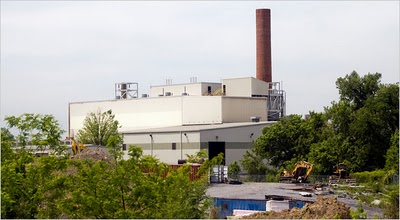
Incinerator burns through more than Harrisburg’s waste

The waste incinerator in Pennsylvania’s capitol has burned through more than
just garbage over the past four decades. It´s also burned through money, the
patience of residents and now the city´s solvency.

Earlier this month, Harrisburg became the first state capital in memory
— perhaps in history — to declare bankruptcy, thanks to the $310
million debt that hangs over the Harrisburg Resource Recovery Facility.

The incinerator has been a money pit in Harrisburg since it was built in
1972, with the biggest chunk of investment coming when the city spent
$125 million to rebuild the facility in 2003.

Finally, on Oct. 12, with $65 million of its debt due, the City Council
voted to declare Chapter 9 bankruptcy instead of adopting a recovery
plan developed by the state and Mayor Linda Thompson.

The decision has touched off a legal battle. The mayor refused to sign
the declaration, calling it illegal, and a week later, the state enacted
a takeover of the city´s finances. Gov. Tom Corbett is now able to
declare a state of fiscal emergency and take money management
responsibilities from the city. Under the law, the governor also can
appoint a receiver to lead the fiscal recovery.

For the full story, see: WTE plant helps to bankrupt Harrisburg, Pa.
Photo credit: Jessica Kourkounis for the New York Times


———————————————————————————————————————————-

Like this post? You’ll love our daily newsletter, EnviroPolitics
Try it free for 30 days!  No obligation. Cancel anytime with one click

Incinerator burns through more than Harrisburg’s waste Read More »

Top Two Environmental Stories- NJ & PA – Nov. 2, 2011

Business, government and environmental leaders who subscribe to EnviroPolitics
were able to access full versions of the stories below in today’s edition–and dozens more:

In Pennsylvania


Pa.
House panel approves shale impact fee bill
Pennsylvania
House Republicans on Wednesday released a bill from committee that would impose
a local impact fee on natural gas drilling and establish new state regulations
on the growing industry Inquirer
Post-Gazette

Exelon-Constellation merger
could leave up to 600 redundant positions
Exelon President and Chief Operating Officer
Christopher Crane and Constellation CEO Mayo Shattuck are taking the stand
together for the third day before the Public Service Commission in Baltimore,
fielding questions about estimates that the $7.9 billion takeover by Exelon AP

In New Jersey


Christie to allow some privatization in state parks Governor Christie is announcing a long-term funding strategy for New Jersey’s parks that includes leasing golf courses, privatizing concessions and allowing solar installations but keeps state park land under state control AP 

Accelerating the move to alternatively fueled vehicles A Board of Public Utilities working group suggests ramping up state efforts to develop refueling stations for electric cars and trucks NJ Spotlight

Click here to see
today’s entire issue–and to get EnviroPolitics for an entire month without charge or obligation 

Top Two Environmental Stories- NJ & PA – Nov. 2, 2011 Read More »

Today’s top two environmental news stories in NJ & PA

Business, government and environmental leaders who subscribe to EnviroPolitics
were able to access full versions of the stories below in today’s edition–and dozens more:


In Pennsylvania


Legislature
struggles with drilling fees 
The two state legislative chambers are
reversing roles on Marcellus Shale regulations, with an impact fee from the
House GOP gaining steam and the Senate delaying a vote on its levy proposal
until mid-November Post-Gazette

DEP: No damage from drilling water spill
The state
Department of Environmental Protection says there’s no immediate evidence of
environmental damage from 16,800 gallons of recycled water that spilled near a
natural gas well site in southwestern Pennsylvania. A spokesman for Range
Resources which owns the Washington County well, says the spill is nonetheless
“unacceptable” Times Leader Post-Gazette


 In New Jersey


Environmental agency endorses economic
growth plan
The state DEP is wasting little time endorsing the objectives
of a draft blueprint proposed by the Christie administration for targeting economic
growth NJ Spotlight

Dioxin cleanup begins on Passaic River
A floating barge festooned with construction equipment was moored on the
lower Passaic River in Newark on
Monday — the most visible sign that work has begun to remove dioxin-laced
sediment along one of the most polluted waterways in the country The
Record

Today’s top two environmental news stories in NJ & PA Read More »