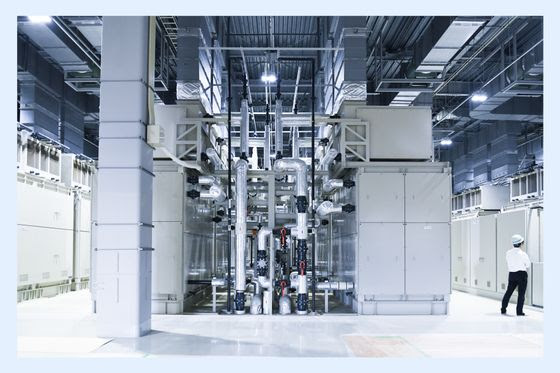
Maybe it’s because I’d been listening to classic rock on the car radio, but my first thought when I saw all those gleaming silver rectangles was a Beatles song: “Here Comes the Sun.”
If you liked this post, you’ll love our daily environmental newsletter, EnviroPolitics.It’s packed daily with the latest news, commentary, and legislative updates from New Jersey, Pennsylvania, New York, Delaware…and beyond. Please do not take our word for it, try it free for an entire month. No obligation.
Governor Phil Murphy signed the new $56.6 billion state budget for New Jersey, which includes a significant tax increase on large corporations and substantial funding for property tax relief, public schools, pensions, and community projects.
Key Takeaways:
The budget introduces a 2.5% tax on large companies to fund NJ Transit, making New Jersey’s business taxes the highest in the nation.
Substantial rebates will be available to homeowners and renters through the ANCHOR program, and seniors can look forward to the StayNJ property tax cut.
The budget allocates significant funds to public schools, community colleges, nursing homes, and various local projects, ensuring support for education and community needs
New Jersey’s $56.6 Billion State Budget
New Jersey Governor Phil Murphy signed a $56.6 billion spending plan that includes a significant tax hike on the state’s largest corporations to fund public transportation.
Starting July 1, the new 2.5% tax will apply to corporations with over $10 million in profits, adding to the existing 9% corporate business tax rate.
This move aims to generate revenue to support NJ Transit, which faces a nearly billion-dollar funding gap.
New Tax on Large Corporations to Fund Public Transportation
One of this budget’s most closely watched aspects is the new 2.5% tax on corporations with profits over $10 million.
This tax is in addition to the state’s existing 9% corporate business tax rate, making New Jersey the state with the highest business taxes in the nation.
The revenue from this tax will help fund NJ Transit, which faces a nearly billion-dollar funding gap.
If you liked this post, you’ll love our daily environmental newsletter, EnviroPolitics.It’s packed daily with the latest news, commentary, and legislative updates from New Jersey, Pennsylvania, New York, Delaware…and beyond. Please do not take our word for it, try it free for an entire month. No obligation.
On May 30, 2024, Vermont Governor Philip Scott allowed S.259, An act relating to climate change cost recovery, to become law without his signature. S. 259, entitled the Climate Superfund Act, will require the development of claims to shift the cost of alleged climate-related impacts in Vermont onto the companies that produced fossil fuels responsible for greenhouse gas (GHG) emissions.
This bill is the first of its kind to become law in the United States, and similar legislation is pending in Massachusetts, New York, and Maryland. Borrowing some concepts from the Comprehensive Environmental Response, Compensation, and Liability Act of 1980 (CERCLA), or Superfund, which imposes strict liability for cleanup of contaminated sites on potentially responsible parties, this Act seeks to assign financial liability for climate-related impacts on the companies that extracted and refined petroleum products and other fossil fuels. Like CERCLA, the Act imposes retroactive liability on entities having conducted lawful business activities in the past.
Vermont’s Act establishes a Climate Superfund Cost Recovery Program to be administered by the Climate Action Office of the Agency of Natural Resources. The Vermont Treasurer will be required to assess the cost of GHG emissions to the state and its residents during the period January 1, 1995 through December 31, 2024. The Agency of Natural Resources will apportion liability and make cost recovery demands to “Responsible Parties,” those entities engaged in the trade or business of extracting fossil fuel or refining crude oil responsible for more than one billion metric tons of covered greenhouse gas emissions during the covered period.
Funds received from these companies will be deposited in the Climate Superfund Cost Recovery Program Fund and used for climate change adaptation projects. A Responsible Party’s first payment would be due six months after the cost recovery demand is made and should be at least 20% of the total demand. Subsequent payments of not less than 10% of the total demand would be due annually thereafter until the entire demand is received.
If you liked this post, you’ll love our daily environmental newsletter, EnviroPolitics.It’s packed daily with the latest news, commentary, and legislative updates from New Jersey, Pennsylvania, New York, Delaware…and beyond. Please do not take our word for it, try it free for an entire month. No obligation.
Scientists have mapped one of the most hazardous spots on the globe in unprecedented detail: a 600-mile geologic boundary just off the Pacific Northwest coast.
Brian Agee deploys the streamer, a 9-mile-long cable embedded with specialized microphones, from the research vessel Marcus G. Langseth in summer of 2021. The craft is trying to map the Cascadia subduction zone off the coast of the Pacific Northwest. (Madeleine Lucas/University of Washington )
Scientists have mapped one of the most hazardous spots on the globe in unprecedented detail: a 600-mile geologic boundary just off the Pacific Northwest coast.
Along this fraught stretch, called the Cascadia subduction zone, two pieces of the Earth’s crust slide against each other, building up stresses capable of unleashing a catastrophic 9.0-magnitude earthquake and generating a tsunami, with waves as high as 40 feet.
Because scientists don’t know when that day will arrive, they prepare by trying to better understand the geological state of play.
The Marcus G. Langseth, a 235-foot research vessel equipped to conduct seismic research. (Harold Tobin/University of Washington )
To do that, a 235-foot ship cruised for 41 days along the coast of Oregon, Washington and British Columbia in summer of 2021, sending sound waves deep into the ocean and recording the echoes with a “streamer” — a 9-mile-long waterproof cable containing 1,200 specialized microphones. Similar to how doctors use ultrasound to see inside the body, they used the data to construct a comprehensive map of the underwater geology in a study published Friday in the journal Science Advances. The new resource will help scientists understand the range of earthquake and tsunami scenarios — and help policymakers devise building codes that protect people.
Because scientists don’t know when that day will arrive, they prepare by trying to better understand the geological state of play.
The entire area, which stretches from Northern California to Vancouver Island, is at risk. But the scientists found that the geometry of the fault
off the coast of Washington, where the fault is flat and smooth, closer to the surface and extends farther onshore, may be particularly at risk.
“I’m excited to use these results to make sure the shaking estimates I’m producing are as accurate as they can be,” said Erin Wirth, a seismologist with the United States Geological Survey who was not involved in the study. “I’ll be busy now.”
If you liked this post, you’ll love our daily environmental newsletter, EnviroPolitics.It’s packed daily with the latest news, commentary, and legislative updates from New Jersey, Pennsylvania, New York, Delaware…and beyond. Please do not take our word for it, try it free for an entire month. No obligation.
Donald Trump took aim at offshore wind during a rally in New Jersey. Photo: Getty Images
ByTim Ferry, US Offshore Wind Editor, RechargeUpdated 3 July 2024
President Joe Biden’s administration issued its ninth record of decision (ROD) for a US offshore wind project with the greenlighting of Shell-EDF’s mammoth 3GW Atlantic Shores array facing New Jersey – a project rival Donald Trump has vowed to stop if he is elected.
Trump took aim at Atlantic Shores during a rally in the state in May, when he referenced the specific number of turbines planned for the project and said: “You won’t have to worry about governor [Phil] Murphy’s 157 windmills” before promising to end offshore wind “on day one” of a new term.
The former and would-be future president has been openly hostile to wind power during his latest campaign, issuing a series of threats to the sector in public and private.
The ROD covers two projects in the same lease 8.7 miles (14 km) off New Jersey collectively referred to as the Atlantic Shores South, but only the 1.5GW Atlantic Shores 1 project has an offtake contract with the state.
The ROD concludes the environmental review by offshore energy regulator Bureau of Ocean Energy Management (BOEM) and its partner agencies and sets the project up for approval of its construction and operations plan (COP), which would then allow the developers to begin at-sea installation.
“The Biden-Harris administration is building momentum every day for our clean energy future, and today’s milestone is yet another step toward our ambitious goal of deploying 30GW of offshore energy by 2030,” said Interior Secretary Deb Haaland.
The news follows on the heels of BOEM’s COP approval Monday for Avangrid’s 2.6GW New England array currently bid into the tri-state procurement round of Connecticut, Massachusetts, and Rhode Island.
With today’s approval, BOEM under the Department of Interior (DOI) has approved more than 13GW of offshore wind capacity, enough to power nearly five million homes.
If you liked this post, you’ll love our daily environmental newsletter, EnviroPolitics.It’s packed daily with the latest news, commentary, and legislative updates from New Jersey, Pennsylvania, New York, Delaware…and beyond. Please do not take our word for it, try it free for an entire month. No obligation.