If you like this post, you’ll love our daily environmental newsletter, EnviroPolitics.It’s packed daily with the latest news, commentary, and legislative updates from New Jersey, Pennsylvania, New York, Delaware…and beyond. Please do not take our word for it, try it free for a full month.
The N.S. Savannah, the first nuclear-powered merchant ship, was built in the late 1950s. It was deactivated in 1971 and is now docked Pier 13 of the Canton Marine Terminal. (Jerry Jackson/Staff)
You, too, might be able to own a 596-foot-long, nuclear-powered floating time capsule that has been visited by a million and a half people, features a ballroom, bar and swimming pool, and once was a star attraction on Johnny Carson’s “Tonight” show.
The Nuclear Ship (N.S.) Savannah — the first nuclear-powered ship ever built explicitly for peacetime purposes — has been moored in a quiet corner of the Canton Marine Terminal in Baltimore since 2008.
Constructed at the height of the Cold War as part of a government program aimed at demonstrating the nondestructive uses of nuclear power, the sleek 21,800-ton vessel achieved just that for nearly a decade, logging nearly half a million nautical miles and visiting 45 countries.
But the Savannah’s life in Baltimore could soon be coming to an end. The agency that owns and operates it — the U.S. Maritime Administration, or MARAD, a division of the federal transportation department — is nearing the end of the lengthy and complicated process of nuclear decommissioning, or removing enough vestiges of its nuclear capabilities to satisfy the U.S. Nuclear Regulatory Commission.
Erhard W. Koehler, senior technical advisor for the Savannah, says that doesn’t mean some otherwise bored billionaire can write a check and have it towed home for his or her own amusement.
But it does mean MARAD has made it known that it’s willing to donate the formerly nuclear-driven merchant ship to a science or history museum as a potential educational enterprise, to a state or municipality as a historic attraction, or to another entity for commercial or other use.
If you like this post, you’ll love our daily environmental newsletter, EnviroPolitics.It’s packed daily with the latest news, commentary, and legislative updates from New Jersey, Pennsylvania, New York, Delaware…and beyond. Please do not take our word for it, try it free for a full month.
William J. Pascrell, Jr., a beloved, old-school New Jersey politician who spent 28 years in the U.S. House of Representatives as a scrappy, impassioned advocate for his constituents, a proud liberal, a beacon of integrity, a ferocious advocate of tax fairness, and a fierce critic of former President Donald Trump and Ticketmaster, died today after a month-long illness. He was 87.
A former high school history teacher who could spend hours talking about the Declaration of Independence and the Constitution – and frequently did – Pascrell had a genuine love of democracy, delighted in finding ways for government to help the people, and steadfastly supported organized labor. Perhaps the only things he loved more than politics were his family, baseball, and the city where he lived his entire life, Paterson.
“As our United States Representative, Bill fought to his last breath to return to the job he cherished and to the people he loved,” Pascrell’s family said in a short statement on social media. “Bill lived his entire life in Paterson and had an unwavering love for the city he grew up in and served. He is now at peace after a lifetime devoted to our great nation America.”
A self-proclaimed late bloomer, the U.S. Army veteran and grandson of Italian immigrants was 50 when first elected to the New Jersey State Assembly in 1987, 53 when he became mayor of Paterson in 1990, and 59 when he narrowly defeated freshman Rep. Bill Martini (R-Clifton) in 1996. He was the second-oldest member of the House, and would have become the oldest had he been re-elected this year.
During his nearly three decades as a congressman, Pascrell led a successful mission to designate Paterson’s Great Falls as a component of the National Park System, sponsored the Alternatives to Opioids section of the 2018 Emergency Department Act to fight the epidemic, sponsored the Bring Jobs Home Act to boost the creation of domestic jobs, and was the lead sponsor of a bill to bring the State and Local Tax Deduction (SALT) back.
If you like this post, you’ll love our daily environmental newsletter, EnviroPolitics.It’s packed daily with the latest news, commentary, and legislative updates from New Jersey, Pennsylvania, New York, Delaware…and beyond. Please do not take our word for it, try it free for a full month.
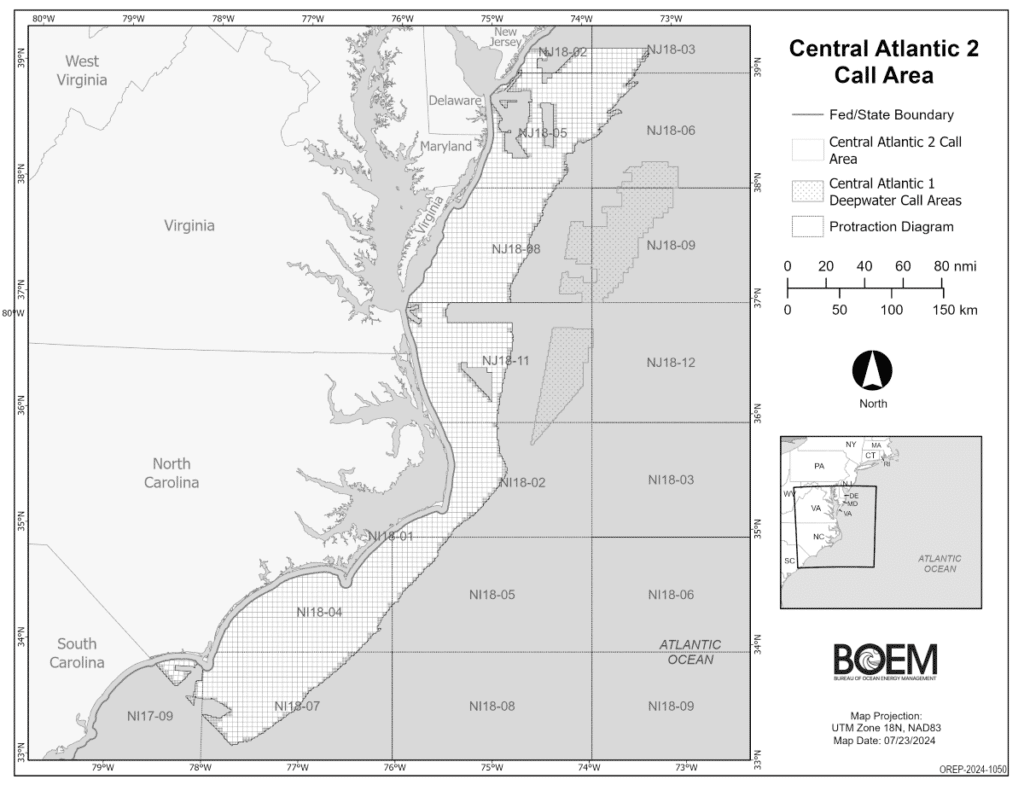
The federal Bureau of Ocean Energy Management (BOEM) today announced that it will publish a Call for Information and Nominations (Call) for a second regional offshore wind energy sale in the Central Atlantic (Central Atlantic 2). This Call invites public feedback on possible commercial wind energy development in areas off the coasts of New Jersey, Delaware, Maryland, Virginia, and North Carolina.
“Today’s announcement kicks off the process for a second potential auction in the Central Atlantic and provides an important avenue to solicit information as we identify potential areas that may be suitable for future offshore wind energy leasing,” said BOEM Director Elizabeth Klein.
The second Central Atlantic Call represents one of the first steps in the leasing process. Today’s announcement builds upon the input and planning that led to the first Central Atlantic lease sale on August 14, 2024, the fifth offshore wind lease sale held during the Biden-Harris administration.
BOEM will publish the Commercial Leasing for Wind Power Development on the Central Atlantic Outer Continental Shelf (OCS) – Central Atlantic 2 – Call for Information and Nominations in the Federal Register on August 22, 2024, which will initiate a 60-day public comment period. BOEM will accept nominations and comments through 11:59 p.m. Eastern Time on October 21, 2024. BOEM will also host several virtual and in-person public meetings in September and October, including a virtual Task Force meeting via Zoom on September 10-11, 2024. To find out more information and to register, go to: https://www.boem.gov/renewable-energy/state-activities/central-atlantic-2-public-meetings.
After the public comment period closes, BOEM will review and analyze commercial nominations and public comments submitted in response to the Call. BOEM will also consider information from Tribal consultations and the Central Atlantic Intergovernmental Renewable Energy Task Force to further evaluate the appropriateness of the Call Area for offshore wind energy development and identify draft wind energy areas (WEAs). BOEM will conduct environmental reviews of the WEAs in consultation with the appropriate federal agencies, Tribes, state and local governments, and key stakeholders. After completing its environmental reviews and consultations, BOEM may propose a competitive lease sale for areas within the WEAs.
If you like this post, you’ll love our daily environmental newsletter, EnviroPolitics.It’s packed daily with the latest news, commentary, and legislative updates from New Jersey, Pennsylvania, New York, Delaware…and beyond. Please do not take our word for it, try it free for a full month.
The Bureau of Ocean Energy Management (BOEM) has executed the first U.S. floating offshore wind energy research lease, covering nearly 15,000 acres off the coast of Maine.
The groundbreaking lease is situated 28 nautical miles off the coast of Maine on the U.S. Outer Continental Shelf and is poised to host up to 12 floating offshore wind turbines, with a potential to generate 144 megawatts of renewable energy.
The research initiative, a collaboration between the State of Maine, the fishing community, wildlife experts, and the offshore wind industry, aims to study the potential of floating offshore wind energy, its environmental impacts, and its compatibility with existing ocean uses.
“Floating wind opens up opportunities to produce renewable energy in deeper water farther offshore,” said BOEM Director Elizabeth Klein.
Maine Governor Janet Mills touted offshore winds as offering a historic opportunity for Maine to create good-paying jobs, reduce reliance on fossil fuels, and fight climate change by cutting greenhouse gas emissions.
If you like this post, you’ll love our daily environmental newsletter, EnviroPolitics.It’s packed daily with the latest news, commentary, and legislative updates from New Jersey, Pennsylvania, New York, Delaware…and beyond. Please do not take our word for it, try it free for a full month.