
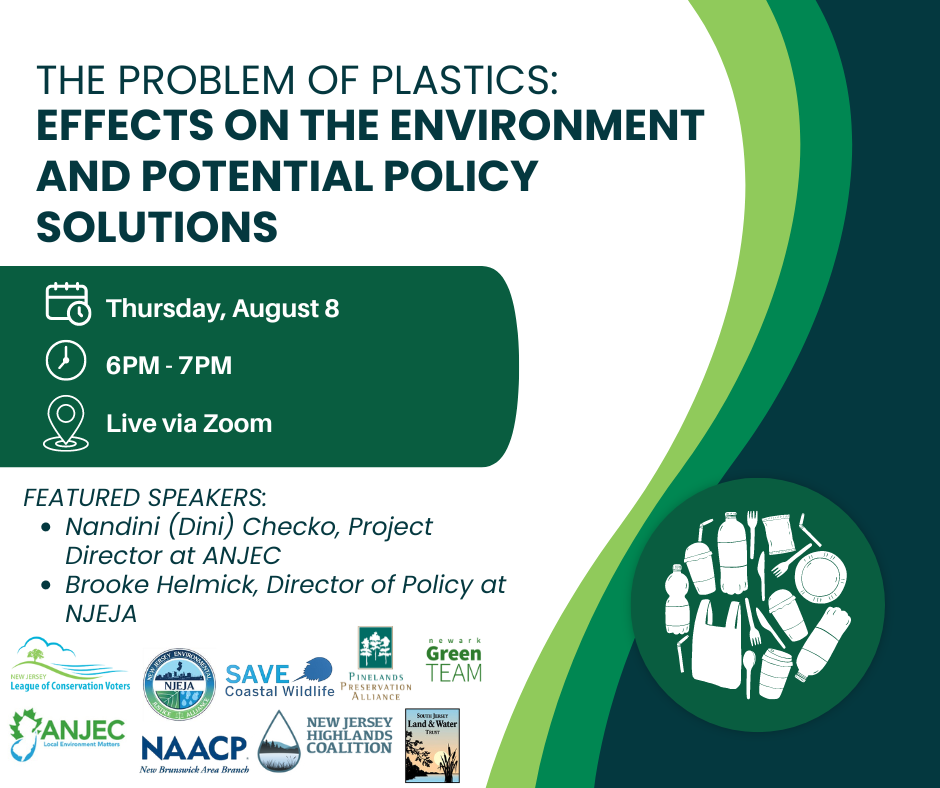
The problem with plastics webinar, August 8
| REGISTER NOW! |
The problem with plastics webinar, August 8 Read More »
| REGISTER NOW! |
The problem with plastics webinar, August 8 Read More »

Walmart and Reynolds Consumer Products have agreed to stop selling certain plastic bags in Minnesota for two and a half years, after the state’s attorney general, Keith Ellison, argued in court that the companies had falsely marketed them as recyclable.
If you like this post, you’ll love our daily environmental newsletter, EnviroPolitics. It’s packed daily with the latest news, commentary, and legislative updates from New Jersey, Pennsylvania, New York, Delaware…and beyond. Please do not take our word for it, try it free for a full month.
Minnesota settles lawsuit over deceptive ‘Recycling’ bags Read More »
By Frank Brill, EnviroPolitics Blog Editor
Sunbathing and refreshing dips in the Atlantic Ocean–plus a flock of recreational diversions–keep vacationers and investors flocking to the Jersey shore year after year. But as sure as a great vacation often awaits, so, too, do hurricanes and coastal storms that wreck havoc on homes and businesses and mandate expensive beach restorations.
For an idyllic week or two ‘at the shore,’ it’s a risk that vacationers take, year after year,
Now, the state wants to impose restrictions designed to curb seasonal damage by limiting where new construction can be located and how high it must be above predicted flood levels.
Business lobbyist Ray Cantor warns that the rules constitute a ‘retreat from the shore’ that will kill New Jersey’s golden tourism goose. Others say it’s just common sense, especially in the face of the undeniable threat posed by climate change.
The battle for public support pivots on our memories, weather, and photos. The developers’ warnings are more convincing when the sun shines.

When storms swallow up beach properties and destroy infrastructure their lament is less convincing.

The first in three public hearings scheduled on the rules–and the only one planned to be held in person– is set for 6 p.m. Sept. 5 at Ocean County College in Toms River. There are two are virtual hearings planned at 2 p.m. Sept. 12 and 10 a.m. Sept. 19.
Related shore regulation stories:
Proposed DEP rules spark debate at legislative hearing (NJ Spotlight)
Protecting against floods or government-mandated retreat (Associated Press)
New rules that would increase building elevations at the shore (Breaking AC)
Public hearing dates announced on proposed flood rules (AC Press)
If you liked this post, you’ll love our daily environmental newsletter, EnviroPolitics. It’s packed daily with the latest news, commentary, and legislative updates from New Jersey, Pennsylvania, New York, Delaware…and beyond. Please do not take our word for it, try it free for an entire month. No obligation.
Support for new shore building pivots on photos: idyllic vs. realistic Read More »
By Mike Hayes, Gothamist
A New Jersey developer is mysteriously walking away from a proposal to build more than 2 million square feet of warehouses in Roxbury, New Jersey after more than two years of negotiations with the township.
Thomas Germinario, an attorney for the township’s planning board, confirmed to Gothamist that the company, Hartz Mountain, withdrew its application to build the warehouses at the former home of Hercules LLC, a powder explosives company that has not operated at the site since the 1990s.
If you like this post, you’ll love our daily environmental newsletter, EnviroPolitics. It’s packed daily with the latest news, commentary, and legislative updates from New Jersey, Pennsylvania, New York, Delaware…and beyond. Please do not take our word for it, try it free for a full month.
Germinario said that the real estate development firm did not give a reason for withdrawing from the project, which was expected to generate 1,200 construction jobs and an additional 1,200 jobs once the warehouses were completed.
The abandoned plan is the latest in the ongoing saga to bring jobs and tax revenue to the suburban township, where the 990-acre property — the largest current parcel of available developable land in Morris County — has been empty for more than two decades. But local officials have questioned whether the township’s infrastructure could handle the tractor-trailer traffic associated with a massive set of five warehouses. Meanwhile, concerns loom about the environmental effects of building on the site, which has a history of chemical contamination.
Related: Why the Roxbury Township warehouse bid blew up Daily Record
The Roxbury project’s setback reflects the conflict that New Jersey, like other states with vibrant port economies, faces around rapid warehouse growth. On one hand, the development of more warehouses in New Jersey reflects a boom in the economy to meet the needs spurred by the expansion of online sales. However, some — including Gov. Phil Murphy — say the state must consider curtailing warehouse development to help save the environment.
Don’t let this opportunity pass you by – reserve your spot for Thursday, August 8 at 6PM today by registering for the webinar now! |
Let us promote your upcoming event. Send details to editor@enviropolitics.com Include a phone number in case we have questions.
EnviroPolitics Events Calendar Read More »
Florham Park, NJ — Matrix New World Engineering (Matrix) is pleased to announce Stephen Famularo, PE, BC.PE, has joined the firm as the Marine and Coastal Practice Lead.
Steve is a professional engineer, commercial diver, and board-certified port engineer with nearly three decades of experience in marine and coastal engineering throughout the United States and Caribbean. His expertise includes underwater inspection and rehabilitation of marine structures, asset management system design, coastal engineering, climate resiliency planning and structural/geotechnical design of piers, wharves, bulkheads, and floating structures.
He has led over $500 Million in waterfront construction and rehabilitation as both the Project Manager and Engineer-of-Record. Some of these prestigious waterfront projects include design of two new homeport facilities for NYC’s ferry system, the design-build construction of Terminal 5 at the Port of Davisville in Rhode Island, and field mapping and development of a web-based asset management system for NYC’s waterfront infrastructure.
According to Jayne Warne, PE, Matrix President, “We are happy to welcome Steve to the firm. His expertise and knowledge are wide-ranging and will help Matrix and its True Environmental platform partners continue to deliver exceptional service to our clients.”
Steve has been tasked with developing and expanding Matrix and True Environmental’s, Marine Survey and Inspection Business Line. “Steve is the perfect person for this endeavor,” said Dennis Petrocelli, SVP of Matrix. “He has vast experience and expertise in building this type of service line, which will only bolster Matrix’s extensive offerings.”
Steve has extensive expertise in project and quality management, business development, line management, and strategic planning. In addition, he has managed on-call agreements for the New York City Economic Development Corporation (NYCEDC), the Port Authority of New York and New Jersey (PANYNJ), the New York City Department of Transportation (NYC DOT) Ferries Division, and the United States Army Corps of Engineers (USACE).
Steve is a member of the Moles, a fraternal organization of the heavy construction industry and the chair of the NYC Department of Buildings Waterfront Code Development Geotechnical, Coastal, and Structural Design Technical Committee. He is licensed as a Professional Engineer in 7 states, an ADCI Surface-Supplied Air Diver, Waterfront Edge Design Guidelines Associate, and Envision Sustainability Provider through the Institute for Sustainable Infrastructure.
Steve graduated Magna Cum Laude from Manhattan College with a B.S. in Civil Engineering and earned his M.S. in Coastal Engineering from the University of California-Berkeley.
If you liked this post, you’ll love our daily environmental newsletter, EnviroPolitics. It’s packed daily with the latest news, commentary, and legislative updates from New Jersey, Pennsylvania, New York, Delaware…and beyond. Please do not take our word for it, try it free for an entire month. No obligation.
Matrix adds Marine and Coastal Practice Lead Read More »