
Show your support for New Jersey wildlife
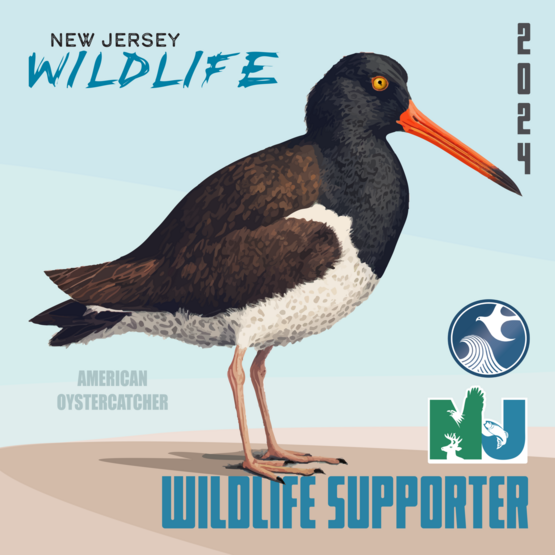
Show your support for New Jersey wildlife Read More »
April 2024 saw trillions of periodical insects begin their descent on the midwest and southeast of the United States. They caused so much noise that local residents called the police to complain.
These insects are called cicadas. Two broods of cicadas, Brood XIX and Brood XIII — which come out every 13 years and 17 years respectively, are emerging at the same time for the first time in 200 years
If you liked this video, you’ll love our daily environmental newsletter, EnviroPolitics. It’s packed daily with the latest news, commentary, and legislative updates from New Jersey, Pennsylvania, New York, Delaware…and beyond. Please do not take our word for it, try it free for an entire month. No obligation.
Two broods of cicadas will have you wearing ear plugs to bed: video Read More »
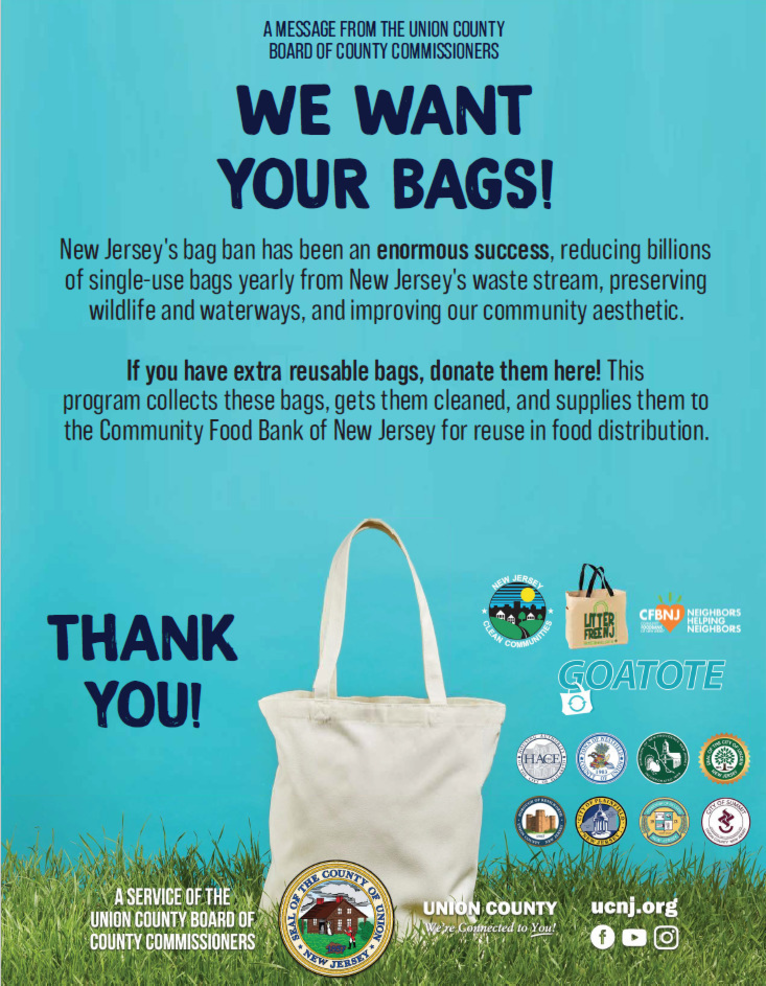
Union County, NJ has announced the expansion of its reusable bag recycling program, aimed at addressing the surplus of reusable bags.
With the implementation of New Jersey’s Get Past Plastic law, which prohibits businesses from providing single-use plastic bags, many individuals have transitioned to using reusable bags. However, some people occasionally forget to bring their reusable bags to stores, resulting in the purchase of additional bags. Over time, this has led to an accumulation of excess reusable bags in households. Furthermore, grocery delivery services often provide customers with reusable bags, contributing to the surplus, a county news release notes.
“With Union County residents at the heart of this initiative, we are transforming excess into opportunity, creating a sustainable cycle that benefits both our environment and our community,” said Commissioner Chairwoman Kimberly Palmieri-Molded. “This program not only tackles waste but also represents unity and responsibility, showcasing the power of collective action for a greener, brighter future. Thank you to all of those who are involved in making this initiative possible.”
Residents from any municipality in Union County can bring their gently-used reusable bags to any of the participating locations. GOATote, Inc. will collect the bags, thoroughly clean and sanitize them, and deliver them to the Community Food Bank of New Jersey in Hillside. From there, the bags will be distributed to local Food Pantries in need.
Click for participating locations
If you liked this post, you’ll love our daily environmental newsletter, EnviroPolitics. It’s packed daily with the latest news, commentary, and legislative updates from New Jersey, Pennsylvania, New York, Delaware…and beyond. Please do not take our word for it, try it free for an entire month. No obligation.
Union County, NJ has a plan for your reusable grocery bags Read More »

By Jon Hurdle, Delaware Public Media
More than a decade after Delaware first considered buying some of its electricity from future wind farms off the coast, it finally has a bill that would set it on a path to do so.
The Delaware Energy Solutions Act of 2024 was introduced in the General Assembly on April 18, and supporters say they’re cautiously optimistic that lawmakers will pass the measure in the approximately 10 weeks that remain in the current legislative session.
The bill would instruct the state, on its own or with other states, to seek bids from offshore wind developers to supply power to Delaware; draw power from a project generating 800-1,200 megawatts – enough to power at least a third of Delaware’s electricity needs; pay no more than 110 percent of the average electricity price that consumers have been paying for electricity over the last three years, and invite bidders to include the benefits of their project for climate, the economy and public health.
The plan would also allow a developer to raise its costs by 2 percent a year to allow for inflation, a provision designed to avoid the disruption and even cancellation of some offshore wind projects in other states over the past year. Denmark’s Orsted, a leading wind developer, cancelled two planned wind farms off New Jersey last year, saying that inflation and supply-chain problems meant the projects were no longer economic at the price negotiated with the state.
If you liked this post, you’ll love our daily environmental newsletter, EnviroPolitics. It’s packed daily with the latest news, commentary, and legislative updates from New Jersey, Pennsylvania, New York, Delaware…and beyond. Please do not take our word for it, try it free for an entire month. No obligation.
Delaware taking a fresh look at offshore wind energy Read More »

Author: Daniel T. McKillop, Scarinci Hollenbeck law firm
A resolution currently being debated in the New Jersey Legislature would allow voters to determine whether environmental rights should be enshrined in the State Constitution. Senate Resolution 43/Assembly Resolution 119 specifically asks voters to decide whether the New Jersey Constitution should be amended to make the State the trustee of public natural resources and guarantee citizens the right to a clean and healthy environment.
The so-called New Jersey Green Amendment was first proposed in 2017 but has previously failed to gain enough traction to come before voters. Earlier this year, Senator Linda Greenstein and Senator Andrew Zwicker re-advanced the amendment with the introduction of Senate Resolution 43.
As in the past, supporters of the amendment maintain that environmental rights need constitutional protection to ensure that government officials act to prevent environmental harm. “Our environment is our greatest asset,’’ said co-sponsor Sen. Linda Greenstein. “We all need clean air, clean water, and a clean environment to thrive.’’
Meanwhile, business groups argue that despite its laudable goals, the proposed amendment would spur environmental litigation and hamper the state’s economic growth. “It is going to impact every major development that we want, or do not want,’’ said Ray Cantor, deputy government affairs director for the New Jersey Business & Industry Association.
Senate Resolution 43/Assembly Resolution 119 proposes to place the question depicted below on the ballot in November:
“Do you approve of amending the Constitution to grant every person the right to a clean and healthy environment? The amendment would also require the State to protect its natural resources.” If the question is approved, the New Jersey Constitution would be amended to provide that:
“Every person has a right to a clean and healthy environment, including pure water, clean air, and ecologically healthy habitats, and to the preservation of the natural, scenic, historic, and esthetic qualities of the environment. The State shall not infringe upon these rights, by action or inaction. The State’s public natural resources, among them its waters, air, flora, fauna, climate, and public lands, are the common property of all the people, including both present and future generations. The State shall serve as trustee of these resources, and shall conserve and maintain them for the benefit of all people.” The wide breadth of this language may pose problematic to enforce and will likely result in significant litigation among New Jersey stakeholders.
Under Senate Resolution 43/Assembly Resolution 119, as amended, voters would be asked the following question: “Do you approve amending the Constitution to grant every person the right to a clean and healthy environment? The amendment would also require the State to protect its natural resources.”
Editor’s Note: In 1971, Pennsylvania lawmakers amended the state’s constitution to protect :
  Natural resources and the public estate.
        The people have a right to clean air, pure water, and to the
     preservation of the natural, scenic, historic and esthetic
     values of the environment. Pennsylvania's public natural
     resources are the common property of all the people, including
     generations yet to come. As trustee of these resources, the
     Commonwealth shall conserve and maintain them for the benefit of
     all the people.
     (May 18, 1971, P.L.769, J.R.3)

        1971 Amendment.  Joint Resolution No.3 added section 27.
Click to read the full article
If you liked this post, you’ll love our daily environmental newsletter, EnviroPolitics. It’s packed daily with the latest news, commentary, and legislative updates from New Jersey, Pennsylvania, New York, Delaware…and beyond. Please do not take our word for it, try it free for an entire month. No obligation.
Will environmental rights be enshrined in New Jersey’s constitution? Read More »

NJ DEPARTMENT of ENVIRONMENTAL PROTECTION
AIR, ENERGY AND MATERIALS SUSTAINABILITY
DIVISION OF SUSTAINABLE WASTE MANAGEMENT
Notice of Rule Proposal
Electronic Waste Management
Proposed Amendments: N.J.A.C. 7:26-2.8 and 7:26A-1.1 and 1.3
Proposed New Rules: N.J.A.C. 7:26J
Proposed Repeal: N.J.A.C. 7:26A-13
PUBLIC NOTICE
Take notice that the NJ Department of Environmental Protection (Department) is proposing the promulgation of new Electronic Waste Management rules at N.J.A.C. 7:26J, amendments to N.J.A.C. 7:26-2 and N.J.A.C. 7:26A-1, and the repeal of N.J.A.C. 7:26A-13.
This proposed rulemaking amends the electronic waste recycling program requirements to implement amendments to the Electronic Waste Management Act, N.J.S.A. 13:1E-99.95 et seq., which requires each manufacturer of covered electronic devices to provide for the collection, transportation, and recycling of its market-share-in-weight of all covered electronic devices collected in a program year. The Department proposes this rulemaking to ensure that the electronic waste management rules are consistent with the Electronic Waste Management Act, as amended, and to respond to a rulemaking petition filed by the Consumer Technology Association.
Because the Department proposes to establish the electronic waste recycling rules in a new chapter, N.J.A.C. 7:26J, the rulemaking includes the repeal of the existing rules at N.J.A.C. 7:26A-13, Electronic Waste Management, and conforming amendments in N.J.A.C. 7:26-2 and N.J.A.C. 7:26A-1. The rulemaking also includes penalty and noncompliance fee provisions.
The proposal is scheduled to be published in the New Jersey Register dated May 6, 2024. A copy of the proposal is available on the Department’s website at: https://dep.nj.gov/wp-content/uploads/rules/proposals/proposal-20240506a.pdf and LexisNexis free public access to the New Jersey Register at http://www.lexisnexis.com/hottopics/njoal/.
A public hearing concerning the proposal will be conducted virtually via the Department’s video conferencing software, Microsoft Teams on June 12, 2024, at 1:00
Please join the meeting from your computer, tablet, or smartphone.
Click here to join the meeting
Meeting ID: 283 878 367 516
Passcode: RtmWwg
You can also dial in using your phone (audio only)
+1 856-338-7074,,389895327# United States, Camden
Phone Conference ID: 389 895 327#
If you are interested in providing oral comments at the virtual public hearing, please email the Department at daniel.midgett@dep.nj.gov no later than 5:00 P.M. on June 10, 2024, with your contact information (name, telephone number, email address, and if applicable, the name of the organization on behalf of which you are speaking). You must provide a valid email address so the Department can send you an email confirming receipt of your interest to testify orally at the hearing and provide you with a separate option for a telephone call-in line if you do not have access to a computer or mobile device that can connect to Microsoft Teams.
Written comments are due by July 5, 2024. The Department encourages electronic submittal of comments. Written comments may be submitted electronically at https://dep.nj.gov/rules/rule-comment-form/. In the alternative, comments may be submitted on paper to:
Alice A. Previte, Esq.
ATTN: DEP Docket No. 02-24-04
NJ Department of Environmental Protection
Office of Legal Affairs
Mail Code 401-04L; PO Box 402
401 East State Street, 7th Floor
Trenton, NJ 08625-0402
NJDEP proposing to amend e-waste regulations Read More »