Orlando’s airport wants to renege on its “forever” promise to protect the environment of Mud Lake on airport property, alleging its birds are a threat to aircraft and that there is no access to the lake for an emergency response. But in 2015, airport personnel took the Orlando Sentinel to the lake, launching boats for the routine task of removing fish as a way to discourage birds from foraging there. During that outing, Johnny Metcalf, an airport wildlife management supervisor seen here, scoops up largemouth bass out of Mud Lake. At the time, the airport went to great lengths to keep birds away from runways, including importing raccoons and bobcats, and removal of largemouth bass from the secluded lake. Audubon suspects the airport intends to develop or sell land at Mud Lake. (Jacob Langston/Orlando Sentinel)
Orlando’s airport is trying to nullify protections for a large expanse of environmentally sensitive land its managers long ago promised to safeguard “forever.”
The 1,100-acre tract that includes Mud Lake and wetlands is tightly surrounded by high-profile and surging development. Airport officials claim its ecosystem value has been degraded, that it poses a risk to aircraft and that federal rules require revenue from areas not used for aviation.
It is yet another current attempt by local government to renege on a legal preservation pledge in the face of the high-intensity growth of east Orange and Osceola counties.
Audubon Florida’s policy director, Beth Alvi, said in a letter of protest that the airport contends it is “obliged to monetize” available real estate. But she is concerned airport officials are using federal rules as cover for their “operating philosophy” to develop or sell Mud Lake property.
If you liked this post, you’ll love our daily environmental newsletter, EnviroPolitics.It’s packed daily with the latest news, commentary, and legislative updates from New Jersey, Pennsylvania, New York, Delaware…and beyond. Don’t take our word for it, try it free for an entire month. No obligation.
Former labor leader John Dougherty has been convicted of more than 70 counts, including conspiracy, embezzlement, and wire and tax fraud, in his second federal trial. He was acquitted on three counts.
Brian Burrows, Local 98’s former president, was also found guilty of all but three counts.
Prosecutors alleged that they and others embezzled more than $600,000 from the politically powerful union.
Dougherty, along with former City Councilmember Bobby Henon, was convicted on bribery charges in 2021. Dougherty faces a third federal trial on extortion charges.
If you liked this post, you’ll love our daily environmental newsletter, EnviroPolitics.It’s packed daily with the latest news, commentary, and legislative updates from New Jersey, Pennsylvania, New York, Delaware…and beyond. Don’t take our word for it, try it free for an entire month. No obligation.
A4125 – Prohibits the sale, manufacture, distribution, and use of firefighting foam containing intentionally added perfluoroalkyl and polyfluoroalkyl substances; requires DEP to establish a collection and disposal program; appropriates $250,000. • 12/07/2023 Passed in Assembly 71-0-0
A4791 – Establishes “Resiliency and Environmental System Investment Charge Program.” • 12/07/2023 Passed in Assembly 68-4-0
A5806 – Appropriates $48 million from constitutionally dedicated CBT revenues to DEP for State acquisition of lands for recreation and conservation purposes, including Blue Acres projects, and Green Acres Program administrative costs. • 12/07/2023 Passed in Assembly 69-0-0
A5807 – Appropriates $58 million from constitutionally dedicated CBT revenues for recreation and conservation purposes to DEP for State capital and park development projects. • 12/07/2023 Passed in Assembly 68-0-1
A5809 – Amends lists of projects eligible to receive loans for environmental infrastructure projects from NJ Infrastructure Bank for FY 2024. • 12/07/2023 Passed in Assembly 71-0-1
A5810 – Amends lists of environmental infrastructure projects approved for long-term funding by DEP under FY 2024 environmental infrastructure funding program. • 12/07/2023 Passed in Assembly 70-0-1
Our monthly, paid-subscription, newsletter tracks all environmental and energy legislation in New Jersey and Pennsylvania. Free, 30-day trial.
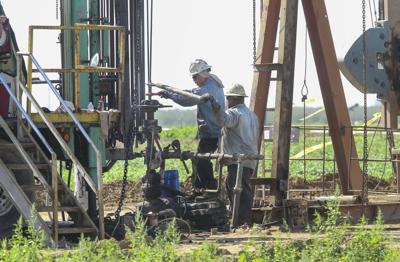
A crew changes the pump on an oil well southeast of Bakersfield in this file photo from 2014. Henry A. Barrios / The Californian. file
BY JOHN COX, Bakersfield.cox@bakersfield.com, Dec 5, 2023
The Sierra Club ratcheted up pressure on Kern County’s petroleum industry Tuesday by releasing a contentious report saying California policymakers should force oil companies to spend more money plugging idle oil wells. The report singled out three locally operating producers — Aera Energy LLC, California Resources Corp., and Chevron — it said earn adequate income but have not spent enough money properly retiring unused wells with the potential to cause pollution.
The companies countered that they have made substantial progress in recent years addressing idle wells, as required by state regulators. Industry trade groups, meanwhile, criticized the Sierra Club’s report as misleading.
Idle wells as an environmental issue gained greater attention last year after dozens of oil field facilities around Kern were found leaking methane at high rates in Bakersfield and Oildale. More were discovered leaking earlier this year in the Arvin and Lamont areas.
Earlier this year the state Legislature addressed the related issue of orphan wells, defined as idle facilities for which no responsible owner can be found. To make sure taxpayers don’t have to pay for future well plugging and remediation jobs, lawmakers passed a law increasing the amount of money companies have to post in the form of a bond when wells change hands.
But the Sierra Club, using Aera, CRC, and Chevron as examples, said more should be done to protect taxpayers and residents alike.
If you liked this post, you’ll love our daily environmental newsletter, EnviroPolitics.It’s packed daily with the latest news, commentary, and legislative updates from New Jersey, Pennsylvania, New York, Delaware…and beyond. Don’t take our word for it, try it free for an entire month. No obligation.
UPPER NAZARETH TWP., Pa. — A proposed industrial park will not go forward after the Upper Nazareth Township Board of Supervisors voted Wednesday against zoning changes for the project.
About 50 people came to the meeting, where township resident Becky Bartlett gave the board a petition opposing rezoning she said included signatures from “over 130” township residents.
Of the township residents who spoke, the overwhelming majority opposed the zoning change.
Speakers cited an already traffic-choked Tatamy Rd., the proposed development’s proximity to Nazareth Area Intermediate School, and risks of the sinkhole-prone geology beneath and around the site.
Representatives for the developer suggested they may still pursue the project in the future, after negotiations allowing the township to set binding conditions for the project through zoning rules.
For now, most of the 52-acre property next to Nazareth Area Intermediate School along Tatamy Rd. will remain mostly zoned for medium-density residential development, allowing single-family homes, small apartment buildings, townhomes, and other uses.
The Northeast of the approximately T-shaped lot is zoned for extractive industries like the adjacent quarry.
It would have been the eighth project by Lehigh Valley Industrial Park, a nonprofit whose developments of the same name include a vast section of the former Bethlehem Steel plant.
If you liked this post, you’ll love our daily environmental newsletter, EnviroPolitics.It’s packed daily with the latest news, commentary, and legislative updates from New Jersey, Pennsylvania, New York, Delaware…and beyond. Don’t take our word for it, try it free for an entire month. No obligation.
The most important visitor to the UAE today didn’t come anywhere near the Blue Zone. Vladimir Putin made his first trip to the Middle East since he invaded Ukraine and energy was top of the list.
His touchdown right in the middle of the biggest diplomatic event the UAE has ever hosted – where a pledge to phase down fossil fuels is the key negotiating call for many – was a real-world demonstration of the primacy the black stuff still holds in the region’s affairs. The Russian president plans to stop off in Riyadh, too, as the three OPEC+ heavyweights try to demonstrate unity.
Back at the Expo, most delegates were focused on tomorrow’s mid-COP rest day – a break from the thousands of steps racked up daily walking to, from, and around the giant site. People were debating whether to hit the beach, the giant Dubai Mall or take an 800-meter ride up the Burj Khalifa, the world’s tallest building.
Business resumes on Friday and the second week of COP is where the negotiations take center stage. There are plenty of fights ahead. As well as the inclusion of language on the phase down of fossil fuels, COP28 CEO Adnan Amin told Bloomberg News there’s a lot of work still to do on climate finance and adaptation as the presidency tries to bridge gaps between the priorities of advanced and developing economies.
For all the anxiety about the role of fossil fuels, the UAE’s fondness for splashy announcements, and the creeping commerciality of COP, there have been significant moments in the first week.
Loss and damage got done on day one, the pledge to triple renewables has momentum and, if it’s followed through, a package on methane could mean material reductions in emissions.
America’s John Kerry has been an energetic presence all week and the veteran politician struck an upbeat tone at a mid-afternoon presser.
“We’ve had a pretty damn good week here in Dubai already,” he said. “We have some tough issues next week, but I think we have people of good faith who know that this is an international negotiation of consequence. And people will measure who steps up.”
More from COP
Kerry backs a fossil fuel phase out. The world also needs carbon capture technology to reach net zero climate targets by mid-century, the US climate envoy says.
Russia welcomes a US-led nuclear power capacity push. “Without nuclear energy it is impossible to achieve climate goals,” Deputy Economy Minister Vladimir Ilyichev says.
Do you know your NDCs from CCS? From the “Paris Agreement” to “peak emissions” and the “global stocktake,” here’s everything you need to know but have been too afraid to ask.
More from Bloomberg
Hyperdrive for expert insight into the future of cars
Energy Daily for a daily guide to the energy and commodities markets that power the global economy
CityLab Daily for top urban stories and ideas, curated for your inbox by CityLab editors
If you liked this post, you’ll love our daily environmental newsletter, EnviroPolitics.It’s packed daily with the latest news, commentary, and legislative updates from New Jersey, Pennsylvania, New York, Delaware…and beyond. Don’t take our word for it, try it free for an entire month. No obligation.