
The Atlantic Sturgeon’s Hudson River Tagging and Recapture Tale

From the New York State Department of Environmental Conservation
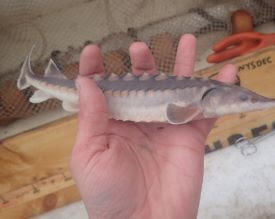
baby sturgeon next to a ruler

Each year, DEC biologists monitor both the juvenile and spawning adult populations of Atlantic sturgeon, one of the Hudson River’s most iconic fish species. These long-term monitoring programs were developed to track the Hudson River Atlantic sturgeon population following the commercial fishery closure in 1996 due to a declining population.

Since the mid-2000s, DEC’s Hudson and Delaware Marine Fisheries Unit has been monitoring the abundance of juvenile Atlantic sturgeon at their overwintering area in Haverstraw Bay. From late February to the end of April, young Atlantic sturgeon are collected using nets at their overwintering area in Haverstraw Bay. The sturgeon are weighed, measured for length, and examined for previous tags. Untagged fish are tagged under the dorsal fin with a Passive Integrated Transponder or PIT tag. This tag is like a microchip put in pets and is about the size of a grain of rice.

Likewise, each June fisheries biologists use much larger nets (even bigger than the mesh of soccer nets) to monitor the size and sex composition of the adult spawning stock near Hyde Park. Adult sturgeon are processed in a similar fashion as the juveniles. However, the sex of the fish can be determined through the expression of milt or eggs, as individuals are mature and are in spawning condition. The adults also are scanned for a PIT tag. These PIT tags help managers and researchers learn more about sturgeon movement and behavior while in the Hudson. The tags also can be scanned and detected by other scientists in other rivers along the East Coast. Atlantic sturgeon migrate as far south as Georgia and as far north as Canada’s Bay of Fundy, so the tags give scientists clues about where sturgeon migrate from place to place. Lastly, the tags can help learn about reproduction, survival, and population recovery.

adult Atlantic sturgeon is brought into a boat

Young Atlantic sturgeon spend up to five to seven years in the freshwater Hudson before moving into the ocean to migrate along the east coast. They are also a late maturing species and females may not spawn for the first time until the age of 15. Therefore, protected sturgeon spawned after the 1996 moratorium would only begin to return and spawn in the Hudson River in the early 2010s.

Through DEC’s long-term monitoring of both juvenile and adult sturgeon, DEC biologists are now seeing sturgeon originally PIT tagged as small toddlers returning to spawn as massive adults. Thus far, seven adult sturgeon have been recaptured on the spawning grounds after being at large for as long as 14 years. In 2023, three adults (two originally tagged in 2009 and one in 2011) were recaptured having grown between approximately a meter to 1.5 meters in length! Biologists hope to see an increasing trend in the number of adults that were originally tagged as juveniles returning to spawn in the Hudson River. This would signify the 1996 moratorium and other protection measures are benefiting the species and adult sturgeon are returning to produce more offspring that will overwinter in Haverstraw Bay and ultimately return again as adults.


If you liked this post, you’ll love our daily environmental newsletter, EnviroPolitics. It’s packed daily with the latest news, commentary, and legislative updates from New Jersey, Pennsylvania, New York, Delaware…and beyond. Don’t take our word for it, try it free for an entire month. No obligation.

The Atlantic Sturgeon’s Hudson River Tagging and Recapture Tale Read More »

Is China violating Montreal by emitting a climate superpollutant? 

Concentrations of HFC-23, one of the world’s most potent greenhouse gases, remained elevated in East Asia after China, a known past polluter, agreed to curb emissions.

BY PHIL MCKENNA AND PETER ALDHOUS, Inside Climate News

Preliminary atmospheric monitoring data from a remote South Korean island off China’s east coast shows elevated concentrations of hydrofluorocarbon-23 (HFC-23), a greenhouse gas 14,700 times more potent than carbon dioxide on a pound-for-pound basis, according to the World Meteorological Association. 

In June 2021, China ratified the Kigali Amendment to the Montreal Protocol, a binding international agreement that seeks to curb emissions of climate-warming HFCs, synthetic gases primarily used for air conditioning and refrigerating. The agreement entered into force in China on September 15, 2021, requiring the country to reduce HFC-23 emissions “to the extent practicable” by the end of 2021.

The primary source of HFC-23 emissions in China was as a byproduct in the manufacturing of HCFC-22, which is used to produce other fluorinated chemicals including polytetrafluoroethylene (PTFE), or Teflon. More than half of all HCFC-22 has been produced in China since 2009, according to a United Nations Environment Programme report. 

To comply with the Montreal Protocol, HCFC-22 manufacturers must install mitigation technologies, at a relatively low cost, to destroy the by-product HFC-23. 

However, air samples collected at Gosan contained elevated concentrations of HFC-23, with some measurements roughly twice that of global background levels measured at other remote locations. The elevated concentrations continued through June 2022, the most recent month for which data is available.

Read the full story here


If you liked this post, you’ll love our daily environmental newsletter, EnviroPolitics. It’s packed daily with the latest news, commentary, and legislative updates from New Jersey, Pennsylvania, New York, Delaware…and beyond. Don’t take our word for it, try it free for an entire month. No obligation.

Is China violating Montreal by emitting a climate superpollutant?  Read More »

Waste industry expresses concerns as EPA ramps up landfill emissions enforcement

A facade of the U.S. Environmental Protection Agency signage on the wall of its building
Joe Cicak via Getty Images


By Jacob Wallace, Editor, Waste Drive

The U.S. EPA’s decision to include landfill methane emissions in its quadrennial document outlining enforcement priorities this year has left industry observers concerned and confused by the enhanced scrutiny.

The agency’s Office of Enforcement and Compliance Assurance said it has documented “widespread noncompliance” in methane emissions from landfills in its FY 2024-2027 National Enforcement and Compliance Initiatives document.

As a result, EPA plans to use preexisting requirements set out by the New Source Performance Standards that govern landfills to crack down on methane emissions. 

“I am not aware that we have ever been the target of the NECIs in the past,” Anne Germain, chief operating officer and senior vice president of technical and regulatory affairs for the National Waste & Recycling Association, said. “This is relatively new ground.”

The move is part of a broader shift toward climate and environmental justice priorities by the Biden administration and EPA in recent years. Another enforcement priority included in the document was PFAS contamination, which the waste industry hopes will lead to more solutions upstream that reduce contamination for landfills and other downstream waste facilities. Landfills are also wrapped up in the “Mitigating Climate Change” goal that will bring stepped-up enforcement of emissions from oil and gas facilities and the use of hydrofluorocarbons as well.

Read the full story here


If you liked this post, you’ll love our daily environmental newsletter, EnviroPolitics. It’s packed daily with the latest news, commentary, and legislative updates from New Jersey, Pennsylvania, New York, Delaware…and beyond. Don’t take our word for it, try it free for an entire month. No obligation.

Waste industry expresses concerns as EPA ramps up landfill emissions enforcement Read More »

This company returns Wind Turbine Blades as park benches and picnic tables

By Coco Liu, Bloomberg

At first glance, the benches outside the Great Lakes Science Center in downtown Cleveland seem unremarkable. But a closer inspection shows that their droplet-shaped shells aren’t made from wood or metal. A scan of the attached QR codes reveals even more: These benches used to be wind turbine blades.

Painted by local artists and weighing in at about 500 pounds (230 kilograms) apiece, the benches were crafted by Rocky River, Ohio-based Canvus, which will install 10 more in the same location later this month. Altogether, the dozen benches reuse roughly a quarter of a single 150-foot (45-meter) wind turbine blade.

Visitors to Every Child’s Playground in Avon, Ohio, will find products from Canvus’s nearby factory. Photographer: Brian Kaiser/Bloomberg

“We give this material a second life,” says Parker Kowalski, co-founder and managing director at Canvus.

Many more blades will soon need second lives of their own, as wind turbines installed in the early 2000s start to reach the end of their lifespan. By 2025, the trade association WindEurope estimates that 25,000 metric tons of wind turbine blades will be phased out each year in Europe alone, equivalent to the weight of more than 6,000 Hummer SUVs. Turbine manufacturers are working on making their blades recyclable, but for now, startups like Canvus offer a more immediate fix: repurposing them into new products.

At the end of a wind turbine’s life cycle, roughly 85% of its components — including the steel tower, copper wire, and gearing — can be recycled through established metal processing. But turbine blades are a more intractable challenge. Coated with epoxy resins, they cannot easily be crushed. Blades are also made primarily from fiberglass and lack the metals and minerals that attract recyclers.

Read the full story here


If you liked this post, you’ll love our daily environmental newsletter, EnviroPolitics. It’s packed daily with the latest news, commentary, and legislative updates from New Jersey, Pennsylvania, New York, Delaware…and beyond. Don’t take our word for it, try it free for an entire month. No obligation.

This company returns Wind Turbine Blades as park benches and picnic tables Read More »

New Princeton U. policy: Destroy rather than recycle computers

By Eden Teshome and Raphaela Gold, Daily Princetonian

The University has sent 1,700 computers to be destroyed since June 2023, according to University spokesperson Ahmed Rizvi in an email to The Daily Princetonian. In previous years, University-distributed computers were wiped and resold to members of the University community, non-profit partners, and the general public for lower prices. A new policy sends the devices to an e-recycling center, stepping away from reuse. Faculty are also now required to replace their devices every four years.

Although this change was made in May 2023, several University websites continue to incorrectly claim that computers are sent to Resource Recovery where they would be resold. According to Rizvi, the decision to destroy the computers was attributed to “an abundance of caution” relating to a backlog of aged machines that came in after the pandemic and worries that said devices may have malware that would activate upon an attempt to wipe them.

“It is surprising and disappointing that the University is destroying computers without at least being transparent about the policy,” wrote Professor Arvind Narayanan, director of the Center for Information Technology Policy (CITP), in an email to the ‘Prince.’

“There are well-known methods to securely delete data, which is presumably what the University did previously. OIT should at least explain why they no longer consider that to be adequate,” he added.

The University provides computers to faculty members through its Faculty Computer Program (FCP). This year, according to Rizvi, the University has provided almost 500 new computers through the program. The program was founded in 1996 to “refresh the computers of full professors, associate professors, and other select faculty members.” 

There have been changes to the program recently. Since January, lecturers and visiting fellows have been able to receive computers through the University. The University also banned computer customizations and required that devices be returned to OIT every four years in order to be replaced.

Rizvi noted in a written comment to the ‘Prince’ that the four-year policy is currently a recommendation but will soon be made an official policy.

OIT Communications Director Milan Stanic wrote to the ‘Prince’ that the new requirement to purchase a new computer every four years is “because those with older operating systems, which are not regularly updated with security patches, are more vulnerable to new security threats and exploits.”

Read the full story here


If you liked this post, you’ll love our daily environmental newsletter, EnviroPolitics. It’s packed daily with the latest news, commentary, and legislative updates from New Jersey, Pennsylvania, New York, Delaware…and beyond. Don’t take our word for it, try it free for an entire month. No obligation.

New Princeton U. policy: Destroy rather than recycle computers Read More »

BILLYPENNGRAM for November 17, 2023

#BILLYPENNGRAM OF THE DAY
Go  ̶B̶i̶r̶d̶s̶  Dogs 
(Photo by @gpatomk)
Want to see your photo here? Tag #billypenngram on Instagram
If you liked this post, you’ll love our daily environmental newsletter, EnviroPolitics. It’s packed daily with the latest news, commentary, and legislative updates from New Jersey, Pennsylvania, New York, Delaware…and beyond. Don’t take our word for it, try it free for an entire month. No obligation.

BILLYPENNGRAM for November 17, 2023 Read More »