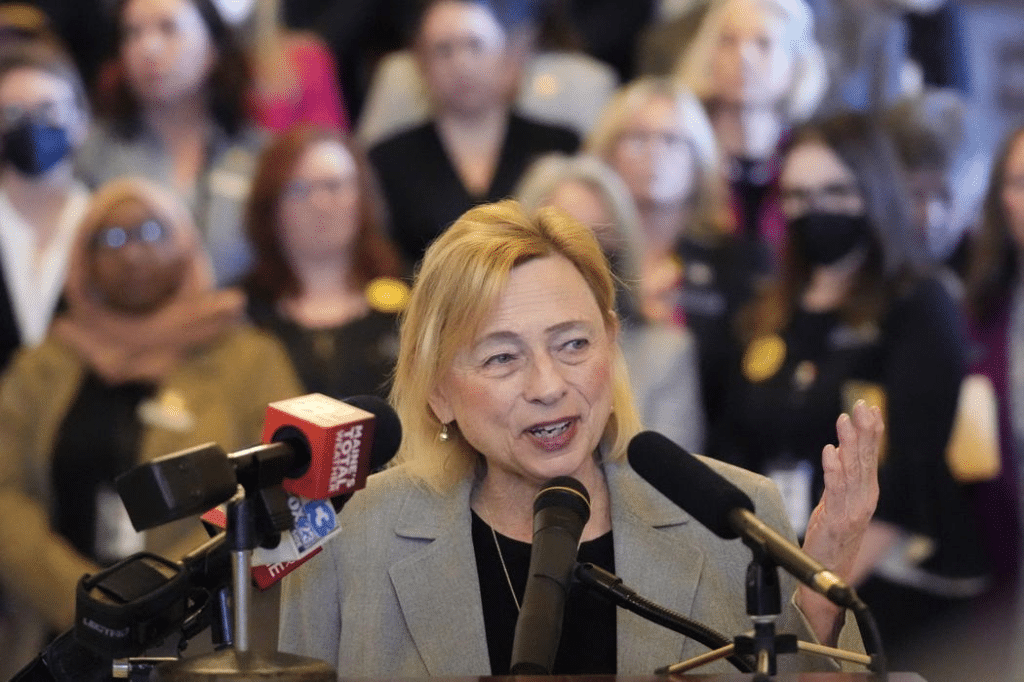
Maine Gov. Janet Mills is threatening to veto legislation governing how the state builds and operates offshore wind projects, citing concerns over pro-union labor provisions.
The Democratic governor championed an earlier version of the bill, but said this past week that she opposes a commitment to use project labor agreements (PLAs), pre-hire deals that set a floor for wages and can help build union power.
Mills argued that mandating a PLA would create a “chilling effect” for non-union companies, discouraging them from bidding on construction.
Supporters of the PLA provision say that is a far-fetched objection, since the agreements do not ban non-union contractors from vying for jobs. (In fact, that’s one reason some more radical unionists say PLAs do too little to advance labor’s cause.)
On Friday, state lawmakers wrote to Mills with a proposed compromise, suggesting new bill text to meet her concerns about potential workforce shortages.
f you liked this post, you will love our daily newsletter, EnviroPolitics.It’s packed with the latest news, commentary, and legislative updates from New Jersey, Pennsylvania, New York, Delaware…and beyond. Don’t take our word for it, try it free for an entire month. No obligation
NEW YORK — You might have seen an affable, 6-foot-5-inch older fellow pacing the paths of Central Park recently, talking to himself. Well, that was no ordinary man. Among his accomplishments: a Rhodes scholarship, a flawless jump shot, even a seat in the Senate. And of late — surprisingly — a moment in the footlights.
Yes, Bill Bradley decided the new world he wanted to conquer, after distinguished careers as a New York Knick and a U.S. senator, was that of a storyteller onstage, like Mark Twain. And that is how “Rolling Along” came to be, and why Bradley made mumbling loops around the park, the way he used to spend hours by himself, practicing layups. Only now, he was practicing his lines.
“Rolling Along” is the show he’d written over the past several years about his extraordinary life, going back to his days as a gangly basketball wunderkind from Missouri, on his way to Princeton and the Olympics. Before the coronavirus pandemic began, he recited it, script in front of him, before small audiences in 20 cities. Last December, he did it again, but this time from memory, for four nights in a theater on West 42nd Street. There, in the room with an audience and five cameras, documentarian Michael Tollin (“The Last Dance,” “Hank Aaron: Chasing the Dream”) put it on film.
“Rolling Along” had its premiere on June 16 at the Tribeca Film Festival — a 90-minute movie as unvarnished as a weathered porch on the Mississippi, the river that inspired the film’s title. It’s just Bradley onstage with a chair, table and glass of water, candidly recounting his biography, a guy seemingly at ease and eager to explore this new terrain as a public figure. In an interview, he confesses as much, about why he made the show: part of a lifelong quest, he says, to “belong.”
“It’s me as an only child,” Bradley declares, “wanting to give myself to a larger family.”
All politicians are performers of one sort or another, the lucky ones by dint of natural gifts. Others lean heavily on the skills of speechwriters. Still others just seem to be (too) in love with the sound of their own voices. You can see in “Rolling Along” that Bradley falls into another, rarer category, one defined by a need to pull himself off the pedestal, to express his feelings in lyrical musings, to reveal a vulnerability underlying his achievements.
“My hope was that people will feel a connection because of the humanity of the piece, and in elements of it people will see their own life,” Bradley says in an interview.
One person who felt a connection was filmmaker Spike Lee, a Knicks fan of rabid dimension, who’s been friends with Bradley for years. Running into each other before the pandemic at Clyde Frazier’s Wine and Dine, the now-closed Manhattan restaurant of another ex-Knick, Walt Frazier, Bradley told Lee: “I’d like to do this thing for you to get your opinion.” Lee invited him to his Brooklyn office, where Bradley read to him “Rolling Along.”
“At the end, he has tears in his eyes,” Bradley says. “And I think, ‘Oh, whoa, that’s confident confirmation of something.’”
If you liked this post, you will love our daily newsletter, EnviroPolitics.It’s packed with the latest news, commentary, and legislative updates from New Jersey, Pennsylvania, New York, Delaware…and beyond. Don’t take our word for it, try it free for an entire month. No obligation
She Helped Bring Long-Gone Wild Oysters Back to the Jersey Shore
She’s also working to protect 160 crucial islands in the Barnegat Bay watershed.
Angela Andersen is the sustainability director for Long Beach Township on LBI. She recently secured an $87,000 grant to fund the restoration of habitats on New Jersey’s bay islands—and she’s happy to take you on a kayak tour of it all. Photo: Dave Moser
Angela Andersen wears many hats. They include a full, brimmed sun hat and a beanie, depending on the season when she is out on the bay.
Andersen, 54, is the sustainability director/field station manager for Long Beach Township on Long Beach Island.
Her career has included roles with the American Littoral Society, which promotes the study and conservation of marine life and habitat, and the New Jersey Department of Environmental Protection, as well as coproducing three locally based documentaries.
Of all her work, Andersen’s legacy will likely be her role in the return of the wild oyster, a staple harvest of our Shore waterways, long since erased. It’s been an overwhelming ecological success story.
“Oysters grow on hard structures, traditionally on the back of their dead ancestors,” Andersen says. “As we were filming our documentary The Oyster Farmers, the ecosystem told us it was healthy enough to support a renewed industry of sustainable shellfish growth and harvest, but also complete habitat restoration. That cycle can’t happen in an unhealthy system.”
Andersen was integral in building oyster reefs by implementing a system that brings together environmental, municipal, academic, business and aquaculture groups to collect oyster shells from restaurants, introduce them to millions of oyster larvae (called spat), and then place them into lease areas on the bay floor.
Oysters are now growing on the reefs, as well as in an increasing number of commercial oyster farms, and have even been found in the wild for the first time in 50 years. The reefs filter microplankton and absorb carbon from the bay—both dangerous in overabundance. Moreover, the well-publicized projects educate residents and create jobs for a new generation of bayworkers.
We’re always looking for stories that might interest our readers. If you come across something so interesting that it cries out to be shared, please send it to editor@enviropolitics.com If we agree, you’ll see it here soon.
For decades, a Nestlé instant coffee factory in Freehold has kept a faint scent of coffee in the air and hundreds of local people employed. But that could soon change. Workers at the plant rallied on Tuesday to protest the rumored closure of the facility, a move that would mean the elimination of 200 union jobs.
“We want a decision. We obviously want a favorable decision that the factory stays open. But the uncertainty is really hard to live with because you don’t know what plans you can make. You don’t know what the future holds,” said Craig Slininger, who has worked at the plant for 26 years.
Freehold Mayor Kevin Kane said he has reached out to state and federal legislators to see what can be done about protecting those jobs and the people who depend on them. “There’s a lot of residual impact, you know, with the closure of a plant like this for this immediate area. We have great restaurants right on Route 33 here. And, you know, a closure of a plant like this will have a direct effect on restaurants, our downtown businesses and things like that,” said Kane.
Nestlé told NJ Spotlight News in a statement that the company is having ongoing discussions with the local union and elected officials about the possible closure, but hinted that the facility is outdated and no longer cost-effective in the company’s eyes. “Decisional bargaining with the union has concluded, and our leadership team will now make a final decision regarding the factory,” a Nestlé spokesperson said. “We are committed to giving our Freehold employees updates in a timely manner.
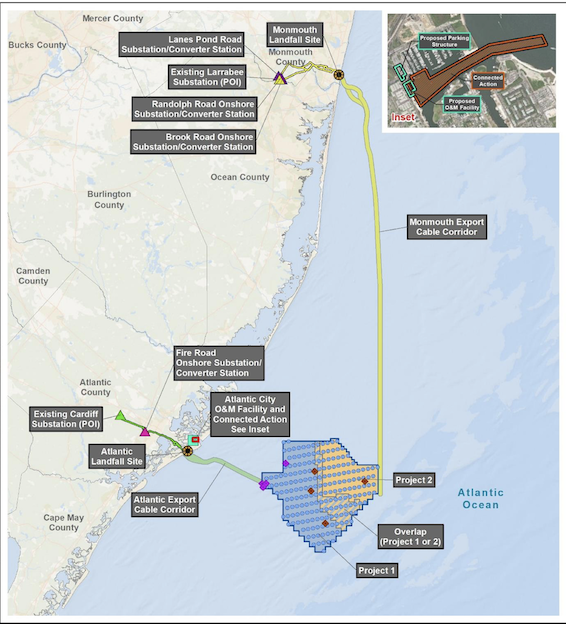
The Atlantic Shores offshore wind project would build up to 200 turbines, rated at a maximum 1,510 megawatts, off Long Beach Island, N.J. BOEM graphic.
By Kirk Moore, Ntional Fisherman Mid-Atlanic News
Local groups opposing New Jersey offshore wind projects hoped this week’s public meetings on the Atlantic Shores development would be a platform for voicing their strenuous objections.
But the federal Bureau of Ocean Energy Management held the first session Wednesday evening in a highway Holiday Inn hotel in Manahawkin, N.J., in the style of an informal informational session, rather than a formal public hearing on its draft environmental impact statement (DEIS) on Atlantic Shores.
Dozens of visitors, many of them seaside residents from nearby Long Beach Island, made a circuit of poster presentations. Presentations on how turbines will be visible from the beach – and the project’s impact on marine mammals – attracted the most attention.
Some visitors went toe-to-toe debating with BOEM staffers and agency contractors about the DEIS findings. Others, who had hoped for publicly making their cases before an audience, were dismissive of the proceedings.
“Typically BOEM. Totally tone-deaf,” said Greg DiDomenico, a fisheries management specialist with Lund’s Fisheries in Cape May, N.J.
“It’s supposed to be all about dialogue,” said Cynthia Zipf, executive director of the Clean Ocean Action environmental group, which has been critical of BOEM’s planning for large wind energy developments in the New York Bight.
On arrival visitors were directed to a reception desk where they could sign up to present formal comments on the DEIS.
“The goal of these meetings is to help attendees provide written comments for the record,” according to email notifications from BOEM. “Comments can be provided by meeting with a court reporter at the meeting, by submitting comments to www.regulations.gov or by sending written comments to BOEM.”
BOEM released the draft environmental impact statement May 15 and is taking public comments for 45 days ending July 3. Four public meetings – the Wednesday session in Manahawkin, another Thursday at the Atlantic City Convention Center and online sessions June 26 and June 28 – will inform the final EIS, the agency says.
The two-phase project could build around 200 wind turbines off Long Beach Island, Brigantine an Atlantic City, an array with a nameplate capacity for generating up to 2,800 megawatts. It’s a 50/50 joint venture between Shell New Energies US LLC and EDF-RE Offshore Development, LLC, a subsidiary of EDF Renewables North America.
Export cables carrying energy from the project would come ashore at landfall sites in Atlantic City, and another about 60 miles north in Monmouth County.
Passions have run high among anti- and pro-wind power groups, since whale strandings on New Jersey beaches last winter that project opponents tied to survey work on project sites.
If you liked this post, you will love our daily newsletter, EnviroPolitics.It’s packed with the latest news, commentary, and legislative updates from New Jersey, Pennsylvania, New York, Delaware…and beyond. Don’t take our word for it, try it free for an entire month. No obligation
Groups that have been at the forefront of the effort to halt plans for hundreds of electricity-generating wind turbines in the Atlantic Ocean have taken their campaign to court.
The groups — Save LBI, Defend Brigantine Beach and Protect Our Coast NJ — say state officials ignored evidence the massive structures will harm the offshore environment in their approvals.
The legal action — naming the state Department of Environmental Protection and company developing the offshore wind project — was filed with the state Appellate Division, the normal venue for challenging the decision of a state agency.
A lawsuit filed by wind-power opponents was rejected by a federal judge earlier this year.
Meanwhile, U.S. Rep. Chris Smith (R-4) said that the Government Accountability Office told him it had agreed to investigate the potential role preliminary work on the offshore wind project might be playing in numerous marine mammal deaths.
If you like this post you’ll love our daily environmental newsletter, EnviroPolitics.It’s packed with the latest news, commentary, and legislative updates from New Jersey, Pennsylvania, New York, Delaware…and beyond. Don’t take our word for it, try it free for an entire month. No obligation.