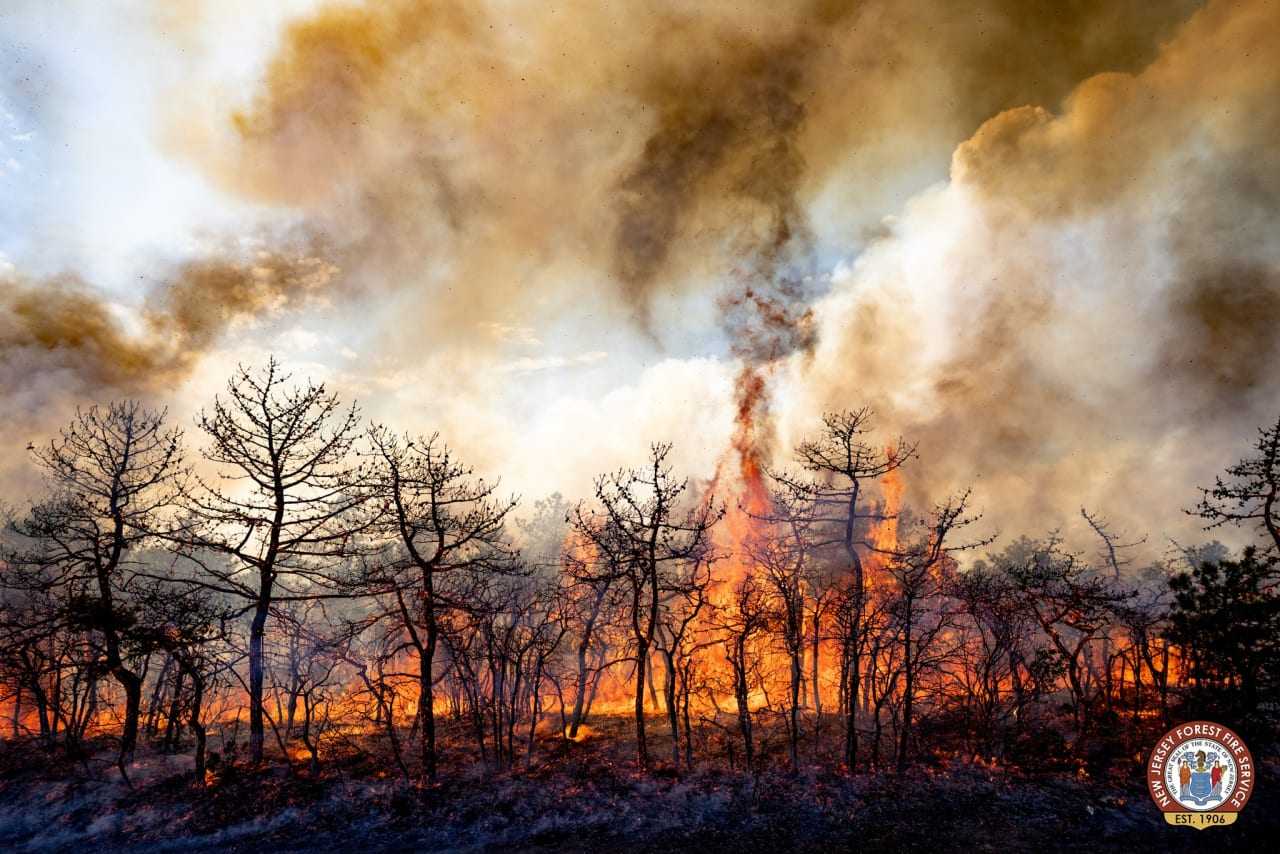
A more than 1,600-acre forest fire that spread across parts of Ocean County this weekend has been placed under control.
The Log Swamp Wildfire in Little Egg Harbor Township had been 100 percent contaminated as of 8 a.m. Sunday, April 16, according to the New Jersey Forest Fire Service.
The blaze burned portions of, the Stafford Forge Wildlife Management Area, and the Warren Grove Bombing Range.
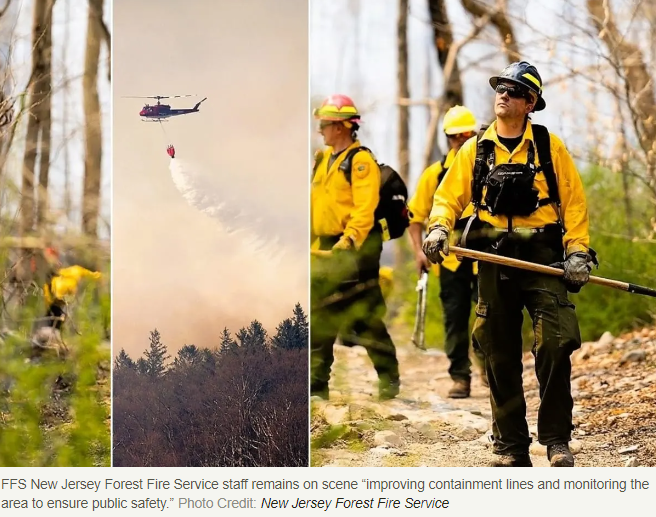
“Forest Fire Service staff will remain on scene to continue improving containment lines and monitor the area to ensure public safety,” the NJFFS said. “While portions of the state received substantial rainfall overnight, the area of the fire only received 0.04 inches of precipitation.”
If you liked this post you’ll love our daily environmental newsletter, EnviroPolitics. It’s packed with the latest news, commentary, and legislative updates from New Jersey, Pennsylvania, New York, Delaware…and beyond. Don’t take our word for it, try it free for an entire month. No obligation.
Gov. Newsom says the state is holding “Big Oil” accountable; fenceline communities say he’s leaving them behind.
In Signal Hill, California, an oil pump jack stands idle near homes, in February 2023. California law S.B. 1137, which required a safety buffer zone of 3,200 feet around homes and schools for new oil and gas drilling, was suspended after the petroleum industry last year collected enough signatures in a petition campaign to place a referendum on the 2024 general election ballot. The bill was originally signed into law by Governor Gavin Newsom last year and also banned new drilling near parks, health care facilities, prisons, and businesses open to the public. Credit: Mario Tama/Getty Images.
The first thing Nalleli Cobo wanted to do when she heard the oil well in her South Los Angeles neighborhood was shutting down was scream. She had so much pent-up energy she didn’t know what else to do.
Cobo grew up breathing foul-smelling, toxic emissions from an oil production site just 30 feet from her home. She sometimes caught whiffs of chocolate and citrus, which she thinks came from chemicals used to mask the fetid smell. At first, she didn’t connect the unexplained ailments she couldn’t shake—uncontrolled nosebleeds, punishing headaches, stomach pains, and crippling body spasms—to the oil wells next door.
Cobo’s mother and sister suffered from similar health problems. When they started comparing notes with neighbors, they realized headaches, nosebleeds, and other ailments were rampant in their close-knit community, where most residents are low-income and Latino. They blamed the cluster of neighborhood wells that bordered their homes, a daycare, a senior living facility, and a school for students with disabilities.
Cobo was just 9 years old when she started organizing to end drilling at the facility that was making her community sick. That was 13 years ago.
If you liked this post you’ll love our daily environmental newsletter, EnviroPolitics. It’s packed with the latest news, commentary, and legislative updates from New Jersey, Pennsylvania, New York, Delaware…and beyond. Don’t take our word for it, try it free for an entire month. No obligation.
Wind turbine maker EWT has signed a contract with Antarctica New Zealand to supply and install three DW54X-1MW turbines. They each have a rotor diameter of 54 meters (177 feet) and a hub height of 40 meters (131 feet).
New Zealand’s Scott Base and the US’s McMurdo Station are both on Ross Island, in the Ross Sea – the southern extension of the Southern Ocean, off the coast of Victoria Land. They’re a few miles apart from each other, and the three turbines will be installed halfway between the two at Crater Hill. (Ross Island is formed by four volcanoes.) The turbines will be connected to a microgrid that provides electricity to both stations; Scott Base is undergoing a redevelopment, which is expected to be completed in 2028.
The wind turbines are part of an extensive upgrade program, including the replacement of three existing smaller and less powerful 300 kW turbines, the replacement of the existing flywheel storage system with a large battery storage system, an upgrade of the high voltage network, and the replacement of the Scott Base’s diesel generators.
If you liked this post you’ll love our daily environmental newsletter, EnviroPolitics. It’s packed with the latest news, commentary, and legislative updates from New Jersey, Pennsylvania, New York, Delaware…and beyond. Don’t take our word for it, try it free for an entire month. No obligation.
THE WORST IS OVER: The wildfire that marched through West Milford the past three days is 100% contained, the New Jersey Forest Fire Service reported on Saturday.
The blaze, which was beaten back at first but then grew steadily over the previous 48 hours, finally topped out at 972 acres on April 15 – and that was it, the service said.
Fire officials also said this would be the last of the updates from the “Kanouse Wildfire,” the largest blaze in North Jersey since 2010.
Ten structures in all were threatened – half of which were evacuated – yet none were seriously damaged thanks to the support of fire companies from Passaic and Morris counties, the NJFFS said.
No injuries were reported.
If you liked this post you’ll love our daily environmental newsletter, EnviroPolitics. It’s packed with the latest news, commentary, and legislative updates from New Jersey, Pennsylvania, New York, Delaware…and beyond. Don’t take our word for it, try it free for an entire month. No obligation.
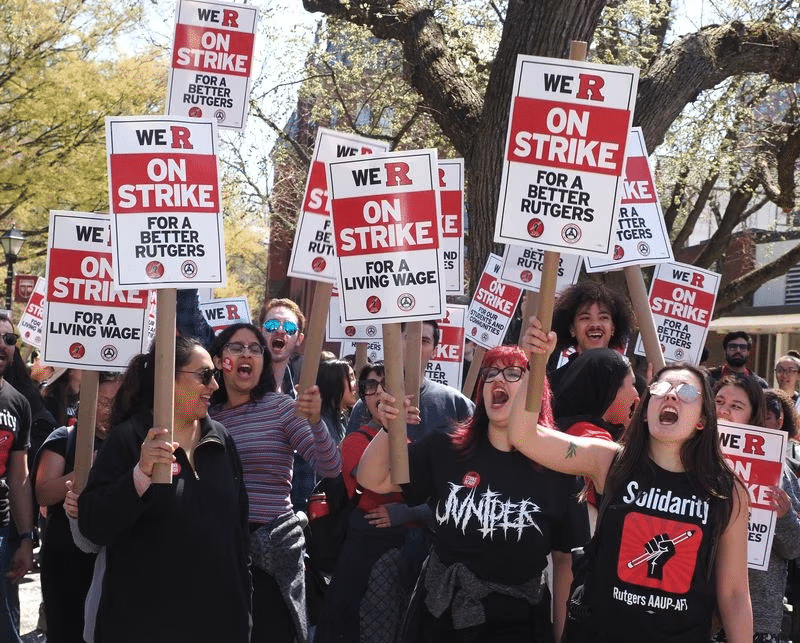
Officials have reached a tentative deal that will halt the first faculty strike in Rutgers University history, at least temporarily, and allow classes to resume after five days of picketing, lengthy negotiations, disrupted schedules, and uncertainty about exams and graduation.
The school and faculty unions that have been striking since Monday agreed to a “framework” of new contracts that would provide better pay, benefits, and job security for full- and part-time faculty, Gov. Phil Murphy announced just before 1 a.m. Saturday.
If you liked this post you’ll love our daily newsletter, EnviroPolitics.It’s packed with the latest news, commentary, and legislative updates from New Jersey, Pennsylvania, New York, Delaware…and beyond. Don’t take our word for it, try it free for an entire month. No obligation.If you liked this post you’ll love our daily environmental newsletter, EnviroPolitics.It’s packed with the latest news, commentary, and legislative updates from New Jersey, Pennsylvania, New York, Delaware…and beyond. Don’t take our word for it, try it free for an entire month. No obligation.
That, officials said, means all classes at Rutgers’ three main campuses will resume Monday, two weeks before the end of the spring semester for the 67,000 students at New Jersey’s largest university.
Union leaders, however, characterized this not as a formal end to the strike — one of the largest in the history of higher education — but a suspension of it. They stressed there is still work to be done to finalize the contracts, including “core” issues involving medical faculty at the state university, and members must then vote on the agreement.
Gov. Phil Murphy’s administration has taken an aggressive approach to environmental litigation since taking office in 2018, filing 20 lawsuits claiming compensation from corporations for damage to natural resources. It filed another 52 complaints seeking the cleanup of sites that have polluted overburdened “environmental justice” communities.
The administration has used legal means to compel corporate polluters to clean up New Jersey’s many contaminated sites, officials say, and to compensate the state and the public for the loss of environmental assets to contamination with industrial waste and chemicals.
It’s a mixed record so far. All but one of the so-called natural resource damage (NRD) suits remain unresolved, including the most recent one against Dow Chemical and other companies. The state is demanding compensation for their alleged pollution with the chemical 1,4-dioxane, a suspected carcinogen, knowing that it would pollute drinking water. Meanwhile, more than 20 of the environmental justice complaints have been settled or subjected to court orders that impose fines or demand cleanup.
The environmental justice complaints require defendants to fix environmental problems such as unsafe drinking water or leaks of toxic materials in marginalized communities that bear a disproportionate environmental burden. In 2020, Murphy signed a first-in-the-nation environmental justice law, which requires state officials to evaluate the environmental and public health impacts of permit applications and to deny permits if an environmental justice analysis determines that a project will have a disproportionately negative impact on overburdened communities.
The administration’s activist litigation strategy reflects New Jersey’s long history of damage from industry — as shown by its highest-in-the-nation number of Superfund sites that have been designated by the federal government. It also comes out of an expectation that the courts are proving the most effective means of ensuring that polluters pay.
‘Very aggressive’
“There are these huge old factories all over New Jersey and a lot of waterways, so there’s a lot of opportunity to have NRDs,” said Miano, referring to natural resource damage cases. Miano, who is not involved in any of the cases, added, “And the state has been going after them pretty aggressively.”
“New Jersey is being very aggressive with these things,” said Steve Miano, an environmental lawyer with Hangley Aronchick Segal Pudlin & Schiller in Philadelphia. “Among the states in the Northeast, they are leading the charge on actually filing cases.
By contrast, the Christie administration didn’t file a single natural resource damage suit, according to the state attorney general’s office.
March 23, 2023: New Jersey announced a lawsuit against the Dow Chemical Company and other companies for widespread contamination of drinking water by a potentially cancer-causing chemical.
The latest natural resource damage suit was filed on March 23 when the state sued the chemical giant Dow Chemical, saying the company made or used 1,4-dioxane, a toxic chemical classed by the Environmental Protection Agency as a likely carcinogen, knowing that it would pollute drinking water across the state.
If you liked this post you’ll love our daily environmental newsletter, EnviroPolitics.It’s packed with the latest news, commentary, and legislative updates from New Jersey, Pennsylvania, New York, Delaware…and beyond. Don’t take our word for it, try it free for an entire month. No obligation.