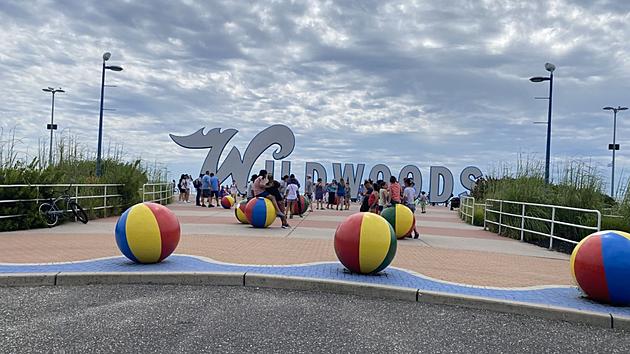
WILDWOOD — A grand jury has returned a 12-count indictment against two current city officials and a former mayor alleging they claimed state health benefits for which they were ineligible, state Attorney General Matthew Platkin said Wednesday.
The announcement is the latest legal woe for Mayor Pete Byron, who pleaded guilty to federal charges of tax fraud Friday.
Also listed in the grand jury indictment are former Mayor Ernie Troiano Jr. and current city Commissioner Steve Mikulski, meaning two-thirds of the three-person Wildwood Board of Commissioners are under indictment.
They each face four counts including official misconduct, theft by unlawful taking, tampering with public records, and falsifying or tampering with records.
All three have pleaded not guilty in front of Superior Court Judge Bernard E. DeLury Jr.
Byron said he intends to remain mayor but declined to comment further, directing questions to Cape May County public defender Eric Shenkus.
If you liked this post you’ll love our daily environmental newsletter, EnviroPolitics.It’s packed with the latest news, commentary, and legislative updates from New Jersey, Pennsylvania, New York, Delaware…and beyond. Don’t take our word for it, try it free for an entire month. No obligation.
ATLANTIC CITY — A joint study by two federal government scientific agencies and the commercial fishing industry documents numerous impacts that offshore wind power projects have on fish and marine mammals, including noise, vibration, electromagnetic fields, and heat transfer that could alter the marine environment.
The National Oceanic and Atmospheric Administration, the Bureau of Ocean Energy Management, and the Responsible Offshore Development Alliance issued their report Wednesday after a 2½-year-long study of the impacts existing offshore wind projects have on fish and marine mammals.
The goal was to solidify existing knowledge of the impacts and call for further research in many areas.
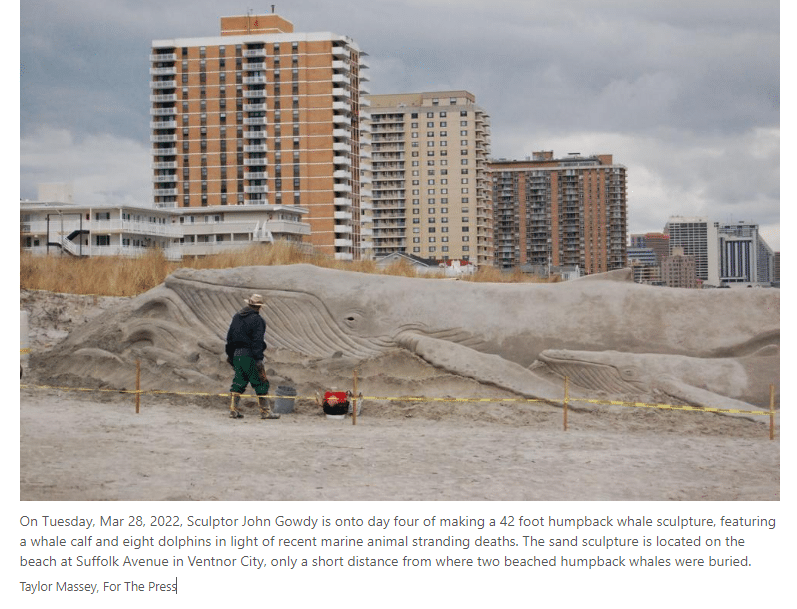
NOAA and BOEM are among the agencies that say there is no link between offshore wind preparation and whale deaths. Their co-authorship of a report detailing potential negative impacts on fish and marine mammals may intensify an already highly politicized controversy.
Asked Friday about the likelihood of this happening, NOAA spokesperson Lauren Gaches reiterated the agency’s position that offshore wind is not causing the whale deaths, which remain under investigation.
“We will also continue to explore how sound, vessel, and other human activities in the marine environment impact whales and other marine mammals,” she said.
The fishing industry is concerned that fish near construction sites may be killed or chased away for prolonged periods even after the turbines are built, according to the report.
“Physical changes associated with (offshore wind) developments will affect the marine environment — and, subsequently, the species that live there — to varying degrees,” the report read. ”These include construction and operation noise and vibration, electromagnetic fields, and thermal radiation from cables, as well as secondary gear entanglement.
If you liked this post you’ll love our daily environmental newsletter, EnviroPolitics. It’s packed with the latest news, commentary, and legislative updates from New Jersey, Pennsylvania, New York, Delaware…and beyond. Don’t take our word for it, try it free for an entire month. No obligation.
Republican State Senate candidate Diedre Paul is headed to court tomorrow in a bid to force her running mate, QAnon supporter Robert Bedoya, off of the ballot.
Bedoya filed with 126 signatures — 26 more than the number required — but Paul says that just 39 of them are invalid. A review of Bedoya’s petitions by the New Jersey Globe shows that he is vulnerable to a challenge.
A Fort Lee Republican county committeeman and former school board candidate, Bedoya’s business card carries the QAnon acronym, WWG1WGA — “Where we go one, we go all” — and lists him as an “Assemblyman-elect”
A Republican source in Bergen County said that Paul is mounting the unusual petition challenge to her running mate because she is taking a principled position in refusing to run with Bedoya. Paul, a veteran of several political battles, has put her principles ahead of the party before.
If a judge tosses Bedoya from the ballot, it will leave Republicans with one candidate instead of two in the 37th district. The GOP can nominate someone through a write-in vote if that top vote-getter receives at least 100 votes.
NEW YORK (March 30, 2023) – Today, the U.S. Environmental Protection Agency (EPA) announced it will award $3 million for New York to plan innovative strategies to cut climate pollution and build clean energy economies across the state.
Earlier this month, EPA announced the availability of the funds, which represent the first funding going to states, local governments, Tribes, and territories from the Climate Pollution Reduction Grants (CPRG) program created by President Biden’s Inflation Reduction Act. Later this year, EPA will launch a competition for $4.6 billion in funding to implement projects and initiatives included in the plans. New York will be eligible to receive that implementation funding because it has opted in to receive the planning grant.
New York is among the 50 states, the District of Columbia, and Puerto Rico that are eligible to receive $3 million each in EPA Climate Pollution Reduction planning grant funds. New York will use the funds to augment climate planning in collaboration with municipalities statewide and to conduct meaningful engagement with communities, including overburdened communities. throughout the state.
New York State’s Climate Act passed in 2019 is among the most ambitious climate laws in the nation. New York State’s nation-leading climate agenda calls for an orderly and just transition that creates family-sustaining jobs, continues fostering a green economy across all sectors, and ensures that at least 35 percent, with a goal of 40 percent, of the benefits of clean energy and energy efficiency investments are directed to disadvantaged communities.
Guided by some of the nation’s most aggressive climate and clean energy initiatives, New York is on a path to achieving a zero-emission electricity sector by 2040, including 70 percent renewable energy generation by 2030, and economywide carbon neutrality by mid-century. New York’s participation in the CPRG program will support its ongoing efforts to reduce economy-wide greenhouse gas emissions and ensure all communities equitably benefit in the clean energy transition.
About the Climate Pollution Reduction Grant Program
The CPRG planning grants will support states, territories, Tribes, municipalities, and air agencies, in the creation of comprehensive, innovative strategies for reducing pollution and ensuring that investments maximize benefits, especially for low-income and disadvantaged communities. These climate plans will include:
Greenhouse gas emissions inventories;
Emissions projections and reduction targets;
Economic, health, and social benefits, including to low-income and disadvantaged communities;
Plans to leverage other sources of federal funding including the Bipartisan Infrastructure Law and Inflation Reduction Act;
Workforce needs to support decarbonization and a clean energy economy; and
Future government staffing and budget needs.
Next Steps
This funding for climate planning will be followed later this year by a national grant competition for $4.6 billion in implementation grant funding that will support the expeditious implementation of investment-ready policies created by the CPRG planning grants, programs, and projects to reduce greenhouse gas emissions in the near term. Through the CPRG program, EPA will support the development and deployment of technologies and solutions that will reduce greenhouse gas emissions and harmful air pollution, as well as transition America to a clean energy economy that benefits all Americans.
By summer 2023, EPA Regional Offices expect to award and administer the funding agreements once all legal and administrative requirements are satisfied.
If you liked this post you’ll love our daily environmental newsletter, EnviroPolitics.It’s packed with the latest news, commentary, and legislative updates from New Jersey, Pennsylvania, New York, Delaware…and beyond. Don’t take our word for it, try it free for an entire month. No obligation.
Construction industry leaders have attacked a recent study promoted by environmentalists that pushed a green energy alternative to NJ Transit’s controversial plan to build a fossil fuel power plant for its train lines.
The study, released earlier this month, argued that a hybrid renewable energy microgrid is feasible to help power NJ Transit’s power needs during an unexpected outage from a major storm or other disruption, as opposed to the fossil-fuel-burning power plant in Kearny that the agency is currently considering.
“Environmentalists lack the basic understanding of construction around these types of projects,” argued Greg Lalevee, business manager for International Union of Operating Engineers Local 825, in a letter to NJ Transit President and CEO Kevin Corbett.
The Transitgrid project has become a flashpoint of controversy since the idea was born years ago. NJ Transit developed the idea as a way to increase resilience on its train lines after they were unable to operate for days due to Superstorm Sandy in 2012. The agency has received approval for a federal grant to cover the majority of project costs.
If you liked this post you’ll love our daily environmental newsletter, EnviroPolitics. It’s packed with the latest news, commentary, and legislative updates from New Jersey, Pennsylvania, New York, Delaware…and beyond. Don’t take our word for it, try it free for an entire month. No obligation.
NEW YORK (March 29, 2023) – The U.S. Environmental Protection Agency (EPA) seeks public input as it proposes to augment its original plan for cleaning up the Matlack, Inc. Superfund site in Woolwich Township, New Jersey.
A 30-day public comment period for the proposed plan begins March 29, 2023. EPA will host a virtual public meeting on April 12, 2023, at 6:00 p.m. to explain the new cleanup proposal. To attend the public meeting, please register here before the meeting begins.
“EPA is committed to ongoing engagement with communities near Superfund sites,” said Regional Administrator Lisa F. Garcia. “EPA is proposing a new treatment to address an additional source of contamination found at the Matlack, Inc. Superfund site in Woolwich. We invite the public to join us and hear about the new cleanup proposal.”
As a result of past truck maintenance and tanker washing operations at the site, the soil, sediment, surface water, and groundwater are contaminated with volatile organic compounds, which can potentially harm people’s health.
EPA’s proposed cleanup technique for cleaning up the drum disposal area is called in-situ thermal treatment. In situ (or in place) thermal treatment methods remove harmful chemicals in soil and groundwater using heat. The chemicals move through soil and groundwater toward wells, where they are collected and piped to the ground surface to be treated using other cleanup methods. Some chemicals are destroyed underground during the heating process.
Under that plan, EPA will install underground barriers designed to remove volatile organic compounds from the groundwater. As groundwater flows through the barriers, they trap harmful contaminants and also make them less harmful. The treated groundwater flows out the other side of the barriers. EPA will monitor the groundwater beyond the barrier to ensure the success of the barrier technology.
In addition, EPA will remove an area of contaminated sediment along Grand Sprute Run and will remove contaminated soil within a former lagoon area. The sediment and soil will be disposed of at off-site facilities licensed to handle the waste. By cleaning up the groundwater and removing ongoing sources of contamination in the soil and sediment, the cleanup also prevents contaminants from getting into Grand Sprute Run, a nearby stream.
Written comments on the proposed plan may be mailed or emailed to Supinderjit Kaur, Remedial Project Manager, U.S. Environmental Protection Agency, 290 Broadway – 18th Floor, New York, NY 10007, Email: kaur.supinderjit@epa.gov.
If you liked this post you’ll love our daily environmental newsletter, EnviroPolitics. It’s packed with the latest news, commentary, and legislative updates from New Jersey, Pennsylvania, New York, Delaware…and beyond. Don’t take our word for it, try it free for an entire month. No obligation.