Jaindl applied to build the warehouses the day before a Lehigh Valley township passed a ban on such projects.
Truck access to a proposed 450,000-square-foot warehouse in Lower Nazareth Township in the Lehigh Valley has drawn concern from a few members of the Lehigh Valley Planning Commission’s Comprehensive Planning Committee.
The warehouse, which is being developed by Jaindl Farms, is located at 523 Nazareth Pike, just north of the intersection of Routes 191 and 946. The LVPC’s study of the project found that it would generate 500 passenger vehicles and 270 truck trips per day. The stretch of Route 191 already averages about 10,000 vehicles per day, according to PennDOT.
A second warehouse — measuring 72,850 square feet — has also been proposed by Jaindl at 4215 Lonat Drive, across the street from the first.
Utilities can’t keep spending on pipelines, and alternative fuels can’t scale. But electric heat and thermal networks could save utility business models and jobs.
National Grid’s North Brooklyn Pipeline phase 4 construction in the Bushwick area of Brooklyn (Erik McGregor/LightRocket/Getty Images)
By Jeff St. John, Canary Media
If New York wants to meet its climate goals, the state’s gas utilities can’t stick to business as usual. Nor can they keep investing billions of dollars in maintaining and expanding the nearly 50,000 miles of gas pipeline they’ve laid over the course of the past half-century.
Instead, state regulators have to start acting now to force the nearly 150-year-old industry to undergo a “managed, phased transition” to a new carbon-free path — or the consequences could be catastrophic.
That’s the key takeaway of the Future of Gas in New York State report released last week by the nonprofit Building Decarbonization Coalition. It concludes that New York must not only halt existing plans to expand and maintain gas pipelines crisscrossing the state but also replace them with alternatives such as underground “thermal energy networks” and electric heat pumps and appliances.
Without a state-guided shift, New York won’t just fail to meet the decarbonization goals it passed into law in 2019, said Lisa Dix, the coalition’s New York director. “If we continue business as usual — which is what we’ve been doing since the climate law passed — we’re going to see ballooning costs, and a potential energy crisis, for New York gas customers,” she said.
f you liked this post, you will love our daily newsletter, EnviroPolitics.It’s packed with the latest news, commentary, and legislative updates from New Jersey, Pennsylvania, New York, Delaware…and beyond. Don’t take our word for it, try it free for an entire month. No obligation
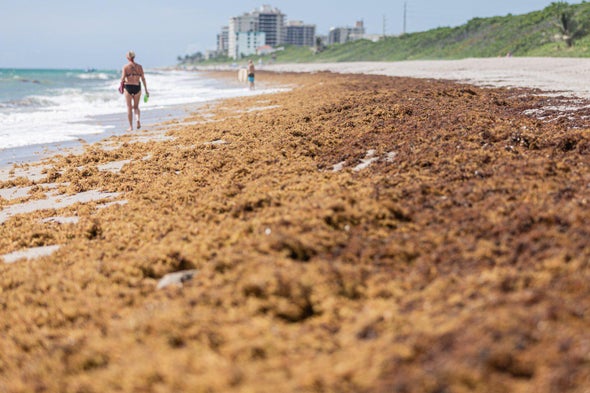
Sargassum piles up on the sands of Juno Beach, Fla., in July 2020. Sargassum has plagued Palm Beach County beaches in recent years, with ample amounts reaching the Gulf Stream. Credit: Joe Forzano/The Palm Beach Post/ZUMA Wire/Alamy Live News
A loose raft of brown seaweed spanning about twice the width of the U.S. is inching across the Caribbean. Currently, bucketloads of the buoyant algae are washing up on beaches on the eastern coast of Florida earlier in the year than usual, raising scientists’ concerns for what the coming months will bring.
The seaweed is made up of algal species in the genus Sargassum. These species grow as a mat of glops of algae that stay afloat via little air-filled sacs attached to leafy structures. The algae form a belt between the Caribbean and West Africa in the Sargasso Sea in the North Atlantic Ocean and then ride the currents west. Scientists say that reports of a massive blob of seaweed slamming into coastlines are overblown because the Sargassum algae are scattered across the ocean, and much of the seaweed will never reach the coast’s sandy shores. But in recent years researchers have generally seen larger so-called Sargassum blooms. And once the seaweed begins washing up on beaches and rotting, it can cause serious problems, local communities say.
Among annual Sargassum censuses in the Atlantic Ocean, “2018 was the record year, and we’ve had several big years since,” says Brian Lapointe, an oceanographer at Florida Atlantic University, who has studied seaweed for decades. “This is the new normal, and we’re going to have to adapt to it.”
The seaweed “blob” has been dubbed the Great Atlantic Sargassum Belt, and though it’s sprawling, the algae in the belt cover only about 0.1 percent of the water’s surface, says Chuanmin Hu, an oceanographer at the University of South Florida, who has used satellites to study Sargassum for nearly 20 years.
Hu and his colleagues estimate the total mass of Sargassum in the Atlantic every month, tracking a yearly cycle that typically peaks in June. To do so, they use data collected by NASA satellites such as Terra and Aqua, as well as National Oceanic and Atmospheric Administration satellites. Last year the seaweed broke the record for the highest amount ever recorded in the Atlantic, with some 22 million metric tons of the stuff found across the ocean, according to the team’s calculations.
Hu says the team estimated that the Atlantic contained about six million metric tons of Sargassum in February and that he’s confident March’s mass will be higher. “This month there should be more. There’s no doubt,” Hu says. “Even in the first two weeks, I have seen increased amounts.”
f you liked this post, you will love our daily newsletter, EnviroPolitics.It’s packed with the latest news, commentary, and legislative updates from New Jersey, Pennsylvania, New York, Delaware…and beyond. Don’t take our word for it, try it free for an entire month. No obligation
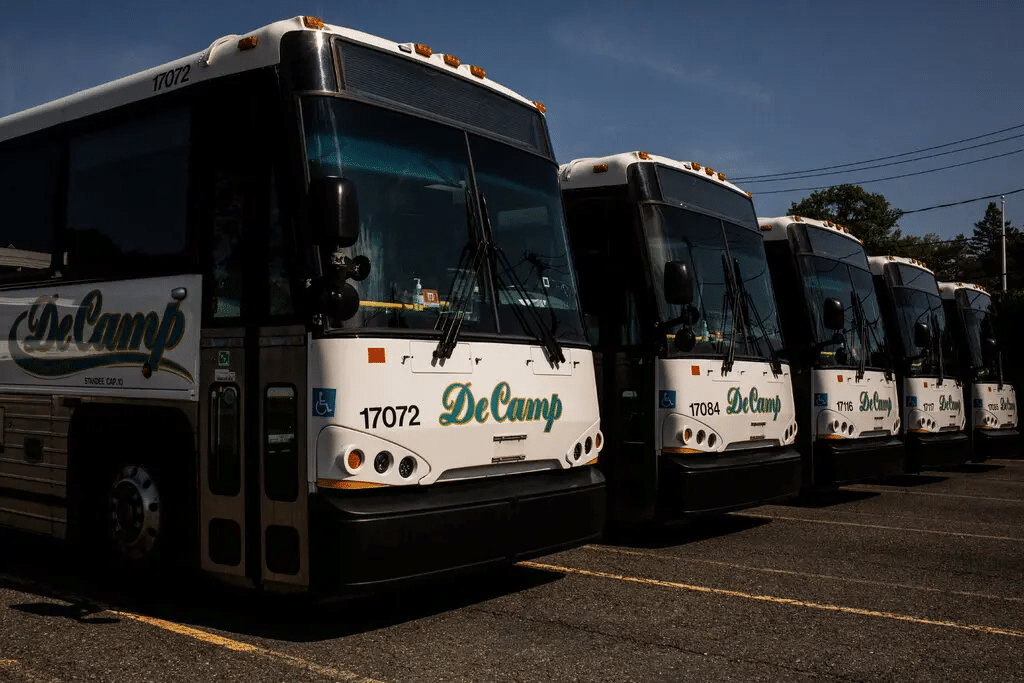
One of New Jersey’s legacy bus companies, which started as a stagecoach line in 1870, is ceasing commuter bus service on April 7.
DeCamp Bus Lines, which will continue to operate charter and casino service, will stop operating its seven commuter routes due to ridership that never returned to pre-COVID 19 pandemic levels, said Jonathan DeCamp, vice president and chief operating officer of the Essex County-based bus company.
“The ridership hasn’t returned, on a monthly basis, we are carrying less than 20% of what did pre-COVID, that’s why the tough decision was made,” he said. “We were able to sustain it up to this point because of the various federal and state programs.”
But that aid has run out and the company can’t keep running that service at a loss, meaning the last commuter routes will be run on April 7, he said. Pre-COVID, DeCamp ran seven commuter routes; three of them returned to service on abbreviated schedules.
Passenger levels dropped from an average of 6,800 riders pre-COVID to 1,250 passengers, DeCamp said.
f you liked this post, you will love our daily newsletter, EnviroPolitics.It’s packed with the latest news, commentary, and legislative updates from New Jersey, Pennsylvania, New York, Delaware…and beyond. Don’t take our word for it, try it free for an entire month. No obligation
Predatory invasive species are blamed for causing blue crab and other commercial stocks to drop significantly, prompting a renewed effort to remedy the situation.
J.C. Hudgins shows a blue crab he caught in the Chesapeake Bay in Mathews, Virginia, on Friday, June 10, 2022. Credit: Kristen Zeis/Deep Indigo Collective for Inside Climate News
Alarmed by plummeting stocks of commercial fisheries in the Chesapeake Bay, officials in Maryland and Virginia are scrambling to control invasive fish species that are causing at least part of the problem.
On Thursday, Maryland Gov. Wes Moore asked the federal government to carry out an evaluation to determine if the situation amounts to a declaration of a “commercial fishery disaster,” which would qualify the state for federal assistance.
In a letter to Secretary of Commerce Gina Raimondo, Moore said the state is increasingly concerned about the explosive growth of invasive fish species in the Chesapeake Bay, including blue catfish, flathead catfish, and snakehead. “There is mounting evidence around the deleterious impacts of these species on the native ecosystem and the communities dependent on the commercial fisheries,” Moore wrote.
The blue catfish, flathead catfish, and snakehead were Introduced in Virginia in the 1970s to create a recreational fishery. They have since spread to tributaries throughout the Chesapeake Bay watershed.
The Chesapeake Bay office of the National Oceanic and Atmospheric Agency (NOAA) identified invasive catfish as a persistent challenge facing the Chesapeake ecosystem several years ago. Known for their voracious appetite, catfish out-compete native species for both habitats and food and threaten key commercial fisheries including blue crab, striped bass, white perch, yellow perch, and American eel.
f you liked this post, you will love our daily newsletter, EnviroPolitics.It’s packed with the latest news, commentary, and legislative updates from New Jersey, Pennsylvania, New York, Delaware…and beyond. Don’t take our word for it, try it free for an entire month. No obligation
The Texas attorney general finally filed suit last year. Still, some residents in Toyah say the Texas Commission on Environmental Quality was “negligent” and want to know what took so long.
Ed Puckett helps operate Toyah’s water treatment plant on a volunteer basis. During a plant tour in early February, he maintained that the water is safe to drink. Credit: Mitch Borden/Marfa Public Radio
This story was reported and produced in collaboration with Mitch Borden, a reporter at Marfa Public Radio.
TOYAH, Texas—It all began simply enough: A boil water notice was issued. A state inspection followed. A list of violations arrived. It’s a well-known pattern in small Texas towns that struggle to maintain their water systems.
But there was nothing simple about Toyah’s water woes, which were years in the making and remain unresolved. A boil water notice issued in June 2018 is still in effect. In the shadow of the country’s most prosperous oil and gas fields, the residents of Toyah, many low-income and Hispanic, have gone nearly five years without safe drinking water.
Elida “Angel” Machuca, a former city council member and mother of two, has made it her mission to expose Toyah’s water crisis. She holds the Texas Commission on Environmental Quality (TCEQ) responsible for allowing the town to stall and remain out of compliance with hundreds of drinking water violations it filed against Toyah over the past five years.
It wasn’t until Sept. 30, 2022, that at TCEQ’s request, the Texas Attorney General brought a civil suit against Toyah to place the public water utility in a receivership.
After years of agitating, Machuca is finally seeing results. But residents still have no clear answer of when the water will be safe to drink.
A cascade of mistakes and mismanagement has left this small West Texas town without safe drinking water, Inside Climate News and Marfa Public Radio found in reporting that included over a dozen interviews and a review of hundreds of pages of public records.
If you like this post you’ll love our daily environmental newsletter, EnviroPolitics.It’s packed with the latest news, commentary, and legislative updates from New Jersey, Pennsylvania, New York, Delaware…and beyond. Don’t take our word for it, try it free for an entire month. No obligation.