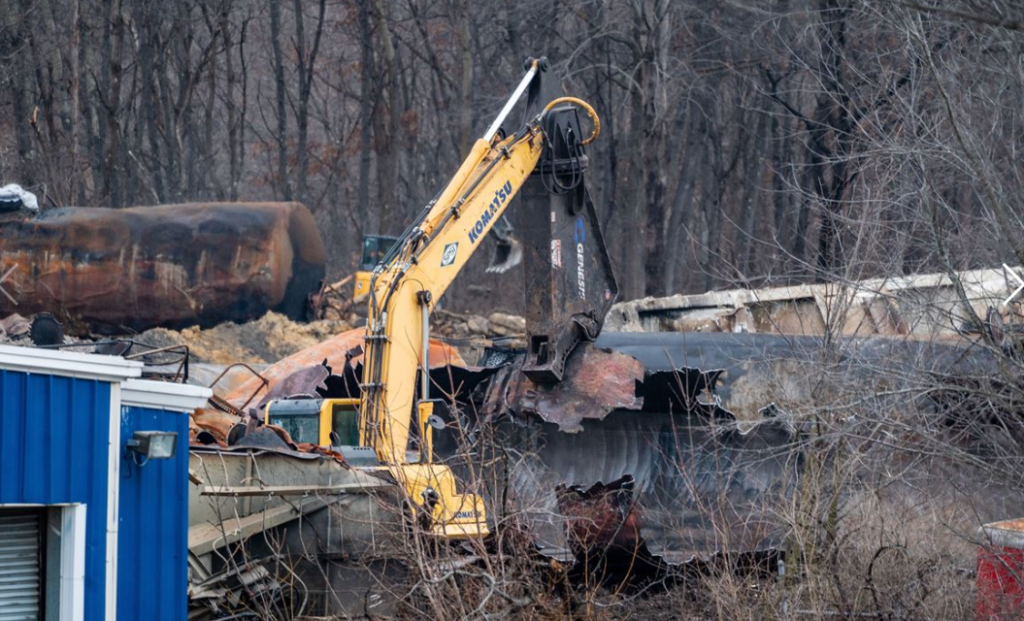
The U.S. Environmental Protection Agency is ordering Norfolk Southern to handle all necessary cleanup after its train carrying toxic chemicals derailed in East Palestine, Ohio, more than two weeks ago.
The agency said it intends to force Norfolk Southern to pay and if it falls short, the company will be significantly fined, the agency said.
If the company fails to complete any actions as ordered by EPA, the agency will immediately step in, conduct the necessary work and then seek to compel Norfolk Southern to pay triple the cost, the agency said.
The announcement came shortly after EPA Administrator Michael Regan visited an East Palestine home, drank the tap water with Gov. Mike DeWine and updated the community on the government’s response.
If you liked this post, you will love our daily environmental newsletter, EnviroPolitics.It’s packed with the latest news, commentary, and legislative updates from New Jersey, Pennsylvania, New York, Delaware…and beyond. Don’t take our word for it, try it free for an entire month. No obligation
Former President Donald Trump plans to visit the Ohio town on Wednesday. Pennsylvania state lawmakers will scrutinize railway company Norfolk Southern during a hearing Thursday in Beaver County. And celebrity environmental advocate will host a town hall Friday in East Palestine.
“The people of East Palestine need help,” Mr. Trump said on his social media network Saturday. “I’ll see you on Wednesday.”
The hearing, being held Thursday morning by a Senate committee at Community College of Beaver County, will include testimony from state and local officials, as well as citizens.
If you like this post you’ll love our daily environmental newsletter, EnviroPolitics.It’s packed with the latest news, commentary, and legislative updates from New Jersey, Pennsylvania, New York, Delaware…and beyond. Don’t take our word for it, try it free for an entire month. No obligation.
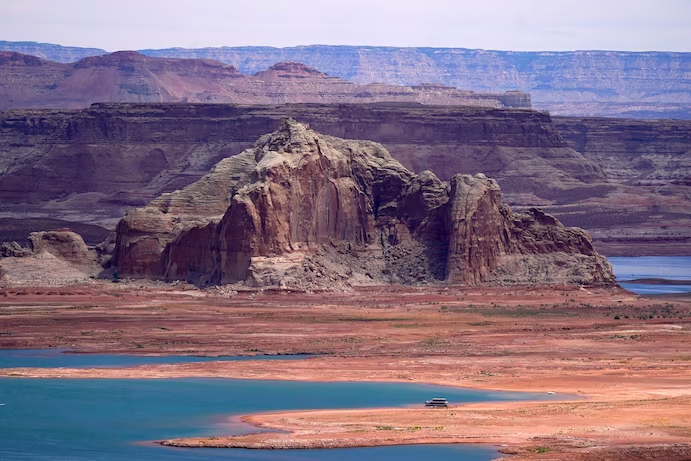
Water levels in the nation’s second-largest reservoir dropped to a record low last week, raising the alarm that major changes are on the way for the seven states — and millions of Americans — relying on that system, experts say.
Lake Powell, a man-made reservoir that sits along the Colorado River on the Arizona-Utah border, generates electricity for about 4.5 million people. It is also a key part of the Colorado River Basin system, which supplies water to more than 40 million people. As of last week, its water levels fell to 3,522 feet above sea level, which is the lowest seen since the structure was filled in the 1960s. It’s now just 22 percent full, and unprecedented cuts in states’ water usage are necessary to avoid dire consequences.
“There’s too little supply and too much demand,” said Brad Udall, a water and climate scientist at Colorado State University. “Ultimately, I think what we’re going to see here is some major rewriting of Western water law.”
“We’re seeing a collision right now between 19th-century water law, 20th-century infrastructure, and 21st-century population and climate change,” Udall added. “And how this works out is anybody’s guess.”
If you like this post you’ll love our daily environmental newsletter, EnviroPolitics.It’s packed with the latest news, commentary, and legislative updates from New Jersey, Pennsylvania, New York, Delaware…and beyond. Don’t take our word for it, try it free for an entire month. No obligation.
BUCYRUS, Ohio — In four terms as a county elected official in northern Ohio, it was the most contentious issue Doug Weisenauer had ever seen.
The state legislature had newly empowered county governments to drastically restrict wind and solar power development, a process formerly overseen by the Ohio Power Siting Board, and the meetings of the three-member governing body for Crawford County (population 41,754) suddenly started becoming a lot more animated.
“As soon as Senate Bill 52 passed, the anti-wind people, they started converging on our weekly commissioners’ meetings and demanding that we do something,” said Weisenauer, a Republican, like the other two members of Crawford County Commission.
Apex Clean Energy, a Virginia company, had been signing leases with locals for a proposed 300-megawatt wind farm, called Honey Creek, but Weisenauer was skeptical it would ever get built, saying in an interview he’d seen more than half a dozen would-be wind projects come and go.
Ultimately, the commissioners voted 2-1 last year, with Weisenauer the lone no vote, for a 10-year ban on wind development. The commission’s decision was overwhelmingly upheld by county voters in a referendum last fall.
“I said all along I am not telling people what they can and can’t do on their property,” Weisenauer said. “It got ugly. Our families have been split, and friendships broken. It was bad for our community.”
Crawford County, of course, is far from an isolated case. Across the country — from suburban Virginia, rural Michigan, southern Tennessee, and the sugar cane fields of Louisiana to the coasts of Maine and New Jersey and the deserts of Nevada — new renewable energy development has drawn heated opposition that has birthed, in many cases, bans, moratoriums, and other restrictions.
With states, corporations, utilities, and the federal government setting aggressive renewable energy goals, as well as big tax incentives such as in last year’s Inflation Reduction Act, wind and solar developers have been pushing projects that are igniting fierce battles over property rights, loss of farmland, climate change, aesthetics, the merits of renewable power and a host of other concerns.
And those debates are often happening in a miasma of misinformation and skewed by political polarization. However, some who have seen the backlash to renewable development up close and personal also say developers need to do a better job of being upfront with communities and convincing them of the benefits of their projects.
If you liked this post, you will love our daily environmental newsletter, EnviroPolitics.It’s packed with the latest news, commentary, and legislative updates from New Jersey, Pennsylvania, New York, Delaware…and beyond. Don’t take our word for it, try it free for an entire month. No obligation
A man tows a canoe through a flooded street of his neighborhood as a truck passes in New Smyrna Beach, Florida, on Sept. 30, 2022, after Hurricane Ian slammed the area. Credit: Jim Watson/AFP via Getty Images
ORLANDO, Fla.—Like many homes in central Florida, Janét Buford-Johnson’s is situated on a pond that in better times would be considered picturesque. During Hurricane Ian in September the pond swelled into a horrific torrent, nearly swallowing her and her daughter alive.
Suddenly and violently in the night, powered by Ian’s unrelenting rains, the water rose inside Buford-Johnson’s tidy sand- and cream-colored home to at least three feet deep. As the water rushed in she and her 15-year-old daughter were rescued before dawn by boat.
“It’s traumatizing,” she said. “The water was high enough where, if I fell and I hit my head, I would not be alive and nor would my daughter.”
Janet Buford-Johnson in her flood-damaged home in Orlando’s Orlo Vista neighborhood. Credit: Amy Green.
For Buford-Johnson and other residents of Orlo Vista, a diverse low-income neighborhood west of downtown Orlando, it was the latest flood. The neighborhood also was inundated during Hurricane Irma in 2017, although less severely. Now as residents face the difficult dilemma of what to do about their dilapidated houses, county commissioners have agreed to a $23.6 million project to deepen the pond and two others and also install a new pump station.
The commissioners say when the work is finished in February 2024 the ponds will be able to hold another 90 million gallons of water, providing more flood control for Orlo Vista while also protecting neighborhoods downstream along Shingle Creek, where all the water here ultimately flows on its way south to the Everglades and out to sea. But Buford-Johnson is unconvinced. She especially worries that the work will not be done in time for the next hurricane season.
If you liked this post, you will love our daily environmental newsletter, EnviroPolitics.It’s packed with the latest news, commentary, and legislative updates from New Jersey, Pennsylvania, New York, Delaware…and beyond. Don’t take our word for it, try it free for an entire month. No obligation