Jay Watson says you can tell the quality of a neighborhood just by counting the trees.
“Clean green streets really have a major impact on how people feel about their community and their lives,” Watson said.
The Ewing native is co-executive director of the New Jersey Conservation Foundation, a nonprofit organization that recently received more than $1.3 million in state grant funding to plant trees and cultivate green spaces in environmentally overburdened communities (EOCs) in Trenton.
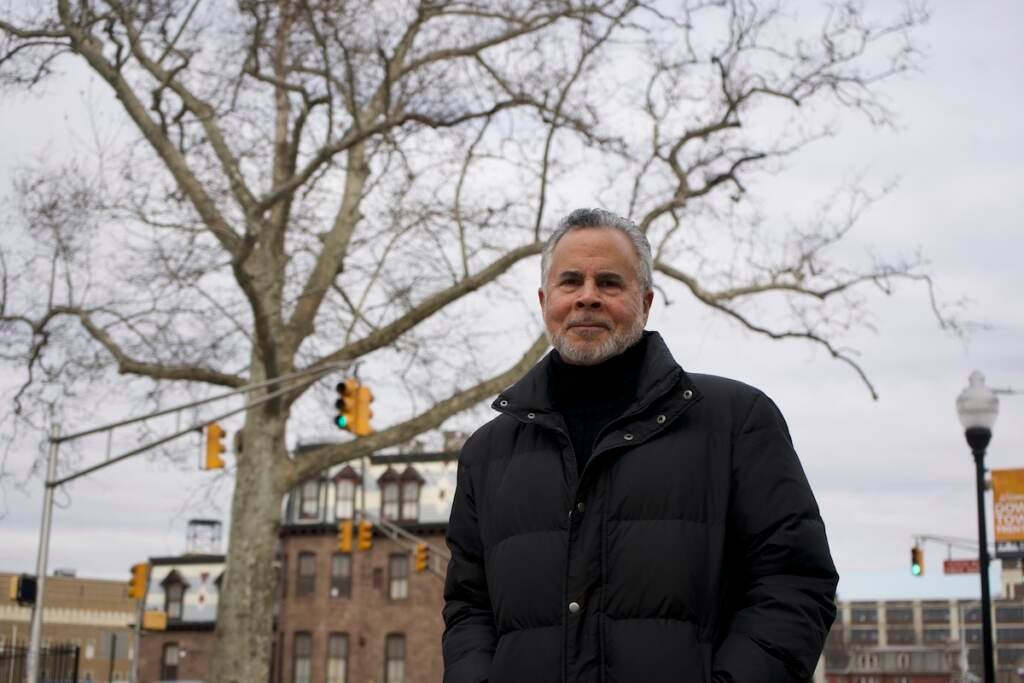
New Jersey Conservation Foundation co-Executive Director Jay Watson stands on the corner of East State Street and South Clinton Avenue near downtown Trenton. (Tennyson Donyéa/WHYY News)
The money is provided by the Natural Climate Solutions grant program funded by “Treasure Our Trees” license plate sales and New Jersey Forest Service No Net Loss Compensatory Reforestation Program. Watson said his organization will collaborate with the city to plant hundreds of oak, red maple, ginkgo, and sycamore trees at a corridor along East State Street and nearby parks.
According to experts, tree canopies have a myriad of physical and mental health benefits. Canopies also reduce urban heat by providing shade and absorbing harmful greenhouse gasses like carbon dioxide. Watson argues that neighborhoods lacking canopies tend to experience more quality-of-life-related issues including a disproportionate amount of crime.
“Data shows that a 10% increase in tree canopies on the street reduces crime by 12%,” Watson said.
If you liked this post, you’ll love our daily EnviroPolitics. It’s packed with the latest news, commentary, and legislative updates from New Jersey, Pennsylvania, New York, Delaware…and beyond. Please don’t take our word for it, try it free for an entire month. No obligation.
After 12 years of Republican control in the state, the election of Gov. Josh Shapiro represents a sea change.
Josh Shapiro waves after speaking at his swearing-in as Governor of Pennsylvania at the State Capitol Building on Jan. 17, 2023 in Harrisburg, Pennsylvania. Credit: Mark Makela/Getty Images
By Jon Hurdle, Inside Climate News
On Christmas Day 2022, part of a natural gas processing plant in Washington County, Pennsylvania caught fire, igniting a vapor cloud and prompting a response by the local fire department, a shutdown by the owner, and notification of the incident to the state’s Department of Environmental Protection. The fire burned itself out by about 5 p.m.
The DEP said its officials went to the Revolution Cryo plant in Smith Township on Dec. 25 and returned on Jan. 3 as part of an ongoing investigation into what caused the incident at the plant owned by Energy Transfer, a leading natural gas pipeline operator. The agency denied claims by some environmental groups that anyone calling its emergency line to report the incident got only a voicemail, and said that no residents evacuated.
As to the causes of the fire, the agency said it “does not comment on ongoing investigations or speculate on possible enforcement actions.”
To the DEP’s critics, its response to the fire, and the fire itself, are the latest signs that the agency is ineffective in dealing with industry and communicating with the public.
“They could have provided a much more detailed and transparent account about what happened, what the risks were, how people should be protecting themselves,” said Matt Mehalik, executive director of the Breathe Project, a nonprofit that advocates for improved air quality in southwest Pennsylvania. “The DEP did not broadcast that very widely, and there was a much more minimized sharing of information that largely is perceived as keeping those people in the dark during that period of time.”
Since the state’s hydraulic fracturing boom for natural gas began in the mid-2000s, critics say the DEP has been hobbled by staff cuts and a cultural reluctance to crack down on the industry in a state with a long history of fossil fuel extraction. The result has been explosions, spills, leaks, and contaminated private water wells as well as growing evidence that fracking for natural gas harms public health.
But with the inauguration of Josh Shapiro as the new Democratic governor and new leadership at the DEP, advocates for tougher regulation of the oil and gas industry, and for an activist approach to countering climate change, hope that the state is poised to begin a new chapter.
“I’m optimistic that making enforcement and being an advocate for the public will be a top substantive priority for the DEP under Gov. Shapiro, and not just on fracking,” said David Masur, executive director of PennEnvironment, an advocacy group.
If you liked this post, you’ll love our daily EnviroPolitics. It’s packed with the latest news, commentary, and legislative updates from New Jersey, Pennsylvania, New York, Delaware…and beyond. Please don’t take our word for it, try it free for an entire month. No obligation.
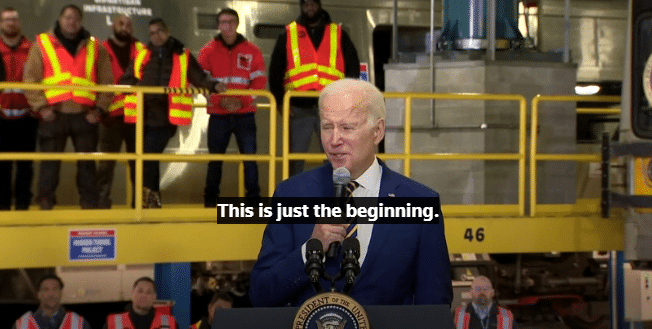
President Joe Biden came to New York City yesterday bearing a significant cash infusion for the Gateway transportation project and a promise to work out all financing for its centerpiece element — two more rail tunnels under the Hudson River.
At a Manhattan news conference, Biden said $292 million from the federal Bipartisan Infrastructure Law had been earmarked for the completion of a concrete casing for the tunnels, running under the Hudson Yards complex.
Biden also said he was committed to finalizing a financing structure for the entire $16 billion project, which had been slow-walked and de-emphasized by the Trump administration.
“It’s going to take time. It’s a multi-billion-dollar effort between the states and the federal government,” Biden said. “But we finally have the money and we’re going to get it done — I promise you. We’re going to get it done!”
The two existing rail tunnels — shared by Amtrak and NJ Transit — are more than a century old and deteriorating.
Estimated to be more than a decade away, completion of the new tubes would allow for restoration and, ultimately, doubling of rail capacity.
If you liked this post, you’ll love our daily EnviroPolitics. It’s packed with the latest news, commentary, and legislative updates from New Jersey, Pennsylvania, New York, Delaware…and beyond. Please don’t take our word for it, try it free for an entire month. No obligation.
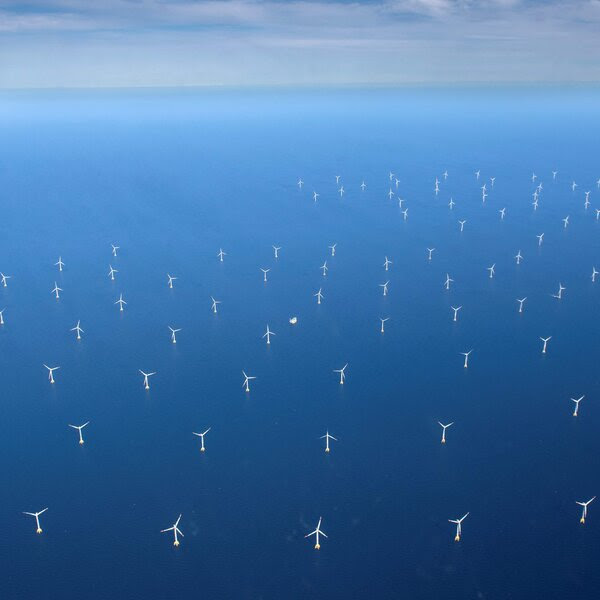
A wind farm on the Baltic, near Rügen Island, Germany. Wind and solar accounted for 22 percent of electricity generation in Europe last year.Fred Tanneau/Agence France-Presse — Getty Images
The shift to renewable energy is speeding up. Here’s how.
Wars have unintended consequences.
Russia’s war in Ukraine seems to have sped up the global energy transition from fossil fuels to renewables.
This is a big deal. Most of us take for granted that we will enter a dark room and flick on the lights, that our homes will be warm in winter, that we will look out the window of a car and watch the world go by.
But what powers our lives is undergoing a huge change.
Consider three recent developments.
Consider three recent developments.
First, according to the International Energy Agency, an estimated $1.4 trillion poured into “clean energy” projects in 2022, a category that includes solar farms, batteries, and electric vehicle charging stations. That’s more than ever before and more than the money that poured into new oil and gas projects. Fatih Birol, the head of the agency, described the energy crisis spurred by the Russian invasion as “an accelerator for clean energy transitions.”
Second, BloombergNEF, a research firm, described this direction of change in a report published last week. Investments in low-carbon energy “reached parity” with capital aimed at expanding fossil fuels, it said.
And finally, the oil giant BP said this week that it expected the war in Ukraine would push countries to ramp up renewable energy projects for the sake of energy security and that oil and gas demand could peak sooner than the company had anticipated just a year ago.
Spoiler alert: The shift away from fossil fuels isn’t happening fast enough to stay within relatively safe boundaries of climate change. For that to happen, a handful of big emerging economies in Asia, Africa, and Latin America will need more renewable energy projects. Financing those projects is more expensive in the countries of the global south than it would be in Europe and North America.
You’re going to hear a lot more going forward about the energy transition. It’s worth pausing for a minute today and looking at how big these changes are.
If you liked this post, you’ll love our daily EnviroPolitics. It’s packed with the latest news, commentary, and legislative updates from New Jersey, Pennsylvania, New York, Delaware…and beyond. Please don’t take our word for it, try it free for an entire month. No obligation.
With the possible exception of ocean dumping, no issue at the New Jersey Shore has ever exceeded in intensity the public concern generated by Ciba-Geigy, the industrial site that is today a not-yet-healed Superfund site in the heart of Toms River.
Actions by Gov. Phil Murphy’s administration through the New Jersey Department of Environmental Protection have caused the Ciba-Geigy issue to resurface, inflaming the feelings of the residents of Ocean County and of those who love the Jersey Shore.
This issue goes all the way back to the 1950s, when industrial production of dyes and chemicals began on that site. Then in the 1980s, a leaking pipeline to the ocean, as well as polluted drinking water, brought Ciba’s pollution into the consciousness of Shore residents. Ciba-Geigy became a notorious Superfund site.
Cancer cluster
Ciba-Geigy also became notorious as a possible cause of a documented childhood-cancer cluster in Toms River. The people of Ocean County suffered disease, death, and fear.
Today this Superfund site is owned not by Ciba-Geigy but by BASF, the huge German chemical corporation that acquired it in 2009.
Every Superfund site is more a process than a stationary situation. Cleanups, or one might better say attempted cleanups, are ongoing processes, literally for generations.
Today, at the discretion of the Murphy administration, the Ciba-Geigy site has been deemed ready to be assessed for what the state of New Jersey calls Natural Resource Damages. This is the process by which the owner of a polluting site compensates the local community and the state for the damage done.
In pursuit of this NRD settlement, the DEP has granted BASF what many experts — as well as the public’s common-sense reaction — hold to be a sweetheart settlement that will allow BASF to escape further responsibility for the site, as did the previous owner, Ciba-Geigy.
Behind closed doors
How sweet is this deal for BASF? We know some things but not others. After closed-door meetings with BASF, Murphy’s DEP has revealed only some of the ingredients that went into the settlement.
The DEP has opened a comment period during which the public has the opportunity to offer its opinions on the deal with BASF. But the validity of this comment period may legitimately be questioned given that the damage assessment, the document most essential for evaluating both the damage done and the fairness of the restoration proposed, has been kept secret.
The ways in which the DEP has procedurally handled this comment period have the heavy odor of a political fix:
The 30-day comment period initially given ran from Dec. 5 to Jan. 3, encompassing precisely the season during which the public has the least availability to take note and react.
The above-mentioned 30-day comment period is illegal because the law requires a minimum of 60 days. As career environmental regulators, the DEP officials surely know this.
When, under public pressure, the DEP did extend the comment period to 60 days, they declined to publish that extension in the New Jersey Register, with the seemingly intended consequence that any comments the public makes during the extension would by law not be allowed into the legal record should there be an appeal.
If you liked this post, you’ll love our daily EnviroPolitics. It’s packed with the latest news, commentary, and legislative updates from New Jersey, Pennsylvania, New York, Delaware…and beyond. Please don’t take our word for it, try it free for an entire month. No obligation.
New York City officials plan for a curbside composting program to be available citywide by the end of 2024, Mayor Eric Adams said in his State of the City address Thursday.
“Hiring our new rat czar will be just the beginning of a new era in delivering the best in public services and public spaces,” Adams said. “We’re going to get stuff cleaner by launching the country’s largest curbside composting program.By the end of 2024, all 8.5 million New Yorkers will finally have the rat-defying solution they’ve been waiting for two decades.”
Over a three-month period, a composting pilot in Queens diverted nearly 6,500 tons of kitchen and yard waste from landfills, Adams reported. “Imagine how much we will accomplish when every family in the city is participating. A lot of people have talked about this issue, but this administration is getting it done,” Adams said.
If you liked this post, you’ll love our daily EnviroPolitics. It’s packed with the latest news, commentary, and legislative updates from New Jersey, Pennsylvania, New York, Delaware…and beyond. Please don’t take our word for it, try it free for an entire month. No obligation.


 A wind farm on the Baltic, near Rügen Island, Germany. Wind and solar accounted for 22 percent of electricity generation in Europe last year.Fred Tanneau/Agence France-Presse — Getty Images
