Ron Goldman filed this report for NJ Spotlight News
Nearly two years after it was introduced, New Jersey’s landmark environmental justice law has yet to take effect. It’s been touted as a national standard for protecting low-income communities against having to bear the brunt of pollution. State environmental authorities are giving community groups and business lobbyists a final chance to influence the new regulations.
If you liked this post you’ll love our daily environmental newsletter, EnviroPolitics.It’s packed with the latest news, commentary, and legislative updates from New Jersey, Pennsylvania, New York, Delaware…and beyond. Don’t take our word for it, try it free for an entire month. No obligation.
the “Inflation Reduction Act of 2022,” the bill would spend nearly $370 billion on a raft of tax credits to help stimulate the adoption of clean energy technologies.
Senate Democrats struck a deal with West Virginia Sen. Joe Manchin on Thursday for an expansive bill that includes the biggest package in U.S. history to address climate change.
The bill, H.R. 5376 (117), dubbed the “Inflation Reduction Act of 2022,” would spend nearly $370 billion on a raft of tax credits to help stimulate the adoption of clean energy technologies, as well as spending for low-income and minority communities that suffer disproportionately from pollution.
It also calls for holding lease sales for oil and gas production on federal land and water, while establishing fines for excessive methane pollution.
Here’s a breakdown of what’s in the bill expected to reach the Senate floor next week:
Clean energy tax credits
Democratic lawmakers have long eyed the party-line budget reconciliation as a crucial vehicle for the extension and expansion of a host of renewable energy tax incentives and for next-generation technologies, including clean hydrogen and advanced nuclear — all of which saw support in the final agreement. The package of credits is seen as the biggest driver of emissions reductions, given its role in accelerating the deployment of renewable energy and new technologies.
The agreement includes 10-year extensions of existing credits for wind and solar, as well as provisions for heat pumps, rooftop solar and standalone energy storage, like batteries. The credits also are tied to prevailing wage and domestic content requirements — a bid to help ensure the clean energy transition is built by a unionized workforce and through a domestic supply chain.
EVs
While Manchin raised criticisms about electric vehicle incentives, they ultimately made it into the package: A $7,500 rebate for new vehicles and a $4,500 tax credit for used ones. It’s a potentially significant boon for expanding electric vehicle purchases to drive down greenhouse gas emissions from transportation, the largest source of the greenhouse gases in the U.S.
If you liked this post you’ll love our daily environmental newsletter, EnviroPolitics.It’s packed with the latest news, commentary, and legislative updates from New Jersey, Pennsylvania, New York, Delaware…and beyond. Don’t take our word for it, try it free for an entire month. No obligation.
NEWARK, NJ — Environmental justice rules that community leaders across New Jersey have fought for more than a decade to secure sent a clear message during a meeting hosted Wednesday in Newark by the New Jersey Department of Environmental Protection (DEP) that they will not let polluting facilities burden their communities anymore.
“This is bare minimum protection. You shouldn’t have three power plants in a four-square-mile community that’s surrounded by a Superfund site,” Ironbound Community Corporation (ICC) Deputy Director of Organizing and Advocacy Maria Lopez-Nuñez told a panel of DEP representatives during the meeting. “You have to look at the multitude of people you’re protecting. That is your job.”
Lopez-Nuñez was one of more than dozens of people who spoke out in support of new draft rules proposed by the department that would require facilities seeking certain permits in overburdened communities to prepare an environmental justice impact statement. The draft rules also propose to increase public input and participation in the permitting process.
The meeting, which was held at the New Jersey Institute of Technology (NJIT), was hosted by the DEP to gather public comment on the proposed rules. The meeting came after Gov. Phil Murphy in September 2020 signed Environmental Justice Law (S232), which gives the DEP the authority to deny permits to polluting facilities that would exacerbate overburdened communities across the state. Overburdened communities include municipalities with at least 35% of households that qualify as low-income and at least 40% of residents identify as minority or as members of a state-recognized tribal community.
The proposed rules would impact environmental justice communities like Newark, where many of its low-income residents and underserved communities have been disproportionately impacted by pollution for decades. The city is located at the center of major transportation hubs for air travel, trucking, and rails, plus a seaport.
Due to Newark’s long history of industrialization and being located in proximity to several major transportation hubs, residents have been subject to high levels of air and water pollution for decades. Ironbound residents are currently in the midst of an ongoing battle to stop the construction of a proposed standby power generation facility in their neighborhood that would run on natural gas – a fossil fuel. Residents have also experienced increased rates of asthma, maternal health issues, and other health complications as a result of pollution.
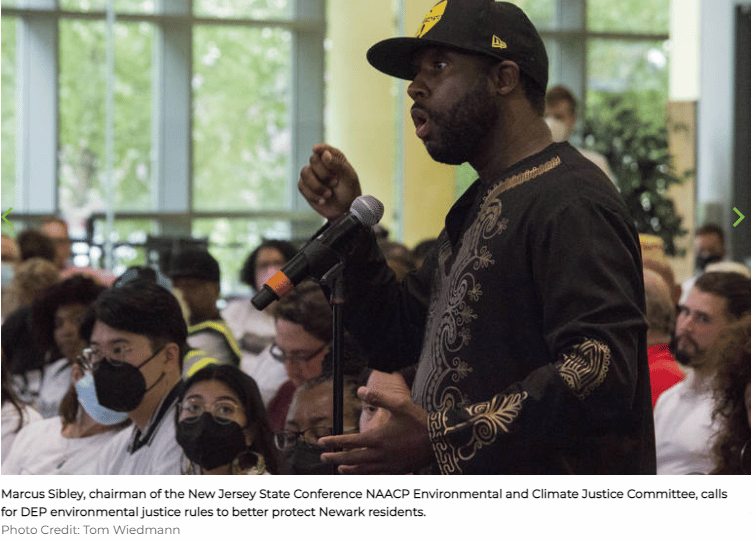
“I used to be a camp counselor at a program right in [Newark’s] Ironbound section, and what I know now, I didn’t know then. I didn’t realize all of the things that were in that environment was impacting those young children,” said Marcus Sibley, chairman of the New Jersey State Conference NAACP Environmental and Climate Justice Committee. “The point of this rule and the point of all of us being here today is to ensure that these young people have a chance. There shouldn’t be anything that prevents our young, beautiful future leaders from being able to achieve their highest goals.”
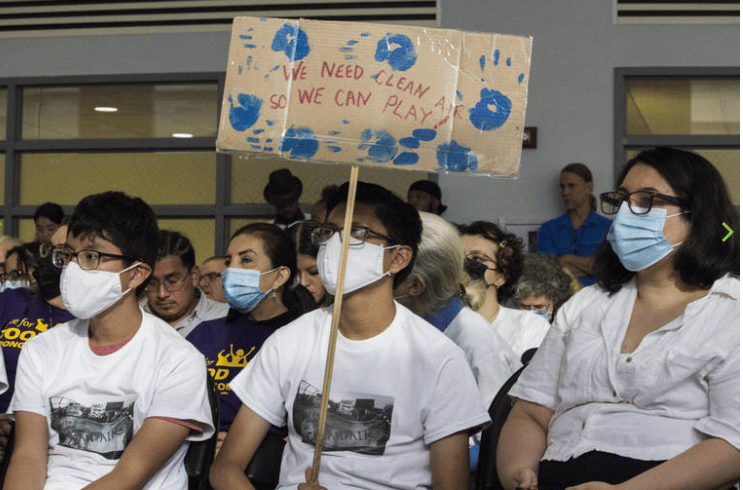
One youngster’s sign in the audience pleaded for the most essential childhood right.
“We need clean air so we can play!” the sign read.
Although environmental advocates turned out in droves to voice their support for legislation that they hope will better protect their communities, industry officials from organizations such as the New Jersey Business & Industry Association (NJBIA) have called for more regulatory flexibility and certain economic exemptions to be included in the rules.
“The proposal misses the mark by only focusing on the potential or presumed negative impacts, as it doesn’t measure actual emissions, but only sources,” NJBIA Vice President of Government Affairs Ray Cantor said in a statement.“The rule does not, at all, account for the jobs and positive economic impacts these facilities have in these communities.”
If you liked this post you’ll love our daily environmental newsletter, EnviroPolitics.It’s packed with the latest news, commentary, and legislative updates from New Jersey, Pennsylvania, New York, Delaware…and beyond. Don’t take our word for it, try it free for an entire month. No obligation.
One of New Jersey’s oldest Superfund sites is a big step closer to being deemed cleaned up. The Environmental Protection Agency is proposing an end to work to clean polluted groundwater at the Universal Oil Products site in East Rutherford, where toxic chemicals contaminated the soil and sediment dating back to 1930.
If you liked this post you’ll love our daily environmental newsletter, EnviroPolitics.It’s packed with the latest news, commentary, and legislative updates from New Jersey, Pennsylvania, New York, Delaware…and beyond. Don’t take our word for it, try it free for an entire month. No obligation.
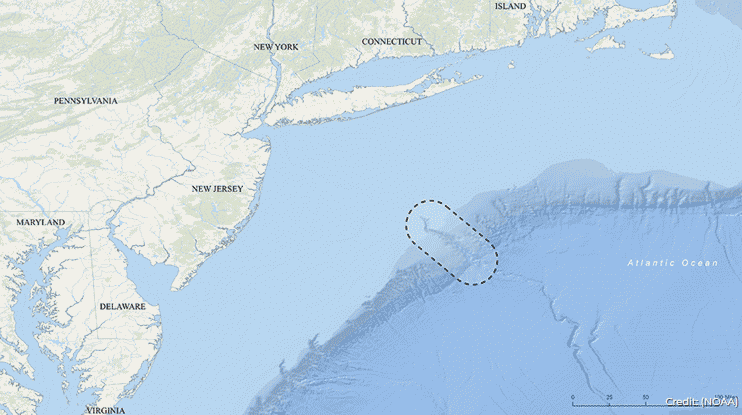
This visual is for reference only and does not represent an official boundary proposal from NOAA.
By Jon Hurdle, NJ Spotlight
An undersea canyon 100 miles from the Statue of Liberty could become a national marine sanctuary if a federal proposal becomes a reality, but New Jersey’s fishing community fears that the designation could lead to more regulation that will hinder their livelihoods.
Federal officials say they are not planning to add new rules to cover the ecologically important Hudson Canyon, and that fishing there would still be allowed under the plan to designate the area a protected sanctuary, as it is in almost all of the 15 sanctuaries that already exist off the U.S. coast.
But representatives of commercial and recreational fishing don’t trust the assurances that their access to the area would not be curbed if the sanctuary is created.
“We’re being given assurances that we will be able to fish commercially and recreationally in the canyon but that could change,” said John Toth, president of the Jersey Coast Anglers Association, a recreational fishing group. “Once it’s a sanctuary, they don’t have to abide by some of the regulations; they could say overnight ‘this type of fishing can’t go into the canyon.’”
Toth spoke after a public meeting last week at which federal officials outlined their plans for the canyon and heard comments that will help to inform an official report on the environmental impacts of creating a sanctuary. The two-month public-comment period ends Aug. 8, and the National Oceanic and Atmospheric Administration expects to make a final decision on the proposal in two to three years’ time.
Abundant and diverse
The agency calls the two-mile-deep canyon an “ecological hotspot” because of the abundance and diversity of its marine wildlife. It says a sanctuary designation would help conserve species, habitats and cultural resources including historic connections that indigenous people have to the area.
The proposal to create a sanctuary was first made in 2016 by a group of environmental advocates including the Wildlife Conservation Society, a nongovernmental organization that manages the New York Aquarium and four zoos in the New York area.
If you liked this post you’ll love our daily environmental newsletter, EnviroPolitics.It’s packed with the latest news, commentary, and legislative updates from New Jersey, Pennsylvania, New York, Delaware…and beyond. Don’t take our word for it, try it free for an entire month. No obligation.
BEDMINSTER, New Jersey — After nearly 21 years and what seems to be an endless river of pain, this is what the 9/11 story has come to.
Three relatives of victims of America’s deadliest terror attack — a wife who lost her husband; a mother who lost her son; a son who lost his father — stood Tuesday on a patch of grass by the local public library in this community of rolling hills and horse pastures. Two miles away sat a golf course owned by former President Donald Trump.
It was 9:20 a.m. The humidity and 90-degree temperatures of recent days had softened. But tempers still steamed over Trump’s decision to host a golf tournament financed by Saudi Arabia despite new declassified FBI files with evidence that at least a dozen Saudi officials provided financial and logistical support to the team of Islamists who pulled off the Sept. 11 attacks, which killed nearly 3,000 people.
The LIV Golf tournament, at Trump National Golf Club in Bedminster, begins Thursday with a one-day pro-am competition, followed on Friday by a three-day, 54-hole tournament featuring such stars as Phil Mickelson, Bryson DeChambeau, Brooks Koepka, and Patrick Reed.
The LIV Golf series, which features several tournaments in the coming months, culminating at Trump’s Doral course in Miami, describes itself as “golf as you’ve never seen it.” That may be one of the most prophetic understatements of sports — in this case, with the additional controversy of 9/11 and Saudi Arabia’s alleged links to Islamist terrorism lurking in the shadows.
If you liked this post you’ll love our daily environmental newsletter, EnviroPolitics.It’s packed with the latest news, commentary, and legislative updates from New Jersey, Pennsylvania, New York, Delaware…and beyond. Don’t take our word for it, try it free for an entire month. No obligation.