CNBC’s Brian Sullivan joins Morning Joe to discuss the potential economic impact of the Supreme Court’s ruling that the EPA doesn’t have power to limit greenhouse gas emissions from power plants. The Washington Post’s Eugene Robinson also joins the discussion.
The vote was 6 to 3, with the court’s three liberal justices in dissent, saying that the majority had stripped the E.P.A. of “the power to respond to the most pressing environmental challenge of our time.”
The implications of the ruling could extend well beyond environmental policy. It also signals that the court’s newly expanded conservative majority is deeply skeptical of the power of administrative agencies to address major issues facing the nation and the planet.
The decision set off criticism from the left, but voices from the coal industry and conservative states praised the ruling.
Mr. Biden, left with far fewer tools to fight climate change, said the ruling was “another devastating decision that aims to take our country backwards.” He vowed to take action even as the court limited his ability to act, adding: “We cannot and will not ignore the danger to public health and existential threat the climate crisis poses.”
Patrick Morrisey, the attorney general of West Virginia and one of the leaders of the challenge to the E.P.A.’s authority, welcomed the decision.
“E.P.A. can no longer sidestep Congress to exercise broad regulatory power that would radically transform the nation’s energy grid and force states to fundamentally shift their energy portfolios away from coal-fired generation,” he said.
If you liked this post you’ll love our daily environmental newsletter, EnviroPolitics.It’s packed with the latest news, commentary, and legislative updates from New Jersey, Pennsylvania, New York, Delaware…and beyond. Don’t take our word for it, try it free for an entire month. No obligation
New York State rejected the renewal permit for a power plant used by Greenidge Generation Holdings Inc. for Bitcoin mining, a decision that comes after about six months of delays.
The Department of Environmental Conservation said it denied the application because of statewide limits on greenhouse gas emissions.
The ruling comes amid a heated debate between environmental groups and cryptocurrency miners about Bitcoin mining, which uses energy-intensive computers to process records of transactions and earn rewards in the virtual currency. It has become one of the most lucrative businesses and has expanded rapidly in the US.
Still, New York is putting forward restrictive measures on crypto mining facilities. The state Senate recently passed a bill that bars miners from using fossil-fuel sources to power their operations.
The bill is set to be delivered to Governor Kathy Hochul, who will decide whether it should become law. Hochul didn’t respond to a request for comment on the legislation.
This is the first time Greenidge’s permits to operate the natural-gas fired facility in upstate Dresden have come up for renewal. The state agency delayed decisions in January and again in March.
If you liked this post you’ll love our daily environmental newsletter, EnviroPolitics.It’s packed with the latest news, commentary, and legislative updates from New Jersey, Pennsylvania, New York, Delaware…and beyond. Don’t take our word for it, try it free for an entire month. No obligation.
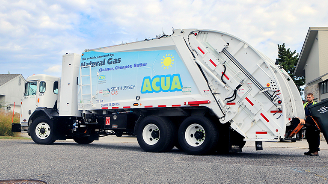
VINELAND — The city and the Atlantic County Utilities Authority have reached a new 17-month agreement for trash and recycling collection services set to take effect Aug. 1 and run through the end of 2023, the city said Tuesday night.
Under the agreement, residents will see their monthly solid waste fee remain $24 per month. However, trash collection will be reduced from twice to once weekly, the city said in a news release. To compensate for the lost trash collection day, residents will be able to request a second 96-gallon trash cart at no additional cost.
The interim agreement will give city officials time to explore long-term options, the city said. City Council voted to introduce the agreement Tuesday.
Vineland will pay the ACUA $194,671.67 per month for trash and recycling collections, according to the agreement.
It also will pay for all tipping fees charged by the Cumberland County Improvement Authority and is subject to increase based on the number of residences receiving services, according to the agreement.
Additionally, the city will be given a credit for missed trash and recycling collections and their associated costs.
“Two government agencies worked out what should have been worked out months ago,” ACUA President Rick Dovey said.
The authority has been plagued by staffing shortages amid a tight labor market, something Dovey said is a widespread trend.
The labor issues have caused the ACUA to struggle to provide timely trash, recycling and yard-waste pick-up in the municipalities it serves. Vineland, one of three Cumberland County towns for which the ACUA holds collection contracts, was withholding payment from the ACUA for months, citing inconsistent service.
The ACUA chose to terminate its waste-collection contract with the city in March.
Prior to negotiating the new agreement, the city had issued a request for proposal for trash collection and recycling services. Although other companies expressed interest in working with the city, they would have needed to scale up their operations, which required a longer lead time than was available to purchase new equipment, the city said.
“There is no doubt that the ACUA’s aggressive growth plan, coupled with pandemic-driven labor market shortages, led to their collection issues in Vineland,” Mayor Anthony Fanucci said. “Additionally, inflationary pressures on fuel, along with supply shortages, made it impossible for the ACUA to provide future services to the city at the current contract levels. This interim agreement makes fiscal sense for both parties in the short term.”
If you liked this post you’ll love our daily environmental newsletter, EnviroPolitics.It’s packed with the latest news, commentary, and legislative updates from New Jersey, Pennsylvania, New York, Delaware…and beyond. Don’t take our word for it, try it free for an entire month. No obligation.
TRENTON, N.J. – New Jersey will now allow steel slag, a byproduct of the steel and iron recycling process, to be used in construction fill for certain industrial and commercial developments and remediation projects without the need for additional Department of Environmental Protection approval.
In May, the Assembly concurred with the governor’s recommendations to align the uses for steel slag in the bill (A642) with those that the DEP had previously identified as qualifying for exclusion from solid waste regulations. The governor signed the bill into law on Friday.
“Not only does steel slag help to reduce construction costs, but since it is produced through recycling, it is also a sustainable alternative to other aggregate materials,” said Assemblyman Ron Dancer (R-Ocean), a prime sponsor of the measure. “This law lessens our reliance on natural resources like sand and gravel while offering an environmentally sound and economical fill option for developers in New Jersey.”
Under the new law, the use of steel slag cannot cause a violation of drinking and groundwater quality standards, and steel slag remains subject to DEP oversight when it is used in ways not covered by the law.
The Federal Highway Administration estimates that between 7.7 and 8.3 million tons of steel slag are used each year in the United States. The primary applications are its use as a granular base or as an aggregate material used in asphalt or concrete. It can be used as a clean fill in remediation projects where contaminated soil has been removed.
If you liked this post you’ll love our daily environmental newsletter, EnviroPolitics.It’s packed with the latest news, commentary, and legislative updates from New Jersey, Pennsylvania, New York, Delaware…and beyond. Don’t take our word for it, try it free for an entire month. No obligation.If you liked this post you’ll love our daily environmental newsletter, EnviroPolitics.It’s packed with the latest news, commentary, and legislative updates from New Jersey, Pennsylvania, New York, Delaware…and beyond. Don’t take our word for it, try it free for an entire month. No obligation.
If you liked this post you’ll love our daily environmental newsletter, EnviroPolitics.It’s packed with the latest news, commentary, and legislative updates from New Jersey, Pennsylvania, New York, Delaware…and beyond. Don’t take our word for it, try it free for an entire month. No obligation.