Scarlet Guarantee program means those with family incomes of $65,000 or lower can attend for free
ByROI-NJ STAFF(New Brunswick)
Officials at Rutgers–New Brunswick announced Monday a sweeping new financial aid program that will enable New Jersey students with family incomes below $65,000 to attend the university – tuition-free.
The program also provides a sliding scale that significantly limits the amount of out-of-pocket tuition and fees paid by students with family incomes below $100,000.
The Scarlet Guarantee program will be available to first- and second-year students and is linked to the Garden State Guarantee, a new statewide program launched last month by Gov. Phil Murphy that assists third- and fourth-year students.
Rutgers officials estimate that 7,600 students will be able to take advantage of the programs.
Chancellor-Provost Francine Conway said the announcement is a pivotal moment for the state.
“These new programs are transformational for our state’s students,” she said. “Students who once thought a college education could never be within reach will have the access and opportunity to fulfill their life’s ambition. I couldn’t be more thrilled that Rutgers-New Brunswick will now be more inclusive of all students.”
If you liked this post you’ll love our daily newsletter, EnviroPolitics.It’s packed with the latest news, commentary, and legislative updates from New Jersey, Pennsylvania, New York, Delaware…and beyond. Don’t take our word for it, try it free for an entire month. No obligation.
A Senate panel will weigh tying New Jersey’s income tax brackets to inflation next week, giving fresh air to a tax cut proposal that has remained stalled for more than a decade.
The proposal that will come before the Senate Budget Committee on Monday would require the Division of Taxation to annually adjust New Jersey’s tax brackets to track with the Consumer Price Index. The change would be costly — it would cut tax collections by hundreds of millions of dollars each year — but it’s one Republicans say is sorely needed as surging inflation cuts into the buying power of taxpayers’ income.
“Our low and middle-income folks need this now more than ever,” said Sen. Tony Bucco (R-Morris), the bill’s prime sponsor. “They do it at the federal level, and there’s no reason we shouldn’t give that same benefit and that same tax break to our residents here in New Jersey.”
New Jersey’s income tax is paid under a series of marginal rates that grow with a filer’s income, topping out at 10.75% for income that exceeds $1 million.
At present, the state’s tax brackets only move when lawmakers approve changes to the state’s tax code.
Though the Legislature approved the creation of a new tax bracket for multi-millionaires — and later millionaires — during Gov. Phil Murphy’s first term, the state’s tax brackets for earners in lower bands have not moved since temporary tax hikes put in place by Gov. Jon Corzine that expired in 2009.
If you don’t tie tax brackets to inflation, proponents of the move argue, they capture filers they weren’t intended to. In 1996, the 6.37% bracket for $75,000 in income was intended for income that in today’s dollars translates to $136,568.
That so-called “bracket creep” is what the sponsors want to avoid.
We’re sure you will benefit from EnviroPolitics because of all the important information it contains every morning.
Our daily subscription newsletter is read by leading environmental attorneys, engineers, consultants, business and political leaders, organizations, and people like youwho want to stay current with everything that’s happening with energy and environmental issues at the local, state, and federal levels.
No need to wait for the occasional free issue. Today we’re offering a very special offer–an entire month of EnviroPolitics absolutely free.
You should jump on this pronto.
Click hereto start your free trial subscription with no obligation.
The Golden State — which has long dealt with smoggy skies — often sets environmental policy other states eventually follow
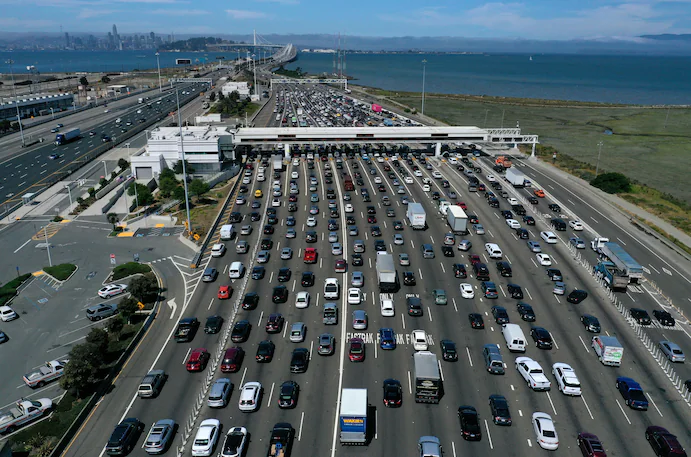
Traffic backs up at the San Francisco-Oakland Bay Bridge toll plaza along Interstate 80 in Oakland, Calif., in July 2019. (Justin Sullivan/Getty Images)
The Biden administration is expected to restore California’s authority to set its own limits on climate-warming emissions from cars, pickups, and SUVs.
Long an environmental leader among states, California often sets a precedent that the rest of the country follows. But when it came to combating climate change, the Trump administration hamstrung the Golden State by stripping it of the right to set its own rules around carbon pollution for the thousands of cars cramming the state’s freeways.
Now, the Biden administration is preparing to undo that Trump-era decision. And the reversal will resonate beyond California to the whole nation’s transportation sector.
What exactly is the Environmental Protection Agency doing?
Federal officials are preparing to restore a “waiver” to regulators in California, giving them the ability to set standards tougher than those from the federal government for the carbon dioxide that spews out of automobile tailpipes, according to two people familiar with the decision who spoke on the condition of anonymity ahead of the agency’s announcement.
Normally, it’s up to the federal government to cut pollution from gasoline-guzzling vehicles. Those mobile sources of emissions, after all, can cross state lines and taint the air no matter where they are made or sold.
But the law treats the country’s most populous state differently. Under the Clean Air Act, California — and California alone — can request permission from the federal government to write its own tailpipe standards if it can provide a compelling reason for doing so. More than a dozen other states have committed to following California’s lead on greenhouse gas pollution from cars.
EPA spokesman Nick Conger said the agency will announce its decision on the California waiver “in the near future.” E&E News first reported that the announcement is coming soon.
Why can California set its own rules?
In the middle of the 20th century, the skies in Los Angeles were once so polluted that, on some days, it was difficult to see even a few blocks ahead. During bad episodes, Californians complained of burning eyes and upset stomachs.
California regulators realized the cars clogging its burgeoning roadways were the reason for the smog. The state sprang into action, developing the country’s first vehicle emissions standards for smog-forming pollutants in 1966.
When federal lawmakers sat down to strengthen the Clean Air Act four years later, they decided to allow California to continue writing its own rules for cars. Over time, the decision has helped spur innovation in the auto sector. Catalytic converters, “check engine” lights and other ideas born out of California’s regulatory system have been adopted in cars sold nationwide.
If you liked this post you’ll love our daily newsletter, EnviroPolitics.It’s packed with the latest news, commentary, and legislative updates from New Jersey, Pennsylvania, New York, Delaware…and beyond. Don’t take our word for it, try it free for an entire month. No obligation.
The department’s inspector general found Zinke had repeated contact with developers about a real estate deal and lied about it to an ethics official. The Justice Department declined to bring charges.
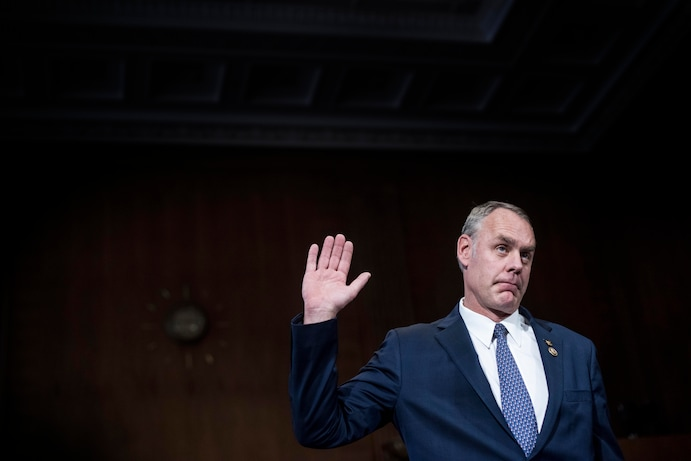
On Jan. 17, 2017, then-Rep. Ryan Zinke (R-Mont.) appears before the Senate Committee on Energy and Natural Resources for his confirmation hearing as President-elect Donald Trump’s nominee for interior secretary. (Melina Mara/The Washington Post)
Facing serious allegations about his ethics and conduct in office, Ryan Zinke, then secretary of Donald Trump’s Interior Department, told a government official in 2018 that he had done nothing improper. Negotiations over a land deal in his hometown of Whitefish, Mont., were proceeding without him. His involvement was minimal, he said; his meeting with the project’s developers at Interior headquarters was “purely social.”
But a report released Wednesday by the department’s internal watchdog caught Zinke in a lie. Email and text message exchanges show he communicated with the developers 64 times between August 2017 and July 2018 to discuss the project’s design, the use of his foundation’s land as a parking lot, and his interest in operating a brewery on the site.
“These communications, examples of which are set forth below, show that Secretary Zinke played an extensive, direct, and substantive role in representing the Foundation during negotiations with the 95 Karrow project developers,” Inspector General Mark Greenblatt’s office wrote.
Zinke “was not simply a passthrough for information,” the report said. “He personally acted for or represented the Foundation in connection with the negotiations.”
The report found that Zinke broke federal ethics rules repeatedly by improperly participating in real estate negotiations with the then-chairman of the energy giant Halliburton and other developers.
Zinke continued to represent his family’s foundation in the negotiations for nearly a year, investigators found, even after committing to federal officials that he would resign from the foundation and would not do any work on its behalf after he joined the Trump administration.
“It does feel like a betrayal,” clean-energy advocate Sam DiFalco said about NJ Transit’s revised plans for a natural gas-fueled power plant in Kearny. The plant is supposed to supply electricity to keep trains running during massive power outages like the one caused by Superstorm Sandy.
Environmental groups had lobbied hard for a solar-powered plant and Gov. Phil Murphy advised NJ Transit in fall 2020 to come up with a greener blueprint. NJ Transit promised to “reimagine” a more environmentally friendly project but a gas-powered plant still dominates the agency’s new request for proposals from developers. “It’s clear the RFP is very tilted towards fossil fuels,” said Dave Pringle of Clean Water Action. NJ Transit says it is committed to designs that maximize clean energy.
If you liked this post you’ll love our daily newsletter, EnviroPolitics.It’s packed with the latest news, commentary, and legislative updates from New Jersey, Pennsylvania, New York, Delaware…and beyond. Don’t take our word for it, try it free for an entire month. No obligation.