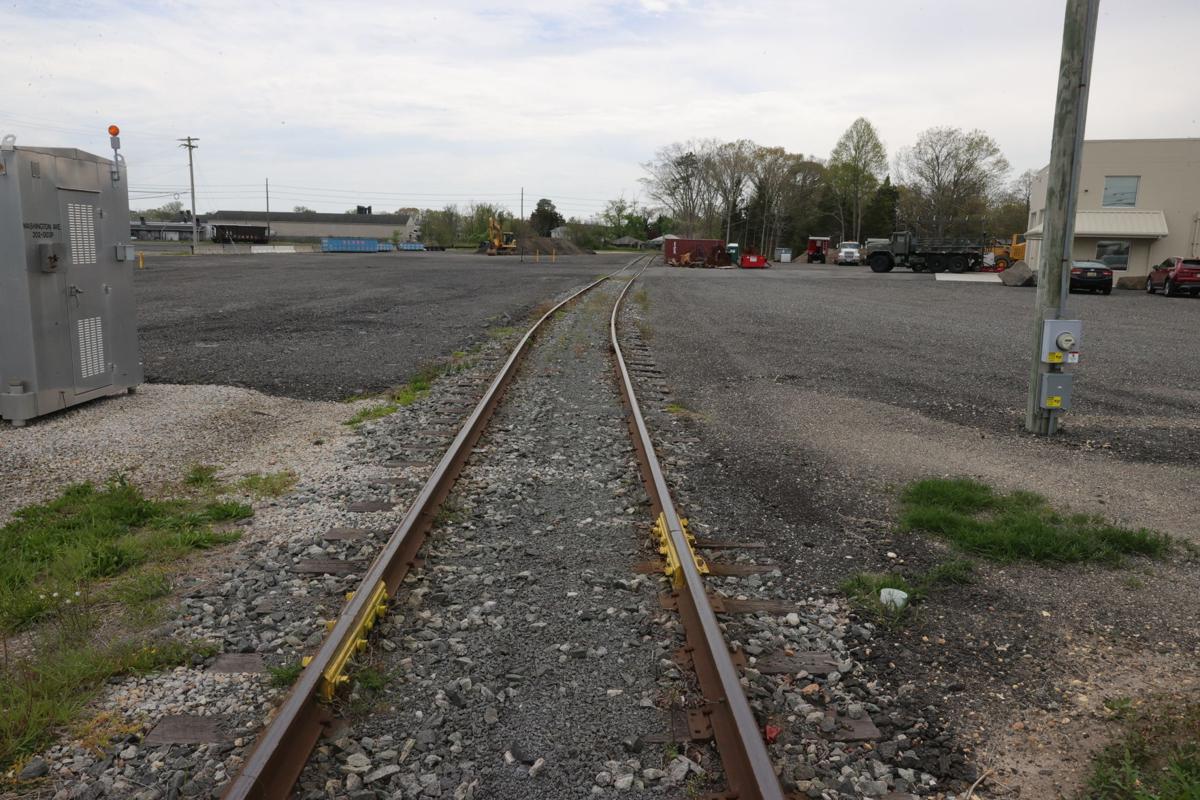
A construction debris trash transfer station is proposed off Washington Avenue in Pleasantville. The Atlantic County Utilities Authority says it would result in increased tipping fees for non-commercial trash. Edward Lea photo
PLEASANTVILLE — Residents looking for a forum to discuss a proposed debris-waste transfer station will, yet again, have to wait for a later date.
Organizers have chosen to further postpone a town hall meeting on the subject, citing a high volume of COVID-19 cases in the region. A new date has not been announced.
The town hall had been scheduled for Wednesday at Mount Zion Baptist Church, after being pushed back from Jan. 19. COVID-19 was cited as the reason then as well.
COVID-19 cases have been declining in the region as the holiday surge of the omicron variant wanes. Atlantic County reported three new COVID-19 cases and one new death in Pleasantville on Wednesday. On Jan. 19, the date the town hall originally was supposed to be held, the county reported 30 new cases in Pleasantville.
The event is being advertised on the website for the “Stop the Dump” movement, a campaign being spearheaded by the Atlantic County Utilities Authority. The website says the event has been postponed and tells visitors to await updates, as does a Facebook page where the event was to be live-streamed.
In 2019, New York State passed a historic law to cut greenhouse gas emissions from every part of its economy. But for some, the most significant part of the legislation was its focus on environmental justice and equity. The law, titled the Climate Leadership and Community Protection Act, required that 35 to 40 percent of future benefits of state investments in clean energy, energy efficiency, housing, workforce development, transportation, and pollution reductions would have to serve “disadvantaged communities.”
That provision was modeled on a similar program in California and later became the template for a national goal called “Justice40,” which President Joe Biden announced when he took office a year ago. But New York — and the federal government, for that matter — can’t be held accountable for that promise until it clears up how the benefits of investments will be measured, and pins down what, exactly, a disadvantaged community is.
While New York state officials worked to clarify the benefits question, a new Climate Justice Working Group, made up of leaders of environmental justice and community organizations from around the state, was tasked with deciding on the criteria to identify disadvantaged communities. After 18 months of deliberation, they have finally arrived at some answers.
In December, Chris Coll, director of the energy affordability and equity program at the New York State Energy Research and Development Authority, informed the Climate Justice Working Group how state agencies have decided to measure benefits. The announcement, which was made during the final working group meeting of the year, confirmed what many in the climate justice community had been hoping for: While agencies will keep track of any nonmonetary benefits from climate-related investments, they will only count direct investments — the actual dollar amounts of climate-related spending — toward compliance with the 35 to 40 percent goal.
HOBOKEN, NJ — Four Hoboken council members raised questions this week about the fact that Hoboken Mayor Ravi Bhalla recently moved from an “of counsel” position at one New Jersey law firm to another. Back in 2018, Bhalla had raised eyebrows when he took a $60,000 slot at a law firm after pledging during his first campaign to focus full-time on the mayor job.
On Dec. 30, 2021, law firm Schenck, Price, Smith, and King — where Assistant City Attorney John Allen also is employed — posted on its website that Bhalla is now “of counsel” there. Bhalla did not announce the change in firms publicly, but it was revealed in the press this week.
In his past slot, Bhalla also held an “of counsel” role and could earn additional funds for delivering clients. Bhalla also earns $116,950 per year as mayor.
Rob Horowitz, who served as Bhalla’s spokesperson for his unopposed re-election bid in November, answered questions this week about the new spot.
Thomas A. Pankok, a humble, community-minded Korean War veteran who served two terms in the New Jersey State Assembly before he was swept out of office in Gov. Thomas Kean’s 1985 landslide re-election, died on January 31. He was 90.
Pankok launched his political career in 1958 as a 27-year-old candidate for Salem City Council. He was re-elected in 1960, winning his West Ward seat with 64% of the vote against Republican David Ayers.
Pankok was elected to the Salem County Board of Freeholders in 1965 with 62% against Republican Joseph Pew. That was at a time when most municipalities had their own freeholder. He won again in 1966, winning a two-year term for a reconstituted, smaller freeholder board.
Pankok ran for re-election in 1968 on a ticket with former Senate Majority Leader John Waddington (D-Salem), who spent 12 years representing Salem County in the State Senate before losing re-election in 1967.
Waddington won, but the decision of Salem County voters to split their tickets led to Pankok finishing fourth in a four-candidate race, about 900 votes behind Waddington. Republican John Pancoast won, and his running mate, David Crockett, lost.
Following the resignation of Salem City Mayor Norris Williams to become undersheriff in 1969, the city council elected Pankok to serve as the new mayor. He did not run in a special election that year.
In 1970, Pankok was again elected to serve as a Salem County freeholder. He and George Ayes, the former mayor of Alloway, ousted Republican incumbent Lester Harris and William Martin by about 1,500 votes.
Despite the Watergate Democratic wave in 1973, Pankok just narrowly won re-election against Republicans Martyna McLean and Martin, who was seeking a comeback. Pankok won by about 300 votes.
Pankok won again in 1976. He ran about 3,000 votes in front of Republicans Stephen Rogers and George Pappas, a former freeholder. He won again in 1979.
When Assemblyman H. Donald Stewart (D-Oldmans) decided not to seek re-election to a fifth term in the 3rd legislative district, Democrats picked Pankok as his replacement on a ticket with four-term Assemblyman Martin Herman (D-Woodbury).
Herman and Pankok defeated Republicans Erwin Sheppard, a Lawrence Township Committeeman, and Harrison Township Deputy Mayor David Liddle. Herman finished 2,825 votes ahead of Pankok, who outpolled Sheppard by 4,025 votes.
The two Democrats were re-elected in 1983 against Republicans Russ Paul and Edmund “Duke” Downer. Pankok won by 3,655 votes.
With Kean, the popular Republican governor, heading the ticket in 1985, the GOP flipped fourteen Assembly seats to take control of the lower house for the first time in twelve years.