The United States and China, the world’s two largest emitters of carbon dioxide, unveiled a deal to ramp up cooperation tackling climate change, including by reducing methane emissions, protecting forests and phasing out coal. Reuters
New Jersey State Senator Kip Bateman’s legislation requiring developers to offer a more environmentally friendly concrete product as an option in new construction is now law.
“We want to encourage the use of concrete products utilizing ‘carbon footprint-reducing technology.’ Concrete is the most widely used construction material, but it is responsible for 8 percent of the world’s carbon dioxide emissions,” said Bateman (R-16). “Technology now allows concrete to be produced with less energy, reducing carbon emissions, and this bill will support its adoption in the marketplace.”
The new law (S3091 / A4933) establishes tax incentives and government purchasing preferences for the use of earth-friendly unit concrete products that utilize the new technology.
A tax credit of $2 per square foot of qualified product, capped at $3,000 for a residential build, and $30,000 for a commercial property.
“The credits will encourage investment in building material that will reduce greenhouse gas and help reduce climate change,” Bateman said. “It is a relatively painless way to cut our carbon footprint and improve the environment.”
The new law also requires the Environmental Protection commissioner to establish standards and procedures for certifying a concrete product that generates at least a reduction of half the carbon of traditional concrete.
If you liked this post you’ll love our daily newsletter, EnviroPolitics.It’s packed with the latest news, commentary, and legislative updates from New Jersey, Pennsylvania, New York, Delaware…and beyond. Don’t take our word for it, try it free for an entire month. No obligation.
Governor Murphy signed a long list of bill into law yesterday. Among them were the following:
SCS for S647 / A4825 (Greenstein, Singleton / McKeon, Karabinchak, Stanley) – Revises cybersecurity, asset management, and related reporting requirements in “Water Quality Accountability Act”
S828 / A2101 (Lagana, Greenstein / Swain, Tully, Verrelli) – Requires public utilities and local units to provide notice prior to initiating certain infrastructure projects
S829 / A2135 (Lagana, Singleton / Tully, Swain, Murphy) – Requires property condition disclosure statement to indicate presence of lead plumbing in residential property
S830 / A2134 (Lagana, Greenstein / Tully, Swain, Conaway) – Requires public water systems to offer drinking water tests to customers in certain circumstances
S894 / A3874 (Pou, Greenstein / Lopez, Vainieri Huttle) – Prohibits sale of paint or coating removal products that contain methylene chloride unless purchaser meets certain safety standards for use
S1010 / A2103 (Lagana, Turner / Swain, Tully, Johnson) – Permits counties and municipalities to bond for alternative fuel vehicles
S1239 / A5131 (Codey / McKeon, Danielsen, Jasey) – Authorizes imposition of fee for connection to municipal electric distribution system
S3091 / A4933 (Addiego, Bateman / Burzichelli, Benson, Mukherji) – Requires builders to offer unit concrete products that utilize carbon footprint-reducing technology as option in new construction; establishes tax incentives, and State and local purchasing requirements, for unit concrete products that utilize carbon footprint-reducing technology
ACS for A3352 / S3504 (Kennedy, Stanley, Calabrese / Smith) – Requires certain newly constructed warehouses to be solar-ready buildings
A3897 / S3263 (Armato, Mazzeo, DiMaso / Beach, Gopal) – Increases fee for New Jersey Waterfowl Stamps
AJR238 / SJR123 (Burzichelli / Sweeney, Singleton) – Urges U.S. President and EPA to take appropriate action, through waivers and other reforms, to allow blending of renewable fuels under the federal “Clean Air Act”
If you liked this post you’ll love our daily newsletter, EnviroPolitics.It’s packed with the latest news, commentary, and legislative updates from New Jersey, Pennsylvania, New York, Delaware…and beyond. Don’t take our word for it, try it free for an entire month. No obligation.
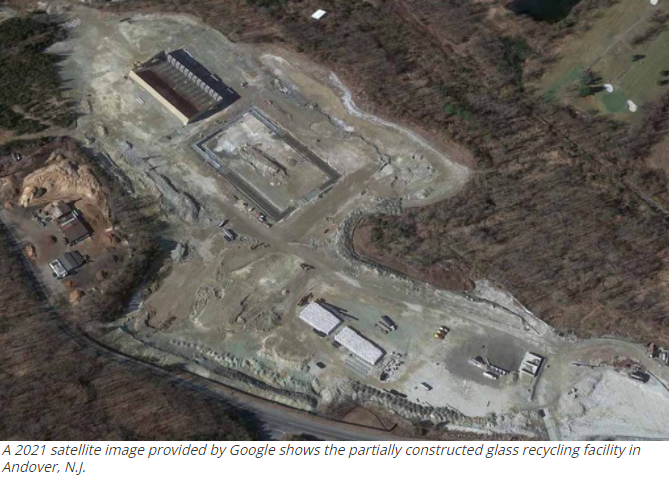
A company working to build a post-consumer glass sorting facility in New Jersey has failed, and its equipment is being auctioned. Meanwhile, environmental regulators are suing the business over contaminated glass piles.
Pace Glass, which already operated a small glass recycling facility in Jersey City, N.J., has been working since 2018 to build what was originally described as a $90 million facility to sort and clean up post-consumer glass for use by bottle producers and other manufacturers.
The facility, in the small central New Jersey borough of Andover, was supposed to be big enough to take much of the glass generated by MRFs in the Northeast region. The construction company working on the project described it as the “world’s largest glass recycling plant with a production capacity of more than 15,000 tons of commercial-grade recyclable glass per week.”
Now, the company has closed and equipment is being sold at court-ordered auctions to pay back creditors, documents obtained by Resource Recycling show.
Additionally, Pace Glass is being sued by the New Jersey authorities.
If you liked this post you’ll love our daily newsletter, EnviroPolitics.It’s packed with the latest news, commentary, and legislative updates from New Jersey, Pennsylvania, New York, Delaware…and beyond. Don’t take our word for it, try it free for an entire month. No obligation.
At the upcoming U.N. climate summit in Glasgow, Scotland — COP26 for short — countries will face pressure to make more ambitious pledges to cut greenhouse gas emissions with the goal of keeping average global warming below 1.5 degrees Celsius, or 2.7 degrees Fahrenheit, compared to preindustrial levels.
Global greenhouse gas emissions
An analysis of national climate pledges by Climate Action Tracker, an independent international collaboration of climate scientists, shows the policies of many countries are inconsistent with their public pledges to cut greenhouse gases.
Those pledges, in turn, are mostly too weak to collectively meet the goals forged as part of the 2015 Paris agreement: to keep global warming “well below” 2 degrees Celsius, or 3.6 degrees Fahrenheit, and, if possible, stop at 1.5 degrees Celsius.
Projected greenhouse gas emissions in 2030
Required
Total
Per person
Pledged
Required for 1.5°C
China
13,828megatons CO2e
9.4tons CO2e
13,625megatons CO2e
7,711megatons CO2e
U.S.
6,163
17.5
3,967
3,329
India
3,932
2.6
5,346
1,863
E.U.
2,854
6.5
2,246
1,833
Russia
2,087
14.6
2,423
1,112
Indonesia
1,259
4.2
1,817
559
Iran
1,094
11.8
1,937
446
Brazil
1,034
4.6
1,307
714
Japan
986
8.2
813
536
Saudi Arabia
984
25
983
395
Earth has warmed more than 1 degree Celsius on average over the past century, and many places have warmed by at least 2 degrees, a Washington Post analysis of multiple temperature data sets found. The United Nations warned in a recent report that the world is on a path to reach 2.7 degrees Celsius, or 4.9 degrees Fahrenheit, of warming over the course of the century.
The United States has pledged to further reduce its greenhouse gas emissions by 2030, but its emissions are currently projected to remain mostly unchanged over the coming decade, according to the Climate Action Tracker analysis. Altering that path would require significant shifts in the way Americans travel and power their homes and businesses, scientists say.
If you liked this post you’ll love our daily newsletter, EnviroPolitics.It’s packed with the latest news, commentary, and legislative updates from New Jersey, Pennsylvania, New York, Delaware…and beyond. Don’t take our word for it, try it free for an entire month. No obligation.