PA Supreme Court Holds That Municipal Stormwater Charge Is a Tax, Not a Fee
US Policy and Regulatory Alert 7 May 2026
On 30 April 2026, the Pennsylvania Supreme Court issued its long-awaited decision in Borough of West Chester v. Pa. State System of Higher Education & West Chester University. A majority of the Court held that the Borough of West Chester’s charge for stormwater management services constitutes a tax, not a fee, from which the Pennsylvania State System of Higher Education and West Chester University are immune.
The decision has important implications that extend well beyond the parties to the dispute at issue, as many municipalities and municipal authorities across the Commonwealth have adopted stormwater charge programs that are relevantly similar.
This would be Clean Harbors’ second major acquisition this year. The company has sought to increase M&A spending this year to expand its environmental services footprint.
Clean Harbors received approval from theU.S. Federal Trade Commission on May 5 to acquire Terra Nova Solutions, an industrial waste and wastewater services company based in North Carolina.
Terra Nova is a portfolio company of Crescentia Capital, a private equity firm that’s part of Maryland-based Calvert Street Investment Partners. Crescentia Capital has also invested in other C&D waste and industrial companies.
Crescentia Capital and Clean Harbors both did not respond to requests for comment
Maine had more community solar capacity than any other state in 2025. But a new law enacted in the name of affordability has brought development to a standstill.
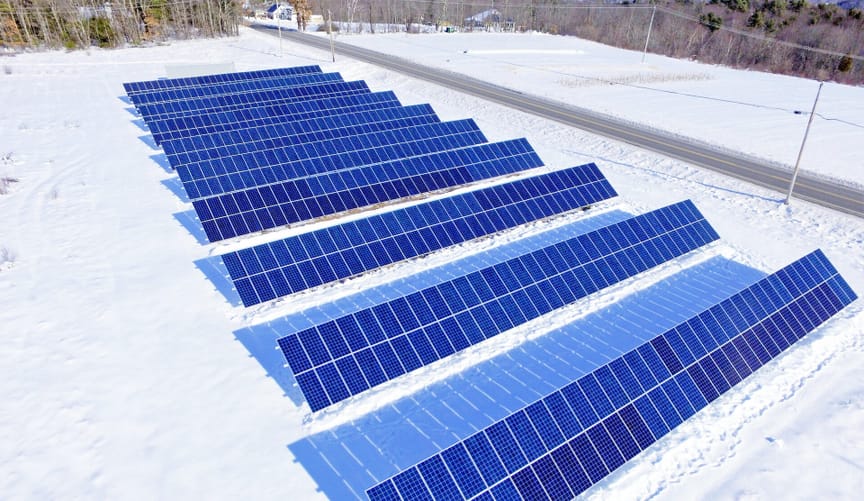
A community solar farm in coastal Maine. A law passed a year ago is freezing out developers of such projects. (William Byers/U.S. Department of Energy)
For years, community solar in Maine grew at a breakneck pace, elevating the state to the top of the list for most capacity per capita in the U.S. Now, however, development has slowed to a standstill, and the industry faces an uncertain future.
“What we saw was a very swift rise, and it has now come to an end,” said Eliza Donoghue, executive director of the Maine Renewable Energy Association. “Right now, there is no opportunity for growth.”
Community solar — larger arrays that sell power to multiple users — took off in Maine after the state expanded the program supporting it in 2019. By the end of 2025, Maine had 694 watts of community solar capacity per person, far and away the most of any state in the country (second-place Minnesota had 164 watts per capita), according to a recently released report from the Institute for Local Self-Reliance.
Then, last year, lawmakers passed, and the governor signed, a law that brought that momentum to a screeching halt. The legislation includes two major stumbling blocks for the future success of community solar in the state, whose legislature and governor’s office are controlled by Democrats
First, it prohibits any larger new projects — residential solar is still OK — from enrolling in net energy billing, the system that allows solar producers to get paid for the energy they send to the grid. It is the backbone of community solar’s financial model.
Second, the law imposes hefty new fees on community solar installations that are already up and running. It’s a move that creates financial hardship for existing projects and makes developers exceedingly wary about doing business in Maine, said Jessica Robertson, director of policy and business development for New England at renewable energy company New Leaf Energy.
MADISON, Wis. — President Donald Trump’s administration is quietly pushing national park, refuge, and wilderness area managers to dramatically scale back hunting restrictions, raising questions about visitor safety and the impact on wildlife.
U.S. Department of the Interior Secretary Doug Burgum issued an order in January directing multiple agencies to remove what he termed “unnecessary regulatory or administrative barriers” to hunting and fishing and justify regulations they want to keep in place.
“Expanding opportunities for the public to hunt and fish on Department-managed lands not only strengthens conservation outcomes, but also supports rural economies, public health, and access to America’s outdoor spaces,” Burgum wrote. “The Department’s policy is clear: public and federally managed lands should be open to hunting and fishing unless a specific, documented, and legally supported exception applies.”
The order applies to 55 sites in the lower 48 states under the National Park Service’s jurisdiction, according to the National Parks Conservation Association. Managers at various locations have already lifted prohibitions on using hunting stands that damage trees, training hunting dogs, using vehicles to retrieve animals, and hunting along trails, according to an NPCA review of site regulations the organization recently performed after learning of the order. The New York Times was the first to report on the changes.
The hunting season in the Cape Cod National Seashore in Massachusetts, for example, would be extended through the spring and summer. Hunters in the Lake Meredith National Recreation Area in Texas would be allowed to clean their kills in bathrooms. And hunters would be allowed to kill alligators in the Jean Lafitte National Historical Park and Preserve in Louisiana.
Burgum’s order comes as hunting continues to decline amid increasing urbanization. Only about 4.2% of the U.S. population identified as hunters older than 16 in 2024, according to the U.S. Fish and Wildlife Service and the U.S. Census data, leaving state wildlife agencies short on revenue from license sales and excise taxes on guns and ammunition.
For the past 15 years, onshore wind projects have followed the same process to get the Department of Defense’s permission to build. Now, that familiar route has been closed off, effectively jeopardizing all new wind projects on private land — more than 250 nationwide — and threatening to sideline 30 GW of potential generation capacity, according to the American Clean Power Association.
All wind projects in the U.S. must first head through the Military Aviation and Installation Assurance Siting Clearinghouse, where, in the DOD’s own words, they’re supposed to undergo a “timely, transparent, and repeatable process to evaluate potential impacts” to national security and military operations. It’s a routine that has spanned presidencies, including the first Trump administration, and that typically revolves around making sure turbines don’t interfere with radars or federal airspace.
If an issue arises, developers and the DOD usually come to a mitigation agreement that resolves both parties’ concerns. These deals are often settled in a matter of days, the Financial Times reports. But the DOD hasn’t signed off on a mitigation agreement since last August, the American Clean Power Association says, leaving at least 60 wind projects that were already in formal negotiations awaiting sign-off from the DOD.
New Jersey’s energy regulators are taking steps to explore a system that would see the state’s utilities draw profit based on their performance rather than tying their returns to capital investments that improve grid reliability but drive up customer bills.
The move follows an executive order Gov. Mikie Sherrill (D) signed when she took office that directed the Board of Public Utilities to examine whether the profit model of New Jersey’s four regulated utilities has outlived its usefulness amid electricity rates soaring as a result of infrastructure investments and data centers’ mammoth power demands.
NJ bill promoting community agriculture
“This model has served the state for decades, but it also creates a structural incentive to favor capital-intensive solutions even when lower cost non-wires or demand-side alternatives may be available,” the board’s president, Christine Guhl-Sadovy, said during a May 7 stakeholder meeting.
In New Jersey, electric distribution companies like PSE&G and Jersey Central Power and Light profit from investments in distribution infrastructure at levels negotiated with regulators and repaid by customers on monthly bills. Their return on equity typically hovers around 9.6%.
Though the price of electricity accounts for the largest share of customer bills, utilities do not profit from its sale; instead, they pass it through at cost.
Officials discussed transitioning New Jersey’s utilities to a business model that pays them based on their performance across an array of metrics including affordability, reliability, customer service quality, and the speed at which they connect projects to the grid.
Current and former utility regulation chairs from states that have already moved to performance-based models, or are in the process of implementing them, broadly praised the shifts, but cautioned they were mostly made in different energy environments than the one New Jersey faces now.
The price of and demand for electricity was largely level through the 2010s before spiking in recent years, and the scale of growth driven by data centers that can consume as much power as, for example, the City of San Francisco is unprecedented.