Important Updates on EPA’s TSCA New Chemicals Program


EPA News Release

The Environmental Protection Agency (EPA) is conducting an evaluation of its policies, guidance, templates, and regulations under the Toxic Substances Control Act (TSCA) new chemicals program to ensure they adhere to statutory requirements, the Biden-Harris administration’s executive orders, and other directives. The agency has identified several instances where the approach for making determinations and managing risks associated with new chemicals can more closely align with the requirements of TSCA to ensure protections for human health and the environment, including the use of significant new use rules (SNURs) and assumptions related to worker exposures.

EPA remains committed to meeting statutory deadlines for review and determinations on new chemicals submissions under TSCA section 5 and will continue to engage with submitters to ensure the agency is moving as expeditiously as possible to come to a resolution on their submissions. Additionally, EPA will provide timely communication for any changes to stakeholders and the public through the normal distribution lists used to announce TSCA developments.

Use of SNURs

EPA will stop issuing determinations of “not likely to present an unreasonable risk” based on the existence of proposed SNURs. Rather than excluding reasonably foreseen conditions of use from EPA’s review of a new substance by means of a SNUR, Congress anticipated that EPA would review all conditions of use when making determinations on new chemicals and, where appropriate, issue orders to address potential risks. Going forward, when EPA’s review leads to a conclusion that one or more uses may present an unreasonable risk, or when EPA lacks the information needed to make a safety finding, the agency will issue an order to address those potential risks.  

Don’t miss information like this. Sign up for FREE EP Blog updates

As has been the long-standing practice, EPA intends to continue issuing SNURs following TSCA section 5(e) and 5(f) orders for new chemicals to ensure the requirements imposed on the submitter via an order apply to any person who manufacturers or processes the chemical in the future. This ensures that other manufacturers of the same new chemical substance are held to the same conditions as the submitter subject to the TSCA section 5(e) or 5(f) order. A SNUR requires manufacturers to submit a significant new use notification to EPA for assessment before the chemical substance can be manufactured or processed for the new use described in the SNUR.

Worker Exposures

EPA now intends to ensure necessary protections for workers identified in its review of new chemicals through regulatory means. Where EPA identifies a potential unreasonable risk to workers that could be addressed with appropriate personal protective equipment (PPE) and hazard communication, EPA will no longer assume that workers are adequately protected under OSHA’s worker protection standards and updated Safety Data Sheets (SDS). Instead, EPA will identify the absence of worker safeguards as “reasonably foreseen” conditions of use, and mandate necessary protections through a TSCA section 5(e) order, as appropriate. 

Learn more about EPA’s TSCA new chemicals program.

Try our daily newsletter, EnviroPolitics, FREE for a full month!

Important Updates on EPA’s TSCA New Chemicals Program Read More »

Electric car companies competing to score a battery breakthrough

GM is the latest company to team-up with a battery start-up in a bid to develop a solid-state vehicle battery.

Mark Reuss, General Motors president speaks at their Detroit- Hamtramck assembly plant on Jan. 27, 2020 in Detroit, Michigan. Credit: Jeff Kowalsky/AFP via Getty Images

Mark Reuss, General Motors president speaks at their Detroit- Hamtramck assembly plant on Jan. 27, 2020 in Detroit, Michigan. Credit: Jeff Kowalsky/AFP via Getty Images

By Dan Gearino, Inside Climate News

Automakers are pairing off with battery companies to try to win the race to develop an electric vehicle battery that costs less and has a much longer range.

The quest is for a “solid-state” battery, a technology that uses a solid substance to transfer lithium ions in a form that weighs less and takes up less space than current batteries that use liquids and gels.

General Motors said last week that it has a development agreement with SolidEnergy Systems, or SES, of Singapore, a maker of solid-state batteries, that aims to produce a battery for electric cars by 2023 and have a version to sell to consumers by some later date. Volkswagen, Daimler and others also are betting on solid-state batteries.

The competition to develop a solid-state battery is about gaining an advantage in a fast-approaching era when many more consumers are going to be buying their first EVs, part of a transition from an auto industry that runs mostly on gasoline and diesel to one that runs mostly on electricity. Legacy automakers are hoping that their battery partners will give them an edge and help to close the gap with Tesla, the EV powerhouse that, notably, has not announced any solid-state plans.

“There are lots of approaches being taken that are trying to achieve the same goals: increasing energy density, lower cost and higher performance,” said James Frith, head of energy storage for BloombergNEF, about the solid-state race. “In essence, the question is really who can build these cells in a cost effective manner at scale first.”

Related e-vehicle news:
Inside Clean Energy: How Norway Shot to No. 1 in EVs
In a Major Move Away From Fossil Fuels, General Motors Aims to Stop Selling Gasoline Cars and SUVs by 2035
Chip shortage sidelines Chinese electric car manufacturer
U.S. On-Sale Date Confirmed for VW’s Electric Van
Future EVs: Every Electric Vehicle Coming Soon
2022 Mercedes-Benz EQS Preview: A new EV Luxury Benchmark?

The switch to EVs is happening in large part because of policy changes to address climate change, like the much stricter emissions rules being implemented in the European Union. Automakers need to overhaul their lineups to meet emissions rules, and their businesses will depend on being able to produce EVs that people want to drive, which means extending battery ranges and reducing costs.

Volkswagen appears to have a head start, having worked for nearly a decade with QuantumScape of California on solid-state batteries, with plans to have a battery on the market by 2025.

This week, Volkswagen showed how far along it is with a “Power Day” news event that gave new details about its ramp-up of battery manufacturing and plans to develop charging stations and other infrastructure.

“Let me begin with the obvious: E-mobility has won the race,” said Herbert Diess, Volkswagen’s CEO at the Power Day event. “It is the only solution to reduce mobility emissions fast.”

Longer Range and Shorter Charging Time

Today, nearly all electric vehicles run on lithium-ion batteries in which lithium ions travel through a liquid or gel to discharge electricity.

Solid State Batteries

In a solid-state design, a solid material replaces the liquid or gel. The material, sometimes ceramic, still allows the lithium to pass through. The solid takes up less space than the liquid, which leads to a battery that is smaller and lighter and can pack more energy into each unit of volume.

“Solid state batteries allow you to control what is happening inside a battery more carefully than when using liquid electrolytes,” said Frith.

The idea of a solid-state rechargeable battery is not new, but designers have run into problems with high costs and various technical challenges, like the tendency of solid-state batteries to expand and contract as they charge and discharge.

If QuantumScape, SES or any of the other developers of solid-state batteries can affordably mass produce the technology, the result would be a battery that has longer range and takes less time to recharge than today’s most common batteries. There also would be safety advantages, because solid-state batteries would be cooler and less flammable than some current lithium-ion designs.

The idea is that a battery with those qualities would be so desirable that consumers would eagerly leave behind their gasoline engines.

Techie Chic

Automakers are often putting their battery partners front and center in publicity about their technology plans, a sign that these industry giants want some of the sheen associated with technology start-ups.

General Motors President Mark Reuss announced last week that his company has a new partnership with SES to work on the Ultium system, GM’s name for its battery platform. The companies will jointly build a prototype assembly line in Woburn, Massachusetts, where SES has an office.

Don’t miss information like this. Sign up for FREE EP Blog updates

“Affordability and range are two major barriers to mass EV adoption,” said Reuss. “With this next-generation Ultium chemistry, we believe we’re on the cusp of a once-in-a-generation improvement in energy density and cost. There’s even more room to improve in both categories, and we intend to innovate faster than any other company in this space.”

SES, founded in 2012 by a Massachusetts Institute of Technology alumnus, has a battery design that it says can hold 400 watt-hours per kilogram, which is much more than the 280 watt-hours per kilogram of the lithium-ion batteries in today’s EVs.

The test for GM and SES will be whether it can hit those numbers while mass-producing the batteries, and do so in a way that costs less than today’s batteries.

Needed: A Grand Slam

Volkswagen was early in pairing up with a solid-state battery company, QuantumScape, and it has the advantage of working with a partner that is getting positive attention from investors and the media for the promise of its technology.

One of the people singing the company’s praises is Paul Albertus, the former head of the Department of Energy’s Advanced Research Projects Agency-Energy, or ARPA-E, who now teaches at the University of Maryland.

“In my view, looking at the data QuantumScape has shared, they’re hitting a home run in terms of their performance data,” he said, in a December panel discussion of the technology, organized by QuantumScape. He has no financial relationship with the company. “At the same time they’re also clearly stating, and I think I agree with this, that they ultimately need to hit something like a grand slam in order to bring this technology to market as a compelling product.”

Solid-State Battery Partnerships

QuantumScape started in 2010, co-founded by three people from Stanford University. Volkswagen began working with QuantumScape in 2012 and in 2018 the German automaker became the battery-maker’s largest shareholder and the companies announced a plan to work together more closely.

Among the other automakers working closely with solid-state battery partners is Daimler AG, maker of the Mercedes-Benz brand, which is collaborating with Blue Solutions of France. Daimler has already deployed solid-state batteries from Blue Solutions in some buses, and had to issue a small recall this month because of short-circuiting. Daimler also has said it is working with Hydro-Quebec of Canada to develop solid-state batteries.

Ford and the BMW Group are both working with Solid Power of Colorado on solid-state batteries. Hyundai is an investor in Solid Power, but the South Korea-based automaker has said little about its solid-state battery plans.

Honda and Jaguar Land Rover, among other companies, are working with Ilika of the United Kingdom.

Some automakers are working on solid-state batteries using in-house designs. This includes Toyota, which has said it will introduce its battery and have it available on the market in the early 2020s. Nissan also is doing in-house work on solid-state batteries but hasn’t said much about it.

Toyota President Akio Toyoda spoke about next-generation EV technologies at the 2018 Consumer Electronics Show, saying that solid-state batteries would be “smaller, lighter, and most importantly, for both consumers and automakers, much more affordable.”

To illustrate what this could mean for range, QuantumScape has said that a solid-state design could mean that an EV that now has a range of 200 miles would have a range of 300 to 400 miles.

Read the full story

Electric car companies competing to score a battery breakthrough Read More »

An energy news release that did NOT come out of Mar-A-Lago

U.S. Department of Energy Announces Goal to Cut Solar Costs by More Than Half by 2030
United States Department of Energy - Wikipedia
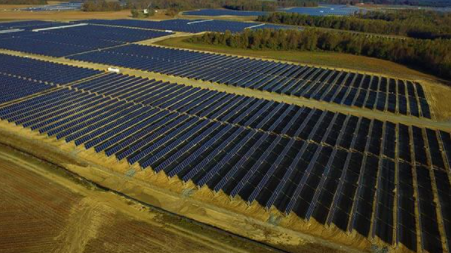
WASHINGTON, D.C. — The U.S. Department of Energy (DOE) today announced an ambitious new target to cut the cost of solar energy by 60% within the next ten years, in addition to nearly $128 million in funding to lower costs, improve performance, and speed the deployment of solar energy technologies. These investments support the Biden-Harris Administration’s climate goals and will pave the way for affordable decarbonization of the energy system and a robust clean energy economy.

“In many parts of the country, solar is already cheaper than coal and other fossil fuels, and with more innovation we can cut the cost again by more than half within the decade,” said Secretary of Energy Jennifer M. Granholm. “This first burst of funding will help us add even more affordable clean energy to the grid, jobs to communities across the country, and will put us on the fast track toward President Biden’s goal of 100% clean electricity by 2035.”

Lowering the cost of solar energy is essential to accelerating deployment and achieving President Biden’s goal of a 100% clean electricity grid by 2035. To reach that goal in the next 15 years, the country will need to add hundreds of gigawatts of solar energy to the grid at a pace as much as five times faster than current installation rates. To that end, DOE is accelerating its utility-scale solar 2030 cost target by five years—setting a new goal of driving down the current cost of 4.6 cents per kilowatt-hour (kWh) to 3 cents/kWh by 2025 and 2 cents/kWh by 2030.

Don’t miss information like this. Sign up for FREE EP Blog updates

“To meet our bold zero emissions goals by 2035, we need to unleash major investment in solar energy and technologies,” said U.S. Senator Edward J. Markey. “I am excited to see the Biden-Harris Administration and the Department of Energy grant the Massachusetts Institute of Technology (MIT) this research and development funding today to help the Commonwealth scale up our clean energy deployment and innovation. This funding will be a bright spot for the Massachusetts clean energy economy and will help us lower costs, create jobs, and deploy more gigawatts of solar than ever before.”

“To combat climate change, America must put clean energy within the reach of every household. Today’s grant awards support research and development projects that will make solar panels more affordable and effective,” said U.S. Senator Ben Ray Luján. “I applaud the Department of Energy for making this strong investment in our energy future.”

“As Chairwoman of the House Science, Space, and Technology Committee, it is thrilling to see my constituents selected to advance technologies that will play a critical role in reducing greenhouse gas emissions from the electricity sector. Not only will these awards help the United States achieve the deep decarbonization needed to mitigate the growing impacts of climate change, but they will put many Americans in my district and around the country back to work in the midst of the COVID-19 pandemic,” said U.S. Representative Eddie Bernice Johnson, Chairwoman of the House Science, Space, and Technology Committee.

Traditional solar panels convert sunlight into electrical energy using photovoltaic (PV) solar technologies, which by 2035 could represent between 30% and 50% of electricity supply in a decarbonized electricity sector. Funding announced today through DOE’s Solar Energy Technologies Office (SETO) will support advancing two materials used to make solar cellsperovskites and cadmium telluride (CdTe) thin films.

  • $40 million for perovskite R&D: Perovskites are a family of emerging solar materials that have potential to make highly efficient thin-film solar cells with very low production costs. DOE is awarding $40 million to 22 projects that will advance perovskite PV device and manufacturing research and development—as well as performance through the formation of a new $14 million testing center to provide neutral, independent validation of the performance of new perovskite devices.   
  • $3 million Perovskite Startup Prize: This new prize competition will speed entrepreneurs’ path to commercializing perovskite technologies by providing seed capital for their newly formed companies.
  • $20 million for CdTe thin films: The National Renewable Energy Laboratory will set up a consortium to advance cheaper CdTe thin-film solar technologies, which were developed in the United States and make up 20% of the modules installed in this country. This consortium will advance low-cost manufacturing techniques and domestic research capabilities, increasing opportunities for U.S. workers and entrepreneurs to capture a larger portion of the $60 billion global solar manufacturing sector.  

In addition, DOE announced $7 million as part of a new funding opportunity for projects to increase the lifetime of silicon-based PV systems from about 30 years to 50 years, lowering the cost of energy and reducing waste. The aim is to improve PV system components, such as inverters, connectors, cables, racks, and trackers.

Today’s announcement also supports several concentrating solar-thermal power (CSP) projects. Unlike PV technologies that directly convert sunlight into electricity, CSP captures heat from sunlight and uses that thermal energy to spin a turbine or power an engine that then generates electricity.

  • $33 million for CSP advances: The new funding opportunity also includes funding for improvements to the reliability and performance of CSP plants, which can dispatch solar energy whenever it is needed; identifies new solar applications for industrial processes, which contribute 20% of U.S. carbon dioxide emissions; and advances long-duration thermal-energy storage devices. Long-duration energy storage is critical to decarbonizing the electricity sector and couples well with CSP plants, but the cost must fall by a factor of two to unlock deployment.
  • $25 million to demonstrate a next-generation CSP power plant: Sandia National Laboratories will receive funding to build a facility where researchers, developers, and manufacturers can test next-generation CSP components and systems and advance toward DOE’s 2030 cost target of 5 cents/kWh for CSP plants.

Consistent with DOE’s commitment to ensuring the benefits of federal funding reach diverse communities, applicants to the Perovskite Startup Prize and the PV/CSP funding opportunity must submit a Diversity and Inclusion Plan and propose measurable actions to increase the participation of underrepresented groups on their teams, in their research, and in the broader community.

Learn more about SETO and its research priorities in PV and CSP, and attend upcoming webinars on the open opportunities:

An energy news release that did NOT come out of Mar-A-Lago Read More »

Plan underway to catalog NJ’s vulnerable coastal communities

Environmental working group to identify gaps in coastal restoration, enhancement and preservation efforts

One of New Jersey’s many back bay communities


By ANDREW S. LEWIS, NJ Spotlight

As the Murphy administration works toward its goal of better preparing the state for the impacts of climate change and reducing greenhouse gas emissions by 80% by 2050, the Department of Environmental Protection is increasingly focusing on the roughly 1,800 miles of tidal marshes, estuaries and back bays of New Jersey’s coastal zone.

But with well over 100 municipalities in that region, most with their own land use rules and needs, and each with a unique set of environmental challenges, it would be virtually impossible to develop from Trenton alone a comprehensive outline of climate priorities based on urgency and individual vulnerability.

To avoid the blind spots that can come from top-down climate policy and funding allocations, a team of researchers from the DEP, Rutgers University, Jacques Cousteau National Estuarine Research Reserve, Partnership for the Delaware Estuary, and other environmental groups is working at the local level to map areas across the state that offer the largest value for net carbon sequestration, ecosystem health, and community resilience — three key priorities in Gov. Phil Murphy’s climate agenda.

“Ecosystem projects need landowner and community buy-in and need to be maintained over time to function, just like a garden,” said Liz Semple, a manager in the DEP’s Office of Coastal and Land Use Planning. “We’re looking to identify areas and ultimately projects that will have state, regional or local/nonprofit champions.”

Harnessing local knowledge

The initiative, called the Coastal Ecological Restoration and Adaptation Plan and funded by a $150,000 grant from the DEP, will be implementing a nomination process to identify projects that address these priorities in critical areas of the state. Ultimately, the list will be synthesized into a publicly available map layered with in-progress and potential projects that focus on either environmental restoration, enhancement or preservation. Completed projects going back at least 10 years will also be included.

“The result of this effort will be a mapped catalogue of sites and projects to help inform the DEP and others on where resources could be allocated for future projects,” said Richard Lathrop, director of Rutgers University’s Center for Remote Sensing and Spatial Analysis and one of the project’s leads. “And to help the human and natural communities in the state’s coastal zone adapt to ongoing climate change and sea level rise.”

The process for soliciting future restoration and adaptation projects will kick off with a webinar on April 14. Along with officials from all levels of government and organizations like the Barnegat Bay Partnership, NY-NJ Baykeeper, and the Partnership for the Delaware Estuary, the public is also invited to participate and nominate projects.

Read the full story

Try our daily newsletter, EnviroPolitics, FREE for a full month!

Plan underway to catalog NJ’s vulnerable coastal communities Read More »

New Hampshire looks to offshore wind energy

By Megan Fernandes Fosters Daily Democrat

The Seacoast region is in the early stages of evaluating the challenges and opportunities of offshore wind renewable energy generation with wind turbines off the local coastline.

Because the more than 800-foot-tall wind turbines would be anywhere from 10 to 20 miles away from the shore, experts said, they should not be very visible from the shore and they will be out far enough to avoid interfering with commercial fishing operations.

Three wind turbines from the Deepwater Wind project stand in the Atlantic Ocean off Block Island, Rhode Island. New Hampshire is now in the process of working with neighboring states Maine and Massachusetts on a possible wind turbines project.

But building a multi-billion-dollar offshore wind project like this requires a lot of upfront work to build the labor workforce and industry infrastructure for the project and to maintain it for the long term, experts say. The planning is still in its infancy, so construction of an undertaking like this is still at least five to seven years out.

The Seacoast Chamber Alliance, state Sen. David Watters, D-Dover, and New Hampshire Offshore Wind Industry Development Director Michael Behrmann led a conversation over Zoom video conference Tuesday on how neighboring New England states can benefit from a cooperative approach to wind power. 

From left to right: Susannah Hatch, New England for Offshore Wind and Environmental League of Massachusetts; Curt Thalken, PE, Normandeau Associates; New Hampshire Offshore Wind Industry Development Director Michael Behrmann; (second row) Bob LaBelle, Former BOEM Deputy Associate Director;  Joe Casey, IBEW;  Elizabeth Donohue, Eversource and (bottom row) Senator David Watters (D-Dover).
Where is the New England wind turbine project is now?

Discussion Tuesday centered around how New England can build out the infrastructure for this industry to have a wide-ranging economic impact.

This topic of discussion dates back to 2019, when Gov. Chris Sununu called for the Bureau of Ocean Energy Management to establish a tri-state federal task force to plan Gulf of Maine lease areas. It involves New Hampshire, Maine and Massachusetts working together to develop offshore wind as a reliable renewable energy source. This led New Hampshire to create the Offshore Wind Commission, which is led by Watters serving as chair. Its goal is to evaluate and push legislation to help spur the development of the offshore wind industry. 

In Massachusetts::Biden administration puts Vineyard Wind back on track

“I saw this as an extraordinary opportunity for economic development and job creation for New Hampshire,” Watters said, noting the state’s Seacoast region is in what he calls “a sweet spot” because its existing harbor facilities in Portsmouth and other locations help position the area to be an integral part of the up-and-coming industry in Northern New England.

This month, Watters introduced Senate Bill 151, which will be heard by the Legislature in the coming weeks. It would establish a framework for the future procurement of upward of 800 megawatts of renewable energy and the financing of offshore wind energy generation resources in New Hampshire through the solicitation and development of long-term contracts with distribution companies by the Public Utilities Commission.Your stories live here.Fuel your hometown passion and plug into the stories that define it.

The Seabrook nuclear plant produces 1.2 GW, so it would take 120 10MW wind turbines to equal the capacity of Seabrook.

More: Seabrook nuclear power plant’s license extension upheld, with conditions

“That [bill] will potentially lock in very, very competitive prices for New Hampshire consumers from offshore wind both existing [in southern New England] and what’s going to be built,” Watters said.

This is just the start of a lengthy process to bring projects like this to the Seacoast, leaders said. 

Elizabeth Donohue, a representative from Eversource on the panel, said while developing the industry takes a lot of time and money, it gives back in terms of economic benefits. It will take regional partnerships to make it work, she said.

Read the full story

If you liked this post you’ll love our daily newsletter, EnviroPolitics. It’s packed with the latest news, commentary and legislative updates from NJ, PA, NY, Delaware…and beyond. Try it free for an entire month.

New Hampshire looks to offshore wind energy Read More »

With hurricane season growing longer, meteorologists will ditch Greek names and start forecasts earlier

Record ocean warmth means 2021 could be another busy year for tropical storms in the Atlantic.

Aerial view of a flooded area in the village of Queja, in San Cristobal Verapaz, Guatemala on Nov. 7, 2020. Credit: Esteban Biba/Pool/AFP via Getty Images

Aerial view of a flooded area in the village of Queja, in San Cristobal Verapaz, Guatemala on Nov. 7, 2020 after Hurricane Eta. Credit: Esteban Biba/Pool/AFP via Getty Images

By Bob Berwyn, Inside Climate News

The record-setting hurricane season of 2020 has prompted the World Meteorological Organization’s hurricane experts to change how they name tropical storms and when to start issuing regular hurricane bulletins.

When Hurricanes Zeta, Eta and Iota slammed the Caribbean and the Gulf of Mexico in the first two weeks of November 2020, the rapidly growing list of unusual, similar-sounding names may have diluted critical safety messaging in the storm-plagued region, National Hurricane Center director Ken Graham said Wednesday, during a discussion of the changes at a meeting of the WMO’s Hurricane Committee.

There were a record number of named tropical storms in the Atlantic last year, and some storm-weary residents in hurricane-prone regions were getting the names mixed up, he said. Hurricane experts, the WMO announced, will stop using Greek alphabet names after exhausting the “regular” alphabet, which has only happened twice—in 2005 and last year. The committee is also retiring the names Eta, Iota, and Laura, which were given to 2020 storms, and Dorian, from the 2019 season, because of the death and destruction that the hurricanes with those names caused. 

“There was so much focus on the names that maybe the impacts of storms were lost,” he said of the series of confusing storm names last year. “In some cases, names were pronounced incorrectly, and some of the names were not easily translatable to Spanish,” he added. “Hurricanes do not have international boundaries,” so critical safety communication needs to be absolutely clear in various languages.

Don’t miss information like this. Sign up for FREE EP Blog updates

Hurricane experts in the United States started giving tropical storms short, distinctive female names in the mid-1950s, to streamline communications about the hazards. The WMO added male names in 1978 and Greek alphabet letters toward the end of the hyperactive 2005 hurricane season, which had the most named tropical storms until last year.

The unusual spate of late season storms started Oct. 27, when Zeta hit Louisiana at peak intensity, after causing widespread damage in the Yucatán Peninsula and Jamaica. In the Southeast United States, Zeta killed six people, flooded city streets and knocked out power for more than 2 million people.

Hurricane Eta hit Nicaragua’s Mosquito Coast Nov. 3 as a 150 mph, category 4 storm, killing 210 people. Two weeks later, Iota’s winds quickly ramped up from 110 mph to 150 mph, just before blasting nearly the same section of the Nicaraguan coast. It was the strongest storm of the 2020 season, and the latest-forming category 5 hurricane on record in the Caribbean.

Together, the two late-season tropical storms caused 272 fatalities and more than $9 billion in damages.

Related: Hurricane Season 2018: Experts Warn of Super Storms, Call For New Category 6

The WMO’s Hurricane Committee also decided to start issuing its regular hurricane bulletins for the Atlantic on May 15, two weeks earlier than in previous seasons, Graham said. That decision came after discussions about changing the “official” start date of the season from June 1 to May 15—considerations that are continuing amid worrying signs that the hurricane season may be getting longer.

While research into whether the season is expanding is still inconclusive, the 2020 season was the record sixth in a row in which a tropical storm formed before the official start date. Ocean heat is the main fuel for hurricanes, and global warming is driving sea surface temperatures and deep ocean heat to new record levels nearly every year.

“The length of the hurricane season increases by about 40 days per degree Celsius of warming (the season starts about 20 days earlier and lasts about 20 days longer, on average),” according to the National Oceanic and Atmospheric Service. “But the link to climate change for this is not as clear because our understanding of how and why hurricanes form is not as strong as our understanding of how and why hurricanes intensify.”

Right now, the Atlantic Ocean is about 1.8 degrees Fahrenheit to 3.6 degrees Fahrenheit warmer than average, so the coming season is likely to again see above average hurricane activity, said Jim Kossin, a hurricane researcher with NOAA and the University of Wisconsin. 

Related: In a Warming World, Hurricanes Weaken More Slowly After They Hit Land

“We’ve had a number of advances in our understanding of how tropical storms will be affected by global warming,” he said.

The most intense storms are more frequent, tropical storms are intensifying faster over warmer water and hurricane tracks seem to be shifting toward the poles, Kossin noted.

“They seem to be moving more slowly along their tracks over land, which can have a huge effect on local rainfall amounts and wind damage,” he added. “Any of these changes would certainly affect hurricane risk for people and communities.” 

Care to share? Use icons below to share this post on social media

With hurricane season growing longer, meteorologists will ditch Greek names and start forecasts earlier Read More »