Be sharp, keep these out of recycling
Be sharp, keep these out of recycling Read More »

By ANDREW S. LEWIS, NJ Spotlight
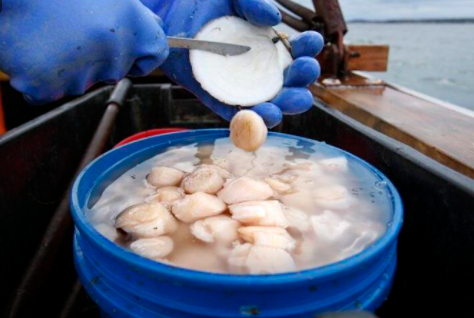
On Monday, U.S. Rep. Frank Pallone stood beside the water at Monmouth County’s Belford Seafood Co-Op, flanked by several New Jersey fishermen, and reflected on the tumultuous year that the state’s fishing industry has endured.
When the historic $2 trillion Coronavirus Aid, Relief, and Economic Security Act was making its way through Congress one year ago, Pallone (D-6th) recalled that at the time he “was concerned that we needed to have specific money targeting to the fishing industry.” Those in the state’s fishing industry, he continued, “often get left behind.”
Because seafood is such a dynamic product, typically undergoing six changes of hand as it moves from seafloor to table, it is particularly vulnerable to any tremor in the economy. Add in a legacy in New Jersey of overfishing, pollution and disease and you have an industry toughened with an ability to weather adversity.
But when almost every link in that critical supply chain shut down last March, “Everybody was scared,” said Dave Tauro, manager of the co-op.
New Jersey received $11 million from the first $300 million tranche of aid to the fishing industry nationwide last year — the ninth-largest payout in the country — and, Pallone said, the state will get about the same amount when funds from the follow-up aid package that was passed in December are disbursed later this year. There isn’t a specific earmark for the U.S. fishing industry in the $1.9 trillion American Rescue Plan from the Biden administration, which cleared the Senate and was set for a final vote in the House of Representatives Wednesday. Monday’s news conference was an opportunity for Pallone to tout the $300 million that he, Rep. Andy Kim (D-3rd), and other coastal lawmakers lobbied to have carved out of both the CARES Act and the $900 billion December follow-up package.
“When we protect and properly manage our resources,” said Shawn LaTourette, acting commissioner of the Department of Environmental Protection, which was responsible for administering the grants, “we’re also supporting the people and the businesses who rely upon those resources, businesses like our commercial and recreational fisheries that are so critical to the state’s economy and identity.”
In all, the emergency grants were paid out to fishing-related businesses from Delaware Bay oyster farmers to Barnegat Bay fluke captains to Ocean County charter boats — and Middlesex County bait and tackle shops, like Fred’s Bait and Tackle in South Amboy, owned by Jung Kim.
“We have faced and overcome many challenges, but nothing could have prepared us for 2020,” said Kim, who along with his wife has owned the bait and tackle shop for more than 35 years. “Our store faced financial loss of sixty to sixty-five percent; one year into the pandemic, our walls and freezers were almost empty, and we were worried about how we were going to replenish our merchandise and supplies for 2021.”
Care to share? Use icons below to share this post on social media
NJ’s fishing industry hooked a lifeline in coronavirus relief aid Read More »
Trump’s success in appointing conservative judges has so far been no match for his team’s own ineptitude, the skill of the environmental bar and industry’s desire to work with the new administration.

By Marianne Lavelle, Inside Climate News
As the Biden administration begins the daunting job of rebuilding U.S. climate policy, it has gotten help from an unexpected, and perhaps unlikely, source—the federal courts.
In Biden’s first few weeks in office, federal judges scrapped the Trump administration’s weak power plant pollution regulation, its rule limiting science in environmental decision-making and a decision opening vast areas of the West to new mining.
The rulings show that although President Donald Trump left his mark on the federal courts with his record-breaking pace of judicial appointments, his influence has not been great enough to prevent federal judges from playing a part in dismantling his deregulatory legacy. And the series of decisions also allows the Biden administration to move forward with some confidence about its own ambitious regulatory agenda, as White House National Climate Adviser Gina McCarthy explained at a major energy industry conference last week.
“As time goes on, we realize how unsuccessful the prior administration was in actually rolling back good regulations,” McCarthy said in a virtual discussion session at CERAWeek by IHS Markit, an annual conclave of top oil, gas and utility executives. “In the courts, even with the new appointees under the Trump administration as judges, we still won over and over and over again, because there is a law in our country. And when you put on that black robe, you tend to want to do your job.”
Don’t miss environmental news like this. FREE EP Blog update
The Biden team’s work on writing new climate regulations begins in earnest soon, with the Senate slated to vote Wednesday on his nomination of Michael Regan, North Carolina’s top environmental official, to head the Environmental Protection Agency. Another point person in executing the Biden climate agenda, Rep. Deb Haaland, (D-N.M.), cleared a Senate committee last week and is on her way to confirmation as the first Native American person to head the Interior Department.
Regan, Haaland and the rest of the Biden climate team may get less help from the federal courts as time goes on. Legal scholars expect that Trump-appointed judges will be skeptical of aggressive government action on climate without explicit authority from Congress, and Trump appointees now occupy one-third of the seats on the appellate bench, including three on the Supreme Court.
But for now, a confluence of factors have given the Biden administration some early legal wins—including the savvy of environmental group litigators, the desire of industry to strike a cooperative stance with the new administration and the legal missteps of the Trump administration.
“We saw that many actions by the Trump administration were a deliberate and illegal effort to permanently limit the ability of EPA to do its job protecting people and the environment,” said Ben Levitan, a senior attorney at the Environmental Defense Fund, one of the groups that have spearheaded the recent challenges. “These decisions clear the way for the Biden-Harris team to turn to the critically important work ahead.”
The biggest break for the Biden team thus far came at the Ben Levitan, where a three-judge panel issued a decision to vacate the Trump administration’s rollback of President Barack Obama’s signature climate policy, its Clean Power Plan. The day before Inauguration Day, the judges excoriated the Trump administration for designing a toothless regulation on power plant greenhouse gas pollution based on what it said were “a tortured series of misreadings” of the Clean Air Act.
Trump’s EPA argued it had no authority to set standards that encourage steps like switching from coal to natural gas or renewable energy to cut carbon emissions. Instead, the Trump EPA said it could only mandate tweaks like efficiency improvements at individual coal plants (while not addressing natural gas plants at all.) But in reality, such improvements do little to slash carbon; the only commercial technology for achieving large cuts in power plant carbon emissions is to switch to cleaner fuels. As a result, the Trump “Affordable Clean Energy” rule would have curbed greenhouse gas emissions from power plants less than 1 percent.
The three-judge panel ruled that the Trump power plant rule “hinged on a fundamental misconstruction of … the Clean Air Act.” Judge Justin Walker, a Trump appointee on the panel, dissented on the legal reasoning but joined in the judgement with two Obama appointees, Judges Patricia Millett and Cornelia Pillard.
If you liked this post you’ll love our daily newsletter, EnviroPolitics. It’s packed with the latest news, commentary and legislative updates from NJ, PA, NY, Delaware…and beyond. Try it free for an entire month.
Federal Courts Help Biden Dismantle Trump’s Environmental Legacy Read More »

An EPA environmental news release
WASHINGTON (March 8,2021) — Today, in accordance with Biden-Harris Administration executive orders and directives, the U.S. Environmental Protection Agency (EPA) is asking for additional public input on five final rules for persistent, bioaccumulative and toxic (PBT) chemicals issued on January 6, 2021 under the Toxic Substances Control Act (TSCA). These rules, which went into effect last month, address exposure to toxic chemicals that remain in the environment for long periods of time and build up in the body.
“These rules are intended to provide critical health protections for Americans, including children, workers, other potentially at-risk groups, and the environment,” said Michal Freedhoff, Acting Assistant Administrator for the Office of Chemical Safety and Pollution Prevention. “Re-examining these rules under the Biden-Harris Administration and making any necessary changes to them will ensure we’re delivering on the promise to protect human health and the environment by reducing exposure to toxic chemicals.”
As a first step in its efforts to immediately review these rules, EPA is opening a 60-day comment period for the public to provide new input on:
This review is being done in accordance with the Protecting Public Health and Environment and Restoring Science to Tackle to Climate Crisis Executive Order, which asks all agencies to review their actions to ensure that they meet statutory obligations, are guided by the best available science, ensure the integrity of federal decision-making, and protect human health and the environment.
Don’t miss environmental news like this. Sign up for FREE EP Blog updates
EPA will use the feedback received during this public comment period to determine the best path forward, which could include amending the current rules to include additional or alternative exposure reduction measures or extending compliance dates for certain regulated products and articles. Upon publication of the Federal Register notice, EPA will accept public comments in docket EPA-HQ-OPPT-2021-0202 on www.regulations.gov for 60 days.
As noted above, the notice seeks comment on newly-raised issues associated with the March 8, 2021, compliance date for the prohibitions on processing and distribution of Phenol, Isopropylated Phosphate (3:1) (PIP (3:1)) for use in articles, and the articles to which PIP (3:1) has been added. Stakeholders recently informed EPA that the prohibition on processing and distribution of PIP (3:1) could impact articles used in a wide variety of electronics, from cell phones, to robotics used to manufacture semiconductors, to equipment used to move COVID-19 vaccines and keep them at the appropriate temperature. Stakeholders note that the complexity of international supply chains makes locating the presence of, and finding alternatives to, PIP (3:1) in components challenging. They assert that an extension to the compliance deadline is necessary to avoid significant disruption to the supply chain for a wide variety of articles. It was not EPA’s intent during the development of the rule to have such a broad disruptive impact. Thus, EPA is also announcing its expectation that this specific issue will be addressed as part of the broader re-examination of these rules. Based in part on the information collected as part of the effort announced today, EPA intends to extend compliance dates as necessary for the prohibitions on processing and distribution of PIP (3:1) for use in some articles, and some of the articles to which PIP (3:1) has been added.
For these same reasons, EPA is issuing a temporary 180-day “No Action Assurance” indicating that the agency will exercise its enforcement discretion regarding the prohibitions on processing and distribution of PIP (3:1) for use in articles, and the articles to which PIP (3:1) has been added. The agency is taking this action to ensure that the supply chain of these important articles is not interrupted while EPA continues to collect the information needed to best inform subsequent regulatory efforts and allow for the issuance of a final agency action to extend the March 8, 2021, compliance date as necessary.
Learn about the public comment period and view the documents related to the “No Action Assurance.”
Learn more about the PBT rules.
Care to share? Use icons below to share this post on social media
EPA wants your (post Trump) thoughts on PBT chemicals Read More »
Greenhouse gas emissions contributing to climate change are under growing scrutiny from regulators and investors alike. Finding the most precise way to measure them remains a complex effort.

Waste companies have long been comfortable dealing with regulations about tracking and reducing greenhouse gas emissions, but heightened attention may make that more complex in the years ahead.
The pressure to address contributions to climate change is starting to come from new sources. Growing numbers of customers and investors are insisting that all industries — waste included — record greenhouse gas emissions and shrink their carbon footprints. In a relatively short period, considering how a company may be exacerbating the effects of climate change morphed from a peripheral concern for investors to a mainstream inquiry.
“I continue to be impressed by how quickly this conversation has changed, and how rapidly it’s evolved in the last few years,” said Hana Vizcarra, a staff attorney at Harvard Law School’s Environmental & Energy Law Program.
Don’t miss information like this. Sign up for FREE EP Blog updates
In January, for example, the chief of the investment group BlackRock, which has holdings in several major waste companies, wrote a letter to CEOs surging them to bring their net emissions to zero by 2050. In many cases that objective would be more aggressive than the climate targets set by the industry’s largest companies. The request comes with force, as the firm has begun to hold companies accountable for their climate-related choices.
The financial group’s announcement happened within a week of the inauguration of U.S. President Joe Biden, who leads an administration that has promised stronger action on climate change and emissions reduction measures – including a focus on methane. Any actions making good on the promises could potentially include actions affecting landfills. All together, the facilities accounted for 17.3% of human-caused methane emissions in the U.S. in 2019, and clocked in as the third largest source of the gas, according to the latest emission data released by the U.S. EPA.
Even if advocates for emission transparency and reduction aren’t talking specifically about landfills yet, those are the facilities waste companies will have to address most directly to meaningfully lower emissions.
If you liked this post you’ll love our daily newsletter, EnviroPolitics. It’s packed with the latest news, commentary and legislative updates from NJ, PA, NY, Delaware…and beyond. Try it free for an entire month.
Investors want emission reductions at landfills Read More »

By Yancey Roy, Newsday
New York Attorney General Letitia James announced Monday she has selected Joon H. Kim, a former U.S. attorney, and Anne L. Clark, an employment discrimination lawyer, to run the investigation into sexual harassment allegations against Gov. Andrew M. Cuomo.
Kim served as the acting U.S. attorney for the Southern District of New York from 2017-18. He had been Preet Bharara’s deputy in the office until President Donald Trump fired Bharara. Kim filled the job until he was replaced by Trump appointee Geoffrey Berman.
Clark is a private attorney who has “successfully represented plaintiffs in numerous sexual harassment and other employment discrimination cases” in the public and private sector, according to James.
“Joon H. Kim and Anne L. Clark are independent legal experts who have decades of experience conducting investigations and fighting to uphold the rule of law,” James said in a statement. “There is no question that they both have the knowledge and background necessary to lead this investigation and provide New Yorkers with the answers they deserve.”
Related news stories:
Cuomo Inquiry to Be Led by 2 Lawyers, Including Ex-U.S. Attorney (New York Times)
Cuomo Probe to Be Led by Ex-Federal Prosecutor, Bias Lawyer (Bloomberg)
If you liked this post you’ll love our daily newsletter, EnviroPolitics. It’s packed with the latest news, commentary and legislative updates from NJ, PA, NY, Delaware…and beyond. Try it free for an entire month.