This New Jersey landfill is preserving capacity through landfill mining

Ocean County Landfill Corp.’s landfill mining project is helping preserve capacity while allowing operators to repurpose cover soil.


By Adam Redling, Waste Today

Preserving landfill capacity is a foremost objective for today’s landfill operators thanks to increasing complications with both permitting of new sites and expansion of existing ones.

In an effort to maximize the capacity at its 300-acre landfill in Manchester, New Jersey, Ocean County Landfill Corp. began to look at options in the mid-2000s for preserving space at the site.

The company first looked at redeveloping an older, unlined portion of its landfill built between 1972 and 1985, which comprised around 60 acres. The original goal was to expand capacity and extend the lifespan without requiring a horizontal or vertical expansion beyond what the landfill was presently permitted for.

“The footprint of the landfill is pretty well-established, and we don’t really have the luxury of going out any farther without encroaching on neighborhoods and wetlands and things like that,” explains Martin Ryan, vice president of engineering at Ocean County Landfill Corp. “So, as we were looking at the lifespan of our facility and trying to figure out ways to squeeze a little more time out of it, we thought that certainly a vertical expansion was something that was a possibility, but that’s not a definite thing that will get approved by the regulators. Also, I think there’s some sensitivity to the surrounding community, as well. You don’t want to have this huge mountain of garbage sticking up out of the pine trees [that surround the landfill], so we had kind of settled on our final elevation with some sensitivity to the surrounding community.”

Ryan says the company first discussed an overliner design where new waste could be placed on top of the existing capped areas within the vertical limits the site was approved for. In order to assess the viability of this, Ocean County Landfill Corp. had waste composition tests performed. The primary goals were to gauge the thickness of cover soils and to obtain waste characterization, condition and stage of decomposition data.

“The firm we hired did a biomethane potential (BMP) test, which basically said that the waste was largely ‘cooked,’ for lack of a better word,” Ryan says. “This meant it was largely decomposed. The testing also found the mass should be stable and not prone to a lot of settlement, while simultaneously showing that there was quite a bit of cover soil there.”

Ryan says, at the time, the landfill was importing almost every yard of soil it was using for cover and capping construction. Between the desire to minimize the height of waste at the landfill and the ample supply of cover soil that would eliminate the need to outsource from third parties, Ocean County Landfill Corp. decided that landfill mining, not installing an overliner, was the best course of action.

Ryan says that, at the time, no landfill mining project of the scale the company was proposing had been undertaken in New Jersey. This necessitated both ample planning and time needed to secure permitting.

“We were looking at mining basically all of the waste that’s in that old, 60-acre part of the landfill, but we looked at it as a win-win because we would be keeping our construction crews busy with mining during times in between building baseliners and caps, we would create a lot of cover soil for us to help offset the need to then import all that soil, and then we’d also develop a new area for future landfilling, which we hope will allow us to operate until around 2036 or 2037, [beyond the original estimated close date of 2024],” Ryan says.

Mining for opportunity

After going through all the regulatory hurdles to be approved by the state, Ryan says that they began screening operations in 2014. They developed a plan for phased excavation and base liner construction that constituted three phases, which would stretch out over approximately 15 years.

Lawrence Kiesel, vice president of construction at Ocean County Landfill, says before commencing operations, the company evaluated several different types of screens for the project. The company demoed both shaker deck-type screens where waste was placed in the top and fines and dirt filtered out the bottom as well as trommel screens that spun to accomplish the same goal.

Ocean County ultimately settled on a Doppstadt SM720K trommel screen since the circular rotation was able to better separate the dirt from the waste. Kiesel notes that the company uses an excavator to dig to a depth of around 40 to 45 feet. The excavator then transfers the waste to an off-road end-dump truck so the material can be moved from the area that is being mined to a separate screening station, where another excavator feeds the hopper of the trommel screen. A wheel loader is then used to load the resulting material into off-road end-dump trucks, which transport the 2-inch-minus cover soil and over 2-inch waste materials, respectively, back to the site’s active landfill cell.

Read the full story

If you liked this post you’ll love our daily newsletter, EnviroPolitics. It’s packed with the latest news, commentary and legislative updates from NJ, PA, NY, Delaware…and beyond. Try it free for an entire month.

This New Jersey landfill is preserving capacity through landfill mining Read More »

Philly labor leader ‘Johnny Doc’ arrested again by federal agents–this time on extortion charges

The Philly electricians union leader is accused of threatening his nephew’s boss.

John Dougherty exits federal court after pleading not guilty at a 2019 arraignment

John Dougherty exits federal court after pleading not guilty at a 2019 arraignment KIMBERLY PAYNTER / WHYY

By Max Martin, BillyPenn

Philly labor leader John “Johnny Doc” Dougherty is now facing not one, but two federal indictments.

Authorities charged the head of the Local 98 electricians union on Wednesday in a new federal criminal matter, according to court documents. Dougherty was arrested at his South Philadelphia home on Wednesday morning and released under supervision in the afternoon, said Acting U.S. Attorney Jennifer Arbittier Williams.

A 19-count indictment charges Dougherty and his nephew, Gregory Fiocca, with conspiracy and extortion. The duo allegedly threatened “violence and economic harm” on a contractor if he did not continue employing Dougherty’s nephew — even for hours he didn’t work.

Through a spokesperson, Dougherty said the charges were part of a long-term “persecution” against him.

Federal prosecutors say nephew Fiocca was a frequent no-show at his union electrical job. But when the contractor failed to pay him for a full 40 hours a week last August, Fiocca allegedly resorted to violence.

Don’t miss information like this. Sign up for FREE EP Blog updates

Fiocca grabbed a project manager identified as “R.G.” by the neck and threw him on a desk, threatening both him and the contractor, identified only as “R.P,” as well as the entire business.

“You owe me, 36 f-king hours before I break your f-king jaw,” Fiocca told the project manager, according to court documents. “Call an Agent. Call the [Union] Hall. There’s nothing you can do to me. I’m getting my money…You think yous are untouchable? I’ll break all of you, I’ll f-king break your face and [R.P.’s] face. How’s that sound?”

Fiocca allegedly said he was “calling my uncle already” and suggested the union leader would be “pulling everyone off the job.” An unnamed Local 98 representative later called Dougherty, according to court filings.

Related news stories:
The FBI sent a dozen agents with a battering ram (BILLYPENN)
‘You Think Yous Are Untouchable?’  (NBC10 video)
John Dougherty charged with extortion (Philly Voice)

The powerful union boss intervened on his nephew’s behalf with “escalating threats of economic harm,” U.S. Attorney Williams alleged outside the federal courthouse Tuesday. Dougherty allegedly threatened to bar Local 98 electricians from working overtime, pull workers from the job site and potentially cut off the contractor’s electrical work with the city unless the spat with his nephew was resolved.

“Fiocca took advantage of his uncle’s position as a powerful leader of an influential union, assaulted a co-worker, and enriched himself at the expense of his employer — and [Dougherty] is alleged to have had his back through all of it,” Williams said.

The contractor continued to employ Fiocca from August through at least mid-January, during which time prosecutors allege Fiocca “did little or no work, and received salary, wages, and credit for employee benefit contributions paid by the contractor,” according to the filing.

Read the full story

If you liked this post you’ll love our daily newsletter, EnviroPolitics. It’s packed with the latest news, commentary and legislative updates from NJ, PA, NY, Delaware…and beyond. Try it free for an entire month.

Philly labor leader ‘Johnny Doc’ arrested again by federal agents–this time on extortion charges Read More »

Tiny Washington hamlet turns landfill trash to natural gas, as utilities fight for a future

Renewable natural gas, enough to supply 19,000 homes each day, is produced at this plant operated by the    Klickitat Public Utility District. The plant is located at a sprawling landfill operated by Republic Services, and upgrades bio-gas generated by the decay of organic wastes. (Steve Ringman / The Seattle Times)
Renewable natural gas, enough to supply 19,000 homes each day, is produced at this plant operated by the Klickitat Public Utility District. The plant is located at a sprawling landfill operated by Republic… (Steve Ringman / The Seattle Times) 

By Hal Bernton, The Seattle Times

ROOSEVELT, Klickitat County — Two trains each day pull into this tiny hamlet tucked deep within the Columbia River Gorge. They carry more than 12 million pounds of garbage that is transferred to a fleet of trucks, which crawl up a cliff-side road full of hairpin turns to the top of an arid plateau.

There, an armada of excavators, bulldozers and compactors work to spread, crush and bury this trash.

Now, this giant landfill is the source of pipeline-quality natural gas — enough for some 19,000 homes to operate furnaces, stoves and water heaters each day.

Now, this giant landfill is the source of pipeline-quality natural gas — enough for some 19,000 homes to operate furnaces, stoves and water heaters each day.

The landfill gas is owned by the Klickitat Public Utility District, which raised some $40 million to build a processing plant to strip out gas impurities.

The production helps fuel a high-stakes political battle unfolding in Washington and elsewhere in the nation over the future of gas utilities in a century of intensifying climate change driven by the global use of fossil fuels.

Each day more than 12 million pounds of garbage is dumped, spread, compacted and finally covered with a layer of dirt at the Klickitat County landfill owned by Republic Services. It sits on a plateau above the Columbia River in Southern Washington.  (Steve Ringman / The Seattle Times)
Each day more than 12 million pounds of garbage is dumped, spread, compacted and finally covered with a layer of dirt at the Klickitat County landfill owned by Republic Services. It sits on a plateau… (Steve Ringman / The Seattle Times) 

A big question hanging over this industry is how to lower the carbon footprint of buildings, which in Washington currently account for more than 23% of state greenhouse gas emissions and represent the fastest-growing source.

Pacific Northwest gas officials cite the potential for greening the state’s pipeline network with landfill renewable natural gas and other low-carbon fuels that can be used for heating and other tasks. This winter, they joined in a lobbying campaign to kill a bill in the Legislature encouraging an alternative path — electrification of buildings from a grid that, under state law, must be purged of greenhouse gas pollution over next quarter century.

In Washington, Puget Sound Energy (PSE) — the state’s largest utility — is in the thick of this fight. The company is a major provider of electricity but also has a big stake in the gas industry with 26,000 miles of pipelines and some 800,000 customers.

PSE has signed a 20-year contract that by 2024 will purchase all the output from the Klickitat plant. The company leaders now champion the potential of this renewable natural gas, along with hydrogen, to help reach an “aspirational goal” of eliminating almost all carbon emissions by 2045.

This path forward would require a kind of energy revolution that could run up against significant supply constraints.

Washington’s pipeline-quality methane production from landfills makes up just 1.3% of the state’s natural gas consumption. A state Department of Commerce study found that extensive use of other organic wastes — such as sewage, dairy manure and food processing leftovers — could push production up to 5% of the state’s consumption. That could possibly climb up to 10% through gasification of wood if cost-effective processing could be developed.

Future supplies of low-carbon hydrogen are uncertain. If production is scaled up greatly, this hydrogen still would have other high-value uses besides home heating, and switching largely to this fuel would require big investments to change pipelines.

Critics in the environmental community are skeptical this vision will ever be fully realized. “This is being way oversold,” said Doug Howell, a senior campaign representative for the Sierra Club.

PSE Chief Executive Officer Mary Kipp acknowledges the way forward is full of challenges but is hopeful that technological innovation will enable the utility to pull off this transformation.

“One thing we have been really upfront on — we don’t have all the answers,” said Kipp, who took over leadership of the utility in 2019.

Legislative battles flare

The uncertainties surrounding alternative pipeline fuels have not slowed gas industry lobbying efforts to fend off legislative attempts to spur greater electrification of buildings.

In Washington state, the industry targeted a bill that initially included what would have been a first-in-the-nation, statewide ban on fossil-fuel heating in new buildings by 2030.

The bill was a priority for Gov. Jay Inslee, who has garnered a national reputation for his zeal in combating climate change.

The bill was introduced by Rep. Alex Ramel, a Democrat newcomer from northwest Washington with a background in energy conservation and environmental organizing.

With Democrats in control of the state House and Senate, Ramel was hopeful that the legislation — at least in some form — could be passed into law.

The bill would help carry out Inslee’s energy strategy for reducing almost all state carbon pollution by 2050 — a target set by the Legislature. The governor’s plan, as outlined in a state Commerce Department document released in January, includes a transition from gas to electric heating in most Washington buildings.

Read the full story

Tiny Washington hamlet turns landfill trash to natural gas, as utilities fight for a future Read More »

Texas power grid CEO fired after deadly February blackouts

Bill Magness, President and CEO of the Electric Reliability Council of Texas (ERCOT), testifies as the Committees on State Affairs and Energy Resources hold a joint public hearing to consider the factors that led to statewide electrical blackouts, Thursday, Feb. 25, 2021, in Austin, Texas. The hearings were the first in Texas since a blackout that was one of the worst in U.S. history, leaving more than 4 million customers without power and heat in subfreezing temperatures. (AP Photo/Eric Gay)

By PAUL J. WEBER Associated Press

AUSTIN, Texas (AP) — Texas’ power grid manager was fired Wednesday amid growing calls for his ouster following February’s deadly blackouts that left millions of people without electricity and heat for days in subfreezing temperatures.

Bill Magness, CEO of the Electric Reliability Council of Texas, becomes the second senior official to depart in the wake of the one of the worst blackouts in U.S. history. The state’s top utility regulator resigned Monday.

Magness was given a two-month termination notice by ERCOT’s board in a meeting Wednesday night. The move came as the grid operator is now under investigation by the House Oversight Committee.

Don’t miss information like this. Sign up for FREE EP Blog updates

“During this transition period, Bill will continue to serve as President and CEO and work with state leaders and regulators on potential reforms to ERCOT,” the organization said in a statement.

Magness, who made more than $876,000 in salary and other compensation in 2019, was the target of much of the outrage over the blackouts that began Feb. 15 when a winter storm plunged temperatures into single digits across Texas, causing skyrocketing demand for electricity to heat homes. Grid operators unplugged more than 4 million customers as the system buckled, which Magness has said was necessary to avert an even more catastrophic blackout that could have lasted months.

Read the full story

House panel seeks storm documents from Texas grid operator

In this Feb. 16, 2021, file photo, a woman wrapped in a blanket crosses the street near downtown Dallas. As temperatures plunged and snow and ice whipped the state, much of Texas’ power grid collapsed, followed by its water systems. Tens of millions huddled in frigid homes that slowly grew colder or fled for safety. (AP Photo/LM Otero, File)

By MATTHEW DALY, Associated Press

WASHINGTON (AP) — The House Oversight Committee is investigating the agency that operates the Texas power grid, seeking information and documents about the lack of preparation for the recent winter storm that caused millions of power outages and dozens of deaths across the state.

Rep. Ro Khanna, a California Democrat who chairs an environment subcommittee, sent a letter to the Electric Reliability Council of Texas, saying he is concerned that the loss of electric service — “and the resulting human suffering, deaths and economic costs” — will happen again unless ERCOT and the state of Texas adequately prepare for a predicted increase in extreme weather events.

Severe winter storms in Texas “have occurred repeatedly over decades, and ERCOT has been unprepared for them,” Khanna wrote in a letter to ERCOT CEO Bill Magness. The group’s own consultant has predicted that severe winter weather events will continue to occur every decade, yet ERCOT and state officials have done little to prepare for them or build appropriate infrastructure, Khanna said.

Read the full story

If you liked this post you’ll love our daily newsletter, EnviroPolitics. It’s packed with the latest news, commentary and legislative updates from NJ, PA, NY, Delaware…and beyond. Try it free for an entire month.

Texas power grid CEO fired after deadly February blackouts Read More »

One of the nation’s largest wind farms is coming to coal country

Despite its historic ties to coal, as well as local denialism about climate change, Carbon County, Wyoming is soon to be home to one of the biggest wind farms in the nation.


By Dionne Searcey, New York Times

RAWLINS, Wyo. — The coal layered underground helped bring settlers to this scrubby, wind-whipped part of southern Wyoming, where generations found a steady paycheck in the mines and took pride in powering the nation.

But now, it is energy from the region’s other abundant energy resource — the wind itself — that is creating jobs and much-needed tax revenues in Carbon County.

Despite its historic ties to coal, as well as local denialism about climate change, the county is soon to be home to one of the biggest wind farms in the nation.

The United States gets only 7 percent of its energy from wind, far less than most experts believe will have a significant environmental effect. And resistance remains outspoken: Just last month, the politicization of wind energy was on full display as numerous Republicans and conservative pundits falsely blamed frozen wind turbines as a chief cause of widespread blackouts in Texas. On Sunday, former President Donald J. Trump joined in, disparaging wind power in a speech before a conservative group.

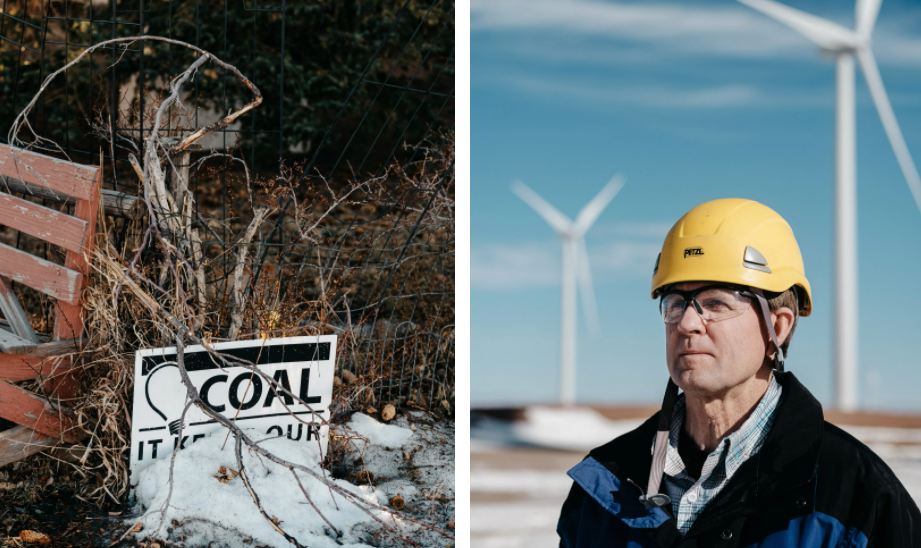
(Left) When mines closed in Hanna, the community was devastated and has yet to fully recover. (Right) The Dunlap Wind Farm.

Carbon County shows how the energy transformation that America needs to make is possible, but may happen reluctantly, driven by pragmatism more than a desire to stop burning the coal and oil that release greenhouse gases into the atmosphere. Here, at least, it comes down to the reality that mines are closing nationwide, and buyers of coal are simply disappearing.

In Wyoming, many residents like Terry Weickum support the coal industry and disapprove of the way the glossy turbines interrupt the emptiness of the sagebrush-spotted landscape. Nevertheless, Mr. Weickum helped bring wind energy to Carbon County, knowing it would help ​Rawlins — a community of 9,000 ​with its downtown gym, coffee shop and the Rifleman Club Bar — to avoid becoming yet another ghost town, forgotten as mining passes into history.

Read the full story

If you liked this post you’ll love our daily newsletter, EnviroPolitics. It’s packed with the latest news, commentary and legislative updates from NJ, PA, NY, Delaware…and beyond. Try it free for an entire month.

One of the nation’s largest wind farms is coming to coal country Read More »

Workable solutions to the replacement of lead service lines (in an exemplary essay)

Two solutions, both practical and efficient, if public officials are committed to addressing the problem

Chris Daggett

Editor’s Note: Those of you who take special pleasure in the written word have been schooled at one time or another on the value of the opening paragraph in an essay that seeks to influence your opinion or solve a problem. Former NJDEP Commissioner Chris Dagger serves up one of the best leads we’ve seen in some time below. It grabs your attention, summons your empathy and entices you to read on. Agree? Disagree? Lets hear from you in the Comment section

By Chris Daggett in NJ Spotlight

What if you knew of a statewide health problem that poisons at least 4,500 children each year, likely causing irreversible damage to their brain, kidneys, and nervous system? And, further, while there is no medical treatment, what if you knew how to avoid new cases, the cost of which is far exceeded by reduced expenses for medical treatment, special education and the full realization of earnings over a lifetime? What would you do?

We do know of such a problem. It’s lead exposure — from lead paint in older homes, lead service lines, indoor lead plumbing, and lead in soil. While attention has been given to each of these areas, lead service lines have received the most attention lately due to water crises in Flint, Michigan, and here in Newark, New Jersey.

An estimated 350,000 lead service lines are scattered across New Jersey, the fifth-highest total in the nation, and the projected cost of completely replacing them is $2.3 billion, a daunting cost given tight state and local budgets.

However, there are two solutions that are both practical and efficient if public officials are committed to addressing the problem. The first is found in water rates, the second in county bonding. In both cases, there is a complicating factor of the general prohibition on using public funds to improve private property when lead service lines are jointly owned by both the water utility and the property owner.

If you liked this post you’ll love our daily newsletter, EnviroPolitics. It’s packed with the latest news, commentary and legislative updates from New Jersey, Pennsylvania, New York, Delaware…and beyond. Try it free for an entire month.

To move forward, we need to recognize the replacement of customer-owned lines as a special case: They form an integral part of a functioning water system and many low-income customers lack the financial means to pay for the work.

A water system’s rate charges provide revenue that is stable and sufficient to cover the cost to treat, store, and distribute high quality water to customers, as well as investments that ensure a state of good repair. Typical capital needs, such as upgrades to aging treatment plants, pipes and pumping stations, are financed by ratepayers because they are considered to be part of a unified system. Individual customers are not charged based on the benefit they specifically receive from each improvement.

Negative results from earlier law

Unfortunately, that is not the case for lead service line replacements. New Jersey’s 2018 legislation to address lead service lines (P.L. 2018, c.114), authorized localities to require property owners to pay $1,000 each to offset the cost of replacing customer-owned lines.

In the first two cities to act, Trenton and Newark, the $1,000 cost share triggered three negative results: decreased participation, a slow pace, and inefficiency. Absentee landlords often refused to pay, leaving many low-income tenants in limbo, and contractors skipped around neighborhoods as handfuls of property owners gradually decided to participate, driving up costs considerably — as much as 25% by some estimates.

By including the full cost of lead service line replacement in water rates, the burden is distributed across the entire service area and, if revenue is used to support water utility debt or federal loans, it is also spread over time. Combined with the fact that the planned work is staggered over several years, the typical cost to an individual ratepayer is often low. Since the improvements are one-time in nature, the rate adjustment can be eliminated once the expense is paid.

As highlighted in a joint study by the Environmental Defense Fund and Harvard University, many other states and cities have pursued this approach, including Michigan, Indiana, Pennsylvania, Missouri, Denver, and Lansing.

Besides maximizing efficiency, this approach is clearly the most equitable. Across the country, poor families in low-income areas struggle with lead poisoning long after more affluent residents have paid to address the problem.

County bonding is another solution

A second funding option is county bonding, particularly in those counties with excellent bond ratings. Newark’s line replacement has proved this concept. With money not available through rate increases, Essex County used its bonding strength to enable Newark to mandate lead service line replacements without requiring property owners to pay a cost share.

Lead service lines have been methodically replaced across entire neighborhoods, maximizing efficiency, and the pace of the program is unprecedented. Since early 2019, the city has replaced 93% of its 18,000 lead service lines. For most communities across the country, the job has taken 15 to 20 years. Newark is likely to complete the work in less than three years, while saving approximately 13% versus past service line projects.

Read the entire opinion piece here

Don’t miss information like this. Sign up for FREE EP Blog updates

Workable solutions to the replacement of lead service lines (in an exemplary essay) Read More »