Novelis, Nespresso launch recycled-content coffee capsule

The new coffee capsule features 80 percent recycled aluminum.

By Megan Smalley Recycling Today

Novelis Inc., a large aluminum rolling and recycling company based in Atlanta, has announced that it has partnered with Nespresso, Switzerland, to launch a coffee capsule made of 80 percent recycled aluminum. According to a news release from Nespresso, Novelis’ alloy has “deep-drawing properties” to meet the coffee capsule market’s need for demanding product specifications, and the alloy supports Nespresso’s continued circularity journey by minimizing waste and maximizing the reuse of product materials.

“This achievement is an important step in helping Nespresso reach its sustainability goals,” says Stephen Boney, vice president of Specialties at Novelis Europe. “We have a long-standing partnership with Nespresso that is focused on implementing more sustainable manufacturing processes throughout the supply chain. As such, we have increased the amount of recycled aluminum content in coffee capsules and developing additional end-of-life recycling solutions for greater circularity.”

Comprised of a thinner aluminum foil, the new capsules contain 9.2 percent less aluminum and are 8 percent lighter. The foil protects freshness and aromas of high-quality coffee and provides a strong barrier against oxygen, light and humidity. Nespresso reports that the foil is infinitely recyclable and requires less energy to produce than virgin aluminum. 

Jérôme Pérez, Nespresso’s head of sustainability, says, “We are constantly challenging ourselves to improve the sustainability and circularity of our operations, including the way we source, use and recycle material. Reaching 80 percent recycled aluminum in our capsules is a significant milestone and something we have worked hard to achieve with Novelis and other partners along the value chain.”

In recent years, Novelis says it has developed many new alloys that are easily recyclable and invested in technologically advanced recycling facilities that have increased recycled product content from 33 percent to 60 percent across its global operations.

Like this? Click to receive free EP Blog updates

Novelis, Nespresso launch recycled-content coffee capsule Read More »

Evacuations during California wildfires complicate troubled virtual asbestos trial

By John O’Brien, Legal Newsline

ALAMEDA, Calif. (Legal Newsline) – Things aren’t smoothing out in the nation’s first attempt at virtual asbestos trials in Alameda County, Calif.

The county is attempting to run two trials on Zoom but has run into technical problems, juror inattention and even one plaintiff being left alone with jurors to have a friendly chat.

The latest problem? Fire. Last week, one of plaintiff Ronald Wilgenbusch’s lawyers, Will Ruiz of Maune Raichle, took a day off from the trial to evacuate his home because of the current California wildfires.

And this week, one juror told the court she had been evacuated from her home and couldn’t be present for the trial.

This comes after two other jurors were excused from the trial, which has survived three motions for mistrial already.

One excused juror said she was having coronavirus symptoms while the other had connection problems, even after the court sent an iPad to his home. Only two alternate jurors remain, and there will possibly be only one if the woman who had to evacuate her home can’t find a way to attend.

The Wilgenbusch trial started with online jury selection during which members of Fryer-Knowles’ defense team complained they were put on mute and unable to object. It also claimed one prospective juror was working out and another was possibly asleep.

When a jury was selected, the court then attempted in-person proceedings. However, a juror reported a fever, moving the trial online and prompting the second mistrial motion, this one from defendant Metalclad.

“(T)he Court has indicated that unless it receives some outside information from a higher authority compelling it to stop, the Court intends to compound the prejudice and move to a fully remote trial proceeding post haste… The Court’s plan to proceed with this trial is – and always has been – unfair and untenable,” Metalclad wrote.

Read the full story

Don’t miss stories like this Click for EP Blog updates

Evacuations during California wildfires complicate troubled virtual asbestos trial Read More »

N.J. reports 346 new COVID-19 cases, pushing total above 190K. Rate of transmission falls for 4th day.

By Matt Arco | NJ Advance Media for NJ.com

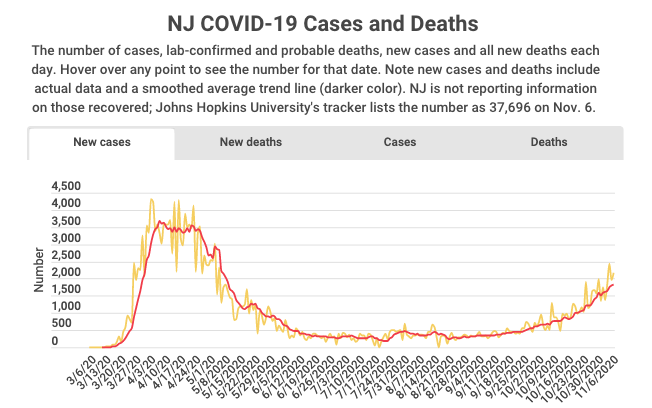
New Jersey health officials reported 346 new coronavirus cases Tuesday and five additional deaths as the rate of transmission dropped for the fourth consecutive day and remains below the key benchmark of 1, which indicates whether the outbreak declining.

The latest update brings the Garden State death toll to 15,953 with 14,124 confirmed and 1,829 probable fatalities — second highest in the United States. The total number of positive coronavirus tests climbed to 190,021, eighth in the nation.

The latest figures were announced on Twitter by Gov. Phil Murphy, hours after he delivered his revised fiscal year 2021 budget address at SHI Stadium at Rutgers in Piscataway.

New Jersey’s rate of transmission now stands at 0.83 after pushing over the key benchmark of 1 last week. The Department of Health reported the rate of transmission was 0.85 Monday, down from 0.90 on Sunday and 0.99 on Saturday. It was 1.04 on Friday and 1.06 on Thursday.

Any number above 1 means each newly infected person is spreading the virus to at least one other person, on average.

Read the full story

EnviroPolitics Blog is working to keep you informed about all aspects of the coronavirus — the status of confirmed cases, disease spread, death toll–and also how Americans are coping. Like this story, for instance. If you like what we are doing, Click to receive free EP Blog updates and please tell your friends about us.

N.J. reports 346 new COVID-19 cases, pushing total above 190K. Rate of transmission falls for 4th day. Read More »

In Pittsburgh, steel mill of past becomes today’s solar array

The largest solar array of its kind in the U.S. now sits atop a former Pittsburgh steel mill

  • By Kiley Koscinski/WESA 

A 133,000-square-foot solar array is now functional at Hazelwood Green’s Mill 19. It’s a project that marries the story of Pittsburgh’s past with its future: bridge workers applied 4,784 solar panels to the frame of a former steel mill now home to robotics nonprofits and one of the several autonomous vehicle developers which call the city home.

Tim Sippey, the site foreman, used to pick his father up from a late shift at Mill 19 when he was growing up.

“I remember what the inside of that mill looked like when I was a little kid,” he said. Sippey’s father worked at the former LTV Coke Works site for 32 years.

He said the memories came flooding back when arrived for his first day at the job site.

“There’s a certain smell to the mill,” he said. “Even when they were digging down there, the dirt still smelled that way.” Sippey said he wore his father’s hard hat to work when crews began fitting and clamping panels into place in September.

Solar array in Illinois becomes a place honeybees can call home

The $5 million project was completed by Scalo Solar Solutions, which is also installing solar panels in the parking lots at Hazelwood Green. Mike Carnahan, the company’s vice president and general manager, said panels were preassembled and tested on the ground before a crane lifted them 85 feet in the air to the frame of the old mill.

Crew members then clamped the panels onto the frame of the 1943 building while standing on netting between the beams. Carnahan said the site looked like a giant jungle gym.

The roof is sloped at 20 degrees to capture as much sunlight as possible.

“It’s providing shade for the building and it’s producing all the energy that this facility is going to need,” said Carnahan.

Crews placed the final section of panels at the end of July. Wiring and testing have been completed, making the solar array fully functional. It’s the largest single sloped solar array in the United States.

Read the full story

Try our daily newsletter, EnviroPolitics, free for a full month!

In Pittsburgh, steel mill of past becomes today’s solar array Read More »

From the L.A. Times: Fighting Fire With Networking

Feeling abandoned by the state and federal government during an unparalleled conflagration of fires, volunteer firefighting units in two Santa Cruz Mountains towns have been forced to tap an alternative: unofficial help from an elite network of the nation’s finest emergency response units — who quickly provided needed equipment and support.

Over the weekend, crews from an elite FEMA Urban Search and Rescue unit in Menlo Park delivered spare water tenders, firefighting rigs, cots, sleeping bags, radios and communications equipment, food and water to struggling units in Boulder Creek and Ben Lomond. There, veteran and decorated first responders established makeshift command and operations centers to battle the CZU Lightning Complex fire raging in the mountains above Silicon Valley.

The unit is called California Task Force 3, and it is one of 28 such forces in the United States. The team of roughly 200 has responded to some of the nation’s most notorious and deadly disasters, including the 2018 Camp fire, the 2010 San Bruno gas line explosion, and notorious hurricanes such as Katrina, Irma and Harvey.

The death toll from the historic firestorms hitting Northern California rose to seven as officials used a small break in the weather to make progress against a series of lightning-sparked blazes that have been burning for a week.

Live Fire Updates from the New York Times

‘Megafires’ Could Burn for Weeks
There are 625 blazes burning across the state, and they have scorched an area larger than the state of Delaware.

Firefighters reported an increase in containment of the two largest groups of fires, the L.N.U. Lightning Complex and the S.C.U. Lightning Complex.

Here’s what you need to know:
Damage from the L.N.U. Lightning Complex fire in Vacaville, Calif., on Monday.
Damage from the L.N.U. Lightning Complex fire in Vacaville, Calif., on Monday.Credit…Ian C. Bates for The New York Times

Firefighters make progress, but warn that ‘this is going to be a marathon.’

Strained by hundreds of fires that have burned through more than 1.4 million acres, California fire officials are warning that the state is now living through a “megafire era” in which blazes burn for weeks across vast expanses of land.

There are currently 625 blazes burning across the state, and they have scorched an area larger than the state of Delaware. Seven deaths have been linked to the fires and more than 1,000 homes and other buildings have gone up in flames, many of which were consumed by two groups of fires in Northern California — the S.C.U. Lightning Complex and the L.N.U. Lightning Complex — that are the second-largest and third-largest ever in the state.

“We are essentially living in a megafire era,” said Chief Jake Hess of the Santa Clara Unit of CalFire, California’s fire agency. “We have folks who have been working for CalFire for the last five years and that’s all they understand — megafires — since they started.”

Read the full story

If you liked this post you’ll love our daily newsletter, EnviroPolitics. It’s packed with the latest news, commentary and legislative updates from New Jersey, Pennsylvania, New York, Delaware…and beyond. Don’t take our word for it, try it free for an entire month. No obligation.

From the L.A. Times: Fighting Fire With Networking Read More »

NY, NJ hesitant on offshore grid planning amid federal uncertainty

Two offshore wind turbines | AP Photo

By SAMANTHA MALDONADO and MARIE J. FRENCH, Politico

ALBANY — New York and New Jersey may have their offshore wind goals nailed down, but how to bring the power to land remains very much in the air.

Transporting electricity produced by wind turbines off the coasts of New York and New Jersey to shore requires a decision: should states guide a planned grid offshore or let each project developer go it alone?

So far the two states have opted to let offshore wind developers plot their own path for transmission lines to connect to their grids. That may ultimately result in higher costs, missed opportunities and an inability to advance future offshore developments.

Both states are examining the issue of transmitting offshore wind to shore and plugging it into some of the oldest electric infrastructure in the country.

“If we’re going to have a complete revolution of where we get our power from, it only makes sense that you’re going to plan out how to get that power to shore,” said Janice Fuller, president of New Jersey OceanGrid, a division of transmission developer Anbaric. “It can’t be left to this one-at-a-time, we’ll figure it out as we go [process]. … We only have one opportunity to do this right.”

With each new award to an offshore wind developer who picks the least-cost and best-located point to hook into the grid, the number of places to interconnect decreases and potential upgrade costs increase. That may raise the bids submitted by wind developers to states seeking thousands of megawatts to support their climate goals.

A major barrier to policymakers moving ahead with detailed plans for an offshore grid is the lack of clarity on where new wind projects might be sited. The federal government is slow-walking new leases off the area’s coastline, making any planning nebulous.

“It is harder to make material progress on transmission issues on the wet side when you don’t know where the lease areas will be located,” said Doreen Harris, interim president and CEO of the New York State Energy Research and Development Authority.

As it stands, there may not be enough capacity in the leased areas to meet the two state’s goals: a combined 16.5 gigawatts by 2035.

Setting up an offshore grid to collect electricity generated from multiple wind projects and making proactive onshore upgrades to the grid could ensure lower overall costs for electricity customers, and prevent major additional work on land. Fewer cables could minimize impacts on traditional maritime interests, including shipping and fishing.

“From Anbaric’s perspective, there’s risk mitigation through planning transmission. If you’re making decisions about transmission ahead of time or in parallel with your construction of generation, you can help to de-risk some of this,” Fuller said.

Read the full story

If you liked this post you’ll love our daily newsletter, EnviroPolitics. It’s packed with the latest news, commentary and legislative updates from New Jersey, Pennsylvania, New York, Delaware…and beyond. Don’t take our word for it, try it free for an entire month. No obligation.

NY, NJ hesitant on offshore grid planning amid federal uncertainty Read More »