HARRISBURG, Pa. — Pennsylvania’s Supreme Court ruled unanimously Friday on a key concern surrounding an avalanche of mailed ballots, prohibiting counties from rejecting them if the voter’s signature on it does not resemble the signature on the voter’s registration form.
Two Republican justices joined five Democratic justices in the decision.
The verdict was a victory for the state’s top election official, Kathy Boockvar, a Democrat who had asked the court to back her up in a legal dispute with President Donald Trump’s campaign and Republican lawmakers.
“County boards of elections are prohibited from rejecting absentee or mail-in ballots based on signature comparison conducted by county election officials or employees, or as the result of third-party challenges based on signature analysis and comparisons,” the justices wrote.
Trump and former Vice President Joe Biden are locked in a battle to win Pennsylvania’s 20 electoral votes. With Democrats voting by mail at an almost 3-to-1 rate over Republicans, the prospect of disqualified ballots poses a greater threat to Biden’s candidacy.
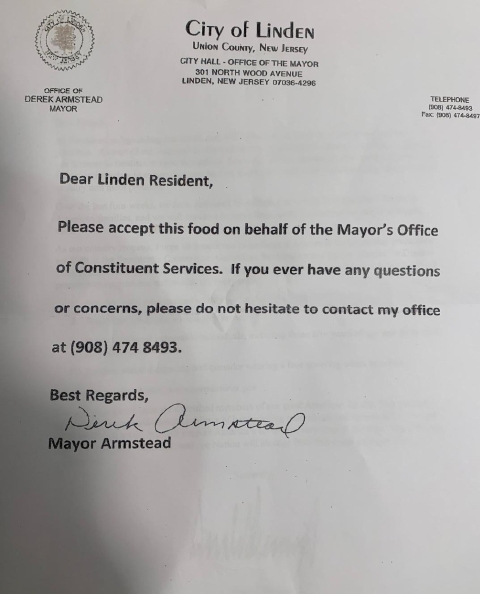
A letter from President Donald Trump that accompanied U.S. Department of Agriculture fresh food boxes for Linden was replaced by one from the city’s Democratic mayor, Derek Armstead.
Food boxes were opened by local public works department employees. Trump’s letter was removed and a letter from Armstead was added.
“The original letter in these boxes was removed, and the mayor had city employees put in his letter on work time,” said Councilwoman Gretchen Hickey, a Democrat and an Armstead political rival.
Armstead acknowledged that his message was added to the box, offering local residents the impression to recipients that the food came from him.
“Whenever I do a delivery, I always add a letter from the mayor,” Armstead told the New Jersey Globe.
Trump says his administration has delivered 100 million Farmers to Families food boxes since May as part of a program to send nutritious food to families in need.
“The Mayor bragged about himself and his hand-outs,” Hickey said. “Trickery, deceitfulness, and theft for votes is very much alive in Linden.”
Read the full story
If you liked this post you’ll love our daily newsletter, EnviroPolitics.It’s packed with the latest news, commentary and legislative updates from New Jersey, Pennsylvania, New York, Delaware…and beyond. Don’t take our word for it, try it free for an entire month. No obligation.
Coronavirus Cases, Hospitalizations and Deaths are Rising – New Jersey reported 1,139 new coronavirus cases and 11 additional deaths on Friday, marking the sixth consecutive day with more than 1,000 new positive tests as hospitalizations also continued to rise to the highest numbers in three months. (nj.com)
Gov. Murphy: I Don’t Want to Shut Down the State Again – Gov. Phil Murphy said he thinks New Jersey can handle COVID-19 outbreaks by location; he said the state is better prepared for a second wave; and he said he doesn’t want to shut the state down again. But there are no guarantees, he added. (ROI-NJ)
Election 2020: The Ballot Counting in New Jersey Will Soon Begin, But Don’t Expect to Hear About It Until Election Day – With thousands of mail-in ballots already in, New Jersey officials will begin counting general election votes on Saturday. It’s the first time counties can start counting ballots this early, but they cannot reveal any count results, under a law Gov. Murphy signed in August. If they do, they risk criminal prosecution. (NJ Spotlight News)
Today is the Deadline to Request a New N.J. Ballot – If you misplaced it, made a mistake while completing it, or damaged it, you can request that a new ballot be mailed to you. (nj.com)
More School Districts are Offering In-Person Instruction – Although COVID-19 cases are on the rise, New Jersey schools are slowly shifting back to in-person learning. Statewide, 245 school districts have remained all-remote for now, down from 266 two weeks ago. (NJ Spotlight News)
A List of School Districts – See the latest plans for your school district: remote, in-person or hybrid. (NJ Spotlight News)
N.J. Coronavirus Cases – New Jersey Residents(Source: N.J. Health Department) Total Confirmed Deaths Reported: 14,484 Total Positive COVID-19 Cases Reported: 225,430 For data on hospitalizations and discharges, click here.
TRENTON, N.J. – Assemblyman Ron Dancer’s bill to allow housing for employees at facilities that board horses passed the Assembly Agriculture Committee Thursday.
he bill (A2768) would amend the Right to Farm Act to allow housing for equine-related farm employees as long as the newly constructed housing is in a separate area or level from the horses and meets all Uniform Construction Code standards, including fire ratings.
The bill also makes providing this housing an act that falls under Right to Farm protections.
“Farm employees often need more access to the horses they care for,” said Dancer (R-Ocean). “They will be able to take better care of these animals if they can live on the same farm.”
Dancer’s bill will require the state agriculture development committee to adopt rules and regulations to implement the bill. The committee would adopt an agricultural management practice that permits the housing of equine-related farm employees in the same building where the horses are boarded either in a separate area or level from the horses.
“Taking care of a horse is one of the most demanding and worthwhile jobs one could do,” said Dancer. “The horse industry is important to New Jersey’s economy, and we must keep this industry thriving.”
Republicans and even some Democrats criticized Joe Biden after he said during the final presidential debate that he wanted to “transition from the oil industry” in order to fight what he called the existential threat of climate change.
When pressed by debate moderator Kristen Welker, the former vice president suggested the burning of petroleum, which adds greenhouse gases to the air, eventually has to end “because the oil industry pollutes significantly.”
“It has to be replaced by renewable energy, over time. Over time,” he added.
The comment drew attacks from both the oil and gas industry and its Republican allies, who faulted Biden for endangering energy jobs with his climate policies. But what he had to say shouldn’t shock anyone who has been following the Democratic nominee’s campaign.
And on stage in Nashville, President Trump immediate pounced in defense of an industry that has been a consistent ally, trying to score political points with voters in oil-producing states. “Basically what he’s saying is he is going to destroy the oil industry,” Trump responded. “Will you remember that Texas, will you remember that Pennsylvania, Oklahoma?”
Biden’s assertion is in line with his long-term climate goals. But it comes at a delicate moment for him and other Democrats.
His official plan for tackling climate change calls for eliminating the nation’s contributions to rising global temperatures by the middle of the century. It comes in response to U.N. scientists who say rapidly cutting greenhouse gas emissions is necessary to avoid irreversible damage to the planet.
While Biden’s plan does not call for a ban on fossil fuels and includes measures for continuing their use by capturing their carbon emissions, the 2050 goal still cannot be achieved without significantly curtailing the burning of oil and gas. Indeed, the Democrat’s proposal includes a major subsidy for consumers to buy electric vehicles and get rid of cars that rely exclusively on petroleum-based fuels.
On the campaign trail, Biden has taken pains to repeatedly insist he will not stop one extraction technique — hydraulic fracturing, or fracking — heavily used in the crucial swing state of Pennsylvania.
With his lead in the polls nationally, Biden may have more leeway to push a more progressive climate change agenda. But they may hurt down-ballot Democrats struggling to keep their seats.
At least two representing oil-producing districts — Reps. Kendra Horn of Oklahoma and Xochitl Torres Small of New Mexico — distanced themselves from Biden after the debate.
On the other side of the political spectrum, climate activists once reluctant to back Biden were happy to see him voice what they saw as a strong message on global warming.
“Tonight marked a distinct shift in Biden’s rhetoric on climate: he went on offense,” said Evan Weber, political director for the youth-led Sunrise Movement. “Biden’s closing statement on what he would say to the country on Inauguration Day sounded a lot like our vision of the Green New Deal.”
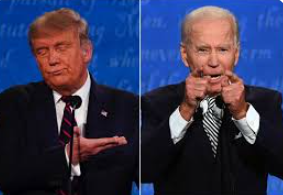
Biden and Trump sparred over energy policy during a presidential debate that heavily featured climate change for the first time in years.
The president also dinged Biden’s energy efficiency goals. “They want to knock down buildings and build new buildings with little, tiny windows,” he said without evidence. What Biden’s climate plan actually provides is incentives for retrofits to improve energy use in existing structures.
Trump again claimed Biden’s plan to fight climate change would cost $100 trillion — far from the former vice president’s actual proposal to spend $2 trillion over four years. The president’s exaggerated price tag most likely originates from a conservative wonk’s back-of-the-envelope calculations on Twitter more than a year ago for the Green New Deal — well before Biden rolled out his own plan.
“He kept referring back to plans of the Dem primary candidates Biden defeated (and we criticized) but didn’t touch Biden’s actual plan,” Josh Freed, head of the climate and energy program at the center-left think tank Third Way, said by email.
Trump also said Biden supports a ban on fracking — a claim his Democratic opponent has repeatedly knocked down, including on Thursday evening. “I never said I oppose fracking,” Biden said.
Biden has sometimes fumbled over his words when describing his position on fracking on the campaign trail. He supports ending new permits for fracking and other oil and gas drilling only on federal lands out West — but not on state or private lands such as those in Pennsylvania.
The technique is controversial both for the risk it poses to drinking water and for the greenhouse gas emissions it causes. His stance has helped him win the support of labor groups in the energy sector. Still, during the debate, Biden emphasized he wants to reduce fracking’s environmental footprint.
On Climate Change When asked about climate change, Mr. Trump said that “what I want is the crystal clean water, the cleanest air.” He did not mention that his administration had rolled back several environmental regulations, including the Clean Water Act. Biden responded that climate change is a serious issue.
“Climate change, climate warming and global warming is an existential threat to humanity,” Biden said. He said that his plan, which had been endorsed by major environmental and labor groups, would provide “millions of new good-paying jobs.” Biden also talked about the importance of developing solar and wind energy.
“I know more about wind than you do. It’s extremely expensive. It kills all the birds,” Mr. Trump replied. He also accused Biden of flip-flopping on banning fracking, which Biden denied.
“I do rule out banning fracking,” Biden said, but he added that “we need other industries.”
Welker also pointed out that Black people are disproportionately affected by rolling back regulations, allowing the nearby environment to be polluted.
“The families that we’re talking about are employed heavily,” Mr. Trump said, declining to directly answer the question.
“It doesn’t matter what you’re paying them, it matters how you keep them safe,” Biden said in his response, explaining that he would “transition from the oil industry” to be replaced by renewable energy over time. Mr. Trump said that this was proof that Biden wanted to “destroy the oil industry.”
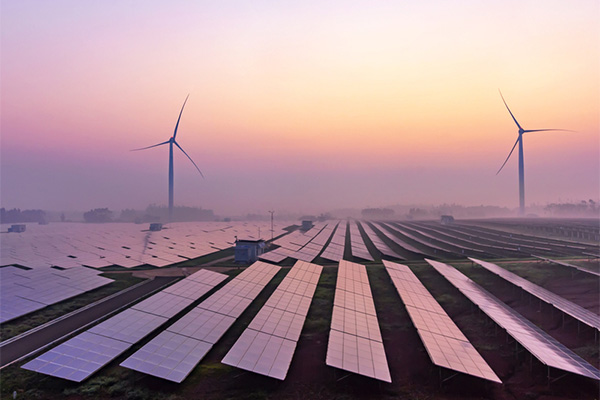
The harnessing of renewable energy for electricity generation, innovations to ditch fossil fuels and rely more wind, solar, and hydro, and energy playing a critical role in a post-Covid world
By PVBuzz editorial team
Washington DC – According to a review by the SUN DAY Campaign of data just released by the Federal Energy Regulatory Commission (FERC), renewable energy sources (i.e., biomass, geothermal, hydropower, solar, wind) dominated new U.S. electrical generating capacity additions in the first eight months of 2020.
Combined, they accounted for 63.3% – or 10,445 megawatts (MW) – of the 16,499 MW of new utility-scale capacity added during the first two-thirds of this year.
FERC’s latest monthly “Energy Infrastructure Update” report (with data through August 31, 2020) also reveals that natural gas accounted for 36.5% (6,029 MW) of the total, with very small contributions by coal (20 MW) and “other” sources (5 MW) providing the balance. There have been no new capacity additions by oil, nuclear power, or geothermal energy since the beginning of the year.