NY State Lifts Restricted Access to Give Public a Peek During Breeding Season Slowdown at Important Refuges

Wilson Hill Wildlife Management Area in New York State

From the New York State Department of Environmental Conservation

The New York State Department of Environmental Conservation (DEC) announced today that several otherwise restricted Wildlife Management Areas (WMAs) in Jefferson and St. Lawrence counties will be opening to the public from Saturday, Aug. 15, through Sunday, Aug. 30, 2020. Portions of these WMAs are normally marked as “refuge” or “wetlands restricted areas” to allow waterfowl and other listed species to breed and raise young without interference from people.

During the 16-day period, Upper and Lower Lakes and Wilson Hill WMAs in St. Lawrence County, including the posted Wetland Restricted and Refuge areas, will be open to visitors each day from sunrise to sunset.

Perch River WMA in Jefferson County will also be open to visitors with two exceptions, the Mossentine parking lot and dike will be closed due to construction and Perch Lake proper will have limited hours. Visitors will be asked to keep a safe distance from all construction areas and obey posted signs. In addition, Perch Lake proper will be open starting at NOON until sunset daily. Access to lake will be by foot only.

Don’t miss information like this Click for free EnviroPolitics Blog updates

Perch River WMA encompasses more than 8,000 acres in the towns of Brownville, Orleans, and Pamelia. Perch River WMA can be accessed from State Route 12, Allen Rd., Buckminster Road, Vaadi Road, Cook Road, and Perch Lake Road. The Perch Lake proper (accessed by Perch Lake Rd.) will be open from NOON until sunset. Fishing will be allowed, but motorized boats are not permitted.

Upper and Lower Lakes WMA is located about two miles west of the village of Canton along State Route 68 in St. Lawrence County. This WMA, the largest in the region, is an 8,757-acre upland/wetland complex between the Grasse and Oswegatchie rivers.

Wilson Hill WMA is in northern St. Lawrence County, approximately six miles west of the village of Massena off State Route 37. Situated along the St. Lawrence River, the 4,000-acre area consists of several large pools of open water marsh bordered by a combination of dense cattails, brushy wetlands, forest, and upland meadow. Fishing is not allowed in Nichols Pool.

DEC will be conducting habitat and wildlife management projects on the WMAs throughout the 16-day period. Please avoid operating machinery and pay attention to temporary signage. For additional information, bird lists, and maps, contact DEC’s Regional Wildlife Office at 315-785-2263 or visit the DEC webpage.

While enjoying outdoor spaces, please continue to PLAY SMART * PLAY SAFE * PLAY LOCAL and follow the Centers for Disease Control (CDC)/New York State Department of Health (DOH) guidelines for the preventing the spread of colds, flu, and COVID-19:

  • Stay home if you are sick, or showing or feeling any COVID-19 symptoms, such as fever, coughing, and/or troubled breathing;
  • Practice social distancing. Keep at least six (6) feet of distance between you and others even when outdoors;
  • Wear a mask when you cannot maintain social distancing;
  • Avoid close contact, such as shaking hands, hugging, and high-fives;
  • Wash hands often or use an alcohol-based hand sanitizer with at least 60% alcohol when soap and water are not available; and
  • Avoid unnecessary contact with surfaces that are often touched, such as doorknobs and handrails.

PLAY SMART * PLAY SAFE * PLAY LOCAL encourages New Yorkers to recreate locally, practice physical distancing, show respect for all outdoor adventurers, and use common sense to protect themselves and others.

Not receiving our free EP Blog updates?

NY State Lifts Restricted Access to Give Public a Peek During Breeding Season Slowdown at Important Refuges Read More »

What we know about the fatal shark attack in Maine

Authorities say a great white shark attacked Julie Dimperio Holowach about 20 yards off the shore of Bailey Island.

 By Dialynn Dwyer, Boston.com

A New York woman was killed in a shark attack while swimming off the coast of a Maine island on Monday.

It is the first recorded fatal shark attack in Maine — and the second recorded unprovoked attack by one of the ocean predators in a decade. It follows two years after Massachusetts saw a Revere man killed by a shark while boogie boarding at a Wellfleet beach and a New York man survived but suffered severe injuries in another attack by a great white at a Truro beach.

“This is a highly unusual event,” Patrick Keliher, commissioner of the Maine Department of Marine Resources, said at a Tuesday press conference. “However, at this time, the department is urging swimmers and other people recreating in or around the waters of the Casco Bay region, and in particular near Bailey’s Island, to be aware of their surroundings and to avoid schools of fish, which will attract seals. The seals in return will attract sharks.”

Below, what we know about the second fatal shark attack New England waters in two years.

What Maine officials are saying about the attack

During the press conference on Tuesday, Maine officials said Dimperio Holowach, who was wearing a wetsuit, and her daughter were swimming approximately 20 yards from the shore of Bailey Island when the attack occurred around 3:26 p.m. on Monday.

The woman’s daughter was able to make it back to shore, uninjured.

Officials expressed gratitude for the quick actions of nearby kayakers, who helped bring Dimperio Holowach to the shore, where she was pronounced dead by local EMS.

“In the face of that situation, the fact that they were able to kayak into that area and help bring the body back to shore was nothing more than miraculous, and we certainly sincerely thank them,” Keliher said.

Tom Whyte points to the area where he witnessed the shark attack that killed his neighbor as she swam in the waters off Bailey Island. —Jessica Rinaldi / The Boston Globe

Tom Whyte was an eyewitness to the attack that claimed the life of the 63-year-old, according to The Boston Globe. He told the newspaper he was working in his second-story office overlooking the island’s Mackerel Cove when he saw the two swimmers head into the water.

Whyte told the Portland Press Herald that the older woman was about 10 to 15 feet away from her daughter, who was not wearing a wetsuit. He heard the family members giggling and laughing but then heard Dimperio Holowach scream, he told the newspaper.

“It looked like she was pulled under,” he said. “I saw her underwater and just her hands were above water.”

Her companion swam back to shore and screamed for help, neighbors running to her side, he told the Globe. Whyte said he watched as a distraught kayaker approached the floating woman in the water, who was brought back to shore.

“It is all very surreal,” he said.

The shark was not observed in the area after the initial contact of the attack, according to officials.

Keliher said he consulted with Greg Skomal, the senior fisheries scientist for the Massachusetts Department of Fish and Game who leads the Massachusetts Shark Research program, following the attack. Using a fragment of a tooth that was recovered, Skomal identified the ocean predator involved in the attack as a great white shark, the commissioner said.

“I want to stress that this is a very highly unusual event,” Keliher said. “In fact, this is the only confirmed fatality in Maine waters from a shark attack. The only other confirmed shark attack in Maine waters occurred 10 years ago, near Eastport, and that shark was determined at the time to be a porbeagle shark.”

What we know about Julie Dimperio Holowach

Officials said Tuesday that Dimperio Holowach and her family owned property nearby and spent about four or five months every summer in the Maine coastal community.

“The individuals were well known in the community, very active within the community while they were here in the summer months,” Keliher said.

Neighbors told the Globe that Dimperio Holowach, a resident of New York City, could be spotted most mornings walking or jogging on the main road of the island and used a neighbor’s floating dock in Mackerel Cove to access the water. She and her husband lived seasonally in a home on Elden Point Road.

Marie Schmon, an island resident, told the Globe that Dimperio Holowach was a “welcoming, warm, civic-minded” woman who “always had a smile on her face.”

Beal, who described himself as close with the tight-knit coastal community of Harpswell, said the 63-year-old and her husband are “well known and very respected individuals” in the neighborhood.

“The community is really at a tough juncture in trying to process yesterday’s event,” he said.

What shark experts are saying 

In a statement, the Atlantic White Shark Conservancy, a nonprofit that works with Skomal to study, tag, and track the ocean predators off Cape Cod and the shores of Massachusetts, expressed its condolences to Dimperio Holowach’s family and friends.

The nonprofit stressed that although sightings of great whites are “rare” in Maine, they do happen.

“White sharks have long been known to be seasonal inhabitants of the Gulf of Maine, and they have been observed preying on seals and porpoises in Maine’s coastal waters,” the conservancy wrote. “Sightings data, catch records, and tagging data indicate that white sharks occur in the region from the early summer through the fall.”

In addition to its work with the Massachusetts Division of Marine Fisheries, the conservancy added that it is continuing to collaborate with scientists at the New England Aquarium, University of New England in Maine, Arizona State University, and the Fisheries and Oceans Canada to “expand our knowledge of white sharks in these areas” to help promote public safety and awareness.

James Sulikowski, a former University of New England professor and researcher who conducts shark research in Maine, told the Press Herald that more white sharks have been seen off the Maine coast in recent years.

Keliher said due to the “rarity” of the attack, widespread beach closures by his department are not being undertaken, though he reiterated that swimmers and those recreating in the water should be aware of their surroundings and avoid schools of fish and seals.

“We have consulted very closely with our counterparts at Mass. Department of Marine Fisheries; we feel like the prudent thing to do at this time is to just continue to express caution in the area and while swimming and recreating,” he said. “It’s the rarity of the event that made us believe that we didn’t need to take action.”

However, some beaches under the jurisdiction of the state Department of Agriculture, Conservation, and Forestry are not allowing swimmers to go in water deeper than their waist.

Read the full story

We’re always looking for stories that might interest our readers. If you come across something so interesting that it cries out to be shared, please send it to editor@enviropolitics.com  If we agree, you’ll see it here soon.   

What we know about the fatal shark attack in Maine Read More »

N.J. reports 24 new deaths, 565 additional cases as rate of transmission increases again

New Jersey reported its highest number of new cases on Tuesday pushing the total over 180K. The rate of transmission increased to 1.14, meaning the outbreak is expanding.

By Matt Arco | NJ Advance Media for NJ.com
New Jersey reported 24 new coronavirus deaths and 565 new cases Tuesday as the rate of transmission increased once again and remains above the key benchmark that indicates the outbreak is expanding after weeks of declines.

“It’s a mixed bag,” Gov. Phil Murphy said Tuesday during a press conference on small business grant funding in North Brunswick. “We’re not out of the woods yet.”

The rate of transmission increased to 1.14. When the transmission rate is above 1, it means that each new case leads to more than one additional case. The rate was 1.09 on Monday after falling below 1 over the weekend to .84 on Sunday.

The 565 new cases is the most reported in a single day so far this month and the third time in four days that number was above 500. New Jersey health officials reported 547 cases Saturday, 512 Sunday and 446 Monday. Murphy has cautioned that the rise in new cases could reflect a backlog from last week in getting test results processed and counted.

The latest update pushes the total number of cases to 180,295 and the total known confirmed and probable deaths to 15,825. That includes 13,905 lab confirmed deaths and 1,920 considered likely caused by COVID-19.

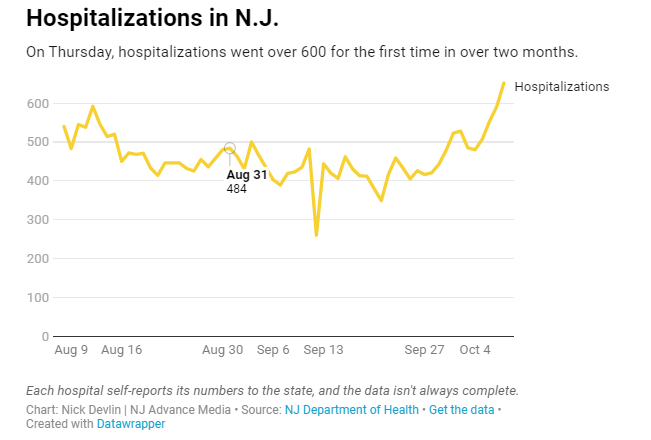
The number of patients with confirmed or suspected coronavirus cases at New Jersey’s hospitals increased slightly as of Monday night to 718. That includes 50 patients on ventilators and 112 in intensive or critical care. New Jersey had more than 8,000 patients at the state’s 71 hospitals at the peak in mid-April.

Murphy cited the recent reports of massive mansion house parties and other case clusters among young people as concerning issues as the case numbers increase.

New Jersey also expanded its coronavirus quarantine travel advisory on Tuesday to include 34 states, Puerto Rico and Washington, D.C. That’s up from 31 states last week.

COUNTY-BY-COUNTY NUMBERS

Atlantic County: 3,297 cases (31 new), 227 confirmed deaths (15 probable)
Bergen County: 20,341 cases (48 new), 1,783 confirmed deaths (263 probable)
Burlington County: 5,684 cases (44 new), 430 confirmed deaths (41 probable)
Camden County: 8,167 cases (45 new), 514 confirmed deaths (55 probable)
Cape May County: 800 cases (6 new), 81 confirmed deaths (5 probable)
Cumberland County: 3,166 cases (23 new), 143 confirmed deaths (13 probable)
Essex County: 19,376 cases (42 new), 1,856 confirmed deaths (247 probable)
Gloucester County: 2,999 cases (14 new), 196 confirmed deaths (7 probable)
Hudson County: 19,399 cases (22 new), 1,330 confirmed deaths (175 probable)
Hunterdon County: 1,123 cases (2 new), 70 confirmed deaths (56 probable)
Mercer County: 7,966 cases (30 new), 569 confirmed deaths (43 probable)
Middlesex County: 17,580 cases (36 new), 1,196 confirmed deaths (212 probable)
Monmouth County: 9,947 cases (44 new), 756 confirmed deaths (100 probable)
Morris County: 7,091 cases (17 new), 676 confirmed deaths (153 probable)
Ocean County: 10,293 cases (57 new), 942 confirmed deaths (70 probable)
Passaic County: 17,348 cases (24 new), 1,090 confirmed deaths (156 probable)
Salem County: 866 cases (7 new), 78 confirmed deaths (5 probable)
Somerset County: 5,155 cases (18 new), 480 confirmed deaths (78 probable)
Sussex County: 1,286 cases (2 new), 158 confirmed deaths (37 probable)
Union County: 16,410 cases (31 new), 1,174 confirmed deaths (175 probable)
Warren County: 1,321 cases (5 new), 156 confirmed deaths (14 probable)

CORONAVIRUS RESOURCES: Live map tracker | Newsletter | Homepage

The rate of transmission jumped back above the key benchmark of 1 Monday. While day-to-day fluctuations aren’t cause for too much alarm, the rate of transmission, or Rt, is used as a key metric to decide whether to reopen more businesses in the state.

“We’re monitoring this every single day and again, day-to-day fluctuations, we don’t go totally crazy,” State Epidemiologist Dr. Christina Tan said Monday. “Again, we look at several different metrics, the cases, the positivity, the syndrome and surveillance, and they’re — those three metrics are very highly correlated, actually. And we haven’t seen anything unusual, but we certainly echo the message about not being complacent.”

An increase in the transmission rate above 1 earlier this month, causing Murphy to pause the state’s reopening plans, which are currently in Phase 2.

A new poll, meanwhile, showed two-thirds of New Jerseyans favor keeping restrictions in place until a vaccine or treatment is available, according to Fairleigh Dickinson University. Only 29% of people surveyed said they want a return to normal despite the risks.

Republicans were the only demographic where a majority (53%) said they support a return to normal life over restrictions, according to the poll.

Read the full story

EnviroPolitics Blog is working to keep you informed about all aspects of the coronavirus — the status of confirmed cases, disease spread, death toll–and also how Americans are coping. Like this story, for instance. If you like what we are doing, Click to receive free EP Blog updates and please tell your friends about us.

N.J. reports 24 new deaths, 565 additional cases as rate of transmission increases again Read More »

EPA Proposes Change to Cleanup Plan for the Imperial Oil Superfund Site in Morganville, NJ

Morganville, N.J. (July 28, 2020) – The U.S. Environmental Protection Agency (EPA) is proposing a change to its plan to address groundwater contamination at the Imperial Oil Superfund Site in Morganville. Data collected since the original cleanup plan was selected in 1992 indicate that natural processes are effectively reducing the levels of contaminants and that active treatment of the groundwater is not needed.

As a result, the agency plans to rely on natural processes to address the groundwater rather than extract and treat the groundwater as the original decision stated. Throughout the cleanup, monitoring and further studies will be conducted to ensure the effectiveness of the remedy.

“We are glad to see that the groundwater data collected over the last nine years, suggest that our previous cleanup actions were effective and contaminant levels are continuing to decrease,” said EPA Regional Administrator Pete Lopez. “Under the Superfund program, our work here is reaping benefits and today the site is populated with trees, grass, restored wetlands, a pond and a bike path.”

The Imperial Oil facility, located in the Morganville section of Marlboro Township, operated from the 1950s until 2007. Improper work practices and piles of waste from oil reclamation activities contaminated soil and sediment on the plant property, in adjacent wetlands, the nearby Birch Swamp Brook and on several residential properties. Groundwater underlying the site was also contaminated.

The site cleanup was originally overseen by the New Jersey Department of Environmental Protection (NJDEP). The NJDEP excavated soil, cleaned up part of the wetlands and sediment in the brook and removed oil that was floating underneath the ground and on top of the groundwater.

Don’t miss information like this Click for free EnviroPolitics Blog updates

The EPA took over the cleanup of the property in 2006 at NJDEP’s request. In 2008, the EPA completed the demolition of structures on the site, including all production, storage and maintenance buildings, as well as above-ground tanks.

In 2011, the EPA completed the excavation of the soil and the restoration of the industrial property.  The excavated property areas were seeded and restored along with the restoration of the wetlands. In 2013, EPA completed the cleanup of the remaining wetlands and contaminated sediments in Birch Swamp Brook.

As part of today’s announced plan, EPA is requiring periodic collection and analysis of groundwater samples to verify that the level and extent of contaminants are declining, and that people’s health and the environment are protected. The EPA will conduct a review within 5 years to ensure the effectiveness of the cleanup.

A 30-day public comment period for the proposed plan will occur from July 28, 2020 until August 28, 2020. EPA will host a Virtual Public Meeting on August 11, 6:00 p.m. To register for the public meeting go to https://www.eventbrite.com/e/imperial-oil-virtual-public-meeting-tickets-114604428932  

For more information about the meeting, please contact the Community Involvement Coordinator Pat Seppi at Seppi.Pat@epa.gov, (212) 637-3679.

Written comments on EPA’s proposed plan may be mailed or emailed to Renee Gelblat, Remedial Project Manager, U.S. Environmental Protection Agency, 290 Broadway, 19th Floor, New York, New York 10007-1866 or Gelblat.Renee@epa.gov. Comments postmarked on or before August 28, 2020 will be accepted.

The EPA’s proposed plan for the site will be made available at www.epa.gov/superfund/imperial-oil.

If you liked this post you’ll love our daily newsletter, EnviroPolitics. It’s packed with the latest news, commentary and legislative updates from New Jersey, Pennsylvania, New York, Delaware…and beyond. Don’t take our word for it, try it free for an entire month. No obligation.

EPA Proposes Change to Cleanup Plan for the Imperial Oil Superfund Site in Morganville, NJ Read More »

Philadelphia extends indoor dining ban as ‘second wave of the epidemic’ reaches city

Outdoor diners at Parc in Rittenhouse.

By Kennedy Rose Philadelphia Business Journal   

If you were looking to take a seat in an air-conditioned restaurant to escape Philadelphia’s summer heat, you’re going to have to keep waiting.

Philadelphia again extended its ban on indoor dining at restaurants to Sept. 1 after the city has seen another week Covid-19 cases on the rise. The previous ban was set to end Aug. 1. 

Health Commissioner Dr. Thomas Farley said during a press conference Tuesday that he sympathizes with restaurant owners, but that the risk of infection spread is increased with indoor dining and while case counts are rising.

“It’s better for them to not open than to open and to have to turn around and completely shut down again a week or two later,” Farley said.

Try our daily newsletter, EnviroPolitics, free for a full month!

Mayor Jim Kenney said his administration is working with restaurants to help with permits extending outdoor seating to sidewalks or “streeteries.”  Philadelphia is allowed to offer indoor dining while limiting capacity under guidance from the Pennsylvania Department of Health, but city officials have prohibited it as Covid-19 case rates still hover around more than 100 per day.

The city’s health department reported an additional 142 new Covid-19 cases on Tuesday, for a total of 29,945 since the beginning of the pandemic. For the week ended July 25, the city averaged 164 cases per day, up from last week’s average of 141 cases per day. The increase in cases is partially attributed to the increase in testing, but the average number of cases reported Tuesday will likely increase because of a lag in reporting from labs processing Covid-19 tests, Farley said.

Read the full story

Philadelphia extends indoor dining ban as ‘second wave of the epidemic’ reaches city Read More »