What autopsies are telling us about coronavirus

A story of 38 brains, 87 lungs and 42 hearts. Learning from the dead that could help the living

An examination room in the morgue at the Franklin County Forensic Science Lab in Columbus, Ohio. (Ty Wright for The Washington Post)

By Ariana Eunjung Cha Washington Post

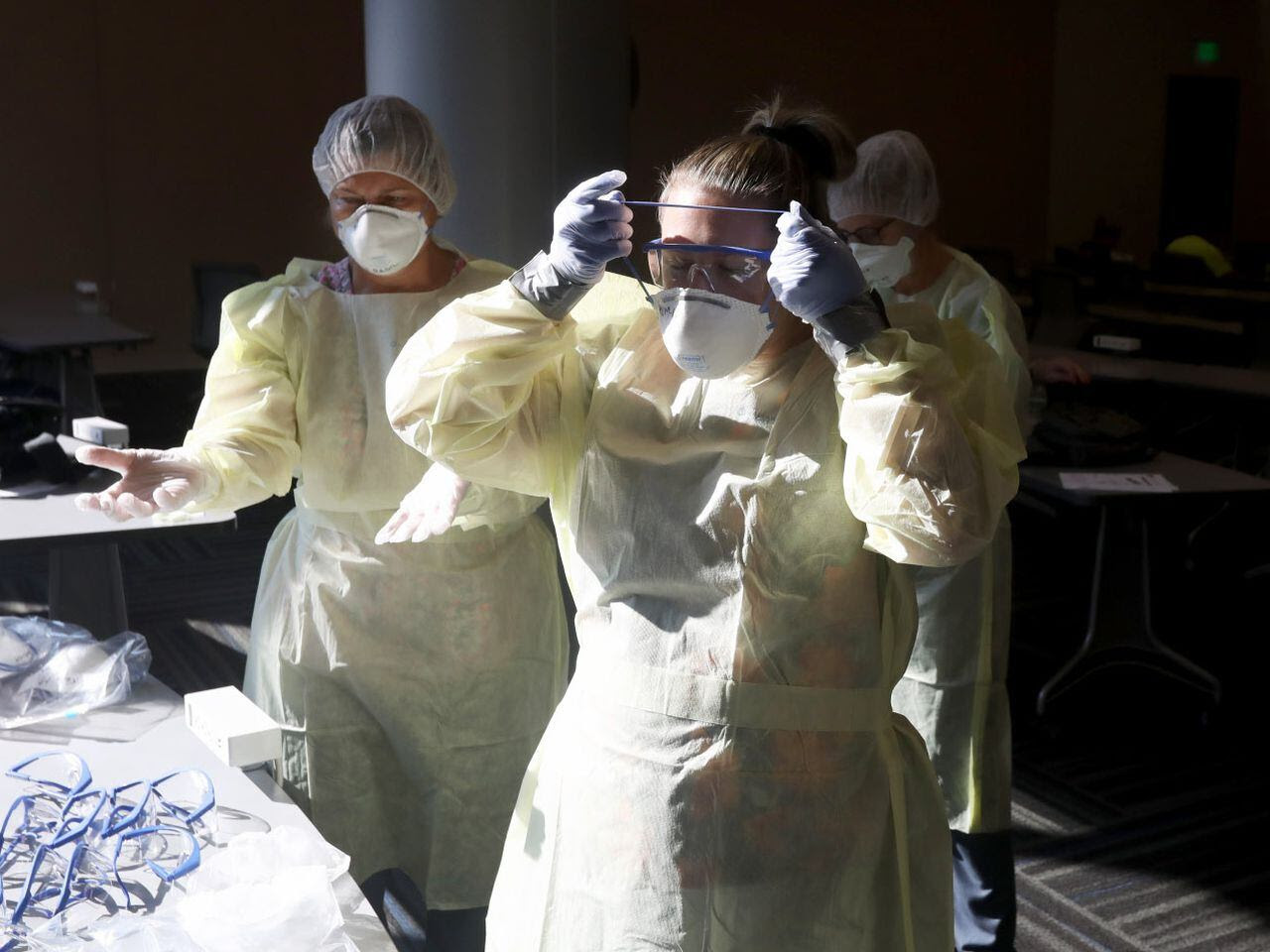
When pathologist Amy Rapkiewicz began the grim process of opening up the coronavirus dead to learn how their bodies went awry, she found damage to the lungs, kidneys and liver consistent with what doctors had reported for months.

But something was off.

Rapkiewicz, who directs autopsies at NYU Langone Health, noticed that some organs had far too many of a special cell rarely found in those places. She had never seen that before, yet it seemed vaguely familiar. She raced to her history books and — in a eureka moment — found a reference to a 1960s report on a patient with dengue fever.

In dengue, a mosquito-borne tropical disease, she learned, the virus appeared to destroy these cells, which produce platelets, leading to uncontrolled bleeding. The novel coronavirus seemed to amplify their effect, causing dangerous clotting.

She was struck by the parallels: “Covid-19 and dengue sound really different, but the cells that are involved are similar.”

Autopsies have long been a source of breakthroughs in understanding new diseases, from HIV/AIDS and Ebola to Lassa fever — and the medical community is counting on them to do the same for covid-19, the disease caused by the novel coronavirus. With a vaccine probably many months away in even the most optimistic scenarios, autopsies are becoming a critical source of information for research into possible treatments.


When the pandemic hit the United States in late March, many hospital systems were too overwhelmed trying to save lives to spend too much time delving into the secrets of the dead. But by late May and June, the first large batch of reports — from patients ranging in age from 32 to 90 years who died at a half-dozen institutions — were published in quick succession. The investigations have confirmed some of our early hunches of the disease, refuted others — and opened up new mysteries about the pathogen that has killed more than 500,000 people worldwide.

Among the most important findings, consistent across several studies, is confirmation the virus appears to attack the lungs the most ferociously. They also found the pathogen in parts of the brain, kidneys, liver, gastrointestinal tract and spleen and in the endothelial cells that line blood vessels, as some had previously suspected. Researchers also found widespread clotting in many organs.

A mysterious blood-clotting complication is killing coronavirus patients

But the brain and heart yielded surprises.

Read the full story

EnviroPolitics Blog is working to keep you informed about all aspects of the coronavirus — the status of confirmed cases, disease spread, death toll–and also how Americans are coping. Like this story, for instance. If you like what we are doing, Click to receive free EP Blog updates and please tell your friends.

What autopsies are telling us about coronavirus Read More »

Ocean, concessions legal again in Rockaway Beach

People at Rockaway Beach the day after it opened for swimming again
SCOTT LYNCH / GOTHAMIST

BY SCOTT LYNCH reports for Gothamist 

People at Rockaway Beach the day after it opened for swimming againCheeseburger ($9.50) and Fries ($4) at RippersFried Chicken Sandwich at High 97 ($10)Brothers at Beach 106thVIEW ALL22

On the one hand it seems like the most natural thing in the world, that on a hot sunny day at one of New York City’s great beaches people would swim and play and jump around in the water. On the other hand, given that we’re still in the midst of a pandemic, it also feels surreal that we can do this again.

It’s true though: lifeguards are now on duty at the city’s beaches, for those who want to get in on some of that cool and refreshing Atlantic Ocean action. When I asked one young guard at Rockaway if he was happy to be back on the job he said without hesitation, “I’m ecstatic. I fucking love the beach.”

While beaches were previously open, swimming was not permitted, and Mayor Bill de Blasio had sent mixed messages about what was allowed prior to July 1st when lifeguards returned; in May, he said, “It’s just not time for beaches yet. If people want to take a beach chair and sit on the beach, fine. If it starts to seem like a typical summer beach scene, that’s what we won’t allow.”

A lifeguard stands on his chair on a crowded beach
SCOTT LYNCH / GOTHAMIST

The return of legal swimming to Rockaway also marks the reopening of the boardwalk concession stands, with vendors serving food and drinks once again at Beach 106th, Beach 97th, and Beach 86th. And they have plenty of pandemic protocols in place.

There are no tables at any of the stands, for instance, though the benches on the boardwalk remain in place and, of course, you can always bring your food down to the beach (though technically not your alcohol). Each concession has a two-window “Order Here” and “Pick Up Here” setup, with plexiglass shields between customers and counter workers. Distancing is expected on any lines that may (will) occur, and there are more reminders and demands and pleas to wear a mask than anywhere I’ve seen.

A word about masks. Wear a mask. Just wear one! Cloth, surgical, N95, bandana, fashionable, silly, functional… if you’re going to be close to or interacting with another human being, wear a mask. Don’t be like the dude who was leaning over the counter maskless talking with a masked-up worker who couldn’t really back up and, when I asked why he wasn’t wearing a mask, said “Oh yeah I have one. Back at the house. But I was surfing before…”

A sign reads: Respect the locals, wear a mask
SCOTT LYNCH / GOTHAMIST

At Beach 106th you’ll find the beloved Brothers making their delicious smoothies, salads, pastries, and killer egg-and-pesto sandwiches. Speaking about all of the new pandemic procedures one of the namesake brothers Matthew Webster told me, “Yeah, the whole thing sucks! But I’m excited and grateful to finally be open.” Also here at Beach 106th is the venerable Caracas Arepas with a pared-down menu of arepas, empanadas, and beverages like frozen sangrias.

Read the full story

Happy Fourth of July from EnviroPolitics

Ocean, concessions legal again in Rockaway Beach Read More »

New York adds 241 acres to Catskills Preserve

Acquisitions Create New Recreational Opportunities, Trails to Connect Existing Public Lands, and Access to Renowned Trout Fishery

NYDEC News Release

New York State Department of Environmental Conservation (DEC) Commissioner Basil Seggos today announced the acquisition of 241 acres in the Catskills, including 208 acres adjoining existing Forest Preserve lands in the Bluestone Wild Forest that will preserve critical open space and expand recreational opportunities to support the local economy. The purchases of the two properties were made possible through a partnership with the Open Space Institute (OSI) and $758,000 from New York’s Environmental Protection Fund (EPF).

“New Yorkers will have new opportunities for outdoor recreation in the Catskills thanks to these significant acquisitions, which will expand our trail network to connect the Jockey Hill and Onteora Lake properties in the Bluestone Wild Forest and protect critical habitat in the town of Warwarsing,” Commissioner Seggos said. “We are grateful to our partners at the Open Space Institute and the Woodstock Land Conservancy, and for Governor Andrew Cuomo’s continued commitment to the Environmental Protection Fund and other significant investments in forest conservation and preservation.”

In addition, DEC and the Office of Parks, Recreation and Historic Preservation (State Parks) today launched the PLAY SMART * PLAY SAFE * PLAY LOCAL Campaign to encourage all New Yorkers to recreate safely, responsibly, and locally this summer and to always treat fellow outdoor adventurers with respect. The campaign invites people to take the PLAY SMART * PLAY SAFE * PLAY LOCAL pledge, and promise to use common sense to protect themselves and others when enjoying the outdoors.

During the State’s ongoing response to COVID-19, New Yorkers across the state want and need to get outside for a nature break, which is good for physical and mental health. See a video message from DEC Commissioner Basil Seggos and State Parks Commissioner Erik Kulleseid.

“During the State’s ongoing response to the COVID-19 public health crisis, DEC is working with our partners at State Parks to encourage all New Yorkers to PLAY SMART * PLAY SAFE * PLAY LOCAL when visiting public lands and parks. Getting outside can serve as a much-needed getaway from the stresses and fears of everyday life. So get outside, but #PlaySmartPlaySafePlayLocal, and remember to treat the outdoor adventurers you encounter with respect,” DEC Commissioner Seggos said.

Read the full story

Don’t miss information like this Click for EP Blog updates

New York adds 241 acres to Catskills Preserve Read More »

Tesla now the most valuable automaker in the World — surpassing Toyota

By Derick Lila PV Buzz

Tesla’s market cap has exploded and it has become the most valuable automaker in the world.

The company smashed through milestones, surpassing auto giants like Toyota in terms of market value. Shares are up a staggering 26% this week — and then there are the Q2 delivery numbers. Tesla crushed those as well even in the middle of a pandemic.

Tesla delivered more vehicles than expected this quarter — a total of 90,650. Of these deliveries, about 80,000 were Model 3s and Model Ys.

Tesla usually doesn’t break down how many of the deliveries came from the gigafactory factory in Shanghai China versus how many came out of the Tesla plant in Fremont California. Analysts were not expecting Tesla to deliver more than 78,000 vehicles this quarter because the plant in California was basically shut down for five or six weeks because of COVID-19.

Nonetheless, Elon Musk and his team were able to not only meet expectations but exceed them by a wide margin. Now, this sets up the question of whether or not Tesla can hit its guidance of delivering a half-million vehicles this year.

In order to do that, Tesla will have to deliver at least 322,000 vehicles over the next six months — challenging, not impossible — but definitely challenging.

Read the full story


Tesla now the most valuable automaker in the World — surpassing Toyota Read More »

More openings as NJ heads into July 4 weekend

Briana Vannozzi reports for NJTV News

Today marks another big step forward in New Jersey’s coronavirus recovery plan.

Ahead of the Fourth of July holiday weekend there are a number of reopenings including casinos, amusement parks, museums and libraries, to name just a few.

Indoor dining is still on an indefinite pause, and the governor warned he’ll scale back reopenings if the same large crowds without masks gather at sites across the state.

Gov. Phil Murphy extended the public health emergency for another 30 days to keep his executive orders in place. While signing another, in contrast, that raises the limit on crowd sizes for outdoor gatherings to 500 people, effective today.

The limits on indoor gatherings remain. Despite progress slowing the virus, the state reported another 27 COVID-19 related deaths on Thursday. Total confirmed and probable fatalities is 15,105.

There were 539 new positive test results overnight for a cumulative total of 172,356.

The state also announced another roughly 130 contact tracers have been on-boarded over the past week to help prevent new cases that become flare ups and threaten the state’s recovery.

If you liked this post you’ll love our daily newsletter, EnviroPolitics. It’s packed with the latest news, commentary and legislative updates from New Jersey, Pennsylvania, New York, Delaware…and beyond. Don’t take our word for it, try it free for an entire month. No obligation.

More openings as NJ heads into July 4 weekend Read More »

EPA’s divisive “temporary enforcement policy” set to end

USEPA headquarters in Washington, D. C.

From the Saul Ewing Arnstein and Lehr law firm

On June 29, 2020, the U.S. Environmental Protection Agency (EPA) announced that its March 26, 2020 Temporary Policy Memo, which modified the Agency’s enforcement discretion in light of the sweeping impact of the COVID-19 pandemic in the United States (the “Temporary Enforcement Policy”), will terminate in its entirety at 11:59 PM Eastern Daylight Savings Time on Monday, August 31, 2020. Accordingly, EPA will not base its exercise of enforcement discretion on the Temporary Enforcement Policy as to any noncompliance by regulated entities occurring after August 31, 2020.

EPA’s Temporary Enforcement Policy suspended enforcement activity and imposition of penalties for violations of routine compliance monitoring, testing, sampling, laboratory analysis, training, reporting and certification obligations, where a regulated entity could document that noncompliance was attributable to operational challenges arising from the COVID-19 pandemic. The Temporary Enforcement Policy quickly drew sharp criticism from Democratic lawmakers and coalitions of environmental conservation groups and states, and prompted multiple lawsuits against EPA. These still-pending legal challenges argue that EPA’s Policy has allowed polluting industries to shirk their obligations under various environmental laws, compromising public health and further endangering already imperiled species.

In choosing August 31 as the termination date for the Temporary Enforcement Policy, EPA observed that as state and local restrictions imposed to combat the COVID-19 pandemic are gradually relaxed or lifted, operational challenges being faced by regulatory entities should begin to subside. EPA further noted that “as states and business begin to re-open, there will be a period of adjustment as regulated entities plan how to effectively comply both with environmental legal obligations and with public health guidance.”

EPA’s June 29 announcement additionally advised that, notwithstanding the August 31 termination date, EPA reserves the right to terminate its Temporary Enforcement Policy at any earlier time, on a regional or national basis and in whole or in part, upon seven days’ advance notice to the public.

Don’t miss information like this Click for free EnviroPolitics Blog updates

EPA’s divisive “temporary enforcement policy” set to end Read More »