Public schools in Pa. were required to pay employees through June, but the mandate has expired, the Inquirer reports, so many districts are furloughing staff. The moves, which are not yet happening in Philadelphia, come as another potential health issue rears its head. The bacteria that causes Legionnaires’ disease flourishes in stagnant water, like that in semi-shuttered academic buildings. Experts tell the New York Times it can only be cleared out by flushing every tap. So far in Pa., it’s been found in four schools near Pittsburgh, per WXPI.
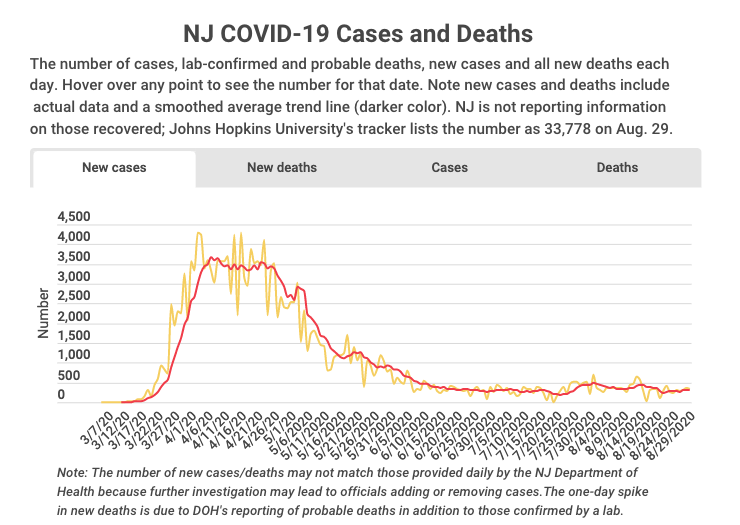
New Jersey reported four more deaths attributed to the coronavirus and 306 new cases Sunday as the state’s rate of transmission ticked up for the second straight day after declining for more than a week.
But the rate remains below a critical benchmark measuring the virus’ spread.
The Garden State has reported 15,937 total deaths related to COVID-19 — 14,157 confirmed and 1,780 considered probable — in the nearly six months since its first case was announced March 4.
The state has reported 191,611 total positive tests in that time — the eighth-most in the nation — out of more than 2.8 million total administered tests. More than 33,700 residents have recovered, according to Johns Hopkins University, though that number is likely much higher.
Gov. Phil Murphy announced the latest figures on Twitter. He did not detail when the newly reported deaths occurred.
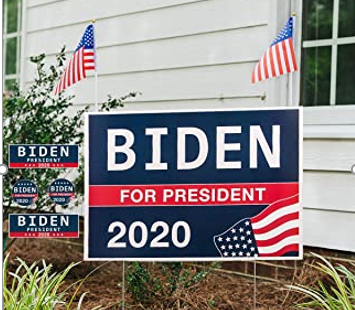
Across Pennsylvania — especially in rural communities — tens of thousands of yard signs supporting Joe Biden have popped up as his fans try to replicate how President Trump showed his growing support in the state when he was campaigning in 2016. And, just as quickly, some of those signs have been vanishing.
It usually happens in the dark of night, local Democrats say, but sometimes in daylight. Sometimes entire streets or neighborhoods are cleared. Pro-Biden Facebook groups have devoted long threads to strategies for deterring sign snatchers — one suggestion involves clear hair gel and pesky glitter, another electrifying the metal frame with a car battery.
While sign thefts are a problem every election year for candidates of both parties — and are an ongoing source of headaches for campaign staffers and party officials — some Democrats in Pennsylvania and several other states insist it’s worse for them this year and illustrates the emotional intensity of the coming election. While there are examples of Trump signs also disappearing, there hasn’t been the same level of public outcry.
Campaign staffers frequently roll their eyes at the utility of campaign signs, preferring to spend their time and money on higher-tech sales pitches. But as the Trump campaign proved in 2016, signs can create a momentum for a candidate all on their own, persuading people that siding with a candidate, even a controversial one, is safe.
Now, with many people stuck at home amid a historic pandemic, yard signs have become a stand-in for other shows of support for a candidate, such as attending a rally or marching in a parade. When that symbol vanishes, it can feel like a violation.
We’re always looking for stories that might interest our readers. If you come across something so interesting that it cries out to be shared, please send it to editor@enviropolitics.com If we agree, you’ll see it here soon.
NOMINATIONS ADVISE AND CONSENT BY SENATE Thursday, August 27, 2020
DELAWARE RIVER PORT AUTHORITY: Sara Shuttleworth Lipsett, of Cherry Hill, to replace Frank DiAntonio. Aaron T. Nelson, of Marlton, to replace Ricardo Taylor.
MARINE FISHERIES COUNCIL: Richard N. Herb, of Avalon, to succeed himself. Jeffrey Howard Kaelin, of Cape May, to replace Erling A. Berg.
STATE BOARD OF AGRICULTURE: Warren L. Hollinger, of Port Norris, to replace Daniel Farrand. Holly Sytsema, of Wantage, to replace August Wuillermin.
THOMAS EDISON STATE UNIVERSITY BOARD OF TRUSTEES: Kemi Alli, of Bernardsville, to succeed herself. Lydia Stockman, of Pennington, to replace Marilyn Pearson. Michael Toscani, of Lawrenceville. Johnnie Whittington, of East Windsor, to replace Richard Arndt.
ASSOCIATE JUSTICE OF THE SUPREME COURT: Fabiana Pierre-Louis, of Mount Laurel.
New Jersey officials today reported an additional 388 confirmed cases of COVID-19, a slight increase from yesterday and bringing the statewide cumulative total to 191,320.
State health officials have said they were keeping tabs on trends in counties with 25 or more new cases and today there were again five: Bergen (49), Middlesex (42), Monmouth (32), Ocean (37), and Passaic (34).
Eight counties saw single-digit increases or no new cases at all.
Another four lab-confirmed COVID-19 deaths were reported, bringing that total to 15,933 deaths among New Jersey residents.
Deaths stemming from a confirmed COVID-19 infection have reached 14,153. Another 1,780 are listed as probable COVID-19 fatalities, as determined in an ongoing review of death certificates and other data by state epidemiologists.
Two deaths were reported by state hospitals as occurring yesterday; lab tests will determine whether they are COVID-19 related.
The United States’ death toll from the coronavirus is now 182,175, up more than 700 overnight, according to Johns Hopkins.
The number of patients being treated for COVID-19 in New Jersey hospitals was unchanged yesterday.
With all 71 hospitals in the state reporting, 437 patients were being treated for confirmed or possible cases of COVID-19.
88 were in critical/intensive care and 26 of those were on ventilators, up slightly in both cases.
49 COVID-19 patients were discharged, either to their homes or other care facilities.
If you liked this post you’ll love our daily newsletter, EnviroPolitics.It’s packed with the latest news, commentary and legislative updates from New Jersey, Pennsylvania, New York, Delaware…and beyond. Don’t take our word for it, try it free for an entire month. No obligation.
The new owner of a vacant, dilapidated Jersey City property that has been the subject of years of litigation was cited by the state for failing to remediate the contaminated site.
The soil and groundwater at 125 Monitor St., contain arsenic, copper, lead, petroleum hydrocarbons, tetrachloroethene (PCE) and trichloroethene (TCE), the state Department of Environmental Protection said in the complaint filed in Hudson County Superior Court.
“These hazardous substances in the soil threaten human health and the environment in several ways, for example, persons handling the soil can come into contact the hazardous substances and suffer adverse health effects,” the complaint says. “The soils at the property remain contaminated with hazardous substances above the applicable standards.”
The owner of the property, cited in the complaint as 125 Monitor St. LLC, faces a fine of up to $50,000 for every day the cite is not in compliance. The address for the LLC, on Bloomfield Avenue in Clifton, belongs to Manage NJ, what appears to be a real estate management company. Company officials did not return a call for comment.
125 Monitor St. was one of 12 sites across the state whose owners were sued for ignoring remediation orders.
A Tonnelle Avenue property in Jersey City was also cited. Fathi and Alia Hassanein, owners of the 111-113 Tonnelle Ave. property, were cited for the removal of underground storage tanks without necessary permits. The DEP also said the property was back-filled with gasoline-contaminated soil and the owners have not complied with the DEP site investigation/remediation orders.
The 2.2-acre site at 125 Monitor St., which includes a six-story warehouse, was purchased for $5.5 million in March 2019, but the deal was contested in a civil lawsuit. On Aug. 24, Hudson County Superior Court Judge Jeffrey Jablonski approved the sale.
DEP officials say the new owners of the property agreed to an administrative consent order (ACO) on April 29, 2019, to remediate the hazardous substances at the site.
The complaint says the owners complied with some requirements of the ACO, but failed to comply with several of the core requirements, including the establishment of a remediation funding source for the cost of future remediation; and applying for a soil remedial action permit.
The Real Deal website reported in 2007 that Landmark Developers planned 180 loft condominiums in the building. Jersey Digs reported in 2015 that the Jersey City Redevelopment Agency had designated Ironstate Development’s Graffiti 125 LLC as the property’s redeveloper, with plans for 152 units and 139 parking spaces.