You might be shut in but you need not be shut out of essential political, energy, environment–and Covid-19–news for New Jersey, Pennsylvania, New York and Delaware.
To help you stay mentally sharp and informationally up-to-date, we are offering you the chance to subscribe to our daily EnviroPolitics newsletter for a full, 30 days–without charge or obligation. No tricky stuff. We won’t continue your subscription unless you notify us that you want too continue. And we won’t charge you a penny for your information-packed, month-long reading pleasure.
NEW JERSEY – Many New Jersey towns rank surprisingly high on New Jersey’s coronavirus case list — and it’s not just the communities that have been at the focal point of the outbreak since it began in March.
Patch put together a list showing all the towns and their latest reported number of coronavirus cases, ranking them based on population. Another list ranks the total cases that Patch compiled on its own, since the state of New Jersey has never provided a list
The lists show the new coronavirus is not just a North Jersey problem, an urban problem and one that’s primarily a factor in the Garden State’s densely populated areas.
This is a problem that all New Jersey continues to face, even as the overall new daily coronavirus numbers in the state continue to sink.
Indeed, the per-capita rates in bucolic, middle- to upper-income towns such as Morristown and Deal are among the highest in New Jersey.
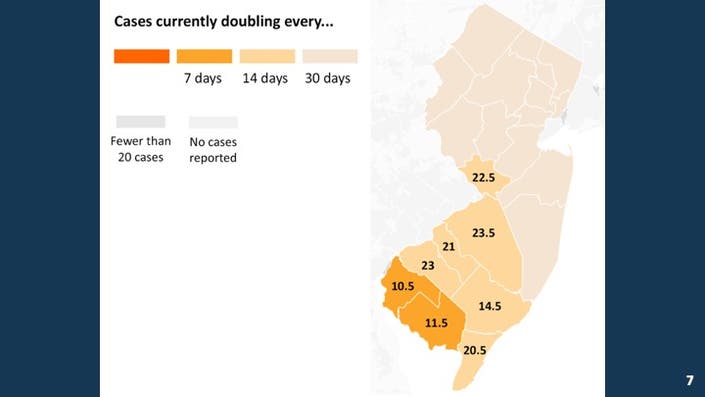
The disease is virtually everywhere — 555 of New Jersey’s 565 communities have it — and parts of South Jersey continue to show a faster rate of growth, while the curve in North Jersey – where the disease originally surged – has flattened.
The amount of days it takes for cases to double, for instance, is now much slower in North Jersey now than it is in southern New Jersey
Getting the town-by-town information has been difficult. Patch investigated every county to get the information. If the county didn’t have data, Patch researched every town and obtained the numbers.
Here’s what you should know about how forthcoming — or secretive — many of the towns have been:
Eighteen of New Jersey’s 21 counties provide maps and lists that show where the cases are.
Others, such as Union and Hudson counties, leave it up to the towns to report numbers, and many don’t use the most updated systems or technology to release those numbers.
Atlantic County has relaxed its initial defiance to providing the numbers, but it still delivers them in a unique way via somewhat vaguely worded news releases. Patch attempted to provide the most accurate numbers by simply adding them.
One Union County town, Winfield, hasn’t released new numbers in more than a week.
Atlantic County Executive Dennis Levinson even said his region made a conscious decision early on not to provide this information to the media “to help protect our full time, permanent residents from an influx of second homeowners and out-of-towners who could potentially carry the virus from areas of outbreak including New York, North Jersey and the Philadelphia suburbs.”
As of Sunday, only 10 towns had not reported a case. They were:
Cape May Point
Elsinboro
Harvey Cedars
Mantoloking
Pine Valley
Shiloh Township
Stockton
Stone Harbor
Tavistock
Walpack Township
Here are all the towns ranked from top to bottom, based on the rate of cases per 1,000 people and using the latest numbers, which largely came from Friday and Saturday (the total case list is below):
By RYAN KNELLER THE MORNING CALL |MAY 09, 2020 | 12:07 PM
More than two months after Pennsylvania’s first coronavirus case was diagnosed, the state’s case count reached 55,316 on Saturday, including a total of 3,688 deaths.
The statewide totals represent an increase of 1,078 cases and 72 deaths since the Pennsylvania Department of Health’s briefing on Friday.
The Lehigh Valley had 68 new cases — 29 in Lehigh County and 39 in Northampton County, with 11 new deaths — six in Lehigh and five in Northampton. The Valley’s case total is 5,530, with 278 deaths, though state death totals have been lagging behind county reports.
Most of the patients hospitalized and most deaths in the state have been people 65 or older, and two-thirds of the deaths have been in nursing homes.
The latest numbers were reported by the state Health Department just as restrictions were eased in 24 counties by Gov. Tom Wolf, who shut down the state about two weeks after the virus surfaced here. In those counties, mostly in northern and central Pennsylvania where populations are comparatively low, stay-at-home orders were lifted Friday and retail stores were allowed to open. But people there are still told to practice social distancing and wear masks, and restaurant dining rooms remain closed.
Next Friday, 13 more counties, mostly in Western Pennsylvania, will go from red to yellow, in the governor’s three-phase approach to reopening the state.Advertisement
“As we prepare to move a number of counties from red to yellow, we need all Pennsylvanians to continue to follow the social distancing and mitigation efforts in place,” Pennsylvania Health Secretary Dr. Rachel Levine said Saturday in a news release. “We must continue to protect our most vulnerable Pennsylvanians, which includes our seniors, those with underlying health issues, our health care workers and our first responders. I am proud of the work that Pennsylvanians have done so far, but we cannot stop now, we must continue to take the necessary steps to protect ourselves from COVID-19.”
Wolf on Thursday extended the stay-at-home order for the rest of the state until June 4. House Republicans blasted the decision and called for the widespread lifting of restrictions.
The governor has not said if the order might be lifted earlier in the Lehigh Valley, though some local legislators have pressed him to do so.
According to state Sen. Lisa Boscola, D-Northampton County, some infectious disease experts believe the region could safely have some restrictions lifted.
“The trend is positive. The peak was like three weeks ago,” Boscola said of the pandemic’s effect on the region. “I always felt the Lehigh Valley should go into yellow sooner rather than later.”
New Jersey Gov. Phil Murphy says the state has made steady progress in its battle against the coronavirus, but he is urging residents to continue social distancing.Michael Mancuso | NJ Advance Media for NJ.com
Seven weeks after Gov. Phil Murphy ordered residents to stay home and non-essential businesses to close to fight the spread, New Jersey’s death toll from the coronavirus increased to at least 9,116 fatalities Saturday, with state officials reporting at least 137,085 total cases since the outbreak started in early March.
Officials confirmed another 166 deaths attributed to COVID-19 and 1,759 new positive tests in the 9 million-resident Garden State, which has more cases and deaths than any U.S. state but New York.
Murphy said the daily number of cases and hospitalizations keeps dropping. But he has yet to give a definitive timeline for gradually peeling back his near-lockdown orders, saying the state risks the numbers jumping again if reopening is rushed. He has called on residents to continue social distancing and wearing face masks when going out to stores or parks.
This is the fourth straight day there were fewer than 2,000 new positive COVID-19 tests announced, even though deaths are up.
Murphy said the state is “seeing the most progress” in the number of positive tests that come back each day. It fell from the 50% range a month ago to 27% on Monday, he said.Governor Phil Murphy✔@GovMurphy
For the latest tests which we can assign a collection date to – in this case May 5th – that rate had dipped to 27 percent.
We’re making progress.
The governor also said the total number of patients in intensive care is getting better, but not at the rate “we’d like to see.”
“We are not out of the woods, folks,” Murphy added during his daily coronavirus briefing in Trenton.
About half of the state’s COVID-19 deaths have come at longterm care facilities, such as nursing homes and veterans homes. There were 4,825 deaths at the facilities as of Friday, officials said — 124 more than the day before.
On Friday, the state reported a 4-year-old girl with an underlying medical condition was the first child in New Jersey to die from COVID-19 complications. Officials declined to provide additional details about the child’s death, including which town or county she was from.
On Saturday, state Health Commissioner Judith Persichilli said there is “no indication at this point that the death was related to Kawasaki,” a rare disease that has been linked to children infected with COVID-19. Persichilli and Murphy, however, would not disclose that the underlying medical condition was.
“This is a very specific situation with this blessed little kid,” Murphy said, adding he would not release any other details about how the child died.
There have been a total of 273,375 COVID-19 tests performed in New Jersey, with a positivity rate of 38.7%, according to the state’s coronavirus tracking website.
The Department of the Treasury responded to a request from a bipartisan group of senators to extend the ITC safe harbor deadline by one year for energy projects that started construction in 2016 or 2017, saying in a letter that it “plans to modify the relevant rules in the near future.”
“We are pleased about the Treasury Department’s action to advance clean energy projects. While this mostly applies to wind projects, flexible policies such as this one that unlock clean energy are very positive and we urge Congress to take a similar approach to developing legislation that unleashes new solar and wind projects and the economic growth that comes with them,” said Dan Whitten, VP of public affairs at SEIA, in a statement.
“We are encouraged by the Treasury Department’s letter announcing its intent to modify time-sensitive safe harbor deadlines for renewable energy tax incentives,” said Gregory Wetstone, president and CEO of the American Council on Renewable Energy (ACORE), in a statement. “Extending these safe harbor deadlines would be immensely helpful as the renewable sector has been hit hard these last couple of months by supply chain disruptions, shelter-in-place orders and other significant pandemic-related delays. We look forward to further detail on this critical issue, and extend our appreciation to the Treasury Department for this important step, which will help the renewable sector continue as a key economic driver through this downturn, and an effective climate solution over the long haul.”
NEW YORK, May 8 (Reuters) – The Trump administration has offered to place a $10 million cap on Philadelphia Energy Solutions’ biofuel blending obligations, effectively slashing the bankrupt refiner’s regulatory liability by more than 70%, according to a proposed settlement between the two parties dated earlier this week.
The deal is intended to free up more cash for the company to pay off its list of creditors, according to the filing.
It marks the second time the U.S. Environmental Protection Agency under President Donald Trump has agreed to waive significant portions of PES’s obligations under the U.S. Renewable Fuel Standard, a law that requires refiners to blend biofuels like ethanol into the fuel pool or buy credits from those that do.
Under the agreement, PES – which entered into bankruptcy after a catastrophic fire last summer – will have to hand over 161,830,963 biofuel blending credits, called RINs, or pay up to $10 million to meet its obligations, whichever comes first, the filing said. The cost of those credits had previously been estimated at $35 million, according to court documents.
The agreement “can reduce the $35 million RINs Retirement Obligation Reserve to $10 million on the Effective Date, which makes funds available to satisfy the creditors’ claims promptly,” the filing said.