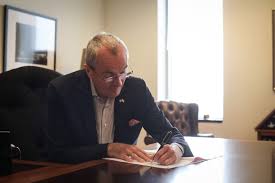
New Jersey school hallways have been empty since mid-March and will stay closed for the duration of the academic year. See second story below. (Andrew Mills | NJ Advance Media)SL
Two months after announcing the state’s first case, officials Tuesday said the death toll from the coronavirus in New Jersey has increased to at least 8,244 with at least 130,593 total cases, as residents and businesses remain under near-lockdown to slow the spread of the virus.
The numbers include 334 new deaths attributed to COVID-19 and 2,494 new positive tests in the Garden State, which remains the U.S. state with the second most coronavirus cases and deaths after New York.
“It is unfathomable,” Gov. Phil Murphy said of the death toll. He noted there is still some lag in the reporting of the cases from the weekend and that the numbers don’t reflect those who died in the last 24 hours.
Hospitalizations for confirmed or suspected coronavirus cases – a number Murphy has made a key benchmark to start lifting social distancing restrictions and closures – have continued to drop in New Jersey.
As of 10 p.m. Monday, there were 5,328 coronavirus patients across New Jersey’s 71 hospitals, according to the state’s figures. That is the lowest number in more than a month and a 36% drop from a peak of 8,293 on April 14.
“We have avoided the worst of it by a lot,” Murphy said. “Let’s keep at it, because our vigilance is working, it’s paying off and it needs to keep paying off.”
Of the patients hospitalized Monday night, 1,534 were in critical or intensive care and 1,169 were on ventilators. That latter is the lowest number of patients on ventilators since April 4, when the state started publicly tracking those figures. Officials said 232 coronavirus patients were discharged between Sunday and Monday night. That does not include patients who died.
The state’s number of cases is cumulative and does not include the likely thousands who have recovered from COVID-19, officials say. It’s hard to get an exact figure for how much the virus is spread in New Jersey because of gaps in testing and lags in results.
New Jersey schools will remain closed for the rest of this academic year as the state continues its battle against the coronavirus pandemic, Gov. Phil Murphy announced Monday.
The governor tweeted he will extend the statewide school closure throughout the rest of the academic year. The state’s schools will continue teaching about 1.4 million public school students from home.
The order also applies to private schools with longer school years, he said. They must remain closed until at least June 30.
“We reach this conclusion based on the guidance from our public health experts and with a single goal in mind, the safety and well-being of our children and our educators,” Murphy said Monday during his daily briefing on the pandemic.
“This has been an inclusive and rigorous process involving people with a wide range of experiences and perspectives,” he said. “I had hoped we could get back to a sense of normal by allowing our children to return to the schools they love, and to be with their friends and classmates. But, the reality is that we cannot safely reopen our schools to provide students and families, or faculty and staff, the confidence needed to allow for a return to in-person instruction.”
EnviroPolitics Blog is working to keep you informed about all aspects of the coronavirus — the status of confirmed cases, disease spread, death toll–and also how Americans are coping. Like this story, for instance. If you like what we are doing, Click to receive free EP Blog updates and please tell your friends.
Editor’s note: Earlier today, we reported the following bill as signed into law. That was incorrect. Governor Phil Murphy yesterday returned absolute vetoes for the following bills. Our thanks to sharp-eyed legal librarian Janice Lustiger (Norris McLaughlin) who caught the mistake.
A3813/S2292 (Burzichelli, Schepisi, Lampitt / Cardinale, Beach) – Permits use of virtual or remote instruction to meet minimum 180-day school year requirement under certain circumstances
A3841/S2300 (Pintor Marin, Bramnick, Chiaravalloti / Diegnan, Sarlo, A.M. Bucco) – Automatically extends time to file gross income tax or corporation business tax return if federal government extends filing or payment due date for federal returns
A3842/S2282 (Greenwald, Taliaferro, Quijano / Ruiz, T. Kean) – Establishes Bridging the Digital Divide in Schools Grant Program in DOE to provide and expand access to technology and equipment for students in certain school districts
A3846/S2293 (Sumter, Chaparro, Quijano / Madden, Lagana) – Creates “Temporary Lost Wage Unemployment Program;” allows persons to claim for lost wages due to coronavirus disease 2019, and employers to pay wages to workers ordered under quarantine by licensed healthcare practitioner; appropriates $20,000,000
A3856/S2297 (Downey, Wimberly / Gopal, Singer, Greenstein, Cruz-Perez, Pou, Ruiz, Addiego, C.A. Brown) – Makes FY 2020 supplemental appropriation of $10 million for healthcare and residential facility sanitation due to coronavirus disease 2019 outbreak
A3857/S2275 (Coughlin, Quijano, Speight, Jasey / Cryan, Singer, Turner, Singleton, Cruz-Perez, Ruiz, Addiego, Scutari, T. Kean, Bateman, C.A. Brown, O’Scanlon, Oroho) – Makes FY 2020 supplemental appropriations of $15 million for grants to food banks
A3858/S2288 (Mukherji, Spearman, Zwicker / Greenstein, Vitale, Singer, Cruz-Perez, Ruiz, C.A. Brown) – Requires Commissioner of Human Services to issue supplemental cash assistance payments to Work First New Jersey recipients under certain circumstances; makes appropriation
S3864/S2299 (Downey, Houghtaling, Swain / Greenstein, O’Scanlon, Gopal, Ruiz, Turner, C.A. Brown, Holzapfel, Singer, Singleton) – Authorizes notaries public to perform certain notarial acts remotely
If you liked this post you’ll love our daily newsletter, EnviroPolitics.It’s packed with the latest news, commentary and legislative updates from New Jersey, Pennsylvania, New York, Delaware…and beyond. Don’t take our word for it, try it free for an entire month. No obligation.
During the pandemic, a South Jersey hospital worker faces extra expenses and challenges
This is an installment of “Hunger in NJ,” a series produced by NJTV News and NJ Spotlight on food insecurity, a condition facing thousands of families in New Jersey, often forcing them to choose between paying the bills and putting enough food on the table.
Leonna Bryant is a community outreach worker at a South Jersey hospital. She’s also a single mom to her fourth grade daughter, Leah. When schools closed in March, their life changed dramatically.
“She was going to before- and after-school care. So I went from paying $232 for the month for before- and after-care, to paying $200 a week now. It is a lot because you don’t budget for this. And now I’m paying potentially another mortgage for child care, so it is definitely a lot,” she said.
And Leah being home also means she’s not getting breakfast and lunch at school like she normally would. The extra food costs add an additional $50 to Bryant’s already tight budget.
Bryant is also a student at Mercer County Community College. When the state shutdown came into force to curb the spread of the coronavirus, the college surveyed its student body to find out what the most pressing needs were.
“So we asked them, are you food insecure? Are you in need of assistance for housing? Are you in need of assistance for child care?” said Jianping Wang, the college’s president. “About 60% of them said they need help for food.”
The college began distributing $50 grocery-store gift cards to students in need. Bryant was one of them. She received it from Beth Knight, an executive at the school.
“She sent me the gift card and it was like, I sat at my desk and I was just crying. Because I was like, I can’t believe that out of all the kids at Mercer County, I was one of the ones they chose to help when I know there are people in way worse situations than me,” Bryant said. “That meant a lot.”
“Our students not only have academic needs when they come to our college. But they have many, a whole host of needs — child care, food, transportation, technology. And if we don’t assist them with those important, related, educational needs, they will not succeed and our mission will not be accomplished,” Wang said.
Bryant said the gift card fed her and her daughter for a week. And, there is a food bank that she can go to if things get bad enough.
“I’m not there yet, but it’s only right around the corner,” she said. “I know that those options are available … I’m taking it one day at a time. I got to be honest.”
And with each day comes balancing the stress of possibly being exposed to COVID-19 at work, the struggle to finish college, and home schooling her daughter — all while being dangerously close to not being able to put food on her family’s table.
Support for “Hunger in NJ” has been provided by the Robert Wood Johnson Foundation.
Low interest rates make the borrowing cheaper, but the new debt shows how much new spending outpaces falling revenue
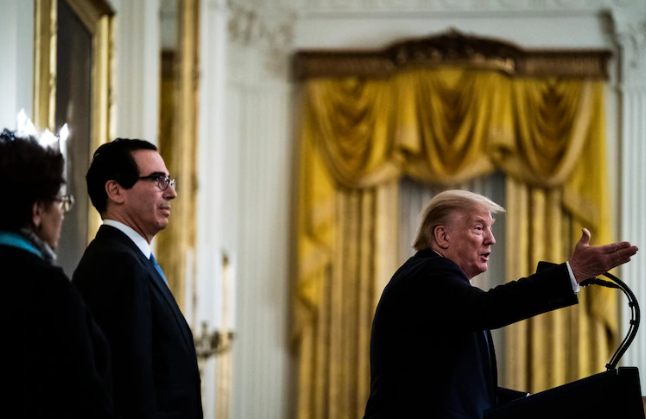
President Trump and Treasury Secretary Steven Mnuchin deliver remarks last week on the Paycheck Protection Program. (Jabin Botsford/The Washington Post)
The Treasury Department plans to borrow $2.99 trillion from April through June to cover the federal government’s massive response to the coronavirus pandemic, issuing a tremendous level of debt to try to limit the economic impact on U.S. businesses and workers.
Last year, Treasury borrowed $1.28 trillion over 12 months. Its plan to borrow $3 trillion would be done over just three months.
“This is just a recurring experience, which is you look at the numbers, and they’re bigger than you ever imagined could be possible,” said Douglas Holtz-Eakin, president of the American Action Forum and former director of the Congressional Budget Office. “And then you look at the size of the problem and you think that’s perfectly justified.”
Congress has approved nearly $3 trillion in spending in the past two months to try to arrest the economic fallout of the crisis. Because revenue is falling, Treasury is planning to issue large amounts of debt to cover these costs.AD
Treasury said it planned to borrow an additional $677 billion from July through September.
The large spike in debt issuance is meant to cover the cost of government assistance to individuals and businesses, the deferral of individual and business taxes until July, and an increase in the assumed end-of-June Treasury cash balance.
These figures only take into account legislation that has been passed so far this year, senior Treasury officials said Monday. An expansion in government relief, or the passage of additional legislation, could spur Treasury to increase borrowing later in the year.
“My expectation is that we will see something else,” said Michael Strain of the American Enterprise Institute. “It’s reasonably likely that the economy is going to need significant government support for many, many months … that is going to have to change as the public health situation changes and evolves.”
Interest rates are very low, making it relatively cheap for the government to borrow money. President Trump has said the government should take advantage of low interest rates to issue even more debt and expand things like infrastructure spending.
But some Republicans have already begun expressing reluctance about approving more spending, raising concerns about the roughly $25 trillion in existing government debt.
Before the pandemic hit the United States, budget forecasters had projected that the U.S. government would run a roughly $1 trillion deficit, representing the gap between spending and revenue. But the large increase in spending and the sharp decline in revenue has led forecasters to push their deficit projections to more than $3.5 trillion. The government borrows money to cover this balance by issuing debt.
EnviroPolitics Blog is working to keep you informed about all aspects of the coronavirus — the status of confirmed cases, disease spread, death toll–and also how Americans are coping. Like this story, for instance. If you like what we are doing, Click to receive free EP Blog updatesand please tell your friends about us.
The state Department of Health on Monday reported 825 new coronavirus cases in Pennsylvania and 14 deaths, bringing the total numbers to 50,092 cases and 2,458 deaths.
It’s the lowest number of new cases reported since March 31.
The Lehigh Valley had 65 new cases — 39 in Lehigh County and 26 in Northampton County — but no new deaths. The Valley’s case total is 5,203, with 177 deaths, though state death totals have been lagging behind county reports.
Most of the patients hospitalized and most deaths in the state have been people 65 or older, and two-thirds of deaths have been in nursing homes.
There are 195,498 patients who have tested negative to date.
At Monday’s daily briefing, state health secretary Rachel Levine said 2,689 patients are hospitalized with COVID-19, with 46% of beds, 40% of ICU beds and 75% of ventilators available.
Gov. Tom Wolf has rolled out a color-coded plan to gradually reopen portions of the state where per capita case counts are low, contact tracing and testing are possible and populations aren’t too dense. The reopening process began Friday with restrictions loosened in 24 counties, allowing them to reopen businesses that have been shut down because of the pandemic.
The Lehigh Valley is in the Northeast region, where the case count is more than three times higher than it needs to be to meet the reopening threshold.
Levin said the state will get data on Tuesdays and Thursdays, examine models and discuss contact tracing and testing before Gov. Tom Wolf makes decisions about relaxing restrictions.
EnviroPolitics Blog is working to keep you informed about all aspects of the coronavirus — the status of confirmed cases, disease spread, death toll–and also how Americans are coping. Like this story, for instance. If you like what we are doing, Click to receive free EP Blog updates and please tell your friends about us.