The New Jersey Senate’s Environment and Energy Committee is meeting this morning to consider only one bill – a stubbornly controversial ban on single-use plastic and paper bags, S864.
Main provisions of the bill had changed a number of times before time ran out on it in the lame-duck session that ended earlier this month. Now, the legislature is back in action for a new, two-year session.
Today, we’ll get our first look at who’s for and who’s against the latest version.
We’ll be back later with an update. In the meanwhile, check out our live meeting coverage on Twitter. @enviropolitics @frankbrill
Coca Cola’s Head of Sustainability Bea Perez told the BBC that consumers like plastic-packaged drinks because they’re able to reseal the beverages in lightweight packaging.
She also said that getting rid of plastic altogether and using only aluminum and glass packaging could push up the company’s carbon footprint and hurt sales.
“Business won’t be in business if we don’t accommodate consumers,” she said. “So as we change our bottling infrastructure, move into recycling and innovate, we also have to show the consumer what the opportunities are. They will change with us.”
As many companies rush to meet promises to replace their plastic packaging, Coca-Cola is not among them.
The company has made sustainability pledges in recent years, but it’s not trying to get rid of plastic. Coca-Cola has announced goals for its packaging to be 100% recyclable by 2025, and to make bottles with an average of 50% recycled material by 2030. Greenpeace has been critical of Coca Cola’s current plan, saying it doesn’t address the urgency of plastic pollution.
Coca-Cola spokeswoman Ann Moore said in an email to Food Dive that packaging waste is a major problem, and Coke recognizes that it has a responsibility to help solve it, but “all packaging has a potential environmental impact, so it’s not as simple as saying one format is better than another.”
If you like this post you’ll love our daily newsletter, EnviroPolitics.It’s packed with the latest news, commentary and legislative updates from New Jersey, Pennsylvania, New York, Delaware…and beyond. Don’t take our word for it, try it free for an entire month. No obligation.
Coca-Cola has been criticized heavily for its plastic usage before, and Perez’s comments are likely to only fuel critics’ ire. They have already elicited negative reaction.
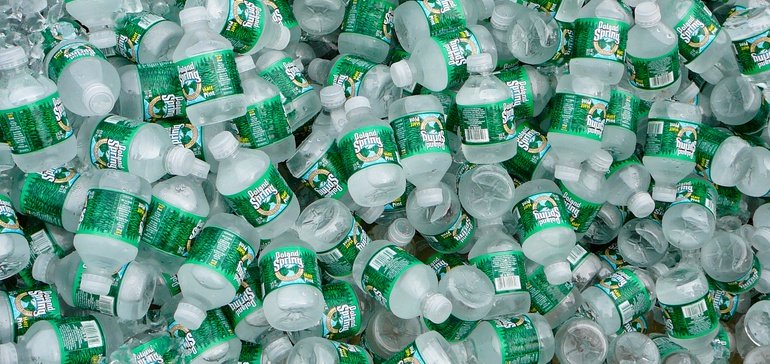
“Shame on Coca Cola yet again hiding behind the public instead of taking responsibility for the 120 billion plastic Coke bottles that pollute our planet every year,” Sian Sutherland, co-founder of A Plastic Planet, told Food Dive in an email. “People buy what they are sold and it is Coca Cola’s job to sell them something different — toxic-free and nature safe.”
Coke’s sustainability head’s comments contradict with other reports claiming consumers are driving the demand for more alternatives to plastic packaging. And the beverage giant has been recognized as a leading cause of plastic pollution. In 2019, Coke was found to be the most polluting brand for the second year in a row in a global audit of plastic waste by a Break Free from Plastic study. Nestlé was No. 2, followed by PepsiCo.
Coca-Cola, which reportedly produces 3 million tons of plastic packaging annually, has made more sustainable moves in recent years. In 2018, Coca-Cola extended a loan to the Netherlands-based recycling company Ioniqa Technologies to develop the tools to process otherwise hard-to-recycle types of PET plastics.
Last year, Coca-Cola said it is updating packaging for the Dasani water brand to help reduce plastic waste, and will ensure all Dasani bottles continue to be fully recyclable. A 20-ounce HybridBottle will launch nationwide in mid-2020 made with up to 50% plant-based renewable and recycled PET plastic, and aluminum cans for the brand will expand to the rest of the country this year, the company said.
If you were in the market for a new beach chair, Tuesday night in Wildwood was the time to pick one up.
The thousands of people who descended upon the Jersey Shore town for President Donald Trump’s ‘Keep America Great’ rally at the Wildwoods Convention Center left behind a sea of trash in the parking lot — including their abandoned beach chairs and blankets — after the rally wrapped up.
Clean up begins after President Donald Trump’s “Keep America Great Rally” in Wildwood, Tuesday, Jan. 28, 2020. (Tim Hawk | NJ Advance Media for NJ.com)
Rally-goers were allowed to bring chairs as they waited in line — some for up to 48 hours before the event — but they weren’t allowed to bring them inside the venue.
Factor in the blankets they used to stay warm, and all their drinks and food they were snacking on during the long wait in the parking lot and the convention center ends up with a parking lot full of trash to deal with Wednesday morning.
Fox Park, however, where the line ended Tuesday and where crowds remained to watch Trump on the jumbotron when they couldn’t get inside, was spotless Wednesday morning.
Fox Park, which is owned by the city, was spotless this morning
City officials said the park cleanup was the responsibility of Wildwood, while the parking lot mess was the responsibility of the convention center, which Wildwood city does not manage.
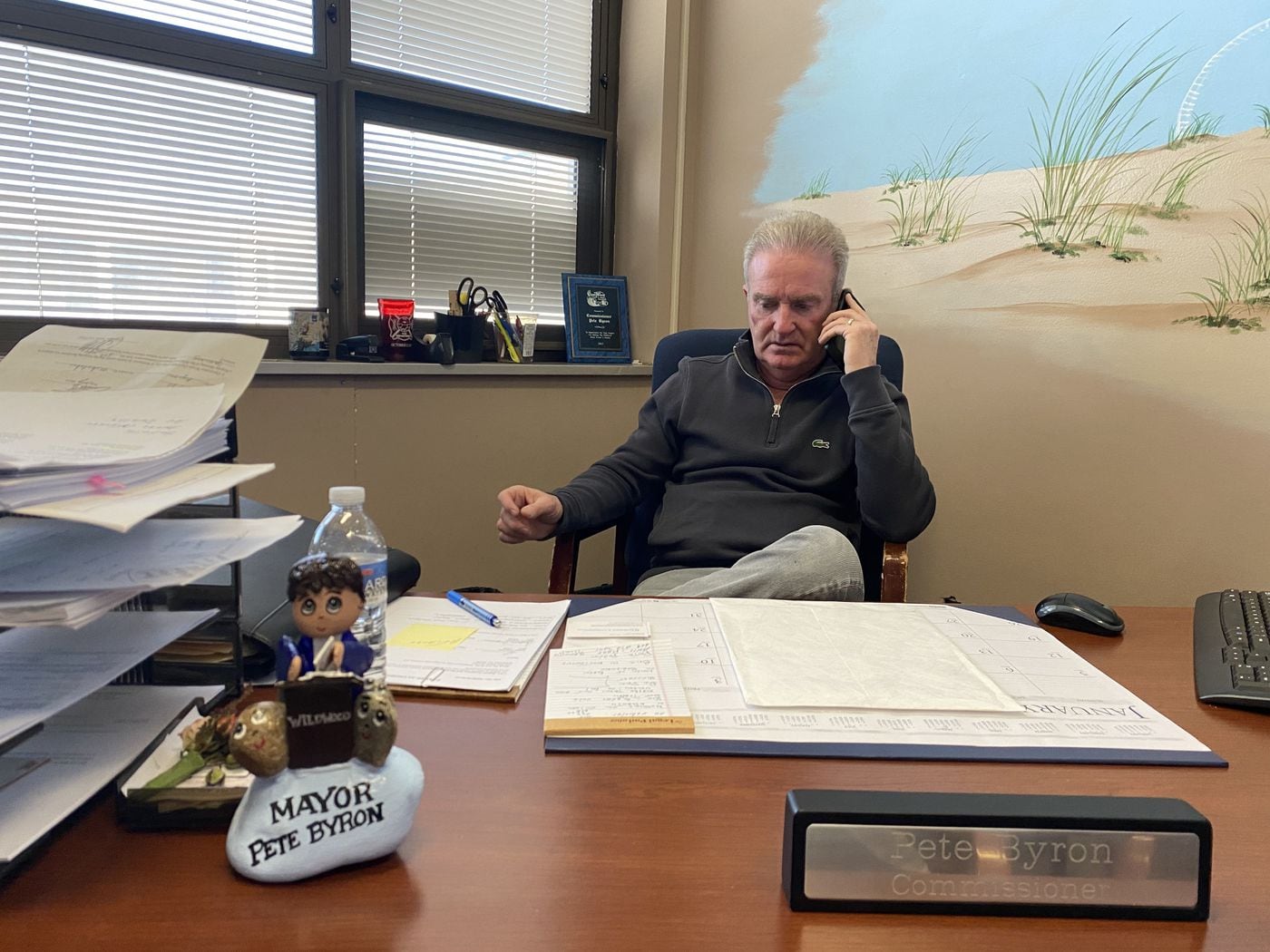
Mayor Pete Byron on Tuesday said he wasn’t invited to the rally after he told NJ Advance Media he would be seeking reimbursement from the local Republican party. He had instructed all city workers to keep detailed logs of hours and expenses related to the rally. Byron did not return a request for comment early Wednesday morning.
A convention center employee said the cleanup was expected to be completed later Wednesday.
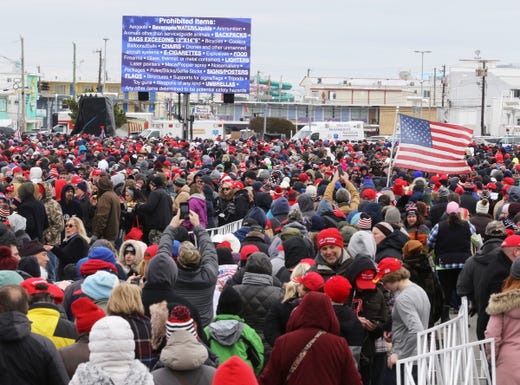
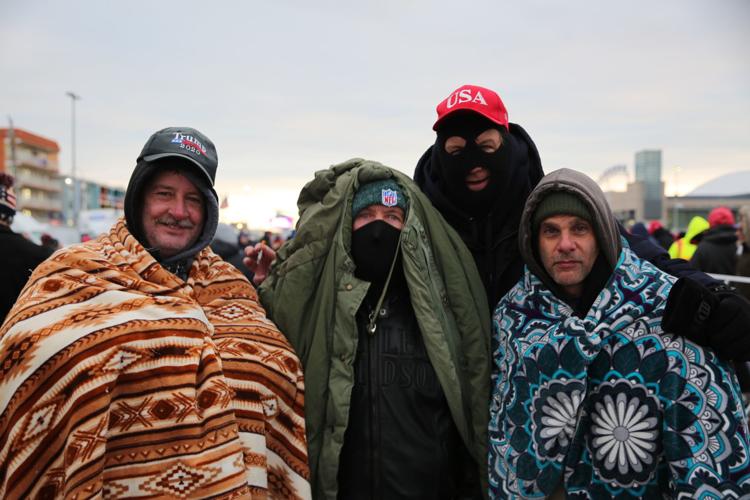
Trump supporters before the doors to the Wildwood Convention Center were opened.
By Frank Brill, EnviroPolitics Editor
The doors to Wildwood’s Convention Center were opened at 3 p.m. today, much to the delight of the large and spirited gathering of the president’s supporters who have been milling together outside for hours (in some cases days), bundled up against a cold and gray day at the Jersey Shore.
Many will not be admitted for Trump’s 7 p.m. speech since the building’s legal occupancy level is around 7100 and the crowd outside far outstrips that number. Two jumbotron screens have been set up outside for the faithful who don’t make it inside.
Here are several updates from news sources that have been providing live coverage throughout the day.
‘It’s like an Eagles tailgate:’ Trump supporters share beers, brotherhood before Wildwood rally (Philadelphia Inquirer)
For many people who came down to the Shore, the Trump rally has been more of a social gathering than a political one. People crowded into nearby bars, sharing laughs, buying each other beers, and sporting matching MAGA hats.
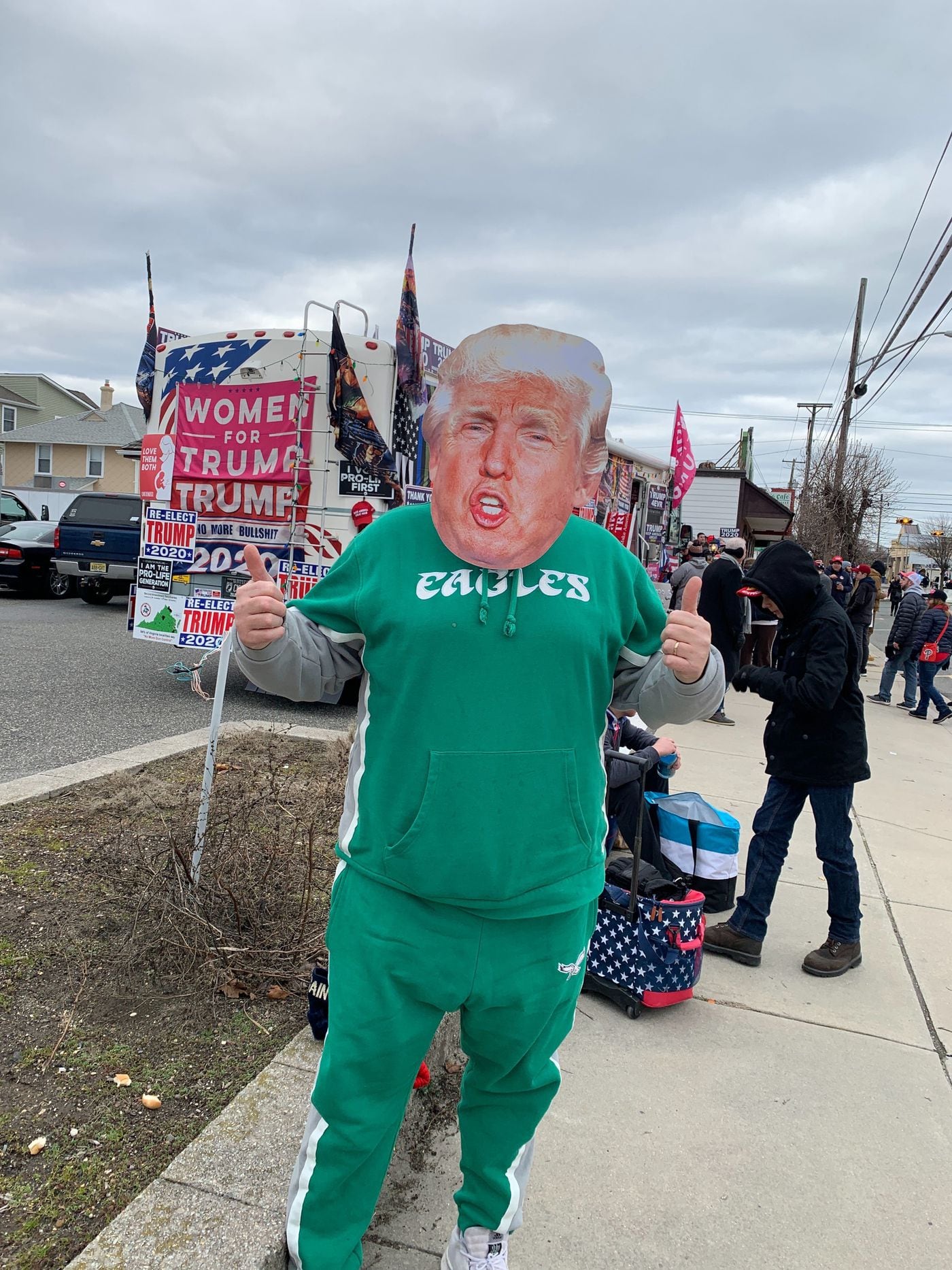
ELLIE RUSHING/STAFFRich Duranto.
“It’s like an Eagles tailgate,” said Rich Duranto from Philadelphia, who has been walking through the crowds in a bright green Eagles track suit wearing a Trump mask he bought from CVS two years ago.
“It’s fun, it’s an event,” he said. “I’ll definitely be back.”
He loves Trump for his ability to entertain. He said that Trump lies sometimes, which bothers him, but he said usually they’re “just little lies.”“We all tell little lies. They all lie,” he said about politicians. “[Trump] is just the most entertaining liar.”
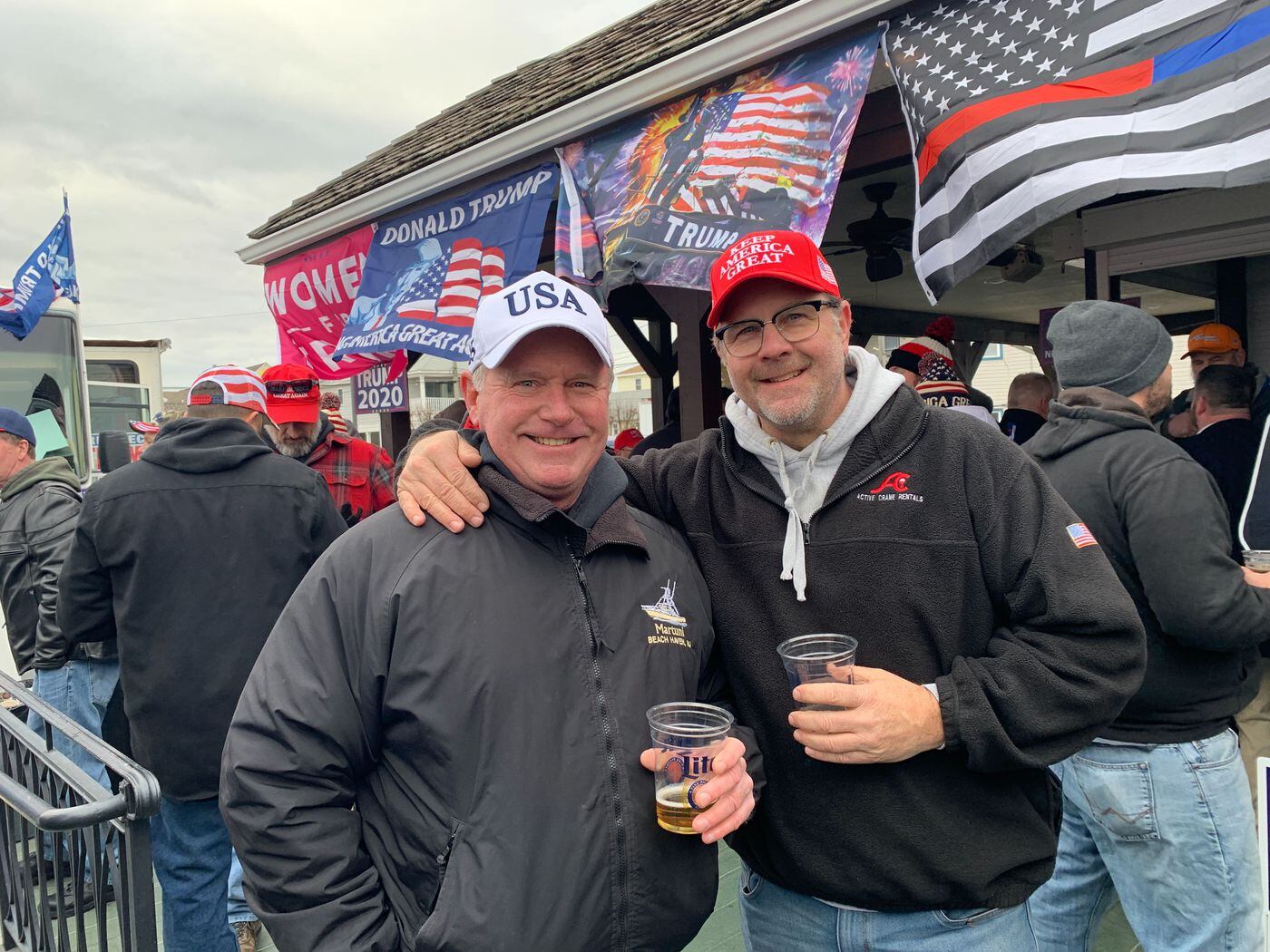
ELLIE RUSHING/STAFFJeff Bottari, left, and Scott Wistar took off work early and drove from Landerberg, Pa. to witness their first Trump rally.
Jeff Bottari, 58, and Scott Wistar, 56, took off work early and drove from Landerberg, Pa. to witness their first rally.
“It’s like a brotherhood,” said Bottari, “we’re all in here buying each other beers.”
“It’s not divisive like people try to say,” said Wistar. The two friends have tickets to the event but said they didn’t want to wait in line and couldn’t arrive early enough. They wanted to come down to meet more Trump fans and show their support for the President who they said has been the “only candidate… that has delivered on all campaign promises.”
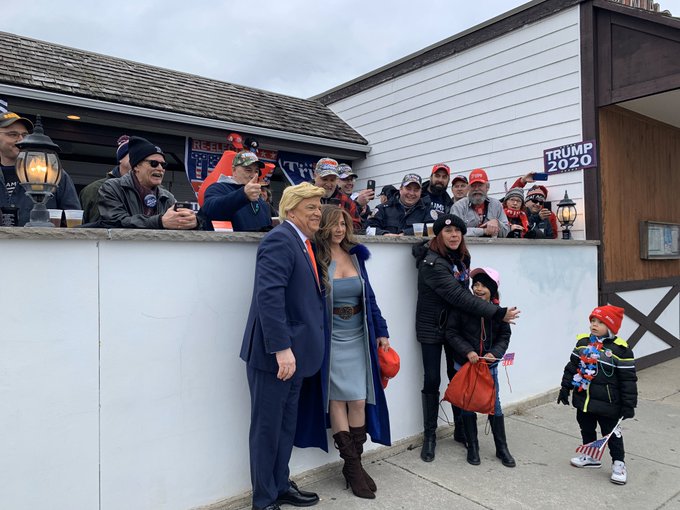
Donald and Melania Trump look-alike’s make their rounds, amping up bars full of supporters who’ve found the rally to be more of a social event than a political one.
Donald and Melania Trump look-alike’s make their rounds, amping up bars full of supporters who’ve found the rally to be more of a social event than a political one. pic.twitter.com/m0ZbhQHP7I— Ellie (@EllieRushing) January 28, 2020
— Ellie Rushing
‘Lock him up, lock her up:’ Trump fans and foes spar on the Wildwood Boardwalk
Hours before the rally, Trump protesters and supporters continue to shout at each other on the Wildwood Boardwalk, the Inquirer’s Amy Rosenberg reports.
With cowbells, posters, flags, and baby Trump balloons, the two sides are verbally sparring, shouting “lock him up” and “lock her up” — a reference to 2016 Trump supporters’ preferred chant about Democrat Hillary Clinton.
Protesters says love no hate makes America great. Trump fans says no more BS. And “Four more years”
Wildwood’s Democratic mayor isn’t welcome at the Trump rally
Newly elected Wildwood Mayor Pete Byron, a Democrat.
By AMY S. ROSENBERG
Newly elected Wildwood Mayor Pete Byron, a Democrat, says he’s been banned from the Trump rally in his own town by Rep. Jeff Van Drew, a newly-minted Republican.
Byron ousted former mayor Ernie Troiano, a Trump acolyte, but had welcomed the president to his town as a historic and meaningful event, one he planned to attend. He also suggested he might seek reimbursement from the Republican Party for rally expenses.
In a conversation with Van Drew, Byron said he was told he wouldn’t be welcome. Troiano was given a VIP ticket.
“I was not invited,” Byron said Tuesday, hours before the rally. “I’ve been informed that Congressmen Van Drew and the President are upset with the fact that I said I think the city should be reimbursed.”
Byron said he told Van Drew he had shown respect for the rally, and that “you should show the same respect to me as the Mayor of the City of Wildwood. It shouldn’t be about I’m a Democrat or Republican.”
Byron said he still thinks the city should be reimbursed.
“I have no way of knowing what these costs will be,” he said. “These rallies can be pretty expensive. There’s a lot of overtime.”
He said the rally has been an economic boost to the seaside town and has led to national exposure. Byron said he would watch the rally but wouldn’t seek any alternate way inside the Wildwood Convention Center.
“I”m the Mayor,” he said. “Why should I have to sneak into an event in my hometown?” He said he was “very disappointed” in Van Drew, who he has known for years. “He’s still my Congressman and we need to have a relationship. The decision’s been made. This is his coming out party. You have a congressman and a president. Who else would he answer to?”
Earlier this month, after the rally was first announced, Byron said: “This isn’t about whether you’re Republican or Democrat. It isn’t even about the man. It’s about the position. … Check your affiliation at the door, and let’s just all participate in this monumental [and] exciting time for Wildwood.”
Trump’s N.J. Rally: Sold Out Hotels, Long Lines and Subpoena-Coladas (New York Times)
President Trump arrives Tuesday to hold a rally in the state — his first there since taking office — where registered Democrats outnumber Republicans by a million voters.
Many hotels in Wildwood that normally close for the winter have reopened in anticipation of Mr. Trump’s arrival. Credit…Hannah Yoon for The New York Times
By Tracey Tully
WILDWOOD, N.J. — Joe Tartamosa’s second daybreak in an ever-growing line outside the convention center in Wildwood was a lot less pleasant than his first.
“It was brutal,” said Mr. Tartamosa, who spent the night in the cold, wind-whipped line with thousands of other ticket holders who were hoping to get inside for President Trump’s rally on Tuesday night. “I was probably a little ill-prepared.”
He and his 16-year-old son, Nick, had left their home in Woodbury Heights, N.J., to arrive at 4:30 a.m. Monday to lock in a spot close to the front.
He had plenty of company. About 12 hours before the rally’s 7 p.m. start, the line had spilled past the gates arranged in switchback lanes outside the convention hall and onto nearby streets.
Those at the very front of the line had arrived at about 2 p.m. on Sunday and had spent two days and nights bundled in blankets, “Keep America Great” flags and woolen Trump 2020 hats.
Still, the mood remained festive in Wildwood, one of the Jersey Shore’s most popular destinations, where Mr. Trump was planning to hold his first political rally in New Jersey since taking office.
“He’s the only president in my lifetime who actually did what he said he was going to do,” said Russ Hickman, 55, of Dias Creek, N.J., who was fifth in line on Monday afternoon.
Mr. Trump’s decision to stage one of his raucous rallies in Wildwood, motivated by a desire to support a local congressman who had recently switched parties, upended the usual rhythms of this beach community about 160 miles south of New York City.
Seasonal workers were back on the job. Motels have reopened and restaurants and bars have awaked from winter hibernation.
People started lining up for the rally on Sunday afternoon. Credit…Hannah Yoon for The New York Times
The LED lights on the towering Ferris wheel near the convention center have been specially programmed to pulse in patterns of red, white and blue.
“It’s a once-in-a-lifetime opportunity, regardless of your political view,” Nick Holland, 29, said Monday as he worked the front desk of the local recreation center.
“Today I put up signs: Welcome Mr. President. I never thought I would do that in my lifetime,” he said. “You can feel the energy. It reminds me of Christmas Eve, and tomorrow Santa’s coming.”
As his impeachment trial unfolds in Washington, Mr. Trump is headed into what in some ways is enemy territory. New Jersey is a Democratic stronghold where Hillary Clinton easily beat him statewide by 14 percentage points and where a so-called blue wave helped to flip four Republican congressional seats in 2018.
Most of Mr. Trump’s campaign rallies have been held in states where a majority of voters supported him in 2016, and are critical battleground states ahead of this year’s election.
But Wildwood, in Cape May County, is in a district far more friendly to Republicans.
It leans conservative and is represented by Jeff Van Drew, a freshman congressman who opposed impeachment and last month defected from the Democratic Party to join the Republicans with a pledge of “undying support” for Mr. Trump.
If you liked this post you’ll love our daily newsletter, EnviroPolitics.It’s packed with the latest news, commentary and legislative updates from New Jersey, Pennsylvania, New York, Delaware…and beyond. Don’t take our word for it, try it free for an entire month. No obligation.
Some came to Wildwood, NJ as early as Sunday and have remained staked out through the nights and the cold, hoping to be among the 7000 who will be allowed to cram into the Willwood Convention Center tonight to hear President Donald Trump excoriate his impeachment trial, Nancy Pelosi, Adam Schiff, and Democrats in general.
Trump tee-shirt and hot coffee vendors were making a killing and counter-protests are expected.
WILDWOOD — On the sidewalk outside Fox Park across from Kelly’s Cafe on Monday morning, Maria Poalillo teared up when she spoke of Donald Trump.
“I’m so happy he’s my president,” said Poalillo, 64, of Totowa, Passaic County.
She had been camped there with her sister, Toni Patacco, 54, also of Totowa, since Sunday afternoon, making the pair some of the earliest arrivals for Tuesday evening’s rally featuring the president and U.S. Rep. Jeff Van Drew at the Wildwoods Convention Center.
Just before Poalillo became choked up, cars flew by beeping their horns in recognition of their support, as the drivers pumped their fists out their windows. Poalillo and those around them howled and cheered in response.
“I can’t do this in Northern New Jersey, OK? Because they’ll smack me in the face,” she said. “Very Democratic. Nasty Democrats! Nasty! Mean.”
Those supportive motorists honking their approval represent the general vibe in town since this weekend, Poalillo said.
“One finger. One guy gave us the finger,” she said. “So out of 500 cars, one finger, that’s really good.”
Nestlé Waters North America (NWNA) is supporting an amendment to a bill in Maine (LD 102) that would set minimum post-consumer recycled (PCR) content requirements for plastic beverage containers sold in the state. The amendment NWNA is backing calls for altering targets to begin at 25% by April 2025 and increase to 30% by April 2030. Nestlé Waters North America (NWNA) is supporting an amendment to a bill in Maine (LD 102) that would set minimum post-consumer recycled (PCR) content requirements for plastic beverage containers sold in the state. The amendment NWNA is backing calls for altering targets to begin at 25% by April 2025 and increase to 30% by April 2030. Nestlé Waters North America (NWNA) is supporting an amendment to a bill in Maine (LD 102) that would set minimum post-consumer recycled (PCR) content requirements for plastic beverage containers sold in the state. The amendment NWNA is backing calls for altering targets to begin at 25% by April 2025 and increase to 30% by April 2030.
The original bill called for these containers to have 15% PCR by 2022, increasing to 25% by 2024. Other notable changes include an exemption for small manufacturers and the removal of language setting requirements for plastic caps.
Recycling equipment company Tomra has endorsed the new language, along with the National Resources Council of Maine (NRCM), Conservation Law Foundation and other environmental groups.
“Recycled content legislation supports plastic recycling markets because it creates more demand than would otherwise be created because of the relatively low-cost of virgin plastic,” said NCRM’s Sustainable Maine Director Sarah Nichols in a statement to Waste Dive.