Former Gov. Chris Christie has tapped a longtime member of his inner circle, Michele Brown, to run his new public policy institute, the New Jersey Globe has learned.
Brown, a former federal prosecutor who held several positions in the Christie administration, will serve as executive director of the Christie Institute for Public Policy. She will receive a six-figure salary for the part-time post, two sources confirmed to the Globe.
The new Christie Institute will focus on civility in politics and will hold an inaugural lecture on September 26 at Seton Hall University with New York Gov. Andrew Cuomo. Priority seating for the event is $500-per-person, with general seating priced at $100-per-person.
Brown told the Globe that the institute will hold quarterly lectures. When asked about her salary, she abruptly terminated the call.
The Christie Institute is also seeking corporate and individual contributions.
Until she was ousted by Gov. Phil Murphy last year, Brown was the $450,000-a-year CEO of Choose New Jersey, a privately-funded group formed by Christie allies to help attract new businesses to the state.
Brown has close personal ties to Christie from their time at the U.S. Attorney’s office, and her financial ties to the governor became an issue in the 2009 gubernatorial campaign when State Sen. Loretta Weinberg (D-Teaneck) — at the time the Democratic candidate for Lt. Governor — said Brown should recuse herself from reviewing Freedom of Information Act requests dealing with Christie’s travel as a federal prosecutor.
Brown later joined Christie’s staff as Appointments Counsel and became executive director of the now-embattled New Jersey Economic Development Authority.
In May 2017, Christie filed a notice of intent to nominate Brown to a Superior Court judgeship, but Brown inexplicably withdrew her name from consideration a few days later.
As a consolation prize, Christie gave Brown a seat on the Horizon Blue Cross Blue Shield Board of Directors.
By Kate Layton, Partnership for the Delaware Estuary
Partnership for the Delaware Estuary (PDE) is one of four agencies to receive top national honors for exemplary work in coastal restoration.
WILMINGTON — The American Shore & Beach Preservation Association (ASBPA) announced today that PDE is a winner of the 2019 Best Restored Shore award for “implementing creative solutions to eroding shores, rising seas, and degrading environmental conditions,” specifically for its living shoreline project at the DuPont Nature Center in Milford, Delaware. Projects in Texas, Louisiana, and Virginia also won the award.
“We are honored to be recognized by the ASBPA for our living shoreline project on the Mispillion River located in the Delaware Estuary,” PDE Executive Director Kathy Klein said. “Our science team has worked tirelessly on this and similar projects that have resulted in stabilizing coastal edges and creating habitat for living resources.”
“Living shoreline” describes a variety of nature-based techniques used for erosion control, water quality improvement, and/or habitat enhancement along shorelines experiencing erosion and/or ecological stress.As living shorelines develop, the services they provide, such as habitat for wildlife, shorebirds, and shellfish, increase. The Mispillion Living Shoreline Project is one of several that PDE has installed and monitored since 2008 throughout Delaware, Pennsylvania, and New Jersey.
PDE first installed the Mispillion Living Shoreline project in 2014 at the DuPont Nature Center and has maintained and monitored it ever since. The goals of the living shoreline were to enhance water quality and stabilize eroding portions of the shoreline adjacent to the nature center. To accomplish this goal, materials suitable for shellfish habitat, including recycled oyster shells and matter made of a composite of oyster shell and concrete, were arranged to provide a suitable home for young oysters and salt marsh mussels while intercepting waves and lessening energy impacts to keep the shoreline from eroding.
Shellfish feed by filtering materials from the water, making the water clearer and more suitable for underwater plants and reducing nutrients that can result in algal blooms. As the shellfish beds grow, the more material the shellfish can filter from the water.
Over the last five years, more than 70,000 oysters and mussels have made the living shoreline their home, resulting in a significant increase in water quality from shellfish filtration. There also has been a reduction in erosion due to the physical structure of the living shoreline materials and shellfish community as a whole. Monitoring the living shoreline on an annual basis has provided valuable information about the effectiveness of living shorelines, not only to meet goals related to shoreline stabilization but objectives associated with shellfish-mediated water quality improvements.
“The Mispillion Living Shoreline is a great example of how we can often use nature-based tactics to address multiple societal goals such as flood protection and clean water, avoiding expensive methods such as bulkheads that degrade the environment and don’t keep pace with sea-level rise,” said Dr. Danielle Kreeger, PDE’s science director. “It’s one thing to say a living shoreline can do these things, but it’s far more useful to actually show it by directly measuring project outcomes using scientific monitoring.”
The Mispillion Living Shoreline project serves as a vital source of information for agencies that regulate water quality. Furthermore, the project demonstrates the advantage of this approach for shoreline designers, builders, and the public.
The work that PDE performed in collaboration with partners at the Delaware Department of Natural Resources and Environmental Control, as well as the DuPont Nature Center, highlights the value of monitoring a project to see if it is meeting its goals. Because the first few years of the project — 2014 to 2016 — were so successful, the team installed a second phase to the shoreline in 2018. PDE is pursuing additional funding to sustain the monitoring into at least 2022.
“By installing and maintaining the appropriate habitat, we could see the shellfish community slowly develop over the first few years,” said Dr. Joshua Moody, PDE’s restoration programs manager. “This initial stage is a vulnerable time for young shellfish communities, as they are susceptible to outside forces such as erosion and predators. By creating the right type of habitat, you can provide refuge from these forces in early stages of development. As the community grows, it becomes more resistant to these forces. By year three, we could see the population stabilize with more, larger animals, and as a result, measure higher annual increases in their ability to filter water. The time it takes for these communities to develop highlights the importance of providing and maintaining the appropriate habitat in early stages of living shoreline development. If you can provide a foundation of proper, stable habitat, we will reap the rewards of the natural services provided by the animals the colonize them.”
Best Restored Shore is a new award category in 2019 from the ASBPA, which makes PDE among its first recipients. ASBPA added this category to recognize innovative shore restoration projects and the hard work that goes into securing funds and ensures project success, thus encouraging other communities to undertake these efforts. It already gives awards for categories such as Best Restored Beach.
Moody will accept the award on behalf of PDE on Oct. 23 at the 2019 ASBPA National Coastal Conference in Myrtle Beach, South Carolina.
National Weather Service Director Louis Uccellini has also broken with NOAA leadership
Kayla Epstein, Andrew Freedman, Jason Samenow and Kate Harrison Belz report for the Washington Post – September 9 at 1:35 PM
The National Oceanic and Atmospheric Administration’s acting chief scientist said in an email to colleagues Sunday that he is investigating whether the agency’s response to President Trump’s Hurricane Dorian tweets constituted a violation of NOAA policies and ethics. Also on Monday, the director of the National Weather Service broke with NOAA leadership over its handling of Trump’s Dorian tweets and statements.
In an email to NOAA staff that was obtained by The Washington Post, NOAA’s Craig McLean, called the agency’s response “political” and a “danger to public health and safety.”
Trump’s incorrect assertion on Sept. 1 that Alabama “would most likely be hit (much) harder than anticipated” set off a chain of confusion and outrage among the public and within NOAA. At the time, the NWS’s forecast guidance showed only a very small risk (about 5 percent) of tropical-storm-force winds for a small portion of Alabama. However, Alabama was not in the storm forecast track or “cone of uncertainty” from the National Hurricane Center, which showed Hurricane Dorian skirting the East Coast far away from Alabama.
Trump demurs when asked about hurricane map
Asked on Sept. 4 about a map of Hurricane Dorian that appeared to be altered by a Sharpie, President Trump said he wasn’t aware of it. (The Washington Post)
NOAA and NWS had also appeared to try to correct the record without angering the president. According to emails obtained by The Post, before the statement on Friday, NOAA staff were instructed to “only stick with official National Hurricane Center forecasts if questions arise from some national level social media posts which hit the news this afternoon” and not to “provide any opinion” in response to Trump’s initial Alabama tweets.
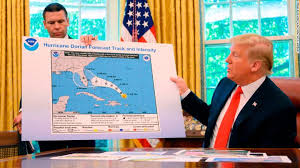
The agency sent a similar message warning scientists and meteorologists not to speak out on Sept. 4, after Trump showed a hurricane map from Aug. 29 modified with a hand-drawn half-circle in black Sharpie around Alabama.
Scientists attacked NOAA officials for conceding to Trump during a weather emergency, when accuracy and messaging are vital to keep the public safe.
The American Meteorological Society issued a statement of support for the NWS, writing: “AMS believes the criticism of the Birmingham forecast office is unwarranted; rather they should have been commended for their quick action based on science in clearly communicating the lack of threat to the citizens of Alabama.”
In his email to employees Sunday, McLean criticized his agency’s public statement, saying it prioritized politics over NOAA’s mission.
“The NWS Forecaster(s) corrected any public misunderstanding in an expert and timely way, as they should,” McLean wrote. “There followed, last Friday, an unsigned news release from ‘NOAA’ that inappropriately and incorrectly contradicted the NWS forecaster. My understanding is that this intervention to contradict the forecaster was not based on science but on external factors including reputation and appearance, or simply put, political.”
He also wrote that “the content of this news release is very concerning as it compromises the ability of NOAA to convey life-saving information necessary to avoid substantial and specific danger to public health and safety.”
“If the public cannot trust our information, or we debase our forecaster’s warnings and products, that specific danger arises,” McLean wrote.
As a result, McLean told his staff that “I am pursuing the potential violations of our NOAA Administrative Order on Scientific Integrity.”
“I have a responsibility to pursue these truths,” he added. “I will.” McLean has extensive experience in NOAA’s ocean programs and is also an attorney who has practiced marine resource law. He has been awarded the Department of Commerce Silver and Bronze medals, among other accolades.
When asked about the McLean email, an NWS spokesperson stressed the agency is committed to promoting and maintaining scientific integrity. “The NWS leadership team stands with the entire National Weather Service workforce and will continue to uphold the scientific integrity of the forecast process as it was skillfully applied by all NWS offices last week to ensure public safety, first and foremost,” the spokesperson said.
In response to McLean’s email, NOAA spokesman Scott Smullen stated: “NOAA’s policies on scientific integrity and communications are among the strongest in the federal government, and get high marks from third party observers. The agency’s senior career leaders are free to express their opinions about matters of agency operations and science. The agency will not be providing further official comment, and will not speculate on internal reviews.”
NWS director backs agency forecasters
Also on Monday, National Weather Service Director Louis Uccellini got a standing ovation at a major weather industry conference in Huntsville, Ala., when he broke with his bosses at NOAA by enthusiastically backing his agency’s forecasters regarding their performance during Hurricane Dorian.
Uccellini, who has been part of NWS since 1989, praised Birmingham’s NWS office for clarifying that there was no threat to the region and upholding “the integrity of the forecasting process.”
“They did what any office would do,” Uccellini told the crowd of hundreds of meteorologists. “With an emphasis they deemed essential, they shut down what they thought were rumors. They quickly acted to reassure their partners, the media and the public — with strong language — that there was no threat.”
“They did that with one thing in mind: public safety,” Uccellini said. “And they responded not knowing where this information was coming from. Only later, [when] the retweets and the politically based comments came into their office, did they learn the source of this information.”
Uccellini noted the strong relationships the Birmingham office has with local emergency officials, particularly in the wake of tornadoes that killed 23 in the region in March. He said these emergency officials praised the Birmingham weather team’s speed in quashing the false information.
“Let me be clear: The Birmingham office did this to stop public panic,” he said, and “to ensure public safety.”
.@NWSDirector offers a very impassioned defense of the @NWSBirmingham, stating they did exactly what they were supposed to do. The office received a standing ovation. So did Louis. The word “integrity” was used a lot. Kudos to him. #nwas19— Matt Lanza (@mattlanza) September 9, 2019
He then called for members of the Birmingham NWS office to stand, along with all NWS employees. Attendees gave them a loud, minute-long standing ovation, and also gave Uccellini a standing ovation.
NOAA’s Jacobs, who has a science background in computer modeling and has sought to improve NWS forecast models, is slated to address the same Alabama audience on Tuesday morning, and there is social media chatter of planned protests of his speech.
The backstory
At stake is public trust in weather forecasts and warnings aimed at saving lives and protecting property, as many current and former NOAA leaders and meteorologists have expressed fear that this controversy has damaged NWS’s credibility by politicizing weather forecasts
The unsigned statement NOAA released late Friday justified Trump’s tweets and statements throughout the past week on Hurricane Dorian’s threat to Alabama by noting that the possibility of tropical-storm-force winds meant that Alabama could be affected.
Trump’s tweet that Alabama would be affected by the storm gained national attention last Wednesday when he presented the version of the forecast cone from Aug. 29, extended into Alabama — modified using a Sharpie. The crudely altered map appeared to represent an effort to retroactively justify the original Alabama tweet.Trump appears to show Sharpie-altered hurricane map
In the face of criticism about the modified map, Trump fired off additional tweets Wednesday and Thursday, insisting Alabama was at risk all along, including presenting a map from Aug. 29 depicting a small possibility that Alabama would see tropical-storm-force winds.
But, on Sunday morning, Sept. 1, when Trump tweeted about the Alabama threat, no credible computer model showed any serious risk to the state.
Suffolk County will follow East Hampton and Southampton Towns with the ban, which means that county residents will no longer be able to release up to 25 balloons every 24 hours, as they’ve been able to so far.
“This means people are aware and will become aware of the dangers of latex and Mylar balloons,” said East Hampton Trustee Susan McGraw Keber, who has been advocating for the legislation. “Our beautiful marine animals and birds may have a reprieve from the ever-present balloons that can prove fatal; our beaches may now be cleaner; and our waterways perhaps less filled with these single use products that are non-biodegradable.”
McGraw Keber said New York State Assemblyman Fred Thiele has drafted legislation to present to the state when they reconvene in January.
“It is anticipated that by spring it will come to a vote and I cannot imagine that this will not pass as it impacts our environment — all negative,” she said. “The victory achieved today is that we have decided to recognize and eliminate harmful products in our environment — our ecosystem will benefit.”
McGraw Keber thanked Colleen Henn who left the Surfrider Foundation but still does the group’s blue task water sampling nationally. “We worked on this together for quite some time,” she said.
The Southampton Town board voted unanimously in June to support a resolution banning the intentional release of balloons.
The intent of the legislation is to reduce the negative impact that balloons have on the environment, the board said.
“We need to change our behaviors and find better alternatives to products that harm our environment,” said Councilwoman Julie Lofstad, who sponsored the resolution. “There are viable alternatives, such as butterfly releases, planting a tree in someone’s honor, or using whirligigs to attract attention, she said.” If we stop and think about where these single use items go after we are done with them, perhaps we will be more cognizant and careful in our choices.”
The legislation represented Lofstad’s latest effort to support environmental sustainability in Southampton; earlier this year, Lofstad sponsored legislation to ban plastic straws and polystyrene in the Town.
An Intentional balloon release is an issue that’s been in the spotlight recently. For many years, some have marked the passing of a loved one by heading to the beach and releasing a bunch of balloons toward heaven. Balloons have also been used to celebrate birthdays, anniversaries, proms and other joyful occasions.
But now, environmental advocates and others, citing the disastrous impacts to the environment, are advocating a ban on balloon releases — and the question of whether or not the ban should be implemented has environmentalists and the party supply industry divided.
According to a report by Global News, the tradition might soon be “deflated,” with some states considering a ban on balloon releases.
Bills to limit the intentional release of large numbers balloons are being discussed by lawmakers in New York, New Jersey, Massachusetts, New Hampshire, Arizona, Rhode Island, and Maine, said Jennifer Schultz of the National Conference of State Legislatures in the Global News report.
Texas is weighing study on “windblown and waterborne litter “including helium balloons; similar legislation was nixed in Kentucky recently, the report said. Meanwhile, the post added, California, Connecticut, Florida, Tennessee and Virginia already have laws that ban or restrict balloon releases.
On Long Island, environmental advocates have urged lawmakers to embrace the ban. East Hampton Town Trustees voted unanimously in December to support a ban on the intentional release of balloons in town; the East Hampton town board adopted the legislation to ban the intentional releases in February.
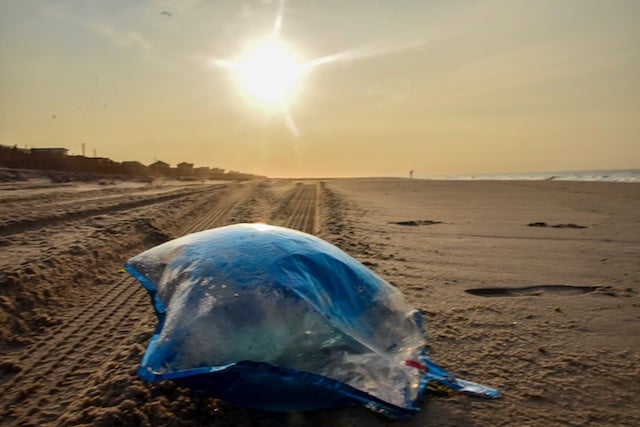
Some residents say they find far too many balloons on the beach. On Long Island, Ken Stier took photos, which he’s shared on social media, “to bring some awareness to the ridiculous amount of balloons that land up on our beaches. These were taken from Field 5, Robert Moses to Ocean Bay. I titled them, ‘They don’t make it to heaven.'”
President Donald Trump and top administration officials were unable Friday to finalize a plan for aiding biofuel — and quelling corn-belt criticism — after agricultural groups and farm-state lawmakers said a compromise under consideration would only stoke more anger.
A White House meeting on the issue Friday afternoon ended without agreement on a final package of changes to bolster U.S. biofuel-blending mandates and take other steps to propel corn-based ethanol, despite weeks of negotiations and Trump’s Sept. 2 tweet promising “big” changes within two weeks. The administration will continue to deliberate, according to people familiar with the talks who asked not to be named to discuss a private meeting.
Trump has been responding to intense criticism from farmers and politicians in the American Midwest who say his administration has too willingly issued waivers exempting small refineries from a 2005 law requiring them to use biofuel, including corn-based ethanol and soybean-based diesel.
The backlash has been especially strong in Iowa, an early voting state that helped elect Trump to the White House in 2016 and is critically important to his re-election in 2020.
However, the administration has struggled to develop an initiative that would satisfy biofuel producers, much less another key constituency: oil refiners.
Biofuel interests and their political allies warned the White House before Friday’s meeting they were disappointed with the administration’s drafted plan, which would not rescind recently issued refinery waivers and would only begin taking steps to account for those exemptions in 2021 blending quotas. They had asked the administration to formally offset refinery waivers sooner by factoring expected exemptions into 2020 blending requirements.
Hours before Friday’s meeting, ethanol and biodiesel supporters were making last-minute appeals to the White House, arguing the effort fell far short of what was needed. Senator Chuck Grassley, an Iowa Republican, said on Twitter that a rumored plan would be a “disaster for ethanol and corn growers.”
Senator Joni Ernst, also an Iowa Republican, drew a similar line in the sand, insisting on Twitter that “the only good deal for Iowa farmers is one that upholds the intent of the RFS,” or the Renewable Fuel Standard, the 2005 law that mandates biofuel.
Joey Garrison, USA TODAY Published 2:32 p.m. Sept. 6, 2019 | Updated 10:38 a.m. ET Sept. 7, 2019
Fall River Mayor Jasiel Correia speaks beside his attorney Kevin Reddington outside the federal courthouse on Friday in Boston, after his appearance on bribery, extortion and fraud charges. Correia pleaded not guilty. (AP Photo/Philip Marcelo)
BOSTON — Jasiel Correia II, the already embattled mayor of Fall River, Massachusetts, was arrested Friday on new federal extortion charges for allegedly operating a scheme to help marijuana vendors get approval to operate in exchange for hundreds of thousands of dollars in bribes.
Prosecutors say Correia agreed to sign non-opposition letters in return for significant six-figure payments from four marijuana vendors looking to open businesses in the city of nearly 90,000 about an hour’s drive south of Boston. The letters are required to obtain a license to operate a marijuana business in Massachusetts, where cannabis is legal.
Correia, 27, appeared in Boston federal court Friday afternoon and pleaded not guilty.
“I’m not guilty of these charges,” he told reporters afterward, standing next to his attorney outside the courthouse. “I’ve done nothing but good for the great city of Fall River, me and my staff, and my team. I’m going to continue to do great things for our citizens.”
The Democrat mayor also is accused of extorting $3,900 in cash and a $7,500-to-$12,000 “Batman” Rolex watch from a property owner in exchange for activating the water supply to his building. In addition, federal prosecutors say Correia demanded his chief of staff give him half of her $78,700 salary in return for appointing her and allowing her to keep her city job.
Four others, including the former chief of staff, Genoveva Andrade, also were charged with federal crimes.
Andrade faces federal extortion, theft and bribery, and false statement charges in connection with the scheme. Antonio Costa, Hildegar Camara and David Hebert were charged separately with extortion conspiracy, extortion, and false statements after allegedly lying to federal agents about their roles in helping Correia with his scheme.
It marks the second time in less than a year that Correia, first elected in 2015, has been indicted. He was arrested in October on charges he defrauded investors of an app company he co-owns by pocketing 64% of their payments to bankroll what prosecutors called his “lavish lifestyle” and political career. He’s pleaded not guilty to those charges as well.
He now faces 24 total charges — 13 from last year’s arrest and 11 new charges — including bribery, extortion conspiracy, extortion and aiding and abetting, wire fraud, and filing false tax returns.
Wire fraud, extortion conspiracy, and extortion aiding and abetting each have maximum sentences of 20 years in person. The maximum sentence for filing false tax returns is three years while bribery carries up to 10 years.
How the marijuana scheme worked, prosecutors say
Despite his legal troubles, Correia survived an effort to oust him from office in March. In an unusual twist, he was recalled by voters, but elected the same night by finishing first among five candidates vying to fill the mayoral vacancy. He is running for his third term in November.
Marijuana has been legal for recreational use in Massachusetts since 2018 and for medical use since 2013. Since taking office, Correia has issued at least 14 non-opposition letters for marijuana businesses to operate in Fall River. Two of those, according to prosecutors, were for his girlfriend’s brother.
Correia began “monetizing his official position” as mayor within months of being elected, prosecutors said.
In the pot scheme, prosecutors said in exchange for his signature two vendors agreed to pay Correia $250,000, another agreed to pay him $150,000 and a fourth $100,000.
One of the vendors also agreed to give an associate working for Correia profits from future marijuana sales, according to a superseding indictment filed Friday. In an agreement with another company, the money was to come to Correia in the form of cash, campaign contributions and a mortgage discharge. Correia told other vendors theirs would be the final non-opposition letter he would sign.
Marijuana also was exchanged for resale, according to prosecutors. They alleged one vendor gave a middleman connected to Correia between 12 and 15 pounds of pot and cash in addition to payments on a $150,000 bribe.
In August, Correia vetoed an ordinance approved by Fall River’s City Council that sought to cap the number of recreational marijuana licenses at 11. He claimed his move was not to suppress competition and called out a council member who’d signed two non-opposition letters and voted for the measure.
“I’m not saying it’s an ethics violation but it is definitely a conflict of interest,” Correia said to The Herald News. “I don’t think he should make a decision with a conflict of interest.”