Larry Smart, a professor in the Horticulture Section of the School of Integrative Plant Science, in a greenhouse examining industrial hemp.
By Justin Muir, Cornell University
Newswise — ITHACA, N.Y. – Cornell University will house the nation’s only industrial hemp germplasm repository – a seed bank – co-located at Cornell AgriTech in Geneva, New York.
Sen. Charles Schumer, D-N.Y. who helped secure $500,000 in federal funding for the U.S. Department of Agriculture’s Agriculture Research Service (USDA-ARS) made the funding announcement on Friday.
“I fought tooth and nail to secure this federal funding,” said Schumer, the Senate minority leader, “while also working to strip back the burdensome federal restrictions that held our farmers and growers back from growing industrial hemp as an agriculture commodity, because I knew the potential this crop had to transform the upstate New York economy.”
At the new repository, the USDA-ARS will maintain the germplasm and collaborate with Cornell University scientists, where they already partner on research for grape, apple, cherry, tomato and Brassica crops.
Larry Smart, a professor in the Horticulture Section of the School of Integrative Plant Sciences, said the hemp repository is a desperately needed resource. The seed bank will enable researchers to identify pest-resistant and disease-resistant genes, giving them the tools to breed new varieties. Getting to the root of crop health, Smart said, is essential for providing better resources to New York hemp growers.
Beyond New York, the new seed bank will benefit hemp growers all across the nation. Christine Smart, professor in the Plant Pathology and Plant-Microbe Biology section of SIPS, said these resources will let them breed hemp varieties that will grow well under different conditions.
She thinks cultivars developed at Cornell could be ready for growers within five years.
Understanding and cultivating these living, genetic resources provide the most promising ways to support growers. The market for hemp has already skyrocketed in the U.S.: According to Cannabis Financial Network, the hemp industry was projected to grow from $400 million in 2016 to $2.1 billion in 2020.
“The more germplasm that scientists have access to,” Smart said, “the better the chances are that we’re going to breed plants that are useful, whether it’s for managing pests or specific climates.”
“The hemp seed bank and the research potential it gives our Cornell and USDA-ARS scientists will be vital resources for New York state farmers,” said Kathryn J. Boor, the dean at Cornell’s College of Agriculture and Life Sciences. “We are grateful to Sen. Schumer for his hard work to secure this federal funding.”
Never mind “keeping ‘em down on the farm.” The youths in this story are showing a deep commitment to their region, coming home as skilled agriculturalists and entrepreneurs, and injecting a much-needed dynamism.
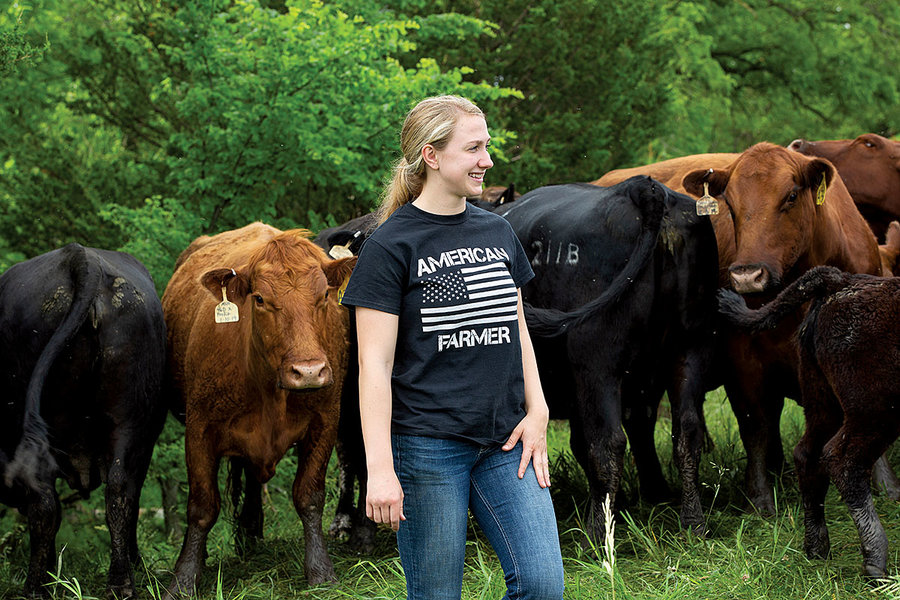
Hanna Esch stands among her cows in Unadilla, Nebraska.
Outside Unadilla, Nebraska, Hannah Esch walks into her cooler and pulls out packages of rib-eye, brisket, and hamburger. Over the past nine months her new company, Oak Barn Beef, sold out of meat four times and brought in $52,000 in sales. Over the next year, she expects to double those sales numbers.
That will be a milestone. It will also be when she finishes her last year of college.
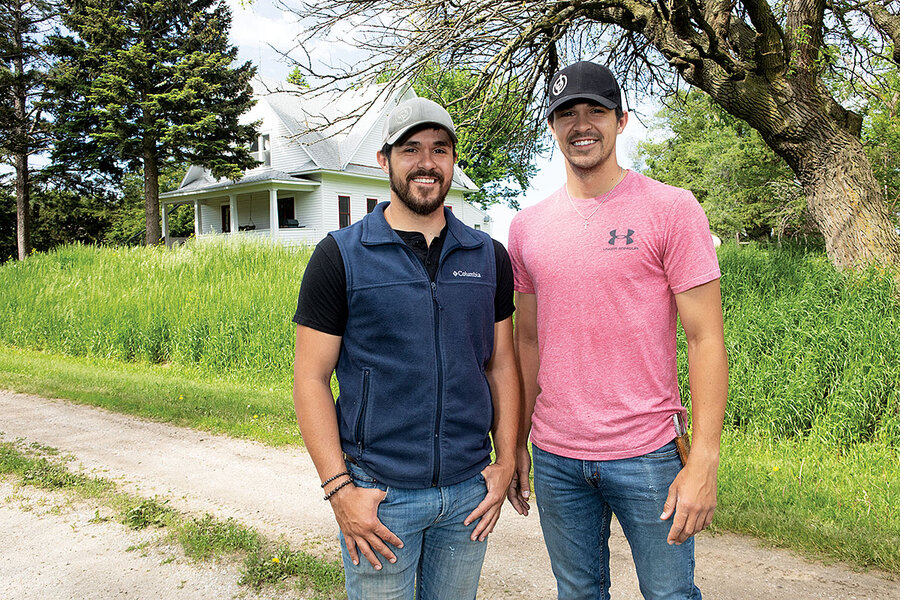
Some 150 miles northwest, the Brugger twins, Matt and Joe, show off how they’re diversifying from traditional agriculture. They directly market the beef from the cows they raise and they grow hops for local microbreweries. But the most visible sign of their commitment to the rural Plains is the two-story farmhouse they’re renovating on the family homestead.
“We’ve just gotten to a point where we can live here,” says Matt, who moved in with his brother in May. It represents free housing, a key attraction for the budding entrepreneurs who have more ideas than dollars. But it’s more than that. It’s the place their great-grandfather bought when he moved here from Switzerland. It’s where their grandfather was born and where they played as children when the house was later rented by people who kept sheep.
“We always wanted to be back in rural economic development,” says Matt. But it wasn’t clear until college what that would mean, which was going back to the family farm. The twins graduated in May.
There’s a new generation of rural entrepreneur returning to the Great Plains. Unlike those who take over a conventional farm and help make it bigger and more efficient, these enterprising young people are starting small and unconventional operations. And unlike previous generations, they aren’t going off to big cities to acquire skills and then returning after a decade or two. Instead, these young people who straddle the end of the millennial generation and the beginning of Generation Z are often coming home right away.
It’s not clear how big the movement is and whether it can reverse the population decline that’s gone on for a century in the rural Plains. But if energy combined with business and social media savvy can overcome demographic decline, then perhaps these youthful entrepreneurs – the first generation born after the farm crisis of the 1980s – have an opportunity to do it.
“There is a spirit in these young people that is different than anything I’ve ever experienced,” says Tom Field, director of the eight-year-old Engler Agribusiness Entrepreneurship Program at the University of Nebraska-Lincoln. Of the 120 or more of its alumni, “90% of them say their goal is to return – or they choose to live in – a small or rural community. These are students who have had international experiences, had internships on both coasts, but they choose to live and work and play in places where they have a deep affinity with the culture, the people, and the landscape.”
Twins Joe (left) and Matt Brugger stand in front of their home in Albion, Nebraska. Melanie Stetson photo Freeman/Staff
It’s not just would-be farmers who are returning. Taylor Walker was a year or so away from getting his teaching degree at Mid-Plains Community College in North Platte, Nebraska, when his father called wondering if he wanted to start a restaurant back home.
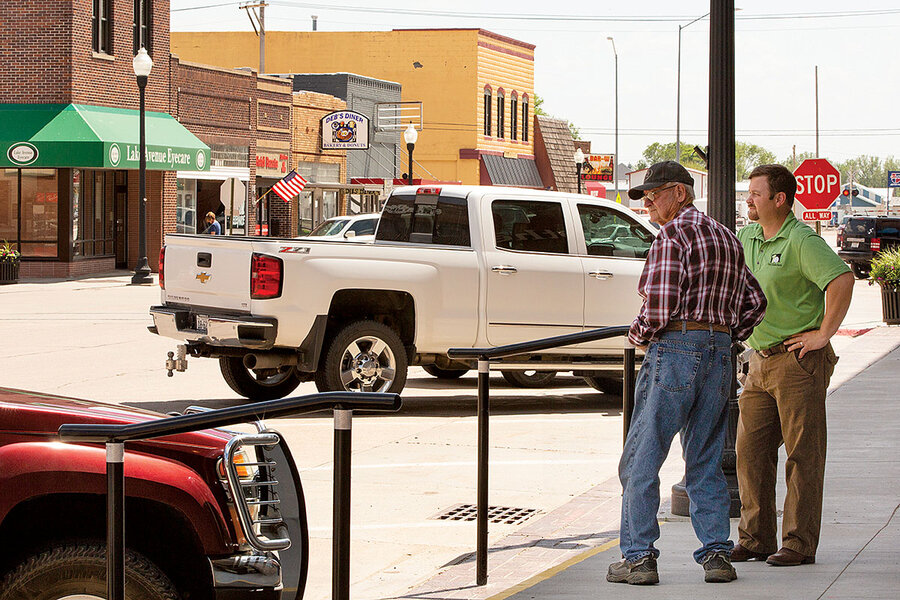
That would be Gothenburg, Nebraska, a city of 3,448 with no stoplights and a big grain elevator just before the railroad tracks. His father, who had run a succession of restaurants in town, had retired and sold his steakhouse in 2016. “Gothenburg got in a panic when it was gone,” says Mr. Walker. “[My father] thought it might be a good idea” to start a new one.
So Mr. Walker skipped the degree and last September opened T. Walker’s on Main Street. It’s much smaller than his dad’s steakhouse but more centrally located, just between Yancy Insurance Agency and Ribbons & Roses, a floral shop. Employees of the two banks across the street come over to enjoy a menu that runs from sirloin steak to grilled trout. “They’ve got the best hot beef sandwich,” says resident Verlin Janssen.
Why move back to a rural community, anyway? “I’m not a real fan of the big cities,” says Mr. Walker. And “I had seen how the community of Gothenburg treated my dad with his businesses. If they continue that for me, then I owe it to them to be here.”
When the Brugger twins first started thinking about a return to the rural Plains, their initial idea was to do something in business development. Then they met with Dr. Field of the Engler program at the University of Nebraska-Lincoln. He urged them to be role models, instead.
“He was the first one to say, … ‘The best thing you can do for your community is to find what you love to do. Start a business around it and hire people to come back … and show other young people that you can do what you love in a rural community,’” Matt recalls. “We completely changed our perspective.”
Now, the recent college graduates run their own company, Upstream Farms. They have 50 cows. They market the beef directly, mostly to the training table program at the University of Nebraska-Lincoln, which serves high-quality foods to student athletes. They raise hops for nearby craft breweries, and because the university takes only the best cuts of beef, the twins sell the rest of their meat as hamburger to the boutique beer firms.
“You grow up and you get to college and it’s all about the industrialization side of [agriculture],” says Matt. “We like to tip our hat to the way that things used to be: this way of life where you had hogs, cows, sheep, chickens. You grew four or five different kinds of crops all on one piece of land. … We like to say that we’re twin brothers farming the Midwest, putting new ideas on old dirt and connecting our customers back to land.”
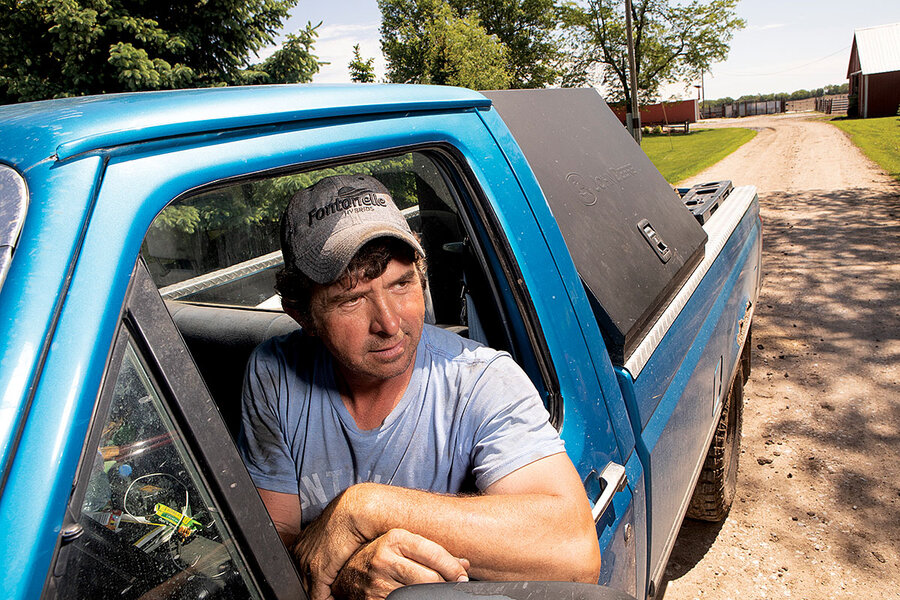
Those new ideas don’t always get the support of their father, Norman Brugger.
Matt and Joe Brugger buy cattle from their father, Norman Brugger, and use his land.
“Two years ago I said, ‘Dad, we need to grow more cover crops,’” Joe recalls. He explained the benefits of raising a crop over the winter to help build up a root system in the soil, which would allow them to use less fertilizer. “Cover crops are nothing new. … [Grandpa] understood it,” Joe adds. “It was Dad who was like, ‘What! We’re going to plant again after we harvest?’”
Norman agreed to experiment with 80 acres. But in the spring, when they went to kill the crop to get ready for planting corn and soybeans, weeds started sprouting in the field because the cover crop seed had been contaminated.
“It was one of those things where I thought I knew what I was talking about,” Joe says. “And it just fell on its face.” Cover crops have been abandoned for the moment.
Perhaps that caution springs from Norman’s experience. He started farming in 1983, near the start of the worst farm crisis since the 1930s. At the time, farmers were going out of business because they had accumulated so much debt buying land at inflated prices during the booming 1970s. When interest rates skyrocketed and crop prices and land values plummeted during the 1980s, farm lenders could no longer justify the debt that farmers were carrying.
While others were selling out, Norman started buying land. It paid off in the long run but required him and his young family to live frugally while crop prices were depressed. A drought didn’t help. According to family lore, the twins’ older sister didn’t see rain until she was 3 years old.
So when the twins proposed building a distillery, their parents responded, “That’s really risky, guys,” Matt recalls. “They go, ‘You guys don’t know what it’s like to live in really, really hard times.’ And they’re right. We’re privileged not to have [known] that. And so we do take more risks. And I think that maybe someday … it’ll catch up with us.”
“But maybe not,” he adds.
Starting a business anywhere is risky, but in rural America it’s even harder. That’s partly because a declining population means a shrinking market of customers.
“You definitely have got to pay attention to what the town has to offer,” says Mr. Walker, the restaurateur who’s following in his father’s footsteps. “Gothenburg does a very good job. They brought in Frito-Lay [which buys corn from local farmers]. … The town has so many opportunities that it helps keep the people here.”
Two men chat in downtown Gothenburg, Nebraska, across the street from a steakhouse that Taylor Walker came back to his hometown to open.
Stability is fragile on the prairie. Despite the good times, Gothenburg has lost more than 3% of its population since 2010, which puts it back to where it was in 1980, before the farm crisis. In rural Nebraska, however, that counts as a roaring success.
Many schoolchildren learn about the Homestead Act, the 1862 law that opened up the Western frontier to settlers with the lure of 160 acres of free federal land. But few outside Nebraska know about the Kincaid Act of 1904, which did the same for the Sandhills and the rest of north-central and western Nebraska. Because the land was arid, the Kincaid Act gave each homesteader 640 acres, a square mile of land – four times what the Homestead Act had offered. The western half of the state’s population skyrocketed.
Already, in eastern Nebraska, however, there were troubling signs of decline. In 21 of the state’s 93 counties, the population had peaked by 1900. One of them, Otoe County, where Ms. Esch runs her cattle, had seen its population grow sixfold in the three decades from the outbreak of the Civil War to 1890, but then it went into a long, slow decline. It lost nearly half its residents through 1990 before rebounding a bit.
The rapid surge from the Kincaid Act also began to wane soon enough. By 1940, the population had peaked in more than two-thirds of Nebraska’s counties covered by the law, including Boone County where the Bruggers live. Using machinery that got ever bigger each decade, farmers consolidated their holdings, and towns started to disappear. When the twins’ great-grandfather moved here from Switzerland, he lived in Akron, a small community built in anticipation of a railroad that never came through. The country store, dance hall, and church are long gone. The twins’ address is now Albion even though the town center is 13 miles away.
The decline in population not only crimps the number of people rural businesses can sell their wares to, but also reduces their labor pool. After graduating from Hastings College in Hastings, Nebraska, Jameon Rush stayed on to do video production for a regional bank based there. During that stint, he started his own video-production company on the side and, when he realized it was viable, struck out on his own full time. What he didn’t count on was the lack of local specialized talent.
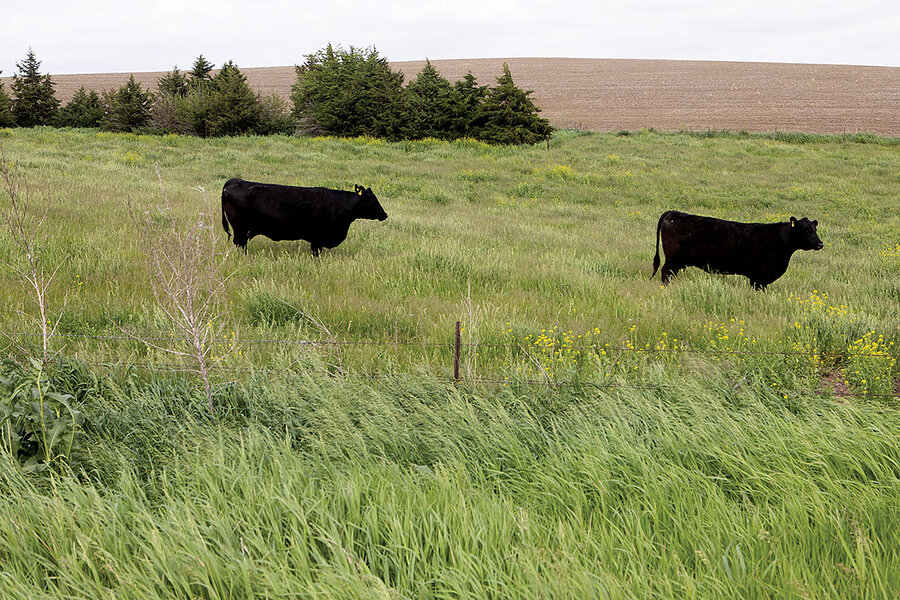
Cows graze in a prairie outside Obert, Nebraska, bordered by plowed fields. Many acres of grassland have been converted into cropland in the Midwest. Melanie Stetson Freeman/Staff
“I was having difficulty finding the right people,” he says. Instead of finding a dependable No. 2 employee for his company, the position became a revolving door, he says. So this year he sold his company to a marketing agency, which was wanting to bring video production in-house. He now works for the firm and in June moved to Lincoln, the state capital, where the company is based.
His relocation to the big city is symbolic of a troubling trend for rural Nebraska. Between 2000 and 2010, the typical rural county in the state (one with no town of 2,500 or more) lost nearly half its population of 20- to 24-year-olds, according to the Center for Public Affairs Research at the University of Nebraska-Omaha. That is partially offset by a 16% net in-migration of 30- to 34-year-olds, presumably people who have worked elsewhere and are now wanting to return to the Great Plains.
But it’s not enough to reverse the overall trend of Nebraskans settling in urban and suburban areas. In 2010, the two counties containing Omaha and Lincoln as well as the county between them represented just over half of Nebraska’s entire population; by 2050, they’re projected to account for two-thirds. The state’s rural counties are expected to lose population over that time.
Seven-day newspapers aren’t just talking about cutting out one or two days a week in print — they’re talking five or six. Is this the only way to accelerate the transition to digital or speeding their own decline?
What do you call a daily newspaper that’s no longer a daily newspaper? “Sunday + Digital” sounds far less poetic.
That’s now more than an academic question. Many publishers — if not most — are now seriously modeling and planning for the transformation of their businesses from seven-day newspapers to something…less, numerous industry sources tell me. And not just a little less — significantly less.
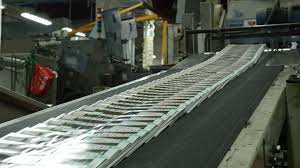
Blame Google and Facebook, blame tariffs and newsprint costs, blame Amazon and Uber for hiring away would-be early-morning newspaper deliverers — it makes little difference. We are on the brink of seeing major cutbacks in daily delivery and daily printing of newspapers, as soon as 2020.
“It is one of the top topics of discussion in the boardroom,” says Peter Doucette, managing director of the Technology & Media Practice for well-used news industry consultant FTI. “The current operating model is under duress like we’ve never seen before. Our point of view is that the daily morning distribution model is no longer going to work in a three- to five-year timeline. That’s broad, of course, and dependent on market.”
“Publishers have been focusing on growing net new digital subscribers” — see Nieman Lab director Joshua Benton’s piece on the difficulty doing so at the L.A. Times — “but they need to think of the transformation event — cutting distribution days — and the effect of moving print subscribers to digital subscribers.”
In essence, Doucette — who joinedFTI a year ago after leaving a high-profile role as chief consumer revenue officer for The Boston Globe’s industry-leading digital subscription initiative — is urging publishers to think bigger. That’s the drama playing out in almost every city large and small: timing that inevitable “transformation event” when the seven-day daily moves into a museum somewhere.
What can publishers — under great financial pressure to make shorter-term decisions — do to make this dramatic move from print to digital something more just the next stage of decline for the business?
While dozens of newspaper titles have cut Saturdays (creating a single weekend paper, something the Europeans have done for decades) or Mondays, this next cut would be far more impactful. The big question now on many corporate tables is whether the right number of days to kill is five or six.
There’s the 7/1 model. That’s basically the Sunday print paper — where most of the ad revenue is still generated — plus digital the rest of the week. Newspapers have been pushing “Sunday + Digital” offers to readers hitting paywalls for years now, and you’re going to see it a lot more — except often as the only home delivery option, not the skimpiest one.\
There’s the 7/2 model. That’s Sunday plus one weekday — maybe a food-heavy Wednesday stuffed with supermarket ads. (That’s a phenomenon that remains in some markets but has vanished in others.)
And, more conservatively, there’s 7/6. That’s what McClatchy piloted this spring at its South Carolina paper the Myrtle Beach Sun News, which I detail below. 7/6 saves a lot less in the physical costs — newsprint, printing, trucks, delivery — but it’s a way to take one step into the transformation process rather than jumping in all at once. And it’s a test: If you break the longstanding bond between the sun rising in the east and papers hitting doorsteps, will enough advertisers and subscribers accept it to make the economics work?
Two more lakes have been added to the state Department of Environmental Protection’s harmful algal bloom list, with Budd Lake and Lake Musconetcong both under a no-swimming advisory until further notice.
Although the DEP did not release specific bacteria counts on its website, it placed the latest two lakes on its list of those impacted by the algal bloom’s cyanobacteria, the bacteria that can cause health issues, including skin rashes, flu-like symptoms, eye irritation, respiratory and gastrointestinal problems and other health implications. DEP advisories have been issued when the bacteria reaches minimally 20,000 cells per milliliter in water sampling tests.
The Lake Musconetcong Community Association announced on its Facebook page on Thursday that the DEP notified it that there is a “confirmed harmful algal bloom present with levels quantified at or above the NJ Health Advisory Guidance.” The community association advised the public that the lake will continue to be monitored and to check back on the organization’s Facebook page for updates.
“It seems we are under the same notice as Lake Hopatcong, where boating is allowed but any contact with water is strongly discouraged,” the association announced. “Fishing seems to be allowed but fish should not be eaten. We assume use of gloves while fishing would be recommended.”
The Budd Lake Beach, Mount Olive Recreation and Mount Olive Township Facebook pages all posted on Thursday that the algal bloom was detected in the lake and Budd Lake Beach would remain closed until test results come back during the week. The Wibit inflatable water park event scheduled for today has been rescheduled to Aug. 18. The beach had previously been closed for five days for an algal bloom incident detected on July 18.
Greenwood Lake in West Milford and New York state has remained under a no-swimming advisory since test results in early July detected the cyanobacteria. Test results from the July 31 water sampling show all sampling sites above the guidance levels. During the last aerial surveillance on Greenwood Lake on July 30 to detect the presence of the phycocyanin — the algal bloom’s greenish pigment visible from the air — the DEP noted cyanobacteria was observed on both the New Jersey and New York sides of the lake.
At Lake Hopatcong on Thursday, the DEP announced the no-swimming advisory remained in effect for all locations on the lake except for the open water areas in Henderson Cove and Indian Harbor, with all beaches throughout the lake closed. The latest water sampling from Indian Harbor on Thursday and released Friday showed the bacteria count was up again to 19,750 cells per milliliter, close to the threshold; and was 11,250 on the July 30 reading.
The DEP continues to recommend no bodily contact for humans and their pets with waters in any lake where there remains a presence of harmful algal bloom. Additionally, drinking lake water or eating fish caught from water containing the bloom also should be avoided.
Boating on a deck or pontoon-style boat is permitted. However, canoeing, kayaking, waterskiing and other sports that could promote close bodily contact to the water are discouraged under the DEP’s advisory guidelines.
About half a million acres of land in the rural Yazoo backwater area in Mississippi is underwater, a devastating blow for a poor region where agriculture is the economy’s lifeblood
Flooded farmland in the lower Mississippi delta. Photo by Rory Doyle, The Guardian
By Rory Doyle for the Guardian
Dating back to late February, about 550,000 acres of land have been underwater in the rural Yazoo backwater area of the lower Mississippi delta. About half of the acreage is farmland, creating devastating effects in a region where agriculture is the lifeblood of the economy. While flooding in the region is common, this year’s floodwater has hung around longer than ever.
A home outside of Valley Park remains surrounded by floodwater. The brown line at the bottom of the house indicates the flood level at its peak.
Carmen Hancock, James Hancock and Rodney Porter have spent the past five months helping their elderly neighbors survive in their homes surrounded by floodwater. “We’re living by the good Lord to do what’s right,” said James Hancock. “There’s a number of older people living in this neighborhood, and it’s just the right thing to do. When the going gets tough, the tough get going. That’s what I live by. You do what has to be done.”
Compounding the problem was a high Mississippi River, which remained near or above flood stage for the longest span since 1927. The perfect storm of historic rainfall and a high river resulted in a backwater flood that has lingered beyond anything the region has ever seen.
Only within with the past couple weeks has the water receded, and for the first time in nearly half a year, farmers are finally beginning to see their land re-emerge.
Backwater flooding surrounds a farm in Issaquena county. Photographs by Rory Doyle,
Efforts to prevent flooding in this region date back to 1941 when Congress approved the Yazoo Backwater Project. The multifaceted plan included a system of levees, canals and drainage structures. But one crucial element was never installed – drainage pumps that would push floodwaters out of the backwater area and eventually into the Mississippi River. Due to construction delays, the pumps were never built, and in 2008, the Environmental Protection Agency (EPA) vetoed the pumps, citing a threat to wetlands and wildlife in this remote part of Mississippi.
The 2019 flood has caused the EPA to review its veto decision, giving hope to many residents that the pumps will finally be installed. Situated in one of Mississippi’s most rural locations, most residents feel they have been left out of the national conversation about flooding in America.
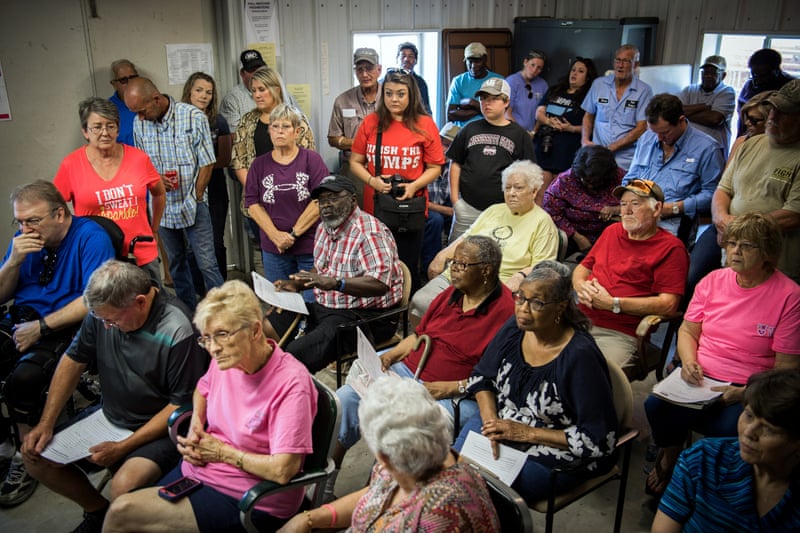
Residents voice their concerns in Valley Park. Photograph by Rory Doyle/The Guardian
“Because no one’s died from this, and we live in such a remote place, it doesn’t seem to be important to national news,” said Paul Hollis, a farmer from Rolling Fork and a local commission for the Mississippi levee board. “We want people to know how many acres of farmland are flooded, how many houses are destroyed and how much wildlife has been impacted by this.”
As the crisis escalates…
… in our natural world, we refuse to turn away from the climate catastrophe and species extinction. For The Guardian, reporting on the environment is a priority. We give reporting on climate, nature and pollution the prominence it deserves, stories which often go unreported by others in the media. At this pivotal time for our species and our planet, we are determined to inform readers about threats, consequences and solutions based on scientific facts, not political prejudice or business interests.
More people are reading and supporting The Guardian’s independent, investigative journalism than ever before. And unlike many news organizations, we have chosen an approach that allows us to keep our journalism accessible to all, regardless of where they live or what they can afford. But we need your ongoing support to keep working as we do.
The Guardian will engage with the most critical issues of our time – from the escalating climate catastrophe to widespread inequality to the influence of big tech on our lives. At a time when factual information is a necessity, we believe that each of us, around the world, deserves access to accurate reporting with integrity at its heart.
Our editorial independence means we set our own agenda and voice our own opinions. Guardian journalism is free from commercial and political bias and not influenced by billionaire owners or shareholders. This means we can give a voice to those less heard, explore where others turn away, and rigorously challenge those in power.
We need your support to keep delivering quality journalism, to maintain our openness and to protect our precious independence. Every reader contribution, big or small, is so valuable. Support The Guardian from as little as $1 – and it only takes a minute. Thank you.Support The Guardian