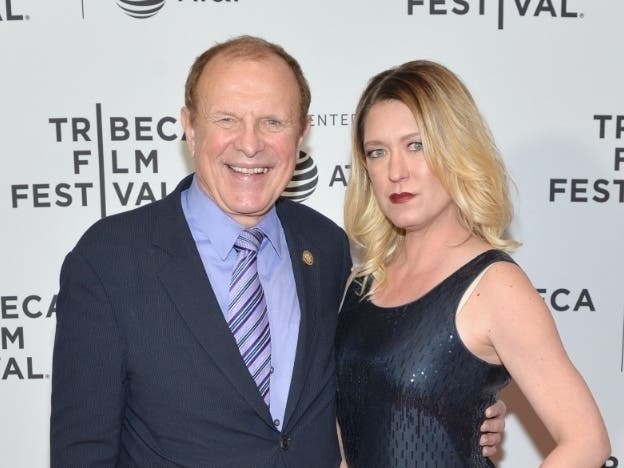
Raymond Lesniak and Salena Carroll Lesniak at the 2017 Tribeca Film Festival. (Noam Galai/Getty Images)
BRICK, NJ — Friends and family are mourning the death of Salena Carroll Lesniak, wife of former state senator Raymond Lesniak, who died Wednesday.
Salena Lesniak was 43, the New Jersey Globe reported. The couple had been partners for 20 years before marrying in 2018, and she died at the couple’s home in Ocean County, the report said. The Lesniaks have a home in Brick Township, according to property records; it was at that home where she died, Patch has learned.
Salena Lesniak had been chairman of the New Jersey Civil Rights Commission, and had led the Bureau of Domestic Preparedness in Union County’s Office of Emergency Management, and was the special assistant to the Union County manager, the Globe report said.
Gov. Phil Murphy issued a statement announcing her death Wednesday afternoon, saying, “Salena was a class act and, along with Ray, a tireless advocate for countless New Jerseyans who needed a champion.”
“If a life is to be measured by the positive impact it had on others, Salena led a full life, indeed,” Murphy said. “Tammy and I send our warmest thoughts to Senator Lesniak and all who held Salena dear.”Subscribe
Raymond Lesniak, 73, served as a state senator for New Jersey’s 20th District from June 1983 through December 2018. He ran for the Democratic nomination for governor against Murphy, John Wisniewski, and Jim Johnson but finished fourth in the primary.
Further information was not immediately available.
Anyone who has traveled in or through New Jersey heading “down the shore” from the north almost certainly has traversed the Driscoll Bridge in Sayreville and no doubt has been witness to the 418 acres of brownfield that sits on its southern end.
The environmental remediation site is the former National Lead Industries property, previously being marketed as “The Pointe” by O’Neill Properties Group out of Philadelphia. O’Neill had obtained initial approvals from state and local authorities in 2014, including financial support from the New Jersey Economic Development Authority (NJEDA) through the Economic Redevelopment and Growth Program. Based on a lack of progress toward development of the enclosed regional mall that was the centerpiece of The Pointe, in 2017 North American Properties was engaged by the designated redeveloper, Sayreville Seaport Associates, to create an updated master plan and position the property for a development start. North American Properties hired Cooper Robertson Partner John Kirk, one of the country’s leading urban designers (and a Maplewood resident), to lead the master planning efforts for Riverton.
North American Properties, a multi-regional real estate development company, took over development of the location hoping to turn it into the largest mixed-use project in the state. NAP announced plans to build a mixed-use, village-style development dubbed “Riverton.”
Together, Cooper Robertson and North American Properties worked to create the Riverton vision and craft a master plan, a new waterfront development along two miles of shoreline in Middlesex County along the Raritan River, and less than 20 miles away from Manhattan.
Riverton is a 400+ acre development along two uninterrupted miles of the Raritan River coastline. – NORTH AMERICAN PROPERTIES
North American Properties says the future development project should be thought of as “America’s next great hometown.” It will be a metropolis-meets-mega-town square with spectacular river views, and is expected to bring more housing, retail and entertainment space, along with hotels, offices and other commercial uses, to a Middlesex County town that hasn’t experienced a revitalization.
The $2.5 billion mixed-use development is expected to create a fully walkable city layout with over 2 million square feet of retail and an infusion of restaurants, 2,000 residential units, Class-A office space, hotels, parks, and a 200-slip marina. Additionally, planned civic services include a fire station, performing arts spaces and a public walkway along the entire riverfront. It will become a place to experience the best of New Jersey. Where land meets water; where small-town quaint meets shore-town casual.
The Riverton peninsula has ready access to and from major vehicular arteries like the Garden State Parkway, U.S. Route 9, and State Route 35, with more than 372,500 vehicles per day travelling past the site. Riverton is positioned to be a beating heart of the area. Mark Toro, NAP’s managing partner, called it an access nirvana with the three major highways all feeding into the pipeline of the site. Additionally, public transportation hubs are within a short drive that connects the community to New York and Philadelphia as well as Boston and Washington, D.C. A ferry terminal in South Amboy is also on the way, just a few miles east of Riverton, which will provide boat service to Lower Manhattan and the Financial District.
Riverton will be a connection point to unite the best of New Jersey whether you arrive by boat or car, bike or bus. – NORTH AMERICAN PROPERTIES
Once completed, Riverton will be the largest mixed-use development in New Jersey’s history.
The contaminated National Lead Industries property sat dormant for decades. Redeveloper Sayreville Seaport Associates spent years remediating the land, starting in 2009. And NAP says the ground has been moving on the site and the first of the retail stores should be a reality within the next two years. Many approvals are still required from state and local agencies, but the first phases of construction are scheduled to begin in spring 2020, with Bass Pro Shop being one of the first planned openings in 2021.
Toro, a New Jersey native and Rutgers University graduate who is now based in Atlanta, said: “We create great, walkable places that connect people to each other; cities to their souls … and individuals to experiences that move them.” Toro said the area is going to be a dwelling place with plenty of experiences for people to come and stay, be entertained and have fun.
The existing bulkhead, which was used for industrial barge deliveries, is to become the place where Riverton’s guests can connect most directly to the river, and an important public gathering spot in the mixed-use village, which is scheduled to open in 2022, with a combination of 460 luxury apartments and 81,000 square feet of creative and collaborative office space over retail and restaurants. A full-service hotel and conference center, Class-A office tower and waterfront townhomes will soon follow.
Riverton will be a new waterfront development in Sayreville in Middlesex County. – NORTH AMERICAN PROPERTIES
Riverton will be designed for a variety of age groups and will offer housing at a variety of price points. The rental rates will be competitive with the newest highly amenitized apartment homes in desirable locations in Middlesex and Monmouth counties.
Riverton is poised to provide an opportunity to serve the New York/New Jersey market, which is home to 16 million people, providing the next generation of commercial real estate, which is “experiential mixed-use.” The size and scale of Riverton enables NAP the “freedom to curate and deploy a full array of uses that will serve to energize the property 18 hours a day,” Toro remarked in a recent interview.
What does this mean for Sayreville?
Riverton will energize the area economically by bringing in new retail, restaurant, office and hotel options. It should generate thousands of local jobs including construction jobs as the project is built, as well as retail and service positions once businesses open. It will also reinforce Sayreville as a destination by creating a new downtown for the way people live, work and play today.
The team at NAP apparently knows how to create dynamic mixed-use environments that become the community’s “third place” — an area to gather outside of home and work that fosters human connection and plays host to meaningful experiences in real life.
For Sayreville and the rest of New Jersey, Riverton will not disappoint.
NAP has proven in many of its other projects that it can capture and hold the human energy its environments create. The firm’s professionals combine the right mix of uses, layer in community gathering spaces, deliver resort-level hospitality and activate the public realm with events to create even more energy and driving value for all components.
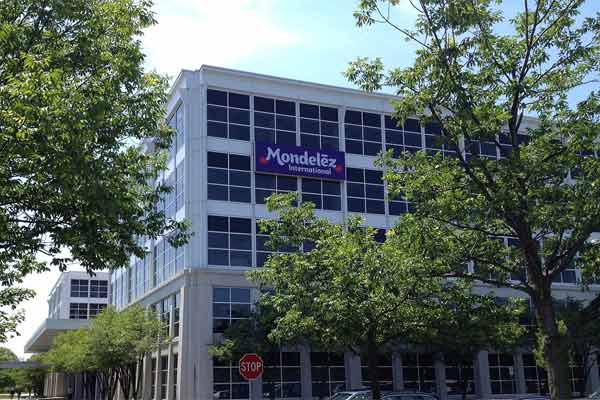
Mondelēz International, Inc., is an American multinational confectionery, food, and beverage company based in Illinois which employs approximately 83,000 individuals around the world.
Oreo-maker, Mondelēz International, and Enel Green Power North America signed a twelve-year power purchase agreement for energy from Texas solar farm.
What Happened?
Mondelēz International agreed to purchase a twelve-year power purchase agreement (PPA) under which Mondelēz International will purchase the energy delivered to the electricity grid from a 65-megawatt portion of Enel Green Power North America’s Roadrunner project.
The Roadrunner solar project, a solar farm in Texas, United States, is Enel Green Power’s largest solar project in the country.
Why It Matters
This agreement is Mondelēz International’s largest renewable energy partnership at a global level and their first renewable energy PPA signed in the U.S.
The partnership enables Mondelēz International to make substantial progress against its sustainability goals by reducing 80,000 metric tons of carbon dioxide emissions – that’s 5 percent of the company’s global manufacturing emissions.
The renewable energy purchased will be enough to produce more than 50 percent of all the Oreo cookies consumed in the U.S. annually.
Solar panel at Susquehanna University Robert Inglis photo for The Daily Item
Solar energy farms could soon sprout from farmland stretched beneath high voltage power lines across the Valley as renewable energy companies are pitching lease proposals to local property owners.
Supervisors in both East and West Chillisquaque townships worked jointly with respective planning commissions and a solar industry representative to create zoning ordinance amendments regulating ground-mounted solar farm systems to get ahead of the installation of such developments.
The amendments call for restrictions on glare, establishes minimum setbacks and stormwater requirements and sets requirements for decommissioning and removing solar systems.
“There were five (companies) that talked to me to lease my ground, but I wasn’t interested,” said Bob Pardoe, secretary of the West Chillisquaque Township Planning Commission.
Pardoe estimated 10 property owners in his township were seriously considering proposals.
A Massachusetts-based firm, Nexamp: Solar Energy Solutions, mailed exploratory letters to property owners in Union County offering an estimated $1,500 per acre annually. The letter said the firm typically seeks 5 to 25 acres.
Legislation signed by Gov. Tom Wolf in 2017 and implemented in 2018 by the Public Utility Commission closed the Keystone State’s borders on solar tax credits.
The move raises the value of such credits, in part, by restricting participation in the state’s renewable energy tax credit program to systems built in Pennsylvania. In the past, Pennsylvania was an open border state and credits could be used from systems in 13 surrounding states and the District of Columbia, according to the PennFuture Energy Center.
Bid prices on such credits were at $35 Thursday compared to $22 on the same date in 2017, according to online market site SREC Trade.
Keith Hevenor, Nexamp communication manager, said this change and other bills pending in the state legislature make Pennsylvania a favorable place to build solar energy farms.
“The legislation has to be in place to be able to turn the energy we are generating into credits that can be monetized,” Hevenor said.
Nexamp hasn’t finalized developments in the Valley, but is currently pursuing agreements in the PPL Electric service area, including the greater Sunbury area, he said.
Free-standing solar farms
Solar panels can be found on rooftops throughout the Valley. What makes the proposed solar farms different is that they’re free-standing.
Hevenor said Nexamp’s systems don’t create large permanent environmental footprints. Concrete pads measuring about 100 square feet are poured for equipment that directs the energy from the panels to the power lines. The panels themselves are affixed to poles that are sunk into the ground without a concrete foundation. The wiring is above ground, he added.
Hevenor said the company establishes funds to remove the systems at no cost to the landowners when a lease ends or isn’t renewed. Leases last about 20 to 40 years on average, he added.
West Chillisquaque Township Supervisor Vaughn Murray said, in working to develop the ordinance amendment, the closest municipality with relative solar regulations was in Cumberland County.
The township has strict stormwater regulations, Murray said, and the farms as proposed are a unique fit.
“It’s not like you’re paving a parking lot. There’s still a chance for water to infiltrate the ground, but it’s not going to infiltrate the way it would in a field of corn,” Murray said.
Farm registration
Cindy Kahley administers the Agland Preservation program for Union County Conservation District. Registered farms are restricted from developing free-standing solar farms, she said. The program has about 8,000 acres of registered farmland. Farms not registered in the program must abide by municipal ordinance, she added.
Kahley said she’s aware of companies approaching landowners in Gregg, Buffalo and Kelly townships.
“A lot of the land I’ve seen that they have been approaching are prime and statewide soils, which are the best soils for farming,” Kahley said. “It would be a huge impact to take that land out of production, which has good prime soils, and have it sit there with free-standing panels.”
That’s not the case in West Chillisquaque Township in Northumberland County, according to Pardoe. The “majority” of land targeted there hasn’t been prime farmland, he said.
Shawn McLaughlin, Union County’s planning and economic development director, said solar farms are worth exploring, but that he’d rather it happen on rooftops or other developed sites.
“I’d prefer to see solar panels and arrays on those first rather than taking up our best farmland or best development sites,” McLaughlin said.
A public hearing on West Chillisquaque’s ordinance proposal will be held tonight followed by a joint meeting of the supervisors and planning commission members Tuesday morning to further discuss related issues.
Newswise — Bottles of beer, wine and spirits contain potentially harmful levels of toxic elements, such as lead and cadmium, in their enamelled decorations, a new study shows.
Researchers at the University of Plymouth in England analysed both the glass and enamelled decorations on a variety of clear and coloured bottles readily available in shops and supermarkets.
They showed that cadmium, lead and chromium were all present in the glass, but at concentrations where their environmental and health risks were deemed to be of low significance.
However, the enamels were of greater concern, with cadmium concentrations of up to 20,000 parts per million in the decorated regions on a range of spirits, beer and wine bottles, and lead concentrations up to 80,000ppm in the décor of various wine bottles. The limit for lead in consumer paints is 90ppm.
The study also showed the elements had the potential to leach from enamelled glass fragments, and when subjected to a standard test that simulates rainfall in a landfill site, several fragments exceeded the US Model Toxins in Packaging Legislation and could be defined as “hazardous”.
Published in Environmental Science and Technology, the research was carried out by Associate Professor (Reader) in Aquatic Geochemistry and Pollution Science, Dr Andrew Turner.
Former Port Authority deputy executive director Bill Baroni, now in federal prison serving an 18-month sentence for his role in the Bridgegate corruption scandal, filed a motion early Monday morning to be released on bail after the U.S. Supreme Court on Friday agreed to review his conviction.
“Based on the Supreme Court’s decision to hear the case, Baroni respectfully moves for immediate release on bail from the sentence he is currently serving, pending the outcome of the Supreme Court case,” they wrote in a six-page brief seeking release.
Federal prosecutors did not oppose the request.
Baroni and Bridget Anne Kelly, one-time deputy chief of staff to then-Gov. Chris Christie were both found guilty in November 2016 of fraud and conspiracy in connection with a scheme of political retribution for their role in shutting down local toll lanes of the George Washington Bridge to create huge traffic tie-ups in Fort Lee.
Prosecutors said the end game was to punish Fort Lee Mayor Mark Sokolich, when the Democratic mayor back away from an expected endorsement of Christie, a Republican, during the governor’s 2013 re-election campaign.
The governor was never charged with any wrongdoing and denied any knowledge of the plan.
Bridget Anne Kelly
U.S. Supreme Court to hear Bridgegate appeal. Stunning move keeps alive case that dogged Christie.
Bridget Anne Kelly, the former aide to the governor, will get a final chance to argue she was wrongfully convicted.
Attorneys for both Kelly and Baroni have argued that whatever happened at the George Washington Bridge, it was not a federal crime. They said in prosecuting the two, the government cited laws normally used in theft and bribery cases to level charges where no theft or bribery was alleged to have occurred.