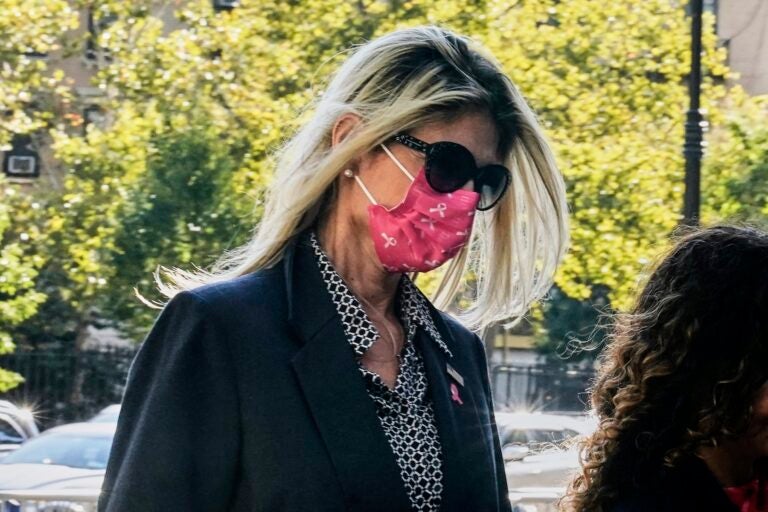
A federal judge in Pennsylvania has ruled that Alina Habba, President Trump’s former personal lawyer, does not have the authority to serve as New Jersey’s top federal prosecutor because of the Trump administration’s violation of appointment rules.
Judge Matthew Brann’s decision halts Habba’s involvement in ongoing cases and deepens concerns over how the U.S. Justice Department is handling the appointments of top prosecutors.
“Faced with the question of whether Ms. Habba is lawfully performing the functions and duties of the office of the United States Attorney for the District of New Jersey, I conclude that she is not,” Brann, the chief district judge for the Middle District of Pennsylvania, wrote in a 77-page ruling that was released Thursday.
Professor Jacob Elberg, of Seton Hall Law School and a former assistant attorney in New Jersey’s U.S. Attorney’s office, spoke with NJ Spotlight News about the ruling and its potential impact on federal prosecutions in New Jersey.
“It’s a real problem,” said Elberg. “First of all, leadership uncertainty in any organization is a significant challenge. But here, it’s worse than that because these cases are hard enough. The job is hard enough without dealing with the potential that cases may be viewed as not legitimate because of her involvement, and in fact that she’s unlawfully in the position.”
If you like this post, you’ll love our daily environmental newsletter, EnviroPolitics.It’s packed daily with the latest news, commentary, and legislative updates from New Jersey, Pennsylvania, New York, Delaware…and beyond. Please do not take our word for it; try it free for a full month
By Veronica Flesher, Patch Staff, Updated Thu, Aug 21, 2025 at 2:23 pm ET
High surf is seen in Seaside Heights on Aug. 19. (Karen Wall/Patch)
Gov. Phil Murphy has declared a State of Emergency for all of New Jersey on Thursday as Hurricane Erin makes its closest pass, bringing 17-foot waves, major coastal flooding to parts of the shore, life-threatening rip currents, and eroding beaches.
This went into effect at 2 p.m.
“Over the past couple of days, we have seen the effects of Hurricane Erin along the Jersey Shore in the form of dangerous rip tides. Today and tomorrow will be no exception,” Murphy said. “As the storm moves past New Jersey over the next 24 hours, we are expecting high surf and rip currents, coastal and flash flooding, and a high erosion risk in parts of the state. We ask all New Jerseyans to monitor local weather forecasts and warnings and stay informed on evacuation protocols, especially if you’re down the Shore.”
Murphy encouraged residents to visit ready.nj.gov for important weather updates and safety information. Those in affected areas are asked to be mindful of evacuation routes.
If you like this post, you’ll love our daily environmental newsletter, EnviroPolitics.It’s packed daily with the latest news, commentary, and legislative updates from New Jersey, Pennsylvania, New York, Delaware…and beyond. Please do not take our word for it; try it free for a full month
Winnie Greco was the mayor’s former director of Asian affairs at City Hall and one of his best fund-raisers. Credit…Nicole Craine for The New York Times
A close adviser to Mayor Eric Adams was suspended from his re-election campaign on Wednesday after giving a journalist cash tucked inside a potato chip bag.
The adviser, Winnie Greco, who was the mayor’s former director of Asian affairs at City Hall and one of his best fund-raisers, had returned to the campaign trail as a volunteer during Mr. Adams’s run for a second term. She had been at the center of controversy after the F.B.I. raided her homes last year as part of a federal investigation into possible Chinese government interference in the 2021 mayor’s race.
On Wednesday, Ms. Greco attended an event with Mr. Adams in Harlem and gave more than $100 in a red envelope stashed inside the snack bag to a reporter for The City, according to an article in the online news outlet. The City promptly reported the incident to the city’s Department of Investigation, and federal prosecutors in Brooklyn contacted the newspaper’s lawyers, according to the newspaper’s account.
If you like this post, you’ll love our daily environmental newsletter, EnviroPolitics.It’s packed daily with the latest news, commentary, and legislative updates from New Jersey, Pennsylvania, New York, Delaware…and beyond. Please do not take our word for it; try it free for a full month
Notable new projects and regulations aim to streamline recycling programs, make recycling less confusing for residents, and more efficiently funnel critical materials into domestic supply chains.
Notable new projects and regulations aim to streamline recycling programs, make recycling less confusing for residents and more efficiently funnel critical materials into domestic supply chains.
Here’s a roundup of recent battery recycling news. What battery recycling trends and news are you tracking? Let us know at waste.dive.editors@industrydive.com.
Princeton NuEnergy opens black mass recycling facility in South Carolina
Princeton NuEnergy, a lithium-ion battery recycling and cathode manufacturing company, said last week its advanced black mass recycling production facility in South Carolina is now fully commissioned and operational.
PNE says the flagship facility is the first commercial-scale advanced black mass and battery-grade cathode active material production facility in the country. The facility is part of PNE’s goal to recycle and produce critical battery minerals in the U.S., especially as federal policy focuses more on establishing domestic energy production and supply chains, the company said in a statement.
The facility, located in Chester, South Carolina, has a5,000 metric tons per annum capacity and mainly produces “high-purity” black mass from manufacturing scrap. In 2026, the company expects to expand capacity to 15,000 tpa, with the capability to scale up to 50,000 tpa “as market demand grows,” PNE stated. PNE says the operation can achieve a recovery yield of over 97%.
Read the full story here
If you like this post, you’ll love our daily environmental newsletter, EnviroPolitics.It’s packed daily with the latest news, commentary, and legislative updates from New Jersey, Pennsylvania, New York, Delaware…and beyond. Please do not take our word for it; try it free for a full month
Minnesota utility regulators have approved the state’s first stand-alone energy storage project, an important milestone in Minnesota’s effort to transition to producing completely carbon-free electricity.
The Minnesota Public Utilities Commission approved a site permit for the 150-megawatt Snowshoe Energy Storage Project, which will be built on an 18-acre site west of Rochester, near the town of Byron.
The batteries will store excess electricity produced by nearby solar and wind farms, and then discharge the power during times of high demand — for example, when people return home from work and school and turn on their air conditioners.
Several battery energy storage systems have been built or approved recently in Minnesota in conjunction with solar energy projects, including a facility approved in July in Faribault County, south of Mankato.
But the Snowshoe project, to be developed by Spearmint Energy, a battery system developer based in Miami with an office in Eden Prairie in the Twin Cities area, is the first standalone battery system to be built in the state that will be connected directly to the electric grid.
If you like this post, you’ll love our daily environmental newsletter, EnviroPolitics.It’s packed daily with the latest news, commentary, and legislative updates from New Jersey, Pennsylvania, New York, Delaware…and beyond. Please do not take our word for it; try it free for a full month