Editor’s Note: While driving into Lancaster, Pa. on Saturday, where I was to attend a meeting of website users and developers, I marveled at the beauty of the individual farms bisected by Route 30 and I wondered how the Amish continue to live here with the chock a block proliferation of motels, hotels, furniture outlets, and fast-food restaurants. Later, during a break, I picked up a copy of the local newspaper and read the story below. While some Amish farmers have picked up and headed to more rural areas, the overall population of Amish families is far outpacing the population growth of the merchant class. If the Amish ever drop their aversion to politics, they likely could stop additional development in its tracks. At the voting booth. _____________________________________________________________________
Lancaster County’s fast-growing Amish population recently exceeded the 33,000 mark as the farming-oriented Plain sect continues to flourish despite the encroachment of urban sprawl.
The Amish, who typically have large families and drive horse-drawn vehicles and farm equipment, are growing so strongly that they accounted for an estimated 41% of the county’s overall population growth last year.
The U.S. Census Bureau says the county added 2,503 people in 2018. Scholars who track the local Plain community say about 1,020 of them were Amish.
Lancaster County’s ability to accommodate the burgeoning Amish population has become an issue in Manheim Township, where the commissioners will soon decide whether to allow the development of a 75-acre housing and commercial project, called Oregon Village, in the midst of a thriving, centuries-old Amish community.
Lancaster County’s Amish population reached 33,143 in 2018, up 3.2%, from the previous year, according to Elizabethtown College researchers. Last year’s growth was typical of what’s happened in recent years.
Elizabethtown College’s Young Center for Anabaptist and Pietist Studies bases its estimates for the Lancaster County settlement on a church district directory and Amish newspapers. (Lancaster County Amish comprise 87% of the entire Lancaster County settlement, which includes parts of neighboring Chester and York counties.)
Since 2014, Lancaster County Amish have grown annually by over 1,000 a year, on average, and at a 3.9% rate. That compares to a much slower 0.5% rate for the county as a whole. Overall, the county is growing by about 2,500 people a year.
Although some Amish families do leave Lancaster County, their population here doubles about every 20 years. In 1970, the Lancaster County portion of the local Amish settlement numbered about 7,000. That climbed to about 12,400 by 1990 and 16,900 by 2000. It has just about doubled since then.
The lawmakers say Patrick McDonnell’s re-appointment should be delayed until pipeline investigations are complete
Kimberly Paynter reports for WHYY
A bipartisan group of state senators from Chester and Delaware counties wants to put off the reconfirmation of Department of Environmental Protection Secretary Patrick McDonnell until multiple criminal probes of Sunoco’s Mariner East pipeline projects are complete.
Led by Chester County Democrat Andy Dinniman, the group asked Sen. Gene Yaw, majority chair of the Environmental Resources and Energy Committee, and Sen. John Yudichak, the minority chair, to delay what is typically a routine hearing on reappointment, which is scheduled for Tuesday.
In the memo to Yaw and Yudichack, the senators, who represent areas impacted by Sunoco/Energy Transfer’s Mariner East pipeline project, pointed to four separate probes including criminal investigations by both the Chester County and Delaware County district attorneys as well as an investigation by the Pennsylvania Attorney General.
In addition to Dinniman, the senators on the memo include Democrats Daylin Leach, Katie Muth and Tim Kearney, and Republican Tom Killion.
The memo also points to an investigation by the state Ethics Commission into the actions of Gov. Tom Wolf’s aide Yesenia Bane who is married to a gas industry lobbyist, and who acted as Wolf’s liaison to DEP during the permitting of the project. The commission closed its investigation of Bane on April 19, clearing her of wrongdoing.
The Trump administration’s move, similar to EPA’s ‘secret science’ effort, offers new ways for fossil fuel and other industries to challenge science-based policies.
The memo was signed by Russell Vought, a former top official at the political arm of the conservative Heritage Foundation who is now acting director of the White House Office of Management and Budget. Credit: Oliver Contreras/For The Washington Post via Getty Images
APR 25, 2019
President Donald Trump’s administration has launched yet another attempt to control the use of science in federal policymaking—this time with a memorandum to government agencies from the White House budget office.
This story has been updated with EPA’s response.
The memo, quietly released on Wednesday, appears aimed at putting into effect some long-sought goals of industry foes of environmental regulations.
Described as “guidance” for executive branch agencies, it offers numerous new avenues for regulated industries to challenge the science used in policymaking. The memo was signed by Russell Vought, a former top official at the political arm of the conservative Heritage Foundation who is now acting director of the White House Office of Management and Budget (OMB).
Observers say the OMB is seeking to implement by fiat restrictions on environmental and health science that have failed to garner support in Congress and have foundered in a formal rulemaking process begun last year by the Environmental Protection Agency.
Hunters worry about marine mammals and a way of life, but there are also some mixed feelings as the Trump administration goes full bore on oil and gas drilling.
Martha Itta, tribal administrator to the Native Village of Nuiqsut, was relieved by a judge’s ruling on offshore drilling. Her community still faces pressure onshore from encroaching oil and gas drilling operations. Credit: Sabrina Shankman/InsideClimate News
If there is one place that has most felt the Trump administration’s push to rapidly expand fossil fuel development, it might be Nuiqsut, a small village nestled on Alaska’s North Slope.
The village has become almost entirely surrounded by oil and gas drilling over the past three decades, and the Trump administration has been aggressively pushing for more drilling in the National Petroleum Reserve-Alaska, just west of the village, and off the coast to the north.
“It’s really overwhelming to try to keep up with everything that’s going on,” said Martha Itta, tribal administrator to the native village and also its vice mayor. She is one of a handful of people in the community trying to ensure the village has a voice as the federal government works to open offshore areas to drilling, rewrite the management plan for the National Petroleum Reserve and clear the way for companies to expand drilling. “There’s a lot of times when we miss out submitting comments on projects or we didn’t fully get to analyze what’s being said and done in these projects,” she said.
On Friday, a federal judge brought a rare wave of relief for Itta with a rulingthat effectively halted plans for offshore drilling in much of the Arctic Ocean off Alaska.
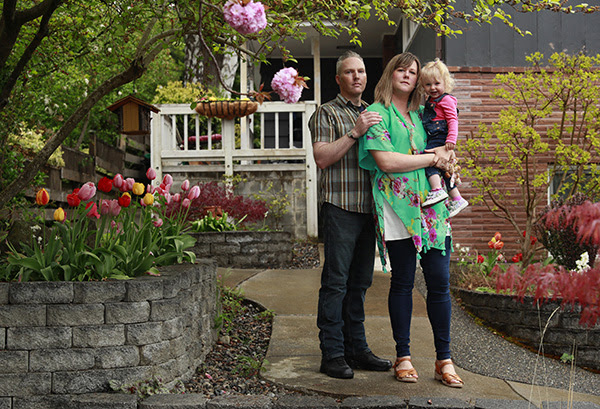
A portrait of Christopher and Susan Rose and their daughter Julia, 19 months, is taken at their West Seattle home Friday, April 19, 2019.
Christopher and Susan Rose, who live in West Seattle with their daughter Julia, were told to check for leaks after a meter reading showed that an astonishing 976,000 gallons of water had gushed out and vanished. Not only couldn’t Christopher find any leaks, at first he couldn’t even find the meter, and neither could a Seattle Public Utilities crew. Then he went online and discovered his enormous bill. It wasn’t a mistake. (Photo: Erika Schultz / The Seattle Times)
Editor’s Note: At a joint yesterday of New Jersey’s Senate and Assembly environmental committees, climate experts from universities, state officials, and environmentalists stressed the need to move state policies into a higher gear to meet the growing threats posed by climate change. NJTV’s Michael Hill presents clips of some of the testimony in his video report above and Tom Johnson of NJ Spotlight expands that coverage with his print story below. If you have the time, you can listen to all the presentations and questions and comments from lawmakers by clicking this link on the State Legislature’s website. –Frank Brill ————————————————————————-
As administration officials and climate experts discuss pending actions, legislators are asked to take the social costs of carbon into account
Photo Credit: Pixabay
New Jersey needs to step up efforts to drive down greenhouse gas emissions, including weighing whether to incorporate the social costs of carbon into an array of government decisions, lawmakers were told yesterday.
With a heightened sense of urgency that had been lacking at previous legislative hearings on climate change, Murphy administration officials and climate experts discussed pending actions to reduce global warming and, perhaps more importantly, what needs to be addressed in the future.
Plenty, the scientists suggested during a rare joint hearing of the Legislature’s two environmental committees. “We need to get the emissions down quickly,’’ said Robert Kopp, a professor at Rutgers University and associate director at the Rutgers Energy Institute, who argued the state should bring carbon emissions down to zero.
Other climate experts from NYU’s Institute of Policy Integrity urged legislators to consider using the social cost of carbon — a tool to put a dollar value on the harm caused by carbon emissions — in government decision-making.
New Jersey needs to step up efforts to drive down greenhouse gas emissions, including weighing whether to incorporate the social costs of carbon into an array of government decisions, lawmakers were told yesterday.
With a heightened sense of urgency that had been lacking at previous legislative hearings on climate change, Murphy administration officials and climate experts discussed pending actions to reduce global warming and, perhaps more importantly, what needs to be addressed in the future.
Plenty, the scientists suggested during a rare joint hearing of the Legislature’s two environmental committees. “We need to get the emissions down quickly,’’ said Robert Kopp, a professor at Rutgers University and associate director at the Rutgers Energy Institute, who argued the state should bring carbon emissions down to zero.
Other climate experts from NYU’s Institute of Policy Integrity urged legislators to consider using the social cost of carbon — a tool to put a dollar value on the harm caused by carbon emissions — in government decision-making.
Smith applauds BPU’s nuclear decision
Indeed, some argued yesterday New Jersey already has moved in that direction with the state Board of Public Utilities voting a week ago to award $300 million in ratepayer subsidies to keep three nuclear plants in South Jersey open. The plants provide 90 percent of the state’s carbon-free electricity.
Sen. Bob Smith, the chairman of the Senate Environment and Energy Committee, told BPU president Joseph Fiordaliso he believes the agency made the right decision. “If we don’t keep that 35 percent fossil-fuel-free energy, there’s no chance we are ever going to get where we want to get,’’ Smith (D-Middlesex) said.
Kopp said the state should begin mainstreaming climate-change impacts into its decision-making, suggesting a generally accepted price of $51 per ton of carbon. “It is certainly adequate to begin incorporating it into decision-making in New Jersey,’’ he told the committees.
For Smith, the top two priorities are getting the state out of the fossil-fuel business and moving the transportation sector toward electrification.
“Those are the two things screaming at us at this point,’’ he said. In a later interview, Smith added the state needs to take a look at the social cost of carbon, too.
Kopp emphasized the urgency of acting now. “In order to stabilize global climate, human emissions of carbon dioxide must be brought to as close to zero as possible,’’ he said. “The faster we reduce emissions, the less severe the impacts and the lower the risk of unwelcome surprises.’’
Those events include more intense storms, heat waves, and the possibility that $36 billion worth of real estate in New Jersey could be under water because of sea-level rise, according to the scientists.
A wakeup call to move more aggressively
A recent report by Rutgers students suggested the social cost of carbon could be incorporated into regulatory and other decisions by the BPU, environmental impact statements, and procurement and capital investments, according to Kopp.
Nine other states are already using the social cost of carbon in electric proceedings, according to Denise Grab, western regional director for NYU’s Institute of Policy Integrity. They include California, Illinois, New York, Minnesota and Nevada, she said.
Some environmentalists called the hearing a wakeup call to move more aggressively on climate change initiatives, such as electrifying the transportation sector.
“It is one thing for activists to call for action,’’ said Doug O’Malley, director of Environment New Jersey. “It is another thing for climate scientists to lay out in stark terms the climate impacts over the next three decades. Climate change is the ultimate pay-now-or-pay-more-later scenario. We’ll be hurting a ton in the future if we don’t act now.’’
Jeanne Herb, executive director of environmental analysis and communications group at Rutgers University’s Bloustein School of Planning, noted New Jersey has a long way to go to achieve the state’s goal of reducing greenhouse gas emissions by 80 percent from 2006 levels by 2050. “To achieve the state’s 2050 limit, we need to reduce emissions by 75 percent below today’s levels,’’ she told the committee.
There are a lot of questions the state needs to answer in moving toward achieving that goal. High on the list, the state still does not have a statewide climate change vulnerability assessment to identify people, places, communities and natural resources most at risk right now.
While the state has initiated a lot of steps to move forward on a clean-energy agenda, Herb said the state does not know how far it is from reaching the 2050 limit. “Knowing how far we are from the 2050 limit is critical to informing policy now,’’ she said.
Others were more skeptical. “The $20,000 question is the Legislature has heard the warning. What action will they take?’’ asked David Pringle, a consultant for New Jersey’s branch of Clean Water Action.