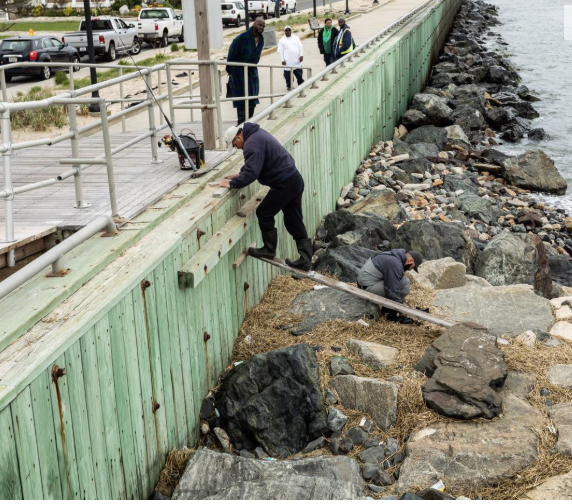
Fisherman uses plank to get access to jetty in Atlantic City. Kristian Gonyea photo
Michelle Brunetti reports for the Atlantic City Press
ATLANTIC CITY — Fish love to hang out by rock jetties.
So that’s where fishermen love to hang out — ‘rock hopping’ and casting their lines from the top of the huge boulders.
But the jetties can be difficult to get to from the new Boardwalk in the Absecon Inlet, constructed by the U.S. Army Corps of Engineers and owned by the city.
Some require climbing over railings and walking down a thin wooden board onto the rocks 10 feet below, all while carrying fishing gear.
“There’s no kind of way I’d go down there,” said 1st Ward Councilman Aaron “Sporty” Randolph at a news conference Monday across from the Flagship Resort on Maine Avenue.
The event was held by U.S. Rep. Jeff Van Drew, D-2, with representatives of state and federal agencies and city officials.
Van Drew said he is forming a committee that will begin meeting soon to discuss options available for solving the problem, both to tackle the technical challenges and the funding challenges.
“We are at the point where we’ve spoken with the Army Corps … the DEP (state Department of Environmental Protection) and we know this is a doable process, and something we can accomplish,” Van Drew said.
It’s happening in the wake of the state legislature passing a bill that codifies the “public-trust doctrine,” which states that everyone has a right to enjoy tidal waters and shorelines.
Sport fisherman Dan Ponzio, of Arthur W. Ponzio & Associates engineering firm in the resort, said he has seen welded heavy aluminum stairways work well under similar conditions in south Florida.
“They are all open, there is no kick plate, so the water goes right through — there is no water resistance,” Ponzio said.
The city owns the Boardwalk, but the design of it and the sea wall are controlled by the funders — the Army Corps and the DEP. So all three need to work together to find a solution.
“This is something Las Vegas doesn’t have … something most other gaming venues don’t have,” said Van Drew, gesturing towards the ocean and inlet.
“But we need to have proper, safe, attractive access in order to accomplish the goals that we want,” including diverse offerings for tourists and better quality of life for residents, he said.
Once believed to be extinct in Cambodia, Cantor’s giant soft-shell turtle is finally recovering.
STEFAN LOVGREN writes for National Geographic PUBLISHED APRIL 23, 2019
KAOH TRONG, CAMBODIA It was late last year when the owner of a popular restaurant in Kratie, a town in northern Cambodia, got a visit from local fishermen who had caught a live turtle in the Mekong River and were hoping to make a sale. The owner sometimes bought turtles, serving them to customers by special request. But the turtle the fishermen had brought this time was different. For starters, it was huge, weighing 37 pounds. Its broad head and eyes close to the tip of the snout resembled that of a frog. The owner, suspecting it was one of the endangered species he’d been told about, thought for a moment, then agreed to buy the turtle, for $75—not to cook it, but to save its life.
A Cambodian community is attempting to save the endangered Cantor’s soft-shell turtle. Watch as they release one that was originally destined for dinner plates.
And so it was that the giant turtle ended up at the Mekong Turtle Conservation Center in Sambor, about 20 miles north. When the restaurant owner’s son delivered it, Bran Sinal, who manages the center, immediately recognized it as a Cantor’s giant soft-shell turtle, an extremely rare species in Cambodia that can grow to the size of a small sofa and live for more than a century. Sinal could also tell that the turtle was a female of breeding age. To lose it would have been a tragedy.
For the next three months, Sinal cared for the turtle at the center. Then, on a recent Friday morning, he and a large group of people, including local officials, villagers, and students, gathered on a pristine beach on the island of Kaoh Trong, in the middle of the Mekong, near where the turtle had been captured, to return it to the river. After two Buddhist monks recited a prayer, the turtle was placed on the ground. It instinctively began digging into the sand to hide. Leaving it there wouldn’t have been a good idea, so the turtle was again picked up and this time released into the water. As it swam away, the students applauded.
“This is a special occasion,” said Sinai afterwards. “It is the first time we have released a broodstock [of this species] back into the wild, so it’s a very good sign.”
Pedestrians walk in Brooklyn on an unseasonably warm day in February 2017, when temperatures reached near 60 degrees. To take action against climate change, New York City is requiring large buildings to retrofit their structures to improve energy efficiency.Spencer Platt/Getty Images
On the steps of New York City’s City Hall last week, about 100 people gathered to enthusiastically chant their support for a landmark climate bill.
It didn’t target cars or coal, but another major emitter — in fact, the source of nearly 70% of New York City’s greenhouse gas emissions. It’s a sector that dominates New York’s skyline, but has largely managed to dodge the spotlight when it comes to climate change.
“Dirty buildings,” they shouted, “have got to go!”
The City Council passed a measure Thursday to require owners of large buildings to invest in retrofitting and improving their structures to slash their contribution to climate change.
Cities around the world have been calling for greater efficiency from new construction, and a number of cities have pledged to make all buildings carbon-neutral by 2050.
But Mayor Bill de Blasio says New York’s new measure, which he will sign into law soon, is the first in the world to actually mandate changes from existing buildings.
Under the law, which its supporters hope will serve as a model for other cities around the world, owners will need to improve insulation, lighting, heating and cooling systems, among other changes, to reduce the amount of energy their buildings use.
The goal is ambitious: The city’s largest buildings will have to cut their emissions by 40% by 2030, and by 80% by 2050. The cost of the necessary changes is estimated at some $4 billion, although some of those costs will be recouped by building owners through energy savings and the added value of an energy-efficient building.
“These are very intense goals, but reachable goals,” de Blasio told NPR in an interview. “These buildings are the single biggest piece of the [climate change] problem that hasn’t been addressed, and we had the tools to do it right now.”
If building owners do not comply with the measure, they will face substantial fines — $1 million or more per year for the largest buildings.
The Empire State Building, shown here in 2010, looks the same as ever. But the landmark is now packed with energy-efficiency retrofits, invisible to tourists and even tenants.Spencer Platt/Getty Images
“Silver buckshot”
So what does it actually take to make an old skyscraper energy-efficient?
A city icon — the 102-story Empire State Building — provides a glimpse.
Actually, there’s not much glimpsing involved. For the past 10 years, the landmark has gone through an ambitious energy-efficiency overhaul, but the vast majority of the changes are invisible.
Edison Dardar has spent his whole life on Isle de Jean Charles, La., where he fishes daily: “I don’t think the island’s going nowhere.” (Carolyn Cole / Los Angeles Times)
This island will cease to exist. That much seems certain.
Over the last six decades, more than 98% of Isle de Jean Charles has vanished into the Gulf of Mexico, leaving a frail strip of land just two miles long and a quarter-mile wide.
Los Angeles Times
With each high tide and with each hurricane, a little more of this historic Native American land sinks below the surface.
Cow pastures are gone. Rice fields are gone. The encroaching saltwater seeps into the roots of the towering live oaks that loom over the bayou, transforming them into eerie gray skeletons.
Only about 40 residents remain — down from a peak of more than 300 — and few take part in the old rituals: crabbing on the bayou, trapping muskrats and mink, afternoon coffee on the front porch.
As life on this narrow ridge of Louisiana’s coast becomes more precarious, the state is pressing ahead with an unprecedented national experiment: a $48-million plan to move the entire community out of harm’s way and build a new settlement in the hope of restoring its cultural traditions and old way of life.
Construction is scheduled to begin this year. But the prospect of rebuilding this sinking community seems increasingly unlikely as tribal leaders who spearheaded the effort have accused the state of hijacking their project and are now urging residents not to move.
“The plan was to reunite the tribe and now it’s going to be destroyed,” said Albert Naquin, the 72-year-old chief of the Isle de Jean Charles Band of Biloxi-Chitimacha-Choctaw tribe, who was born on the island but left after a hurricane destroyed his home in 1974. “Everything went sour.”1.00Play Video
In any case, persuading the island’s last holdouts to leave will not be easy.
“It’s a paradise out here,” Edison Dardar, a 69-year-old fisherman, said as he tromped through his lush backyard in white rubber shrimp boots, stooping to pick up a chicken, survey his neat rows of green beans and admire the nascent fruit of his blackberry bush and persimmon tree.
“This here can’t be remade someplace,” Chris Brunet, 53, said as he looked out across the open land where his family used to grow okra and cantaloupe. “It’s just impossible. It’s a once-in-a-lifetime thing, a setting away from the world.”
In the beginning, the island wasn’t even an island.
When the first settler — a Frenchman named Jean Marie Naquin, who had been disowned by his family for marrying an American Indian — arrived in the early 1800s, it was a ridge covered in dense thickets of live oaks and surrounded by miles of swampy marshland.
He named it for his father, who traveled to this spot 50 miles southwest of New Orleans while working for the pirate Jean Lafitte.
Clockwise from top left: Edison Dardar lives almost entirely off the land and water; Chris Brunet has lived on the island his whole life; fisherman Hilton Chaisson resides on the island along with many relatives; and retired carpenter Johnny Tamplet still lives on the island, although he is not Native American. (Carolyn Cole / Los Angeles Times)
The remote land was a refuge for the family throughout the mid-1800s — when Native Americans across the Southeast were forced from their land in a mass relocation that became known as the Trail of Tears. Over the years, Dardars, Chaissons and Billiots joined the Naquins, building simple mud homes with palmetto-thatched roofs on each side of the bayou that formed the main artery of the community.
People mostly kept to themselves, surviving off the land and sea, catching fish, oysters and shrimp, hunting rabbits and deer and raising cows, chickens and pigs.
Modern times did not come to Isle de Jean Charles until 1953, when a two-mile road was built across the marshland to connect the community to Pointe-aux-Chene on the mainland.
Many residents eyed the causeway with suspicion, fearing it would bring outsiders who would try to wrench them from the land.
“If you hear or see a car coming, go hide,” Naquin’s mother warned him.
As it turned out, there was a far greater threat: the vast network of flood-control dams and levees the U.S. Army Corps of Engineers was erecting along the Mississippi River.
The system disrupted the flow of sediment into the Mississippi River Delta, a natural process that counteracts the erosion of marshes and wetlands by the encroaching waters of the Gulf of Mexico.
Making matters worse, the oil and gas industries were expanding in the delta, and the elaborate web of channels that companies carved through the wetlands for boats and drilling rigs also brought in saltwater that weakened plant roots and hastened erosion. Scientists say climate change will only exacerbate the problem by raising the sea level.
The home of the Naquin family. Chief Albert Naquin’s older sister, Denecia Billiot, 94, still lives in the home. (Carolyn Cole / Los Angeles Times)
When Isle de Jean Charles became an island is a matter of debate, as the changing marshland around it made the edges difficult to define.
With less marshland buffering the island from waves and storm surge, hurricanes take an ever more devastating toll.
In the last two decades, the number of households has dwindled from about 80 to 20 as a succession of hurricanes — Lili, Katrina, Rita, Gustav, Ike, Isaac — slammed the island, filling homes with thick mud.
A ring of levees built more than a decade ago offers some protection from flooding, but the once-free-flowing bayou is now stagnant and strewn with tires, plastic foam take-out boxes and plastic chairs.
The oyster shacks that once lined its banks have been torn down. The only business is a small marina selling bait, fishing lures and Michelob Ultra.
The remaining islanders are retired or work off the island as grocery store clerks and hospital janitors, commercial fishermen and tugboat captains.
Top, Chief Albert Naquin stands at the end of Island Road on the Isle of Jean Charles. Left, Naquin at the home of his sister Denecia Billiot, 94, on the island. Right, Naquin visits homebound residents. (Carolyn Cole / Los Angeles Times)
“We don’t mingle like we used to,” said Al Naquin, 68, the chief’s cousin, as he stood on his porch and pointed out the shed that had replaced his grandfather’s grocery store — which also used to serve as a dance hall, church and school.
While a few islanders fish for flounder and trout or grow okra and green beans, others are just as likely to pick up hot dogs and frozen tilapia from a Walmart in Houma, 25 miles away.
Some of the older residents still converse in Cajun French, just like their parents and grandparents, but many of their grandchildren do not understand them.
Most days, residents remain indoors, listening to country music or watching TV.
“It feels like a ghost town,” Erica Billiot, 37, said as her 6-year-old son, Tristan, played on the edge of a broken wooden bridge over the bayou.
Initially, Billiot was excited about moving to higher ground.
Tristan Billiot, one of the last children remaining on the island, lives with his mother and grandmother. Many of his friends have moved away. (Carolyn Cole / Los Angeles Times)
Whenever strong southern winds blow, she worries that high tides will flood the only road to the mainland, cutting her off from her job as a baggage handler at a local heliport and preventing the bus from ferrying Tristan to school.
But as she mulls the state plan and the thought of losing her family’s weathered clapboard home, she leans toward staying put a while longer.
“It’s going to go away before I pass,” she said. “It’s only a matter of time.”
It was about 20 years ago when the U.S. Army Corps of Engineers first approached the chief with the idea of relocating islanders.
Naquin’s first thought: “Wow, a modern-day Trail of Tears!”
But as the barrel-chested Army veteran contemplated the island’s fate, he changed his mind.
Clockwise from top left: Dwayne Neil throws crab cages along the bayou between Isle de Jean Charles and Pointe-aux-Chene; a boarded-up home on the island; some of the island’s remaining residents; people from the mainland fish off the dock at the island marina. (Carolyn Cole / Los Angeles Times)
Saving the island seemed like a lost cause. In 2002, the Corps decided to exclude the island from a massive 72-mile levee system it was planning, dooming it to a future underwater.
Naquin’s first two attempts to resettle the community failed, as the Corps required a unanimous buy-in, and a small group of residents did not want to leave.
“You can’t get 100% of people to agree on anything,” he said.
Naquin pressed on, working with nonprofits and the state to develop a plan for a community with homes on stilts, a bayou, grocer, tribal museum, green space for powwows and grazing land for buffalo.
“This here can’t be remade some place. It’s a once-in-a-lifetime thing, a setting away from the world.”
Chris Brunet, a lifelong resident of Isle de Jean Charles
In his vision, the community would be not just a safe place for island residents but also a gathering point for the 600 members of his tribe now scattered across coastal Louisiana.
But soon after the U.S. Department of Housing and Urban Development dedicated $48 million to the project in 2016, a rival tribe, United Houma Nation, came forward with a complaint: It had been left out of the plan despite having historic ties to the island.
Interviewing islanders, state officials found that most, but not all, identified — at least loosely — with the Biloxi-Chitimacha-Choctaw. A few said they did not trust tribal leaders to execute a resettlement fairly.
That put Louisiana officials in an awkward position: Federal law does not allow housing projects to discriminate based on tribal affiliation or race.
Inspector General’s Office inquiry comes a week after it launched a probe of Interior Secretary David Bernhardt.
Posters of former Interior secretary Ryan Zinke were plastered on street corners near the Interior Department offices in November 2018. (Robert Miller/The Washington Post)
Juliet Eilperin and Dino Grandoni in the Washington Post April 23 at 2:11 PM
The Interior Department’s Office of Inspector General has opened an investigation into whether six of President Trump’s appointees have violated federal ethics rules by engaging with their former employers or clients on department-related business.
The new inquiry, which the office confirmed in an April 18 letter to the nonprofit Campaign Legal Center, is looking into senior Interior officials, including Assistant Secretary for Insular and International Affairs Doug Domenech, White House liaison Lori Mashburn and three top staffers at the Office of Intergovernmental and External Affairs. The Campaign Legal Center detailed the officials’ actions in a Feb. 20 letter to the inspector general’s office, suggesting a probe was warranted.
To avoid conflicts of interest, Trump signed an executive order days after taking office that requires appointees to recuse themselves from specific matters involving their former employers and clients for two years. The complaint, which cites reports in HuffPost and the Guardian as well as extensive public records, outlines how a half-dozen political appointees at Interior continued to discuss policy matters with organizations that had employed them in the past.
The Guardian reported in May 2018 that Domenech, the highest-ranking official named in the complaint, continued to interact with the conservative think tank that used to employ him before he joined Interior.
Domenech’s calendars indicated that he twice met with representatives from the Austin-based Texas Public Policy Foundation on an endangered species listing and a property dispute. The group had lawsuits pending with Interior over both issues and settled the endangered species case with the department six months after the meeting with Domenech.
Cassidy, a former lobbyist for the National Rifle Association, has also attracted significant attention since joining the department for his work on gun-related issues.
Calendars released by Interior show Cassidy participating in a December 2017 meeting regarding Trump’s decision to scale back two national monuments in Utah, even though Cassidy had lobbied Congress on a bill addressing the president’s ability to establish national monuments just months earlier. This activity, first reported by HuffPost, could violate the federal ethics pledge because Cassidy was prohibited from engaging in particular matters on which he had lobbied during the two years before joining the department.
The controversial quarry in Solebury failed to finish reclamation work by a March 19 deadline.
Kyle Bagenstose reports for the Bucks County Courier-Times
The Pennsylvania Department of Environmental Protection has
brought the hammer down on a controversial quarry in Solebury,
suspending any active mining operations there until the quarry can
complete overdue reclamation work, according to officials and a notice sent to the quarry last week.
The
165-acre quarry, owned by the New Hope Crushed Stone & Lime Co.,
has for years drawn the ire of the township, local residents and the
adjacent Solebury School, which blamed quarrying operations for the
formation of sinkholes on its property. Several lawsuits were filed and
settled, and the DEP’s Environmental Quality Board ultimately declared
the site a nuisance in 2014, leading the DEP to require a reclamation
plan in 2015.
Operations at the quarry were briefly halted in
August 2017 after the DEP said the quarry fell behind on the reclamation
plan, which involves filling the quarry’s pit, grading it to a safe
slope and seeding it, and restoring the nearby Primrose Creek. The
two-week cessation was lifted after the quarry demonstrated it was
working to catch up.
But operations are now halted again after the quarry missed a March 19 deadline to complete the work. Solebury Supervisor Kevin Morrissey wrote in an email last week that the DEP then drafted a “consent order and agreement” to the quarry to address the work, due April 12. After the quarry failed to execute the agreement, the DEP brought the cessation



 Posters of former Interior secretary Ryan Zinke were plastered on street corners near the Interior Department offices in November 2018. (Robert Miller/The Washington Post)