
Along the Schuykill River

#BILLYPENNGRAM OF THE DAY
Colder and cloudier this weekend, but more of this on its way
(photo by @kenai61)
Along the Schuykill River Read More »
#BILLYPENNGRAM OF THE DAY
Colder and cloudier this weekend, but more of this on its way
(photo by @kenai61)
Along the Schuykill River Read More »
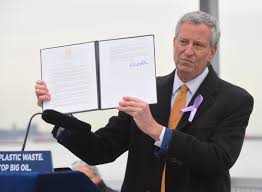
Rina Li reports for Waste Dive
Enjoy those plastic forks while you still can, NYC government employees. Per an executive order signed Thursday by Mayor Bill de Blasio, agencies will now be required to end approximately 95% of single-use plastic
“Big Oil has been pushing single use plastics for too long — and it stops here,” de Blasio said in a statement. “They litter our beaches and parks, jam our recycling machines, and contribute to climate change. Our actions today will help us build a fairer city for all New Yorkers.”
The city will be permitted to maintain a sufficient supply of plastic items for anyone who requests them — including individuals with disabilities — as well as for emergency and medical purposes. All agencies are directed to begin cutting out single-use plastics immediately and to prepare a reduction plan within 120 days, with full implementation slated for the end of the year.
De Blasio also announced Thursday his support for pending legislation to reduce single-use plastic foodware in private establishments — and his intent to work with the New York City Council to ensure the legislation includes appropriate accommodations for individuals who are unable to use non-plastic options.
The directive represents New York’s latest effort to tamp down on petroleum-based products. In addition to banning single-use foam products, the city is currently divesting its pension funds from fossil fuel reserve owners and suing five fossil fuel companies for the billions of dollars that will be spent to protect New Yorkers from the effects of climate change. It’s also committed to doubling pension fund investments in climate change solutions to $4 billion by 2021 — roughly 2% of the city’s $195 billion pension portfolio — and reducing carbon emissions at least 80% by 2050.
“New York City is doing everything it can to end our reliance on fossil fuels and that means tackling the pervasive problem of single-use plastics,” said Daniel A. Zarrilli, NYC’s chief climate policy advisor and OneNYC director, in a statement. “Today’s Executive Order will end the unnecessary use of single-use plastic
Like this? Click to receive free updates
NYC drops plastic in stand against ‘Big Oil’ Read More »

TBrian Fung reports for the Washington Post
The Trump administration and government regulators unveiled a major push Friday afternoon at the White House to accelerate the rollout of the high-speed, next-generation mobile data technology known as 5G.
Under the plan, the Federal Communications Commission will release a wide swath of high-frequency airwaves for cellular use in what will be the largest trove of U.S. wireless spectrum ever to be auctioned off. As much as 3.4 gigahertz of “millimeter-wave” spectrum could be sold to wireless carriers such as AT&T and Verizon in the sale, which will begin Dec. 10, according to FCC Chairman Ajit Pai.
The FCC also proposed a $20 billion fund to expand broadband in rural America over the coming decade, connecting up to 4 million households and small businesses to high-speed Internet, Pai said. The “Rural Digital Opportunity Fund” could launch later this year, after a period of public notice and comment.
Speaking at the White House, Trump argued that the United States could not allow “any other country to outcompete the United States” in the race to 5G, and vowed that it is a race America would win.
“No matter where you are, you will have access very quickly to 5G, and it’s going to be a different life,” he said in remarks at the White House. “I don’t know if it’s going to be better — maybe you’re happy right now — but I’m going to say, technologically, it won’t even be close.”
The two proposals reflect the most intensive effort of the Trump era to close the so-called “digital divide” and gain an edge in the global race to build a fully functioning, nationwide 5G network. Proponents say the advances that 5G offers over 4G LTE will enable mobile download speeds of up to 1,000 megabits per second — roughly 100 times faster than the standard — and pave the way for new technologies such as self-driving cars and virtual reality.
Despite Pai’s focus on auctioning spectrum, his critics say his 5G strategy has overlooked or even caused setbacks in other areas of policy.
“So far this Administration’s interventions on 5G have done more harm than good,” Jessica Rosenworcel, a Democratic FCC commissioner, tweeted Friday. “From imposing tariffs on 5G equipment to alienating allies on 5G security to falling behind the rest of the world on critical mid-band spectrum, it has yet to offer a workable plan for US leadership.”
Friday’s announcement comes in the face of rising competition from China and other nations that are moving swiftly to develop 5G technology.
Whichever country succeeds at deploying 5G early and on a massive scale will reap dividends and shape the global economy for years, analysts say.
Like this? Click to receive free updates
5G is about to get a big boost from Trump and the FCC Read More »
Detectives believe that the two men pictured below may have information about the fire that began on March 30 and consumed more than 11,000 acres of forest in Washington and Woodland Townships.


By Chris Sheldon | NJ Advance Media for NJ.com
Two men are wanted for questioning in connection with the massive forest fire that burned through over 11,000 acres of the Pine Barrens earlier this month.
The New Jersey State Police released a photo of two men standing next to Jeeps with a huge plume of smoke rising in the background and said they “may have information about the fire.”
Investigators have said the blaze, which began on March 30 in the Penn State Forest, was likely caused by human activity in an area of the forest known for illegal bonfires.
The New Jersey State Police is seeking the public’s assistance with identifying two men wanted in connection to the Spring Hill wildfire in Burlington County.
Officials have declined to say whether they thought the fire was intentional or accidental.
The fire was contained on April 1 after it scorched 11,638 acres and was one of the larger forest fires New Jersey has seen in recent years.
Anyone who could help identify the men was asked to contact New Jersey State Police
Like this? Click to receive free updates
Did these two Jeep guys start 11,000-acre Pinelands fire? Can you ID them? Read More »

New Jersey has a shockingly high autism rate in one age group – the highest ever recorded by the Centers for Disease Control and Prevention, researchers say. And nobody seems to know why.
The report, released Thursday by Rutgers University and the CDC, found that about one in 59 4-year-old children has autism in America. New Jersey’s rate was the highest of the states studied: one in 35.
That puts the national rate of autism at 1.7 percent of the 4-year-old childhood population and New Jersey’s autism rate at 3 percent. Twenty years ago, the New Jersey rate was 1 percent.
Walter Zahorodny, an associate professor of pediatrics at Rutgers New Jersey Medical School who directed the New Jersey portion of the study, called the results “consistent, broad and startling.”
Like this? Click to receive free updates
Very troubling results from Rutgers/CDC study of autism in children Read More »

Tom Johnson reports for NJ Spotlight
The state is planning to release a revamped energy plan in the next few weeks, but officials are keeping a tight rein on how much it will slow the prior administration’s aggressive expansion of New Jersey’s natural-gas infrastructure.
At an event yesterday, Gov. Phil Murphy and Board of Public Utilities president Joseph Fiordaliso extolled the administration’s clean-energy agenda. But they offered few, if any, insights into how it will impact the state’s heavy reliance on natural gas — a fuel that provides about 40 percent of New Jersey’s electricity and heats more than 70 percent of homes and businesses.
How those realities fit into the Murphy administration’s goal to have 100 percent of the state’s energy to come from renewable sources by 2050, and presumably a significant portion from New Jersey’s three nuclear plants, remain unanswered.
The issue is becoming more controversial as many environmental groups are pressing for a moratorium on new fossil-fuel projects. At least nine natural-gas pipelines or other projects are pending in the state, as well four natural-gas-fired power plants, most of which face fierce opposition.

Fiordaliso was cautious in describing the administration’s plans for those projects. He declined to answer a question on whether the plan would phase out those projects, saying only “Wait until the master plan.’’
Asked if natural gas would be phased out of the state’s energy mix, as many organizations have called for, he only said that it, along with nuclear power, would be a bridge to a new clean-energy future.
Neither Fiordaliso nor Murphy mentioned the pending application by PSEG Power, which is seeking a $300 million ratepayer subsidy to keep its three nuclear power plants from closing. The company has threatened to close the units, the source of 90 percent of the state’s carbon-free electricity, without the subsidies. A decision is expected to be made on the subsidy at a BPU meeting next Thursday.
The proposed nuclear subsidy is opposed by an array of business, consumer, and environmental groups. Some fear it will crowd out limited state resources to fund clean-energy programs; others say the company has failed to demonstrate that its three nuclear plants are not profitable.
But the question of how big a role natural gas plays in New Jersey’s energy future remains unanswered. “We need that bridge,’’ Fiordaliso said, answering questions from reporters after the event, saying natural gas and nuclear power will provide that link.
Like this? Click to receive free updates
Will NJ’s anticipated energy master plan turn fossil fuel into a dinosaur? Read More »